
BUSINESS
Advent’s ₹3,150 Crore Bet Leaves Yatharth in Family Hands
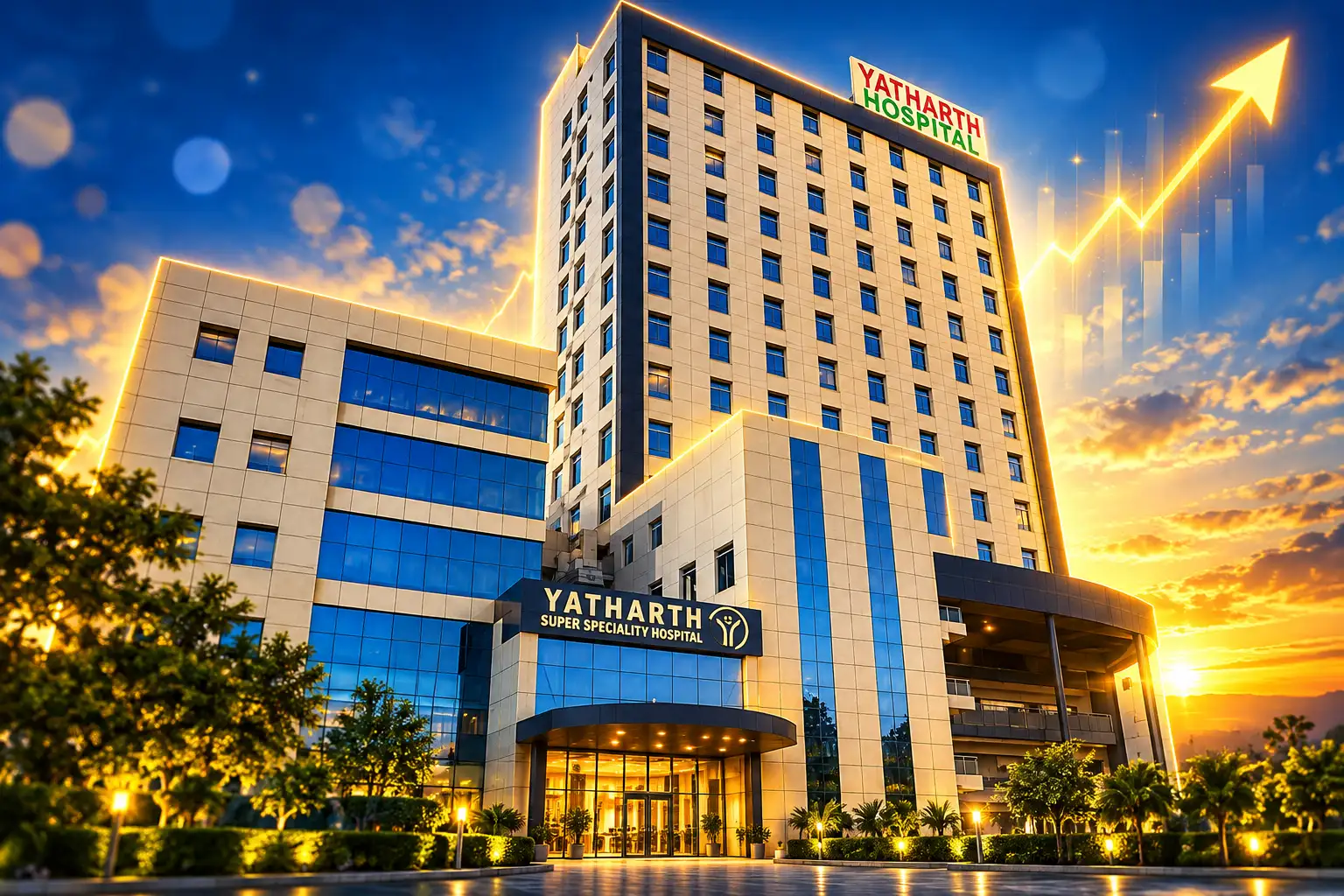
Advent International will put ₹3,150 crore of primary capital into Yatharth Hospital for 24.9%, in shares and warrants.

Yatharth Hospital and Trauma Care Services Ltd agreed on September 17 to take ₹3,150 crore of primary capital from Advent International for a 24.9% stake. The stock closed at ₹1,072.40 on the NSE that day, up 9.17% from ₹982.30, after touching ₹1,083.80.
The cheque goes onto the company’s books, not into promoter pockets. Advent is buying new shares and warrants through Rasmalai Limited, a Cyprus vehicle, and the Tyagi family will still be the largest shareholder when the issue is done.
Advent’s Money Arrives as Shares and Warrants
Advent’s own statement called the deal one of the largest primary infusions by a private equity firm in India’s hospital sector. The firms have entered a definitive agreement for Rs 3,150 crore of primary capital, equal to $328.53 million at ₹95.8825 to the dollar, and Advent is expected to hold 24.9% once closing conditions are met.
The board did not sell a secondary block. It approved a preferential issue of up to 1,30,26,516 equity shares and up to 1,89,47,664 convertible warrants, both at ₹985.17, a shade over the SEBI ICDR floor of ₹984.70 set off the September 15 relevant date. Wednesday’s close was ₹982.30, so the issue sat just above the last full session before the leak of talks.
Only part of the money lands at allotment. The equity tranche, ₹1,283.33 crore, is payable in full up front. Rasmalai pays 25% of the warrant price, ₹246.29 a warrant, or ₹466.67 crore, when the warrants are issued, and the other 75%, ₹738.88 a warrant, when it converts them, a window of 15 to 18 months. That split puts ₹1,750 crore in the company first and leaves ₹1,400 crore tied to exercise.
THE PREFERENTIAL ISSUE TO RASMALAI LIMITED
| Piece | Count | Price (₹) | Cash now (₹ crore) | Cash later (₹ crore) |
|---|---|---|---|---|
| Equity shares | 1,30,26,516 | 985.17 | 1,283.33 | None |
| Convertible warrants | 1,89,47,664 | 985.17 | 466.67 | 1,400.00 |
| Fully converted | 3,19,74,180 shares | 985.17 | 1,750.00 | 1,400.00 |
If every warrant converts, Advent’s vehicle holds 3,19,74,180 shares and 24.9% on a fully diluted basis. At that stake the implied post-money equity value is about ₹12,651 crore. Rasmalai holds no Yatharth stock now and will be classed as a public, non-promoter shareholder.
Talks of a raise of up to ₹3,000 crore, possibly in two tranches, had already circulated on September 15. The board, which had been called on September 14 to consider debt, a rights issue, a QIP or a preferential allotment, came in higher and made the two-stage shape explicit.
The Tyagi Family Remains the Largest Shareholder
Yatharth, founded in 2008, is still a promoter-run chain. After the issue the Tyagi family stays the largest shareholder and, the company said, will keep guiding long-term strategy with the existing leadership team. Promoter holding is locked in for three years from closing. There is no change of control.
Advent still takes a real seat at the table. Rasmalai gets the right to nominate up to two non-executive directors, plus one member on the audit committee and one on the nomination and remuneration committee, with reserved-matter and pre-emptive rights tied to ownership thresholds. The October 15 agenda also lists special rights for the promoters and an upside-sharing arrangement, so the family is not walking away from the economics if Advent later sells well.
That mix is the point of the structure. August chatter had Advent, and a Blackstone-backed hospital group, circling a controlling stake. The paper that was signed is a funded minority. Pankaj Patwari, Advent’s Mumbai managing director, has said the firm looks for companies with extra levers such as acquisitions beyond the base operating case, and this deal is built for that rather than for a take-private.
This investment underscores Advent’s deep and long-standing commitment to India’s healthcare sector, which we believe is entering a decade of structural growth as access expands, quality improves, and consolidation advances. We are pleased to partner with the Yatharth family, bringing our global healthcare expertise and experience investing in founder-led businesses to help support and accelerate the Company’s next phase of growth.
Pankaj Patwari, Managing Director, Advent International, in the September 17 statement
Yatharth Tyagi, whole-time director, said the firm wanted Advent’s healthcare skill and global insight as much as the cash, and that the two sides aim to expand reach and build one of India’s leading healthcare networks.
What Existing Holders Give Up in the Issue
As of the June 2026 quarter, promoters held 55.8% of Yatharth, or 53,762,672 shares. Ajay Kumar Tyagi, a promoter, held 30.59%. Kapil Kumar held 12.62%, Manju Tyagi 11.96%, and Neena Tyagi 0.62%. Mutual funds held 9.74%, other domestic institutions took the rest of a 10.8% DII book, FIIs held 5.6%, and the public held 27.7%.
A 24.9% primary issue shrinks every existing holding by about a quarter on full conversion. The family can still be the largest bloc after that, because 55.8% of the old equity remains a bigger pile than Advent’s new 24.9%. Public holders do not get that cushion. They keep their shares, fund none of the cash, and own less of whatever the cash buys.
WHO OWNS YATHARTH BEFORE THE ISSUE
- Promoters: 55.8% held by the Tyagi family and Kapil Kumar as of June 2026, to remain the largest group after dilution, with a three-year lock-in.
- Domestic funds: DIIs at 10.8%, including Kotak Multicap at 5.00% and Bandhan Small Cap at 4.24%.
- Foreign holders: FIIs at 5.6%, with Jupiter India Fund the named 1.16% line.
- Public and others: 27.7% retail and other non-institutions, the bloc that shrinks most as a share of the company when 3,19,74,180 new shares are born.
The board also voted to lift authorised share capital from ₹115 crore to ₹150 crore, or from 11.5 crore to 15 crore equity shares of ₹10 face, so the new paper fits. Shareholders must approve that increase with the issue itself.
The listed price has already moved through Advent’s entry. Thursday’s close at ₹1,072.40 sat about 9% above the ₹985.17 issue price, which means the market is paying more for the same equity Advent is being allotted. That is a vote of confidence in the cash. It is also the cost of buying Yatharth after the announcement rather than in the issue.
5,000 Beds Now Have a Funded Path
Yatharth runs nine multi-speciality hospitals with about 2,800 operational beds and an announced capacity of about 3,250. The group’s own site lists super speciality hospitals in the NCR plus Jhansi-Orchha in Madhya Pradesh and Agra, with Gurugram still coming. For the June quarter, the first of FY27, consolidated revenue was ₹392.70 crore, up 51% year on year, profit after tax was ₹45.4 crore, up 8%, and average revenue per occupied bed rose 7% to ₹34,758.
The firm has said it wants more than 5,000 beds in three years, and Yatharth Tyagi told analysts on an earnings call that about 70% of the next additions would come through acquisitions, with the rest greenfield, in cities the group already knows. Brownfield work is already queued at Greater Noida and Noida Extension, and a Gurugram hospital is in the pipeline. The capacity addition roadmap in its annual report had already sketched Delhi, Faridabad and further NCR land as the next rungs before this cheque appeared.
WHERE THE BEDS SIT NOW
- Core NCR: Noida, Greater Noida, Noida Extension, Greater Faridabad, New Delhi (Model Town), Faridabad Sector 88 and Sector 20, with Gurugram still to open.
- Beyond the capital: Jhansi-Orchha in Madhya Pradesh and a growing site in Agra.
- Stated next step: from about 2,800 operational beds and 3,250 announced, toward more than 5,000 in three years, with most of the new count meant to be bought rather than built.
₹1,750 crore of immediately available equity is a lot of dry powder for a chain this size. ₹3,150 crore is more, if the warrants convert. The open question, and it is the one that matters once the vote is done, is whether Yatharth spends that money on hospitals that fill and pay, or on beds that sit half-empty while interest and integration chew the margin. Newer units have been asked to wean off government work; Faridabad Sector 20 and Model Town were described on the same call as running with a much smaller state-payer mix than the older Noida hospitals.
Advent Has Bought Indian Healthcare Before
Advent oversees more than $109 billion of assets as of June 30, 2026, with 17 offices across five continents and 460 investments in 45 countries. It says it has made more than 55 healthcare investments across 17 countries over 35 years. In India the names it now puts on that list are Apollo 24/7, Cohance, Felix Pharma, Bharat Serums and Vaccines, and Care Hospitals.
Patwari joined Advent in 2014 in Mumbai and covers healthcare and industrials. His public brief is the experience investing in founder-led businesses that Advent is now selling as part of this partnership. Atin Jain, an Advent director, called Yatharth one of North India’s more differentiated platforms and said the intent was quality care that more people can reach. The firm is not new to Indian hospitals, and it is not taking this one private.
The wider tape has been busy. KKR agreed last month to buy Medicover’s India business for $1.4 billion, and other large funds have spent the past three years on CARE Hospitals and Indira IVF. Yatharth is the rare listed North India chain that just raised primary equity at this scale instead of selling the company.
An October Vote Still Stands Between Advent and the Stake
None of the cash is in yet. Allotment of the shares and warrants is slated within 15 days of shareholder approval, and the company has set an extraordinary general meeting for October 15. The notice covers the authorised-capital increase, the preferential issue, changes to the articles, Rasmalai’s special rights, promoter rights, and the upside-share arrangement. Closing still depends on customary conditions and other regulatory clearances.
THE PATH FROM TALK TO CASH
- August 2026: Talks of a controlling stake in Yatharth circulate, with Advent among the names in the process.
- September 14, 2026: The company tells exchanges the board will meet on September 17 to consider growth funding by debt, rights, QIP or preferential allotment.
- September 15, 2026: Word of a possible Advent raise of up to ₹3,000 crore in two tranches moves through the market; that date is also the ICDR relevant date for pricing.
- September 17, 2026: The board approves the ₹3,150 crore issue to Rasmalai and Advent issues its statement; the stock closes at ₹1,072.40 on the NSE.
- October 15, 2026: Shareholders vote on the capital increase, the issue, article changes and special rights.
- 15 days after approval: Shares and warrants are to be allotted if the resolutions pass and other conditions are met.
- 15 to 18 months after issue: Warrant conversion window, when the remaining ₹1,400 crore can come in.
On September 18 the shares traded as high as ₹1,184, extending the move that began before the board even sat. That price is the market’s present view of a deal that still needs a vote, a closing, and, for the second pulse of cash, Advent’s decision to exercise. Until conversion, more than two-fifths of the advertised ₹3,150 crore is still a right, not a rupee in the bank.
The sharper test is not whether Advent appeared. It is whether a founder-led NCR chain can turn a two-stage primary issue into hospitals that earn, while a global fund sits on 24.9% and two board seats and the family keeps the largest block. The October meeting is where that wager becomes binding.
Disclaimer: This article is news reporting and analysis of a proposed share and warrant issue, and it is for information only. It is not investment advice, a recommendation to buy or sell Yatharth Hospital or any other security, or an offer of securities. Readers should consult a SEBI-registered investment adviser or other qualified financial professional before acting on any share price, deal term or holding. Figures, stakes, closing conditions and the status of the October 15 vote reflect company and Advent statements and exchange disclosures as of the dates named above and can change as approvals, allotment and warrant exercise proceed.

Edinburgh Opens a 2027 Tour Built for Time Trials

Korda Maps Auður From Meðalland to Irvine Bay

Apple Music Films Its New Logo in Mineral Oil

Oppo Prices the Pad Mini Above India’s iPad Mini

Austen Soaks Scotland Before Boelo Brings Weekend Gales

Volkswagen Sells the Osnabruck Plant to Clear a Board Fight

Apple’s Foldable iPhone Hinges on Samsung Display Supply

Saksham Gaur Finds He Is His Own Company’s Client

Tata Motors’ Iveco Tender Opens as Holders Still Decide

Onimusha Way of the Sword Preload Hits a Windows 11 Wall
-
 AUTO2 months ago
Volkswagen Sells the Osnabruck Plant to Clear a Board Fight
-
 NEWS2 months ago
Apple’s Foldable iPhone Hinges on Samsung Display Supply
-
 AUTO2 months ago
Tata Motors’ Iveco Tender Opens as Holders Still Decide
-
 BUSINESS2 months ago
Saksham Gaur Finds He Is His Own Company’s Client
-
 GAMING2 months ago
Onimusha Way of the Sword Preload Hits a Windows 11 Wall
-

 ENTERTAINMENT3 years ago
What is SD on Amazon Prime? – All You Need to Know
-

 BUSINESS2 months ago
Hyderabad 22-Carat Gold Jumps After a False Bargain
-

 NEWS2 months ago
iQOO 16 Locks 8,400 mAh While 100W Charging Holds