
NEWS
Australia Opens the iPhone and Bans Apple’s Workaround Fees
Australian iPhones must get third-party app stores by 1 March 2027, without the 5 percent fee Apple still charges in Europe.

The Federal Court of Australia ordered Apple on 22 October 2026 to let iPhones with Australian Apple Accounts use third-party app stores. Justice Jonathan Beach also barred the extra fees and dual-payment rules Apple still uses in the European Union, Japan and Brazil.
Fortnite is already back on the Australian App Store, but the broader opening starts at noon, Melbourne time, on 1 March 2027, and Apple said it will request a stay and appeal.
Beach Wrote the Orders to Block Apple’s Usual Fees
The fight began as a Fortnite billing dispute and ended as a structural rewrite of how iOS may be sold in one country. Beach declared that since 6 November 2017 Apple has broken section 46 of the Competition and Consumer Act by using its developer contract and App Store rules to lock distribution and in-app payments. The orders dated 22 October 2026 run to 1,104 paragraphs in Epic Games Inc v Apple Inc (No 2) [2026] FCA 1552, file NSD 1236 of 2020.
They do not set Apple’s App Store commission at zero. They do tell Apple it cannot rebuild, around a rival store, the charges and chores it rolled out after other governments forced the door open.
WHAT APPLE MUST CHANGE FOR AUSTRALIAN ACCOUNTS
- Rival stores and web installs: Users must be able to find, get and update apps, including other app stores, by direct download and by alternative stores, after an automated security or privacy scan and notarisation by Apple or a qualified third party.
- The same tools: Apple must give developers the APIs, SDKs and other tools needed to build those stores, on substantially the same terms it gives App Store developers.
- No access charge: Apple must not put fees or conditions on using those other channels, or on the tools needed to run them, in a way that deters that distribution.
- No matching IAP: For apps sold outside the App Store, Apple cannot force the developer to offer Apple’s in-app purchase system beside the developer’s own checkout, or to appoint Apple as agent for that channel.
- No junk take on the other till: On an alternatively distributed app, Apple cannot charge a fee on in-app purchases made without IAP, or on digital goods bought on a website for use in that app.
- Steering is allowed: Inside App Store apps, Apple cannot require IAP for digital goods or stop developers pointing users to another payment method.
- No scare friction: Extra steps for rival installs or other payments cannot be disproportionate to a real security risk, and cannot be heavier than the path a user already takes to buy physical goods without IAP.
- No punishment: Apple cannot reject, retaliate against or otherwise disadvantage a developer for using rival stores, other payments or outbound payment links.
Beach also stopped Apple turning off an app installed from another channel except for illicit or harmful content, malware that needs urgent removal or that is not fixed after notice, or a duty under the Online Safety Act 2021. He refused to make Apple list rival stores inside its own App Store, a line he had already drawn in the liability reasons.
Apple’s intellectual property rights are no shield against the scope and application of s 80.
Justice Jonathan Beach, Epic Games Inc v Apple Inc (No 2) [2026] FCA 1552
That sentence is the hinge. Apple’s public answer is still security and intellectual property. Beach treated those rights as real and still held they do not cancel a competition remedy that requires access to the tools needed to ship an iOS app.
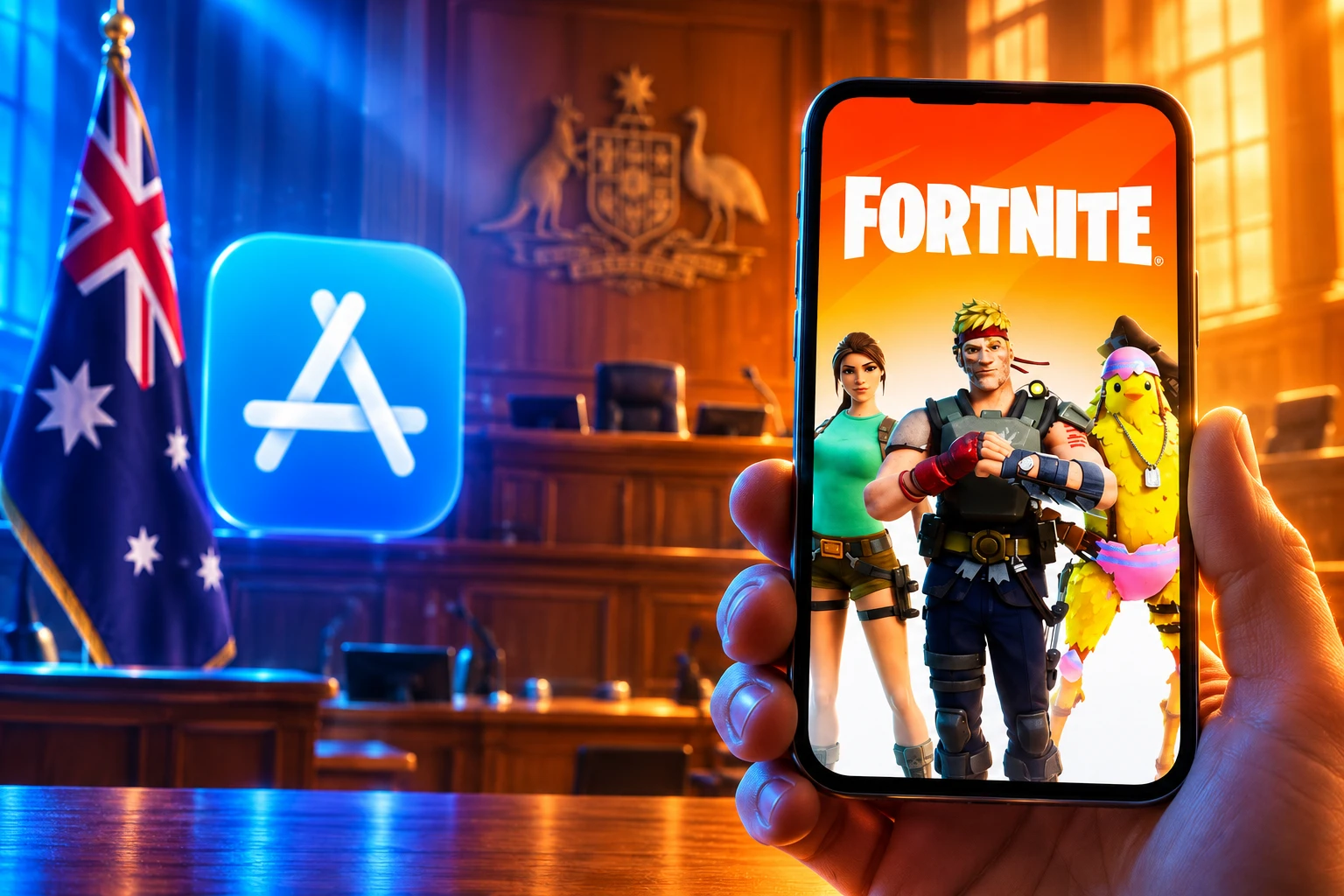
Fortnite Is Back on Australian iPhones
Order 2 sits outside the March clock. Once Epic makes a written application, Apple must readmit Fortnite and other Epic iOS apps (not an Epic store) to the Australian App Store, so long as Epic follows the developer agreement and review rules where those rules match the court’s orders. Epic Games Newsroom said on 22 October that the game would return the next day. The Fortnite account posted on 23 October that it was back.
Big news: Fortnite is coming back to the App Store in Australia tomorrow!
Today the Australia Federal Court told Apple to open up iOS after finding they violated competition law. Here’s what’s changing in Australia in March 2027:
• iOS will be open to third party app stores
•…— Epic Games Newsroom (@EpicNewsroom) October 22, 2026
Australia had been the holdout after Fortnite returned on iOS in other regions. The 2020 facts are on the face of the declaration: Apple refused Epic Direct Pay, pulled Fortnite on 13 August 2020, and terminated Epic’s Team ID 84 developer account on 28 August 2020. Beach called that enforcement a clear example of the restrictive terms.
Fortnite is back on the App Store in the land down under, as the court forced Apple to stop its blockade and change its unlawful App Store rules. Epic Games Store for iOS is coming to Australia in March!
Tim Sweeney, CEO, Epic Games, on X
That split is easy to miss in a victory post. The game is a listing. The store is a software project that still needs the March orders, and those orders can still be stayed.
Noon in Melbourne on 1 March
Orders 3 to 11, the ones that actually open distribution and payments, do not start until Noon (Melbourne time) on 1 March 2027. If Apple files between 1 February and 15 February 2027, with its evidence, the court can push that start to noon on 3 May 2027. Beach also flagged a separate discussion about a stay if Apple appeals, which Apple has now said it will seek.
FROM THE FORTNITE BAN TO THE OPENING DATE
- 13 August 2020: Apple removes Fortnite from the App Store after Epic switches on its own in-app payments.
- 12 August 2025: Beach finds Apple misused its market power in iOS app distribution and iOS in-app payments; a parallel finding is made against Google.
- March 2026: Epic’s Australian case against Google is dismissed by consent after a global settlement.
- 20 April 2026: Beach grants the ACCC leave to make written submissions on the form of relief.
- 2 September 2026: The ACCC authorises fee and billing terms in the Google-Epic settlement through 30 September 2032.
- 22 October 2026: Beach makes the Apple remedies orders and awards Epic 85% of its liability-trial costs.
- 23 October 2026: Fortnite is live again on the Australian App Store.
- 1 March 2027: Orders 3 to 11 are due to start, unless a stay or a court-approved extension to 3 May 2027 intervenes.
Apple’s spokesperson said the company “does not have a monopoly position in Australia or in any market around the world,” and that it “respectfully disagree[s] with many findings in this case, including a market definition that has been rejected by other courts.” The same statement said Apple will “request a stay and appeal the outcome to seek a resolution that respects our intellectual property and protects the safe, secure experience that consumers and developers expect from the App Store.”
A stay on orders 3 to 11 would leave Australians with Fortnite and without a legal right to install another store. That is the practical fight now, not a rerun of whether Fortnite may exist on iOS.
Europe Still Takes 5 Percent on Rival Stores
Apple has already been made to host rival iOS stores in other places. The method has been consistent: keep notarisation, keep a cut, and in some countries force Apple’s checkout to sit beside the rival one. Beach’s Australian text reads like a reply to that method.
HOW THE AUSTRALIAN ORDER SITS AGAINST APPLE’S OTHER OPENINGS
| Place | Web downloads | Rival stores | Apple’s take on rival-store sales | Must offer Apple IAP as well |
|---|---|---|---|---|
| Australia, from 1 March 2027 | Yes | Yes | No access fee; no fee on those in-app or web digital sales | No |
| European Union | Yes | Yes | 5% Core Technology Commission | Allowed alongside under Apple’s 2026 terms |
| Japan, from December 2025 | No | Yes | 5% Core Technology Commission | Yes, alongside |
| Brazil | No (marketplace path) | Yes | 5% Core Technology Commission | Yes, alongside |
In the EU, Apple replaced its per-install Core Technology Fee with a 5% Core Technology Commission on digital sales in apps distributed outside the App Store, effective 1 October 2026. Epic has already called the EU package a new set of junk fees, including a 20% charge on alternative in-app payments and 15% on some outbound links. Japan’s Mobile Software Competition Act opening, which Apple switched on in December 2025, lets users set a default rival marketplace but does not give them a website download path like the EU. Brazil’s CADE settlement followed the same marketplace-plus-commission pattern.
The Australian orders also stop Apple requiring developers to report rival-payment transactions or to offer IAP next to the method they prefer, which is the pairing Apple uses in Japan and Brazil. If the March orders hold, an Epic Games Store on an Australian iPhone would not owe Apple the 5% Europe still collects on the same kind of sale.
The Google Case Ended in a Settlement
Google was in the same courtroom in 2025. Beach found it had also misused market power over Android app distribution and Play billing. It is not in Thursday’s orders because it bought its way out.
Epic and Google signed a new term sheet on 3 March 2026, replacing an October 2025 deal, and the Australian proceeding against Google was dismissed by consent that month. On 2 September 2026 the ACCC issued a determination granting authorisation until 30 September 2032 for specified Play fee caps and for the display and use of payment options other than Google Play Billing.
Apple is the party that still wants a full appellate fight. The ACCC, which spent 2020 to 2025 on its Digital Platform Services Inquiry, asked to be heard on the public-interest shape of any Apple remedy and won leave to intervene on the relief on 20 April 2026. Commissioner Luke Woodward said the orders could have “wide-ranging implications for the distribution of mobile apps and in-app payments in Australia.” The government has already said it will build a separate digital competition regime; this case did not wait for that statute.
Historic App Store and Play commissions sat at about 30 percent on in-app digital goods, which is the figure the ACCC used when it recapped why Fortnite was pulled. Beach did not replace that 30 percent with a court-set rate for Apple’s own store. He reserved s 87 relief that would have voided contract terms, and he did not become a price regulator. The squeeze is on the side door: if you leave the App Store, Apple does not get to invent a new till.
Who Can Sideload, and From Where
Epic asked for global orders, so any store or website could reach any iPhone. Beach refused. He accepted Apple’s argument that the geographic reach should stop at the Australian storefront and at users with an Australian Apple Account, even while he rejected Apple’s narrower reading of the injunction power itself.
AUSTRALIAN APPLE ACCOUNT
- The test: An Apple Account whose country or region is set to Australia, which is how the orders define a “User” for orders 2 to 11.
- The storefront: For those orders, “App Store” means the Australian storefront, not every one of Apple’s 175 localised storefronts.
- The developers: Any Apple Developer Program member, wherever that company is based, may use the new channels to reach those users.
Beach spelled out why the account, not the passport stamp, is the switch. A user signs into one country, ties a card to that country, and unlocks one storefront. Apple already uses that lock in Europe and Japan: a US account does not get EU marketplace installs just because the phone is in Paris. Changing region means cancelling subscriptions and spending leftover store credit, then showing local billing details. No local card, no paid in-app purchases, only free apps.
So a visitor on holiday in Sydney with a US account will not wake up on 1 March with sideloading. An Australian account on a trip abroad is the person the order is built around, subject to how Apple actually codes the entitlement. Developers outside Australia are in, as they already are for EU and Japan alternative distribution. Apple still does not have to put a rival store on the App Store shelf, and it still may notarize.
Notarization Stays, a Global Order Does Not
Apple did not leave empty-handed. The scan-and-notarise gate is written into the definition of Alternative Distribution Channels. Epic’s worldwide injunction is gone. Rival stores do not get a berth inside the App Store. Contract terms are not declared void. Unconscionable-conduct claims under the Australian Consumer Law had already failed at liability. Costs of the remedies hearing are reserved; on the liability trial Apple must pay 85% of Epic’s costs on the standard basis, a haircut Beach tied to the two points Epic lost, the s 87 bid and the global reach.
WHAT THE COURT LEFT IN APPLE’S HANDS
- The security gate: Automated scanning plus notarisation by Apple or a qualified third party, with removal still allowed for malware, illegal content or Online Safety Act duties.
- The map: No order that rewires the other 174 storefronts, and no duty to host a competitor’s store in Apple’s own catalogue.
- The appeal: A live path to a stay and to the Full Court, which Apple has said it will take.
One reply under Sweeney’s post compared an App Store developer ban to an algorithm that accuses you and then hears its own appeal. Order 11 is the court’s answer to that habit in this case: Apple may not freeze out a developer for using the new channels. Whether that clause survives a stay is now a filing question, not a product question.
Sweeney has already dated the next Epic artefact. The Epic Games Store, he said, is coming to Australian iOS in March. Apple has already dated its next legal artefact: a stay request, then an appeal. Fortnite did not wait for either of them.

Edinburgh Opens a 2027 Tour Built for Time Trials

Korda Maps Auður From Meðalland to Irvine Bay

Apple Music Films Its New Logo in Mineral Oil

Oppo Prices the Pad Mini Above India’s iPad Mini

Austen Soaks Scotland Before Boelo Brings Weekend Gales

Volkswagen Sells the Osnabruck Plant to Clear a Board Fight

Apple’s Foldable iPhone Hinges on Samsung Display Supply

Tata Motors’ Iveco Tender Opens as Holders Still Decide

Saksham Gaur Finds He Is His Own Company’s Client

Onimusha Way of the Sword Preload Hits a Windows 11 Wall
-
 AUTO2 months ago
Volkswagen Sells the Osnabruck Plant to Clear a Board Fight
-
 NEWS2 months ago
Apple’s Foldable iPhone Hinges on Samsung Display Supply
-
 AUTO2 months ago
Tata Motors’ Iveco Tender Opens as Holders Still Decide
-
 BUSINESS2 months ago
Saksham Gaur Finds He Is His Own Company’s Client
-
 GAMING2 months ago
Onimusha Way of the Sword Preload Hits a Windows 11 Wall
-

 BUSINESS2 months ago
Hyderabad 22-Carat Gold Jumps After a False Bargain
-

 ENTERTAINMENT3 years ago
What is SD on Amazon Prime? – All You Need to Know
-

 NEWS2 months ago
iQOO 16 Locks 8,400 mAh While 100W Charging Holds