
NEWS
Tymor Marine Turns Hull Video Into Cargo Evidence
Scottish Enterprise funded Tymor Marine to run its AI draught reader on a phone, so bulk cargo claims can reopen a timestamped video of the hull.

Scottish Enterprise funded Aberdeen firm Tymor Marine to put its AI draught-survey tool on a phone that never needs the cloud. The product that came back is a file: a short hull video, time-stamped, that cargo claims can reopen after the ship has sailed.
Tymor built DRFT MRKS for its own naval architects, then spent 15 months turning it into a free store app. In November 2025 the bulk trades gave it an industry award. The reading is faster. The fight it changes is the one over whether the cargo was ever there.
A Two-Centimetre Error Weighs Hundreds of Tonnes
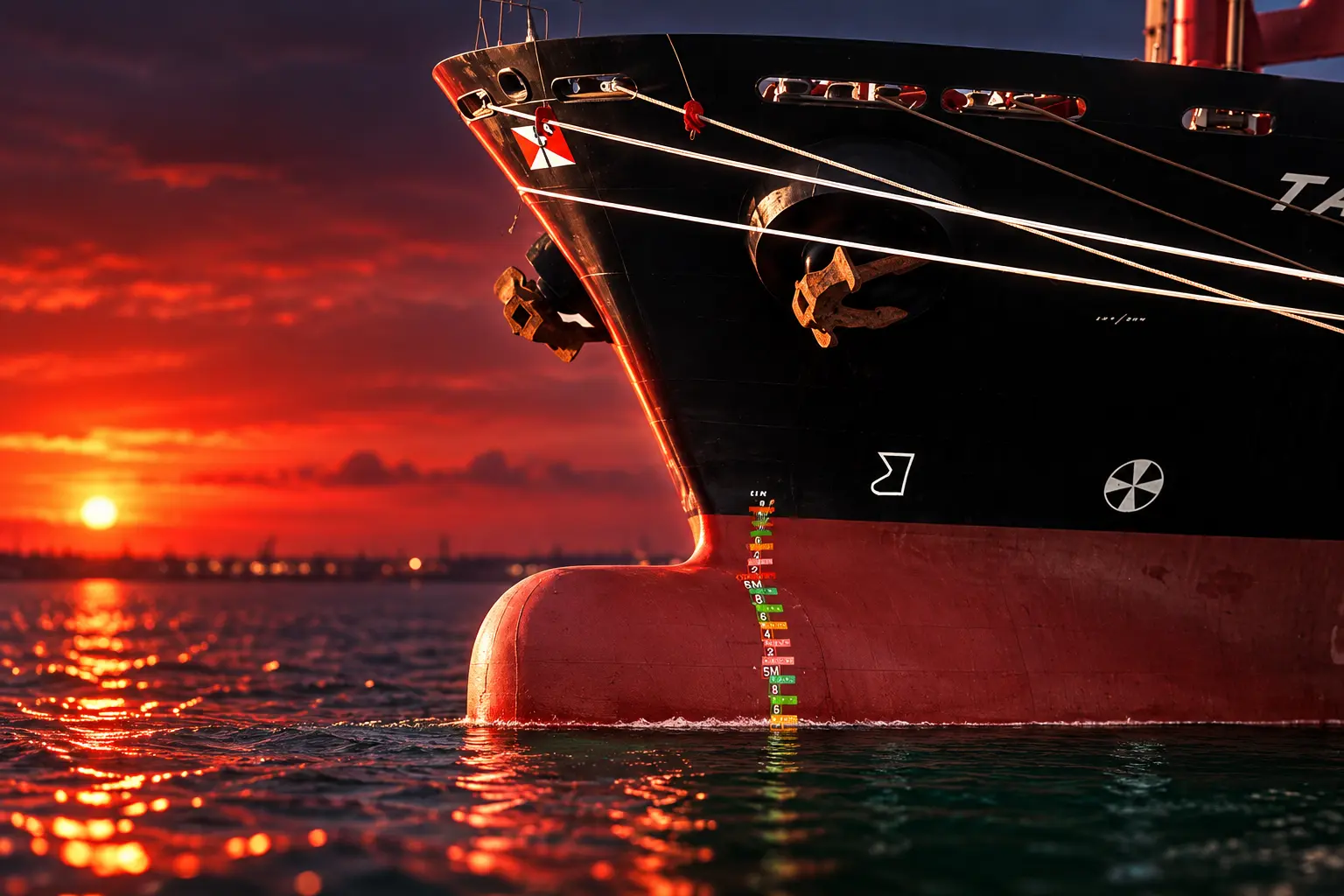
A draught survey turns the depth of hull under water into a weight. That weight is how bulk shipping counts grain, ore and coal when a shore scale is missing, disputed, or not trusted. Get the waterline wrong, and the bill of lading and the ship’s figures part company.
The Swedish Club reviewed about 200 bulk-carrier grain and soya claims from 2018 to 2022, each costing at least USD 5,000. Shortage was the most common claim, at 63 percent of the set. About 70 percent of those shortage files started as a gap between the vessel’s figures and the shore’s. The average shortage claim was only USD 35,000, yet those files made up 44 percent of the Club’s grain-bulker claims costs.
Johan Kahlmeter, the Club’s director of claims, said operators can end up “seriously out of pocket through no fault of their own,” and that in some North African ports draught surveys are not recognised at all. Frequency rose over the same window: 3.7 percent of insured bulkers filed a grain claim in 2018, against 8.9 percent in 2022, with a five-year average of 5.6 percent. Most shortage claims, 68 percent, landed at discharge.
The West of England P&I Club, in a loss-prevention bulletin on draught-survey errors, puts typical accuracy at 0.5 percent to 1.0 percent. It also spells out what a small misread of the marks is worth in tonnes.
WHAT A TWO-CENTIMETRE MISREAD WEIGHS
| Ship class | Deadweight band | Error from 2 cm in mean draught |
|---|---|---|
| Handysize bulk carrier | 10,000-35,000 t | about 68 t |
| Handymax bulk carrier | 35,000-59,000 t | about 90 t |
| Panamax bulk carrier | 60,000-80,000 t | about 112 t |
| Capesize bulk carrier | more than 80,000 t | about 300 t |
Those figures are for two centimetres in the mean draught, not for the whole survey. Ballast soundings, forgotten tank weights, dock-water density and squat still sit in the same calculation. A phone that reads the marks better does not drain a double-bottom. It does give every party the same picture of the hull when the argument starts.
Scottish Enterprise Paid to Get the Model off the Cloud
In February 2024 Tymor said Scottish Enterprise had awarded grant funding to refine DRFT MRKS into a phone app that would run without cloud processing. The firm has not published the sum. The brief was specific: cut the compute until the model fits on a handset, then get it to market.
That was a change of plan, not a polish. In 2023, when Tymor was still proving the idea with CENSIS, Scotland’s sensing and imaging centre, and the University of Edinburgh, the stated aim was a smartphone capture that uploaded to the cloud for a live reading. Ports, open water and older phones are bad places to wait on a signal. A claims file that lives only on a server is also a claims file someone else can lose.
Kevin Moran, Tymor’s managing director and a former seafarer, tied the grant to that shift. “The funding from Scottish Enterprise is fantastic because it will allow our developers to refine our software, reducing its processing requirements so that it can be used within a smartphone app,” he said. “The funding will help us to accelerate time to market with a new technology that is scalable, secure, reliable, and portable.”
He also said the next two decades of digital operations would drive more change in maritime work than the past century. The portable part is the one the grant actually bought. Once the model runs on the device, the video never has to leave the surveyor’s pocket to become a reading, and the reading never has to wait for a masthead link.
How DRFT MRKS Reads a Faded Waterline
DRFT MRKS takes a short clip of the hull, finds where the water meets the painted draught numerals, and returns a reading on the same device in about three minutes. The clip can come from a phone, a tablet, or a drone, so the person filming can stand back from the plating. Checking both sides of a ship by eye can take hours in a small boat, close enough to the steel to slip.
Dr Hakan Bilen, a reader in the University of Edinburgh’s School of Informatics, trained the vision stack. He said early AI research assumed that reading digits and estimating a waterline would be easy, and that chess would be hard. “The opposite has turned out to be the case and it is the seemingly simple tasks that we are still finessing,” he said. The Edinburgh note on the project describes his use of deep neural networks on hull video to find where the digits meet the water in mixed conditions.
The model takes in a video showing a ship’s hull and identifies where digits on the side of a vessel intersects the water line in a variety of different scenarios.
Dr Hakan Bilen, Reader, School of Informatics, University of Edinburgh
Rosie Clegg, a naval architect at Tymor, said the firm had tried to buy this and found nothing on the shelf. “Finding people with the right skills to help us innovate is tricky for a company of our size, we didn’t have deep learning expertise in house,” she said. “Without CENSIS’s support, this project would not have happened.” The first twelve weeks, she said, were spent proving the concept was feasible, then training on footage from real ship visits.
WHAT THE MODEL HAS TO SEE
- The waterline: The code looks for the meeting point of hull and water, not for a typed number in a form.
- Bad paint: Faded, rusted or weed-covered numerals are treated as the normal case, not as a fail.
- Bad light: Night work, glare and shadow are part of the training set Bilen’s group kept expanding.
- Bad water: Swell and wave motion are averaged from video instead of from one glance between a peak and a trough.
- The keep-file: Each reading is stored with the clip, so the sea state in the frame can be inspected later.
Tymor’s product page now leads with that keep-file. The app is sold as a timestamped video of sea state and hull condition, a shared record for owners, charterers, terminals, surveyors and insurers, not as a faster tape measure. When the outturn is short, the parties can watch the same waterline instead of arguing about a handwritten figure and a memory of the swell.
Fifteen Months From Grant to the App Stores
Moran and Professor Colin MacFarlane, an academic, founded the consultancy. It still does conventional naval architecture from Aberdeen, Glasgow and Lafayette, Louisiana. DRFT MRKS started as an in-house fix for that team, then became the product Scottish Enterprise was asked to finish.
FROM WORKSHOP TOOL TO STORE LISTING
- April 2023: Tymor, CENSIS and Edinburgh show a working vision model and talk about a future cloud app.
- February 2024: Scottish Enterprise awards grant funding to cut processing so the model runs on a phone with no cloud.
- August 2024: A beta opens ahead of SMM in Hamburg, with up to 50 mariners, surveyors, owners and managers invited at no cost.
- June 2025: DRFT MRKS ships as a free download on the Apple App Store, with Google Play following in mid-June, on iOS 12 and Android 8 or later.
- 17 November 2025: The app wins the IT Solutions Award, Marine, at the International Bulk Journal Awards at the Titanic Hotel in Liverpool. Peel Ports Group chief operating officer David Huck presents it to Moran.
- 5 August 2026: Moran and principal naval architect Niall MacLennan use DRFT MRKS, with Tymor’s DeadW8 weight software, on a statutory survey of the hospital ship Global Mercy in Las Palmas.
The IBJ judges called the app a way of digitising and automating draft surveying. Moran, after the Liverpool night, said bulk shipping had shaped the tool from the start, and that the aim was “a reliable, digital-first solution that improves accuracy, reduces disputes and gives operators confidence in their measurement data.” At launch he had gone further, saying expert-trained AI could save the industry “millions of dollars annually.” That saving is his claim, not a published claims-book result.
The store listing holds the last 10 surveys with their video. Uses listed around the launch went past bulkers: semi-submersibles, offshore wind monitoring, salvage, tide and water-level work, and flood-risk checks. The same waterline problem shows up anywhere a painted mark meets moving water.
Surveyors Still Sign, the Video Travels With Them
Tymor’s own copy says the app is built to support experienced surveyors, not to replace professional judgement. That line is doing real work. A draught survey is still a chain of tank soundings, density samples, constants and hydrostatic tables. The model only locks down the step that used to be a man in a boat squinting at a 10-centimetre numeral in a chop.
The second-order change sits after the signature. Once the clip is in the file, the surveyor is no longer the only person who saw the hull. The owner, the receiver and the P&I club can watch the same seconds of water. That helps a careful surveyor whose figures are later attacked. It also means a crew phone can produce a competing exhibit without waiting for an independent attendant to fly in.
Draft surveys are a critical tool in bulk shipping, but the reality is that the evidential record behind many readings has not kept pace with the scrutiny applied to modern cargo disputes. Surveyors need time-stamped, retrievable records that can withstand scrutiny long after a vessel has sailed.
Kevin Moran, managing director, Tymor Marine
Moran said that in March 2026, in a note on Australia’s iron ore, coal, grain and alumina trades. Strengthening the record, he said, “supports surveyors in defending their position when discrepancies arise.” The grant’s on-device brief is what makes that defence portable. A clip that needed a cloud round-trip was always going to die in a port with weak data. A clip that finishes on the handset can be kept with the mate’s receipts.
None of that settles a shortage on its own. Clubs still tell masters to clause mate’s receipts when the ship’s figure and the shore figure diverge by more than about 0.5 percent, and to log density, ballast and weather. The video is one exhibit. It is a better exhibit than a number with no picture.
The Hospital Ship That Stress-Tested the Same Tool
On 5 August 2026 Tymor ran a lightweight survey and inclining test on Global Mercy, which Mercy Ships calls the world’s largest purpose-built civilian hospital ship, during annual maintenance at Las Palmas in Gran Canaria, before a healthcare call in Ghana. The ship carries 7,000 square metres of medical space, six operating theatres and 200 hospital beds.
DRFT MRKS took the draughts. DeadW8, Tymor’s other onboard product, keeps a running record of weight changes between statutory surveys so the loading instrument is not working off a five-year-old lightship. Moran put the usual leftover in plain terms: “An inclining experiment takes weeks to plan and a long day to run, and what usually survives it is a report with a number in it.”
Shelley Pigott, executive director of Mercy Ships UK, said the stability information came back approved by flag and class, “with the survey process recorded and stored digitally for the years ahead.” That is the same keep-file the bulk trades want when a North African receiver claims a few hundred tonnes of grain never arrived. A hospital ship is not a Capesize. It is a hard survey in a commercial port, with class watching, which is a sterner test than a store screenshot.
CENSIS, as a public innovation centre, has since folded into a smaller private vehicle. The Edinburgh model, the Scottish Enterprise grant, and a free app that runs without the cloud are what remain of that three-way build. The claims books have not yet published a before-and-after on shortage files. They have already said where the money goes: small, repeat, paper shortages at the discharge port, born from two numbers that never shared a picture.
Frequently Asked Questions
What is a draught survey on a cargo ship?
A draught survey converts how deep a ship sits in the water into a displacement, then subtracts fuel, ballast, fresh water and a constant to estimate cargo weight, using Archimedes’ principle of buoyancy. Surveyors read painted marks at the bow, amidships and stern on both sides, then apply trim, density and hydrostatic corrections; the method is still the fallback when a shore scale is absent or contested.
How does the DRFT MRKS app take a draught reading?
The user films a short clip of the hull marks with a smartphone, tablet or drone, and the on-device model returns a reading in about three minutes without sending the video to the cloud. Tymor says the app stores the last 10 surveys with their footage, works on iOS 12 and Android 8 or later, and launched in June 2025 as a free download on Apple and Google stores.
Why do grain shortage claims so often start with draught figures?
Shore scales and ship calculations rarely agree to the tonne, and many charterparties only treat a gap above about 0.5 percent of the bill of lading as a live claim. The Swedish Club found most grain shortage files in 2018-2022 were vessel-versus-shore discrepancies, concentrated at discharge in North Africa and, after 2021, in China, which is why a shared picture of the waterline is the exhibit clubs have been missing.
Who built DRFT MRKS and which Scottish bodies backed it?
Tymor Marine, a naval architecture firm founded by former seafarer Kevin Moran and Professor Colin MacFarlane, wrote the first version for its own survey teams in Aberdeen. CENSIS introduced the company to Dr Hakan Bilen’s group at the University of Edinburgh to train the vision model, and Scottish Enterprise later funded the work that moved processing off the cloud and onto a phone.
Does DRFT MRKS replace a marine surveyor?
Tymor says no: the app documents the waterline the surveyor saw, including sea state and hull condition, and is meant to support professional judgement rather than sign the report. Ballast tanks, hydrometer density, lightship constants and the legal clausing of mate’s receipts remain human work, and P&I clubs still tell masters to appoint surveyors and to protest when a reading is taken in a swell.
The grant’s end state is not a smarter cloud. It is a clip of the hull that still exists when the ship, and the people who watched it load, have gone.

Edinburgh Opens a 2027 Tour Built for Time Trials

Korda Maps Auður From Meðalland to Irvine Bay

Apple Music Films Its New Logo in Mineral Oil

Oppo Prices the Pad Mini Above India’s iPad Mini

Austen Soaks Scotland Before Boelo Brings Weekend Gales

Volkswagen Sells the Osnabruck Plant to Clear a Board Fight

Apple’s Foldable iPhone Hinges on Samsung Display Supply

Saksham Gaur Finds He Is His Own Company’s Client

Tata Motors’ Iveco Tender Opens as Holders Still Decide

Onimusha Way of the Sword Preload Hits a Windows 11 Wall
-
 AUTO2 months ago
Volkswagen Sells the Osnabruck Plant to Clear a Board Fight
-
 NEWS2 months ago
Apple’s Foldable iPhone Hinges on Samsung Display Supply
-
 AUTO2 months ago
Tata Motors’ Iveco Tender Opens as Holders Still Decide
-
 BUSINESS2 months ago
Saksham Gaur Finds He Is His Own Company’s Client
-
 GAMING2 months ago
Onimusha Way of the Sword Preload Hits a Windows 11 Wall
-

 ENTERTAINMENT3 years ago
What is SD on Amazon Prime? – All You Need to Know
-

 BUSINESS2 months ago
Hyderabad 22-Carat Gold Jumps After a False Bargain
-

 NEWS2 months ago
iQOO 16 Locks 8,400 mAh While 100W Charging Holds