
NEWS
Scotland Accepts Vutrisiran for ATTR-CM as Monotherapy Only
NHS Scotland accepted vutrisiran for ATTR-CM as monotherapy only, while a same-day SMC notice left Bayer’s acoramidis unfunded.

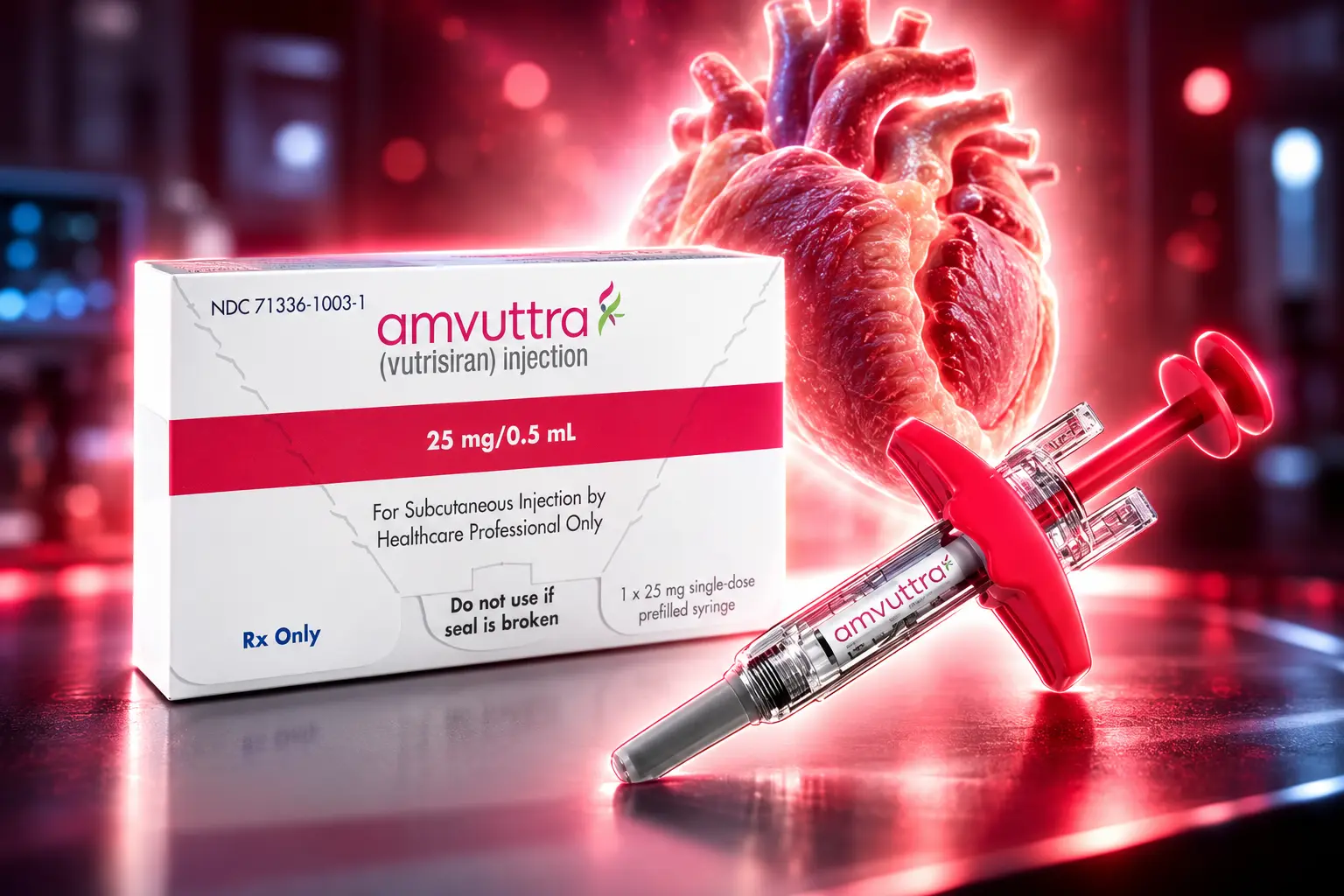
The Scottish Medicines Consortium accepted for restricted use within NHSScotland vutrisiran sodium (Amvuttra, Alnylam Pharmaceuticals) on 12 October 2026, as monotherapy for adults with wild-type or hereditary transthyretin amyloidosis with cardiomyopathy (ATTR-CM). The advice holds only with an approved patient access scheme, or at a scheme or list price at or below the figure used in the cost case.
That wording is the decision. NHS Scotland now has a three-monthly RNA injection to sit beside tafamidis, the daily capsule accepted in 2023. The two are not funded together. On the same day the consortium posted that Bayer’s oral drug acoramidis is not recommended, because Bayer did not submit.
The SMC Puts Vutrisiran on a Monotherapy Lane
ATTR-CM is a rare, fatal heart condition. Misfolded transthyretin, a protein made in the liver, forms amyloid deposits that stiffen the heart and drive heart failure. Wild-type disease appears as the protein becomes unstable with age. Hereditary disease follows one of more than 120 TTR gene mutations. Amyloid can also settle in peripheral nerves and the gut.
Until this advice, tafamidis (Vyndaqel, Pfizer) was the only disease-modifying therapy the SMC had accepted for wild-type and hereditary ATTR-CM. Diuretics, rhythm drugs and, rarely, transplant remain in the background. Vutrisiran is a small interfering RNA drug. It turns down hepatic production of both wild-type and variant TTR, which lowers circulating protein and is meant to slow further tissue deposition.
The published restriction is narrow: monotherapy in adults with wild-type or hereditary ATTR-CM. The consortium said a phase 3 study showed vutrisiran monotherapy reduced all-cause death and recurrent cardiovascular events versus placebo, and that data to compare vutrisiran with tafamidis are limited. Clinical experts who advised the SMC called the drug a therapeutic advance because of that mechanism, and an effective alternative to the capsule.
Vutrisiran offers another treatment option for patients with ATTR-CM, that is administered in a different way from the currently available option and may suit some patients better.
Dr Rob Peel, chair, Scottish Medicines Consortium
Peel’s point is practical. A shot every three months is a different burden from a capsule every day. The restriction still means a newly diagnosed patient in Scotland is choosing one funded disease-modifying drug, not stacking both.
England Already Chooses Among Three Funded Drugs
NICE recommended vutrisiran for the same licensed population on 10 December 2025 (TA1115). Usual care there is tafamidis. The committee said the trial was not built to compare the two drugs head to head, and that indirect comparisons are uncertain, but that people on vutrisiran appear to live about as long, and to worsen at a similar rate, as people on tafamidis. Costs, it said, are similar or lower. The instruction to the NHS in England is to use the least expensive option of the suitable treatments, including vutrisiran and tafamidis, after talking through administration, dose, price and commercial deals with the patient.
England then added a third option. NICE recommended acoramidis (Beyonttra, Bayer), another oral TTR stabiliser, on 14 January 2026. Cardiomyopathy UK, which tracks the appraisals for patients, set that date on the final guidance. Specialist teams in England now discuss which of the suitable drugs to start, still as a choice of one.
Alnylam has put the UK group who may be eligible for vutrisiran at about 1,500 people, with underdiagnosis likely to push the true count higher. NICE committee papers for TA1115 recorded 151 UK patients in HELIOS-B, 23.1% of the 655 people randomised. Scotland’s own caseload is not broken out in the published SMC summary.
ATTR-CM DRUGS ON THE NHS
| Medicine | How it is taken | England (NICE) | Scotland (SMC) |
|---|---|---|---|
| Vutrisiran (Amvuttra) | 25 mg under the skin every 3 months | Recommended 10 December 2025 as an option; pick the cheapest suitable drug | Restricted monotherapy, 12 October 2026, with a patient access scheme |
| Tafamidis (Vyndaqel) | 61 mg capsule once daily | Usual treatment, inside the same choice set | Accepted 13 November 2023, with a patient access scheme |
| Acoramidis (Beyonttra) | Oral TTR stabiliser | Recommended 14 January 2026 as an option | Not recommended, 12 October 2026, after no company submission |
The English rule is still pick-one, not combination. The Scottish difference is the written monotherapy limit plus a missing third drug. Boards north of the border are not being asked to shop a three-way price comparison that already exists in England.
Bayer Leaves Acoramidis off the Scottish List
SMC2986, published 12 October 2026, is a one-page lockout. In the absence of a submission from the marketing-authorisation holder, acoramidis is not recommended for use within NHSScotland for wild-type or variant ATTR-CM. Bayer Plc did not file. The consortium said it therefore cannot recommend the product. The statement of advice is dated 4 September 2026 and went up with the rest of the 12 October batch.
Acoramidis is not an experimental leftover. The European Medicines Agency authorised Beyonttra for this cardiomyopathy in adults, and NICE has already placed it on the English menu. A non-submission in Scotland is a commercial choice with a clinical consequence: the only oral disease-modifying option the SMC has accepted remains Pfizer’s tafamidis, first turned down on value in December 2021 (SMC2426) and accepted on a second resubmission under the end-of-life and orphan process on 13 November 2023 (SMC2585).
That 2023 tafamidis decision already used a confidential patient access scheme. Vutrisiran arrives on the same kind of deal. List prices stay eye-watering. NICE records a list price of £95,862.36 per syringe of 25 mg. Four injections a year put the undiscounted annual list cost at £383,449.44. The NHS discount is commercial in confidence in both countries. Without it, neither oral nor injectable ATTR-CM drug would clear a standard value test.
What HELIOS-B Measured, and What It Missed
The SMC leaned on HELIOS-B, a phase 3 trial of 655 adults with ATTR-CM and a history of heart failure, published in the New England Journal of Medicine. Patients were randomised to vutrisiran 25 mg or placebo, given under the skin every 12 weeks for up to 36 months: 326 on the drug, 329 on placebo. Co-primary endpoints were a composite of all-cause death and recurrent cardiovascular events (hospital stays and urgent heart-failure visits), in the whole trial and in the monotherapy subgroup who were not on tafamidis at baseline. That subgroup is the population the Scottish restriction covers.
HELIOS-B PRIMARY RESULTS
| Measure | Overall population | Monotherapy subgroup |
|---|---|---|
| Composite of death and recurrent CV events | HR 0.72 (95% CI 0.56-0.93) | HR 0.67 (95% CI 0.49-0.93) |
| All-cause death at 42 months | 18% vs 26% on placebo; HR 0.65 (0.46-0.90) | 22% vs 29%; HR 0.66 (0.44-0.97) |
| 6-minute walk change at 30 months | -45.4 m vs -71.9 m; difference 26.5 m (13.4-39.6) | Not the SMC’s published split |
| KCCQ overall summary at 30 months | -9.7 vs -15.5 points; difference 5.8 (2.4-9.2) | Not the SMC’s published split |
Walk distance and the Kansas City questionnaire were reported for the overall trial in the SMC write-up. People on the drug lost less ground than people on placebo. The safety profile matched what was already known. Adverse events hit 99% on vutrisiran and 98% on placebo. Serious events were 62% and 67%. Treatment stopped for adverse events in 3.1% and 4.0%. The most common serious events in either arm were cardiac failure (12% vs 17%), atrial fibrillation (8.0% vs 6.1%) and acute cardiac failure (4.0% vs 5.5%).
The holes the SMC flagged are the ones that shape prescribing. Indirect comparison with tafamidis is thin. A post hoc in-study look at the two monotherapies found no evidence of a difference on the composite (HR 0.83; 95% CI 0.54-1.29), but that analysis was not pre-specified and may be biased, because people already on tafamidis were probably already benefiting at baseline. HELIOS-B was not designed to prove that adding vutrisiran on top of tafamidis works. Hereditary ATTR-CM made up only 12% of participants; a subgroup look suggested possibly less benefit than in wild-type disease, in a sample too small to trust.
Those gaps are why a “new option” in Scotland reads as a fork at the start of treatment. The trial that won reimbursement compared the injection with placebo, with the cleanest signal in people who were not already on the capsule. It did not settle which drug to open with, and it did not settle combination care.
A Quarterly Injection Against a Daily Capsule
The two funded Scottish drugs attack TTR from different ends. Tafamidis is a stabiliser: it props up the TTR tetramer so it is less likely to fall apart and form amyloid. Vutrisiran is an RNA interference drug: it marks TTR messenger RNA in the liver for breakdown, so less protein is made in the first place. The European Medicines Agency has authorised for ATTR amyloidosis with cardiomyopathy as well as for hereditary disease with stage 1 or 2 polyneuropathy. Great Britain’s marketing authorisation for the cardiomyopathy use was granted in July 2025.
The recommended vutrisiran dose is 25 mg by subcutaneous injection once every 3 months. Because the drug lowers TTR, patients take a vitamin A supplement of about 2500-3000 IU a day, and an eye assessment is advised if symptoms of vitamin A deficiency appear. The SMC said treatment should start as early as possible in the disease course to limit accumulating disability.
HOW THE INJECTION IS GIVEN
- The dose: 25 mg under the skin once every 3 months, from a pre-filled syringe.
- Who injects: a clinician, or the patient or a carer after training in the technique.
- The sites: abdomen (not around the navel), thigh, or upper arm if someone else gives the injection; skip skin that is scarred, red, inflamed or swollen.
- The add-on: daily vitamin A at about 2500-3000 IU, with an eye review if night vision or other ocular symptoms appear.
A daily 61 mg tafamidis capsule has no injection training and no vitamin A rule of that kind. It does mean remembering a tablet in a disease that already loads older patients with diuretics and rhythm drugs. For some people the quarterly syringe will be the easier rhythm. For others, especially those who already swallow tafamidis, the SMC’s monotherapy limit means the new option is not an upgrade path.
Patients on Tafamidis Stay on a Single Drug
Anyone in Scotland who started tafamidis after the November 2023 acceptance is outside the new restriction if the aim is to add vutrisiran. Switching remains a clinical judgement for boards and specialists, but the published SMC wording does not open combination therapy, and HELIOS-B was not built to underwrite it. Newly diagnosed patients, and those who have not yet started a disease-modifying drug, are the group this advice actually moves.
Scotland already knew vutrisiran in another ATTR setting. On 11 September 2023 the SMC accepted it, after an abbreviated submission, for hereditary transthyretin-mediated amyloidosis with stage 1 or 2 polyneuropathy, as a second siRNA choice after patisiran. The cardiomyopathy file is a full submission, a different BNF chapter, and a tighter leash.
HOW ATTR-CM DRUGS REACHED THE UK
- 11 September 2023: SMC accepts vutrisiran for hereditary ATTR polyneuropathy (SMC2596).
- 13 November 2023: SMC accepts tafamidis 61 mg daily for wild-type and hereditary ATTR-CM (SMC2585), after an earlier rejection on value.
- July 2025: Great Britain marketing authorisation for vutrisiran in ATTR-CM.
- 10 December 2025: NICE recommends vutrisiran for ATTR-CM in England, with a commercial arrangement, and tells services to pick the cheapest suitable option.
- 14 January 2026: NICE recommends acoramidis as a further option in England.
- 12 October 2026: SMC accepts vutrisiran for ATTR-CM as monotherapy (SMC2900) and, in the same batch, does not recommend acoramidis after a non-submission (SMC2986).
NHS boards in Scotland now have a second disease-modifying ATTR-CM drug to put on formularies, priced only through a confidential scheme, and limited to people who will take it on its own. The capsule stays. The third oral drug England already funds does not arrive with this batch.
Frequently Asked Questions
Can Patients Inject Amvuttra at Home?
Yes, after they or a carer have been trained. The licensed sites are the abdomen except around the navel, the thigh, or the upper arm when another person gives the injection, and the skin must not be scarred, red, inflamed or swollen. Hospital-only supply still applies at the indicative NHS price; home use is about who holds the syringe, not about picking it up in a community pharmacy.
Why Are Eye Symptoms a Warning on Vutrisiran?
Night blindness and other ocular signs of vitamin A deficiency are the prompt to send the patient to ophthalmology, because lowering TTR can pull down vitamin A levels even when a daily supplement is prescribed. General practice nurses who see these patients are being asked to keep the supplement on the list and to treat new night-vision complaints as a reason for an eye review, not as a routine ageing symptom.
Has Scotland Used Vutrisiran Before This Heart Decision?
Yes. The SMC accepted vutrisiran on 11 September 2023 for hereditary ATTR amyloidosis in adults with stage 1 or stage 2 polyneuropathy, as an extra siRNA choice after patisiran, again only with a patient access scheme. That listing did not cover cardiomyopathy; SMC2900 is the separate, restricted heart indication.
Do Women on Vutrisiran Need Contraception?
Product advice says females of childbearing potential should use effective contraception during treatment. If a pregnancy is planned, both vutrisiran and the vitamin A supplement should be stopped and vitamin A levels monitored, under specialist advice, before conception is attempted.
Disclaimer: This article is news reporting and analysis of a Scottish Medicines Consortium decision and related UK appraisals. It is for information only and is not medical advice, a treatment recommendation, or a substitute for a consultation with a specialist in cardiology, amyloidosis or inherited heart disease. Readers who think they may have ATTR-CM, or who are already taking tafamidis, vutrisiran or another heart medicine, should speak to their own clinician before starting, stopping or switching any drug. Figures, list prices, access-scheme status and formulary positions reflect the cited SMC, NICE, BNF and regulator documents as published on the dates named above and may change if companies resubmit or if new trial data appear.

Edinburgh Opens a 2027 Tour Built for Time Trials

Korda Maps Auður From Meðalland to Irvine Bay

Apple Music Films Its New Logo in Mineral Oil

Oppo Prices the Pad Mini Above India’s iPad Mini

Austen Soaks Scotland Before Boelo Brings Weekend Gales

Volkswagen Sells the Osnabruck Plant to Clear a Board Fight

Apple’s Foldable iPhone Hinges on Samsung Display Supply

Tata Motors’ Iveco Tender Opens as Holders Still Decide

Saksham Gaur Finds He Is His Own Company’s Client

Onimusha Way of the Sword Preload Hits a Windows 11 Wall
-
 AUTO2 months ago
Volkswagen Sells the Osnabruck Plant to Clear a Board Fight
-
 NEWS2 months ago
Apple’s Foldable iPhone Hinges on Samsung Display Supply
-
 AUTO2 months ago
Tata Motors’ Iveco Tender Opens as Holders Still Decide
-
 BUSINESS2 months ago
Saksham Gaur Finds He Is His Own Company’s Client
-
 GAMING2 months ago
Onimusha Way of the Sword Preload Hits a Windows 11 Wall
-

 BUSINESS2 months ago
Hyderabad 22-Carat Gold Jumps After a False Bargain
-

 ENTERTAINMENT3 years ago
What is SD on Amazon Prime? – All You Need to Know
-

 NEWS2 months ago
iQOO 16 Locks 8,400 mAh While 100W Charging Holds