
LIFESTYLE
Over Half the Toys on West of Scotland Shelves Failed
Trading Standards found 18,075 failing toys in west of Scotland shops, after a Glasgow warehouse haul, with two regional sweeps still unpublished before Christmas.

Trading Standards officers found 18,075 unsafe or non-compliant toys among 32,316 checked at 165 shops and warehouses across the west of Scotland. North Lanarkshire Council published the figures on 8 October 2026 after leading the work for the West of Scotland Safety Working Group, and said more than 16,000 toys were removed from sale.
That is a genuine clear-out. It is also a sample of stock that had already reached ordinary shelves, after a Glasgow warehouse haul in June and while two other Scottish regional groups have still to report, with Christmas gift buying already in motion.
18,075 Toys Failed in 165 West of Scotland Shops
Officers went into retail and wholesale premises, not only market stalls. Over half the toys they inspected failed the legal tests or the paperwork that is meant to prove those tests were done. The two headline counts are not the same thing: 18,075 toys were found non-compliant or unsafe, and more than 16,000 were taken off the market.
WEST OF SCOTLAND TOY SWEEP
| Count | Figure |
|---|---|
| Premises visited | 165 retail and wholesale |
| Toys inspected | 32,316 |
| Non-compliant or unsafe | 18,075 |
| Removed from sale | More than 16,000 |
Councillor Helen Loughran, convener of North Lanarkshire Council’s Environment and Climate Change Committee, tied the project to parents who assume a toy on a local shelf has already been checked.
Parents and carers should be able to trust that toys offered for sale are safe. This project identified significant levels of non-compliance and demonstrates the vital role Trading Standards services play in protecting consumers.
Helen Loughran, Convener of the Environment and Climate Change Committee, North Lanarkshire Council
She said the joint inspections cut the risk of harm to children and supported businesses that follow the rules. The working group plans to use the findings against unsafe stock further up the supply chain, not only at the till.
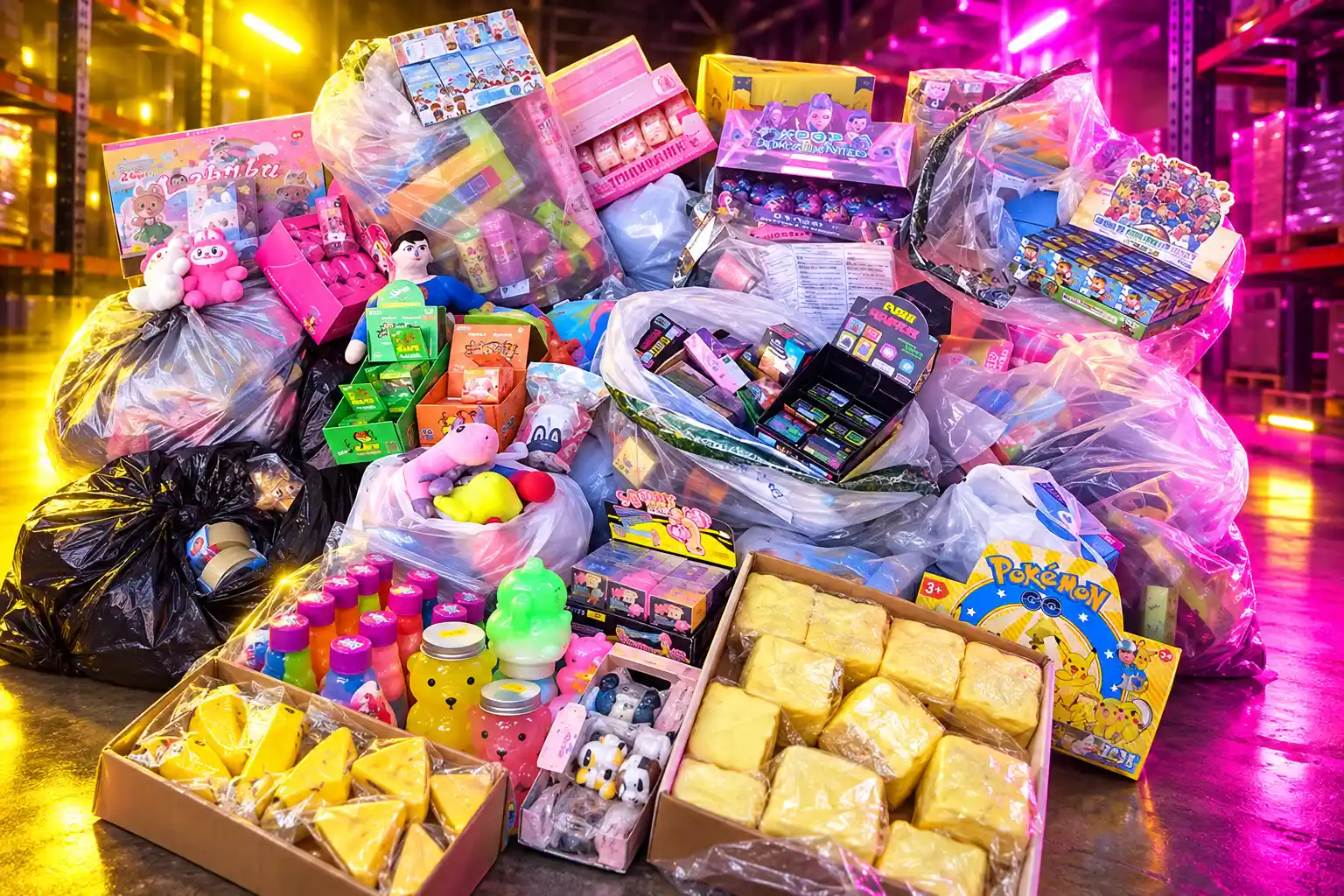
Glasgow Already Pulled 5,900 Fakes From One Warehouse
The west of Scotland numbers did not arrive in a vacuum. On 4 June 2026, Glasgow City Council trading standards officers took over 5,900 counterfeit toys from a Glasgow warehouse on Commerce Street. The haul was illicit squishy toys, the soft dumpling-style items that spread on TikTok, packed in dim sum boxes so the buyer only sees the shape after opening.
The council applied an Office for Product Safety and Standards estimate of £71 of harm per toy, covering injury risk, damaged goods, lost sales and the time spent replacing a dud, and put the saving at about £419,000. Councillor Laura Doherty, convener for neighbourhood services and assets, said the items posed serious dangers and that officers would keep visiting warehouses, with the focus on lower-cost retail and non-traditional supply chains.
That warehouse sits in the same west of Scotland map as the 165 later inspections. A single store-room can restock a lot of small shops. Aberdeen City Council, further north, seized 1,076 similar products in July after parents complained about chemical smells and toys that burst or leaked, including one that held a false fingernail. Trading Standards Scotland was still warning on 2 October 2026 that counterfeit squishies were being taken off sale, citing skin irritation, nausea and breathing problems.
Small Parts and Chemicals Hit Children Under Three
North Lanarkshire said easily detached small parts were among the worst hazards. Children under three put toys in their mouths, and a loose eye, bead or limb can choke, suffocate or injure them internally if swallowed. That is the failure parents can see.
The chemical fails are quieter. The types of chemicals used in toys are limited because some are linked to long-term harm, including effects on fertility and a higher risk of cancer. Officers said a number of the inspected toys failed those safety tests. The council did not publish which substances, or how many toys failed on chemistry rather than on a missing label.
UK product-safety records show why both problems sit near the top of the national pile. In the year from 1 April 2025 to 31 March 2026, the Office for Product Safety and Standards logged 2,396 notifications covering 3,368 products, and toys were the second most notified category at 732 products (22%), behind cosmetics. Among notices given a harm type, chemical harm appeared 145 times and choking 142 times, with asphyxiation on 71.
WHAT THE LAW DEMANDS ON A NEW TOY
- The age range: The rules cover toys designed or intended for play by children under 14.
- The safety mark: A CE mark, a UKCA mark, or both must appear on the toy or its packaging.
- The UK address: A manufacturer or importer name and a UK address must be on the toy, the pack, or an accompanying document.
- The paper trail: Traceability details have to let officers follow the toy back through the supply chain.
- The warnings: Hazard information must be in English, easy to read, and preceded by the word Warning or Warnings.
Many of the west of Scotland toys did not carry that information. Without a UK name and address, a later recall has no one obvious to chase, and a parent has no pack to match against an alert.
Online Marketplaces Showed the Same Failure Rate First
High-street failure on this scale tracks a channel the toy trade has been testing for years. The British Toy and Hobby Association has bought third-party marketplace toys since 2018. It puts at least 15% of UK toy purchases with those sellers, and says platforms still do not carry the same legal duty as a shop for what a third-party seller lists.
In its October 2025 laboratory round, the association bought 70 toys from seven sites, tested the 68 that arrived, and found nine in ten marketplace toys failed UK rules: 55 were unsafe (81%) and six more failed on labelling only, so 61 of 68 failed in total and seven passed. Wish recorded a 100% unsafe rate on the toys tested. Shein and TikTok Shop were at 90% unsafe. Temu was the least bad in that round, at 63% unsafe.
BTHA MARKETPLACE TESTS, OCTOBER 2025
| Platform | Tested | Unsafe share | Total fail share |
|---|---|---|---|
| AliExpress | 10 | 70% | 100% |
| Amazon | 10 | 70% | 80% |
| eBay | 10 | 80% | 90% |
| Shein | 10 | 90% | 100% |
| Temu | 8 | 63% | 63% |
| TikTok Shop | 10 | 90% | 90% |
| Wish | 10 | 100% | 100% |
| All seven | 68 | 81% | 90% |
A mark on the pack was not a clean bill of health. Of the unsafe toys, 67% still showed a CE or UKCA mark and failed anyway. Across the whole sample, 63% were missing a Great Britain address. Kerri Atherton, the association’s head of public affairs, said it was concerning to still see high levels of unsafe toys on sale after years of reporting the failures, while marketplaces said they were acting on the findings.
A follow-up the association published in June 2026 again put the fail rate at 90% on toys bought from third-party sellers on the same seven platforms, with 86% classed as unsafe. Roland Earl, director general, called that share an unacceptable danger to consumers and the biggest threat to firms that already comply. The association argues the Product Regulation and Metrology Act 2025 gives ministers powers to put legal duties on the platforms; those duties are not what west of Scotland shop staff were enforcing in the 165 visits.
Border work is already eating a large share of national enforcement. In 2025 to 2026 the most common corrective action on the product safety database was an import rejected at the border, logged 1,102 times. Destruction of the product was next at 611, then removal of an online listing at 594. The west of Scotland project is what happens when the same goods have already left the port and reached a warehouse or a shop.
What Parents Should Check Before They Buy
The Toys (Safety) Regulations 2011 still set the floor for anything sold as a toy in Great Britain. A CE mark remains a valid route, and a UKCA mark is the other. The presence of either mark is the start of a check, not the end of one, because laboratory work has already found unsafe toys wearing the stamp.
CHECKS THAT STILL CATCH A BAD TOY
- The UK name: Look for a manufacturer or importer name and a UK address you could actually write to.
- The age line: If the pack says 3+ but the photo shows a baby, treat that as a warning the seller is aiming at the wrong child.
- The small parts: Tug eyes, buttons, beads and battery covers; anything that comes away fails the under-three test in real life.
- The smell and split: A strong chemical odour, or a squishy that leaks gel, is the same pattern officers have been seizing all year.
- The price gap: A branded toy at a fraction of the official price is the usual flag for a fake that has not been tested.
Anyone in Scotland who has already bought a toy they now distrust can call Advice Direct Scotland on 0808 164 6000. That service passes reports to local Trading Standards. It is the same number North Lanarkshire has given after earlier fake-doll complaints, including counterfeit Labubu figures that came apart in 2025.
North and East Results Are Still to Come
The west of Scotland group is one of three. North Lanarkshire said further toy safety work is continuing across Scotland, with extra results expected later in the year from the North and East Safety Working Groups. Until those figures are out, 18,075 is a regional sample, not a Scotland total, and shops in the unreported areas are still trading through the autumn.
The calendar around the west sweep already looks like a running job, not a one-week raid.
SCOTLAND TOY SEIZURES, 2025 TO 2026
- 3 July 2025: North Lanarkshire Trading Standards warns that counterfeit Labubu dolls sold locally and online are coming apart and creating a choking hazard.
- 4 June 2026: Glasgow officers recover over 5,900 counterfeit squishy toys from a Commerce Street warehouse and put the avoided harm at about £419,000.
- July 2026: Aberdeen City Council seizes 1,076 products after complaints about chemical smells and toys that burst or leak.
- 2 October 2026: Trading Standards Scotland says hundreds of dangerous counterfeit squishy toys are still being seized and can irritate skin, cause nausea or affect breathing.
- 8 October 2026: The west of Scotland group reports 18,075 non-compliant or unsafe toys from 32,316 inspected, with more than 16,000 taken off sale.
Gift buying for 25 December 2026 does not wait for the North and East spreadsheets. Unmarked stock that survived the west inspections, or that sits in shops those teams have not yet reached, will be in living rooms unless parents and remaining officers catch it first.
Frequently Asked Questions
What Safety Marks Must a New Toy Sold in the UK Carry?
A new toy placed on the Great Britain market must show a CE mark, a UKCA mark, or both, on the toy or its packaging, plus a UK manufacturer or importer name and address and traceability details. Recognition of CE marking for these goods was extended indefinitely from 1 October 2024, so a CE stamp is still a lawful route, and a UKCA mark may appear on an affixed label or accompanying document under a labelling easement that runs until 31 December 2027.
How Do I Report an Unsafe Toy in Scotland?
Call Advice Direct Scotland’s consumer helpline on 0808 164 6000 or use consumeradvice.scot; the service takes the report and passes it to the local Trading Standards team, which decides whether to inspect or seize. The helpline can also advise on your rights as a buyer, but a refund still runs through the seller, not through the officers who test the toy.
What Is the Difference Between a Non-Compliant Toy and an Unsafe Toy?
The Office for Product Safety and Standards treats an unsafe product as one that poses a risk to health or safety, and a non-compliant product as one that does not meet the relevant product-safety law, and the same toy can be both. A missing UK address or a fake mark is a compliance fail even before a lab finds a choking part or a banned chemical, which is why the west of Scotland total mixed the two.
Do CE Marks Still Count on Toys in Great Britain?
Yes. Current government guidance is that certain goods meeting EU requirements, including CE-marked toys, can still be placed on the Great Britain market, while UKCA remains a separate valid route. A mark is not proof the toy passed a recent independent test, which is why 67% of the unsafe marketplace toys in the 2025 British Toy and Hobby Association round still carried CE or UKCA and failed in the lab.
The west of Scotland count is now on the record, with more than 16,000 toys already off the shelves. The North and East totals are not, and 25 December is the date those uncounted aisles are stocking for.

Edinburgh Opens a 2027 Tour Built for Time Trials

Korda Maps Auður From Meðalland to Irvine Bay

Apple Music Films Its New Logo in Mineral Oil

Oppo Prices the Pad Mini Above India’s iPad Mini

Austen Soaks Scotland Before Boelo Brings Weekend Gales

Volkswagen Sells the Osnabruck Plant to Clear a Board Fight

Apple’s Foldable iPhone Hinges on Samsung Display Supply

Tata Motors’ Iveco Tender Opens as Holders Still Decide

Saksham Gaur Finds He Is His Own Company’s Client

Onimusha Way of the Sword Preload Hits a Windows 11 Wall
-
 AUTO2 months ago
Volkswagen Sells the Osnabruck Plant to Clear a Board Fight
-
 NEWS2 months ago
Apple’s Foldable iPhone Hinges on Samsung Display Supply
-
 AUTO2 months ago
Tata Motors’ Iveco Tender Opens as Holders Still Decide
-
 BUSINESS2 months ago
Saksham Gaur Finds He Is His Own Company’s Client
-
 GAMING2 months ago
Onimusha Way of the Sword Preload Hits a Windows 11 Wall
-

 BUSINESS2 months ago
Hyderabad 22-Carat Gold Jumps After a False Bargain
-

 ENTERTAINMENT3 years ago
What is SD on Amazon Prime? – All You Need to Know
-

 NEWS2 months ago
iQOO 16 Locks 8,400 mAh While 100W Charging Holds