
NEWS
The Falkirk Wheel Remade a Town After the Locks
Scotland’s only rotating boat lift still turns on 1.5 kWh, but Falkirk’s payoff is a visitor economy while the canal flight stays dry until 2027.

The Falkirk Wheel still turns on 1.5 kWh a rotation, 24 years after Queen Elizabeth II opened the 1,800-tonne lift. On 26 and 27 September 2026 it was lit for Illumin8, a lasers and sound weekend marking 25 years of the Millennium Link. Through-boats on the Forth and Clyde Flight will not be back until 23 April 2027.
The viral clip is always the same half-turn. The quieter result sits around it: a Central Belt town that now sells overnight stays beside a machine built to replace a lock flight torn out in 1933.
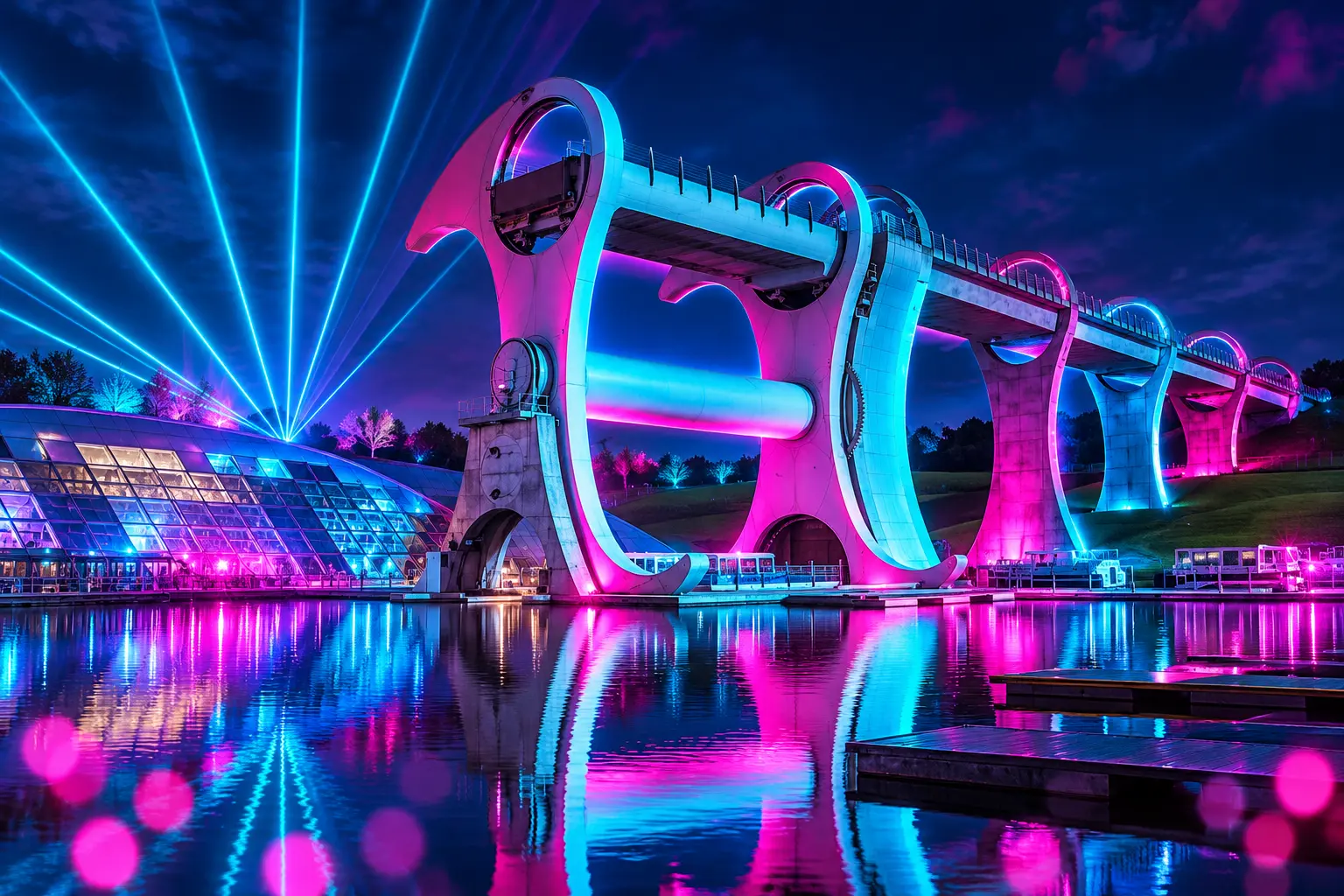
The Wheel Became a Light Show for the Link’s 25th Year
Scottish Canals still bills the Wheel as the world’s only rotating boat lift, a flagship at Tamfourhill on Lime Road. The visitor centre opens from 9:45am to 5:30pm, seven days a week. An adult boat trip is £17.95, a concession £16.50, a child aged 5 to 15 £9.80. Under-fives travel free, though they still need a ticket.
That offer did not pause for a dry flight down toward Grangemouth. Local photographers spent the last weekend of September shooting the arms under colour, not cargo. Online, the same rotation has looped for years as a mute wonder clip. On the ground it is now a night-time set for an anniversary the canals themselves cannot fully keep.
The Millennium Link reopened the Lowland waterways at the turn of the century. The Wheel, opened on 24 May 2002 as part of the Golden Jubilee, was the visible joint. The ceremony had been put back a month after vandals forced the gates and flooded the pit. The Queen still cut the project in.
A 24-Metre Lift Still Leaves Two Locks
Most retellings say the structure replaces 11 locks and a 100-foot drop in a few minutes. The Institution of Civil Engineers splits that line. The wheel’s two gondolas raise boats by 24 metres. The Union Canal still sits 11 metres above the aqueduct at the top, so crews then work two locks to reach it. Twenty-four plus 11 is the 35-metre gap the old staircase covered.
Scottish Canals still describes the link as 35 metres, and the lost flight as more than 100 feet. Both phrases describe the full drop, not the moving steel. The wheel itself is 35 metres tall, about eight double-decker buses. The water step it actually turns through is the 24-metre bite.
OLD FLIGHT, WHEEL, AND THE TWO LOCKS LEFT
| Stage | Height covered | Time on the water |
|---|---|---|
| Eleven-lock flight, infilled 1933 | 35-metre canal drop | Nearly a day, 44 gates |
| Wheel half-turn | 24 metres | Five minutes |
| Forth and Clyde basin to the aqueduct | 24 metres | About 10 minutes |
| Two locks above the aqueduct | 11 metres | Still required |
Those two locks stayed because taking them out with the rest would have blown the budget, Scottish Canals has said. The 11-lock staircase at Camelon, which met Lock 16 on the Forth and Clyde, was dismantled in 1933. Both canals were later closed to navigation in the 1960s. The Union Canal’s formal closure came in 1965.
How the Gondolas Stay Level on 1.5 kWh
Each cradle is a 25-metre trough. Tony Gee, the steel designer retained by Butterley Engineering, specified a pair of 300 cubic metre water filled gondolas on clawed arms turning on a 3.5-metre axle. A boat that noses in displaces its own weight in water, so a full gondola with four narrowboats weighs the same as a full gondola with none. Archimedes does the matching. The motors only have to overcome friction, wind and the small errors in level.
Scottish Canals puts the moving mass at 1,800 tonnes and the draw at just 1.5kWh for each rotation, the usual comparison being eight household kettles. The ICE notes a lift from the lower canal to the aqueduct takes about 10 minutes. The operator’s own line is a five-minute half-turn. Neither is the old day of 44 gates.
WHAT KEEPS 1,800 TONNES IN BALANCE
- Matched troughs: Opposite gondolas stay full, so the wheel is a balanced couple, not a crane lifting a live load from rest.
- Displacement: A boat’s weight is cancelled by the water it pushes out, which is why the count of vessels does not unbalance the turn.
- Bolted joints: Arms reverse up to 40 times a day, so the steel is bolted, not welded, to live with fatigue rather than crack at a bead.
- Wind limit: The design was tunnel-tested for a 120-year Scottish storm and to keep turning in Beaufort 6.
In May 2024, solar panels on the site supplied 9 per cent of the energy used there, 3,743 kWh for that month. The attraction holds a Gold Green Tourism award. The 1.5 kWh figure is the rotation, not the cafe, the pumps or the visitor centre heat.
Tony Kettle Borrowed His Daughter’s Lego
British Waterways first priced a Ferris-style wheel with hanging cars. Architect Tony Kettle, then at RMJM, later called that option unattractive. A 20-strong team rebuilt the idea in three weeks in the summer of 1999. Kettle proved the gears that keep the troughs level with his eight-year-old daughter’s Lego, including a helicopter kit, before the funders would buy a shape nobody had built.
I was making a Lego helicopter for my daughter and realised the gearing could be used to maintain the horizontality of the caissons containing the water and boats.
Tony Kettle, architect, recalling the Falkirk Wheel design
He has also said the simplest tools still work, and that his daughter is still waiting to get the bricks back. Butterley assembled the wheel at Ripley in Derbyshire, broke it down, and sent it north in 35 lorry loads. Crews put it together on the ground in five sections and craned it up. About 1,000 people worked on the job. The ICE says 1,200 tonnes of steel went in, with more than 15,000 bolts matched to 45,000 holes, each bolt tightened by hand. The design life is 120 years.
The ground had been a mine and tar works, contaminated with tar and mercury. Engineers drove 22-metre concrete piles to bedrock. Former ICE president George Fleming called the finished lift a triumph for civil, structural and mechanical engineering. Tony Gee’s sheet also lists the ICE Brunel Medal in 2002 and FIDIC’s Major Civil Engineering Project of the Last 100 Years in 2013. The UK’s other working boat lift is the Anderton lift in Cheshire, built in 1875, shut in 1983 and restored in 2002. It does not rotate.
What the Millennium Link Cost to Build
The ICE prices the Wheel at £17m, about £32m in today’s money, inside a Millennium Link bill of £85.4m. Construction ran three years. The Link was never only a sculpture on a basin. It had to reopen two canals that railways, then roads, had already beaten, then join them again where the staircase had been filled.
FROM COAL BARGES TO A DRY FLIGHT
- 1790: The Forth and Clyde Canal opens as a coast-to-coast cut across the Central Belt.
- 1822: The Union Canal opens from Edinburgh, meeting the older canal at Falkirk down a flight of 11 locks.
- 1933: The connecting locks are infilled as through-traffic dies.
- 1960s: Both canals close to navigation; the Union Canal’s formal end is 1965.
- 24 May 2002: Queen Elizabeth II opens the Falkirk Wheel on a former tar-works site.
- February 2025: Scottish Canals dewaters four kilometres of the Forth and Clyde between locks 3 and 16 for gate replacement.
- 26-27 September 2026: Illumin8 lights the Wheel for 25 years of the Millennium Link.
- 23 April 2027: The operator’s date for putting navigation back on that flight.
The Forth and Clyde had carried more than 3 million tonnes of goods in 1868, and still about 1 million tonnes in 1906, before the First World War and the railways finished the job. Rebuilding 11 locks in the 1990s would have restored a chore. The Wheel was the bet that a landmark would bring people as well as boats. That is the part that stuck.
Half a Million People Come to Watch It Work
Scottish Canals puts annual visits at around 500,000. It also puts through-traffic at more than 3,500 boats a year, a working canal in the shadow of a crowd. Behind-the-Wheel engineering tours were added in 2024. The trip boats Archimedes and Antonine still do the hour-long circuit for people who will never hold a windlass.
Falkirk Council’s STEAM figures for 2024 show 965,000 visits to the area in 2024, up 11.6 per cent on 2023 and back to pre-pandemic levels. Overnight stays rose 14 per cent, day trips 8 per cent, and hotels and other catered beds 23 per cent. Spend reached nearly £157m, up £7.2m on 2023, supporting an estimated 4,500 jobs, about 6 per cent of local employment.
FALKIRK’S 2024 VISITOR COUNT
- The Wheel: Around 500,000 visits a year, per Scottish Canals.
- The council area: 965,000 STEAM visits in 2024, overnight and day combined.
- Helix Park: More than one million visits in 2024, a footfall count that mixes locals and guests.
- The Kelpies: Marked a 10th anniversary in 2024; the horse-head sculptures stand 30 metres high.
Those are three different rulers, not a sum. The pattern is still plain. The Helix and the Kelpies, down the canal toward Grangemouth, arrived after the Wheel had already taught the district that a piece of kit could be a reason to get off the M9. Council leader Cecil Meiklejohn tied the 2024 rebound to jobs in beds and meals, not to barge-miles.
Tourism across our area is rising strongly, with nearly one million visits in 2024. That is a clear sign that Falkirk is firmly back on the map. Visitors are supporting jobs, sustaining hospitality and accommodation providers and making a growing contribution to the wider economy.
Cecil Meiklejohn, Leader of Falkirk Council, 12 September 2025
A 2021 growth-deal paper put the same pairing in writing: the success of the Falkirk Wheel and the Kelpies had already made the district a culture and tourism stop, which is why partners then wanted a national outdoor art park along the canal. The second-order effect is that chain. The first-order effect is still a boat in a trough.
Navigation Stays Closed Until April 2027
Scottish Canals and contractor Mackenzie Construction have been replacing gates on the Falkirk Flight, locks 3 at Grangemouth to 16 at Camelon, the biggest job on the network in 25 years. A four-kilometre stretch has been dewatered since February 2025. Ten lock-gate sets were in the original scope, plus a bypass at Lock 16. Inspections of masonry and gear that usually sit underwater added more work.
The first public date was early 2026, then August 2026. In a later update the operator moved completion to 23 April 2027, the start of that boating season, rather than refill and drain again. Until then, navigation remains suspended until 23 April 2027 on that flight. The Kelpies and the Wheel, sold as one canal story, do not currently share a through-route for a cruiser.
The Wheel’s own basin still takes paying trips. That split is the 24-year record in a single week: a light show for a restored network, and a drained flight the restoration has to rebuild again. Private boats will return in April 2027 if the new date holds. The 500,000 people who come to watch the arms move were never waiting on that water.

Edinburgh Opens a 2027 Tour Built for Time Trials

Korda Maps Auður From Meðalland to Irvine Bay

Apple Music Films Its New Logo in Mineral Oil

Oppo Prices the Pad Mini Above India’s iPad Mini

Austen Soaks Scotland Before Boelo Brings Weekend Gales

Volkswagen Sells the Osnabruck Plant to Clear a Board Fight

Apple’s Foldable iPhone Hinges on Samsung Display Supply

Tata Motors’ Iveco Tender Opens as Holders Still Decide

Saksham Gaur Finds He Is His Own Company’s Client

Onimusha Way of the Sword Preload Hits a Windows 11 Wall
-
 AUTO2 months ago
Volkswagen Sells the Osnabruck Plant to Clear a Board Fight
-
 NEWS2 months ago
Apple’s Foldable iPhone Hinges on Samsung Display Supply
-
 AUTO2 months ago
Tata Motors’ Iveco Tender Opens as Holders Still Decide
-
 BUSINESS2 months ago
Saksham Gaur Finds He Is His Own Company’s Client
-
 GAMING2 months ago
Onimusha Way of the Sword Preload Hits a Windows 11 Wall
-

 BUSINESS2 months ago
Hyderabad 22-Carat Gold Jumps After a False Bargain
-

 ENTERTAINMENT3 years ago
What is SD on Amazon Prime? – All You Need to Know
-

 NEWS2 months ago
iQOO 16 Locks 8,400 mAh While 100W Charging Holds