
NEWS
JWST Finds Infant Galaxies Already Dumping Their Heavy Elements
Three JWST galaxies at redshifts 7.3 to 9.3 already fling carbon, oxygen and silicon outward, tightening the hunt for the first metal-free stars.

Three galaxies at redshifts 7.3 to 9.3 already show carbon, oxygen and silicon in gas that is moving toward Earth. A University of Arizona team read those metals in the galaxies’ own ultraviolet light with NASA’s James Webb Space Telescope, in a paper published on 24 September 2026 in Nature Astronomy.
The same spectra shrink the stretch of time when the first, chemically clean stars could still have been forming in those neighborhoods.
Three Galaxies Already Show Metal-Rich Gas Racing Outward
Yongda Zhu and Zhiyuan Ji, both at Steward Observatory, led the analysis with George D. Becker at the University of California, Riverside, and a larger Arizona group that includes Xiaohui Fan, Eiichi Egami, George H. Rieke and Marcia J. Rieke. They report blueshifted metal absorption in three galaxies from the Cycle 4 program SPURS, at systemic redshifts of 9.3105, 7.8783 and 7.2883.
The paper places those redshifts before the midpoint of cosmic reionization, which it puts at z about 7 to 8, or about 0.65 to 0.75 billion years after the Big Bang, and well before reionization finished near z of 5.3. The galaxies were picked because their rest-frame ultraviolet continua near 1,450 angstroms reached a signal-to-noise ratio above 10 and because their ultraviolet brightness met M_UV brighter than -20.9. No one selected them for known metal lines.
Stellar masses from Hubble and JWST photometry sit at log(M_star/M_sun) of 9.80, 9.11 and 9.48, about 6.3 billion, 1.3 billion and 3.0 billion solar masses. Their ultraviolet slopes are blue, at -2.19, -2.12 and -2.26. Rest-frame optical line ratios of [O III] 5008 to H-beta are 8.0 plus or minus 1.7, 8.1 plus or minus 0.3 and 6.7 plus or minus 0.2.
THE THREE SPURS GALAXIES
| Galaxy | Redshift | log stellar mass | Ions detected | Example centroid (km per second) |
|---|---|---|---|---|
| A | 9.3105 | 9.80 | O I, Si II, C II, Si IV, C IV | C IV at -176 |
| B | 7.8783 | 9.11 | O I, Si II, C II, Si IV | Si IV at -261 |
| C | 7.2883 | 9.48 | O I, Si II, C II, C IV | C IV at -236 |
The paper’s stated velocity range across the sample is 50 to 250 km per second relative to nebular redshifts. Individual fitted centroids can sit slightly outside that band, as with Si IV in Galaxy B. Neutral, low-ionization and high-ionization lines share overlapping velocity structure and a common bulk shift toward shorter wavelengths, which the authors read as gas tied to each host, not as Hubble flow.
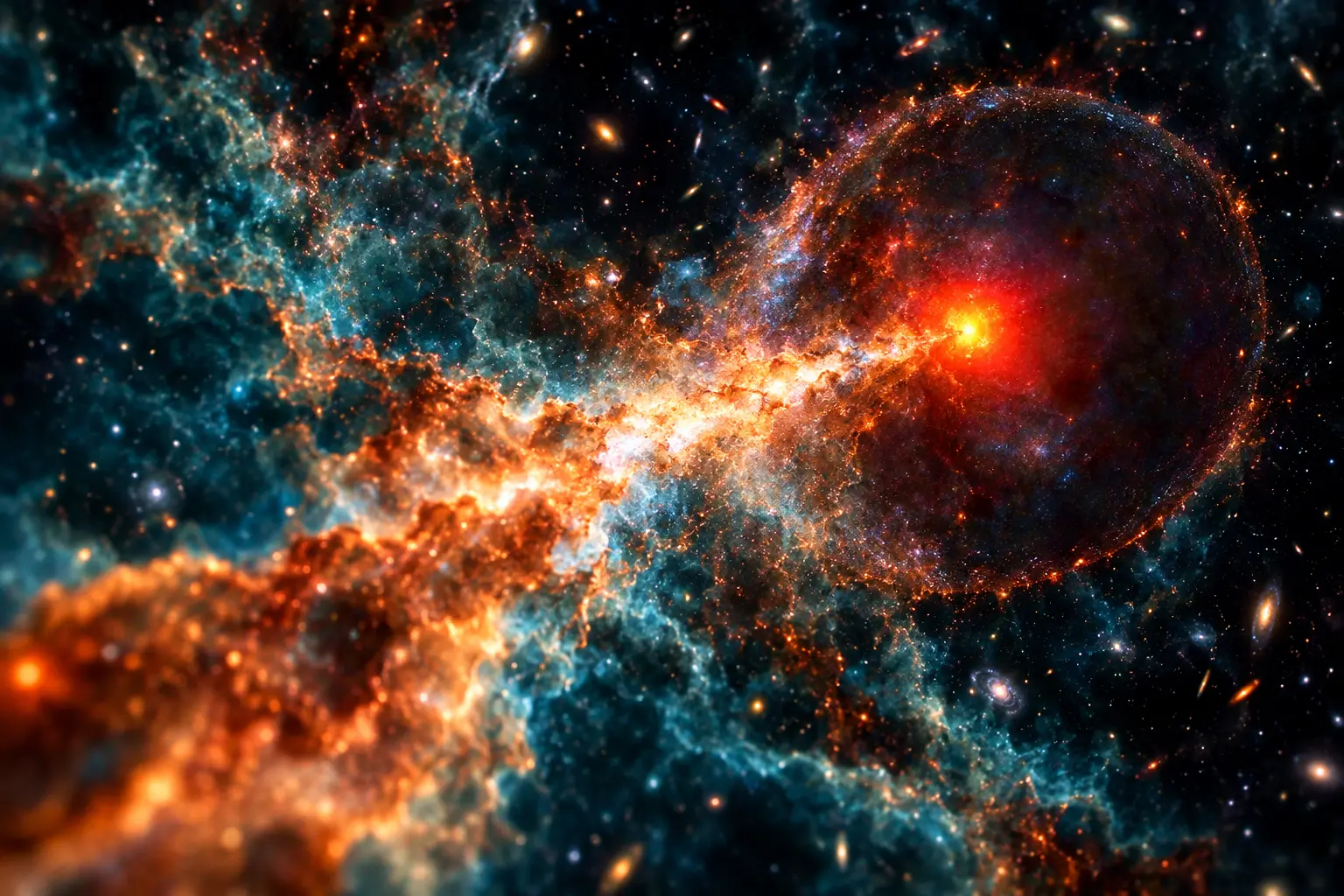
Galaxies as Lamps for Their Own Surrounding Gas
Earlier work on metals beyond galaxies during reionization mostly used quasar sightlines at z of 6.5 and below. Those paths cut through random intergalactic gas and only loosely connect to any one galaxy. Emission lines and broadband colors, by contrast, mostly trace stars and ionized gas inside a galaxy. Medium-resolution NIRSpec spectra, at resolving power of about 1,000, now let the stellar continuum of a z greater than 7 galaxy serve as its own backlight.
Zhu put it in plainer terms. The team used the galaxies themselves as background lamps. As the light traveled toward Earth, it passed through surrounding gas, and absorption at specific wavelengths named the elements in that gas. Arizona said the detections needed nearly 30 hours of exposure, matching the 30-hour G140M depths in the SPURS design. Zhu spent one long night combing public spectra from hundreds of galaxies and kept the three systems whose absorption showed carbon, oxygen and silicon.
A blueshift means the absorbing gas is moving toward the observer relative to the stars. Velocity alone does not pin down whether that gas is a compact wind or a larger halo. The paper is clear on that limit. What the overlapping ions do show is that the material is chemically enriched and kinematically tied to each galaxy.
The Chemical Pattern Already Looks Familiar
Galaxy A, the farthest of the three, shows the full set of tracers. Neutral oxygen, low-ionization silicon and carbon, and high-ionization silicon and carbon all appear in the same velocity frame. Galaxies B and C repeat the neutral and low-ionization suite. B adds Si IV. C adds C IV.
WHAT THE IONS TRACE
- O I 1302: Neutral gas, the coolest phase in the set.
- Si II 1260 and C II 1334: Low-ionization material, the workhorse cool-gas lines.
- Si IV 1393, 1402: Higher-ionization gas, detected in Galaxies A and B.
- C IV 1548, 1550: Still higher ionization, detected in Galaxies A and C.
- Shared blueshift: The lines occupy overlapping velocity windows, which the paper treats as one disturbed, metal-bearing complex.
Equivalent-width ratios among those ions sit near the level of a stacked spectrum of star-forming galaxies at z about 3, a much later epoch. The authors use that stack only as a reference, and they note that individual lower-redshift galaxies scatter by about a factor of two. Still, the infant systems do not look chemically primitive in these ultraviolet lines. Strong carbon and oxygen emission has already been seen inside galaxies at z greater than 14. This paper’s contribution is the gas around the galaxies, in more than one ionization state, already on the move.
We observed that heavy elements escaped from galaxies very, very early in cosmic time.
Yongda Zhu, postdoctoral researcher, University of Arizona
Zhu added that the galaxies were not only making the elements but dispersing them, possibly seeding other systems. He compared the spread to food dye in a cup of water. The color does not stay where it is dropped.
Where Does That Leave Population III Stars?
Population III stars are the hypothesized first generation, formed from hydrogen and helium left by the Big Bang, with no carbon, oxygen or silicon in the fuel. They should have been massive, short-lived and quick to pollute their birth clouds once they exploded. JWST was sold in part as the machine that might finally catch that phase, either as a living cluster or as a still-pristine gas reservoir.
These three luminous galaxies work against that hope in their own surroundings. If stars had already forged metals and pushed them out by the time the universe reached these redshifts, the clean gas those first stars required would have been disappearing around at least this class of system. Arizona used that point to explain why the first stars have been so hard to find.
If you start out with pure vanilla ice cream but start mixing in sprinkles soon after, it won’t be long until you can no longer find any pristine, plain, vanilla ice cream.
Yongda Zhu, postdoctoral researcher, University of Arizona
That is an argument about neighborhoods like these three, not a proof that every pocket of the early universe was salted. Other groups still look for metal-poor overdensities, lensed clumps and late-forming minihalos, and they argue that mixing can be patchy. The SPURS result does not close those searches. It does say that around ultraviolet-bright galaxies at z of 7.3 to 9.3, the baryon cycle had already started, and the clean-fuel window was already closing.
A Cut That Favors the Ultraviolet-Bright Few
The louder limit is the sample, not the chemistry. Continuum absorption at z greater than 7 needs a bright ultraviolet backlight. Only three SPURS targets currently meet that cut. They are not dwarfs. Their stellar masses sit above a billion suns, and their ultraviolet light is at the bright end of the early galaxy population. The paper’s own wording is careful: key conditions for baryon cycling were in place in at least a subset of luminous galaxies in the first several hundred million years.
WHAT WE KNOW
- The detections: Neutral, low-ionization and high-ionization metal lines appear in all three continuum-bright SPURS galaxies that pass the signal cut.
- The motion: The absorbing gas is blueshifted relative to nebular lines, with a sample range of 50 to 250 km per second and overlapping ion kinematics.
- The selection: Targets were chosen for continuum quality, not for a known metal feature or a known metallicity.
WHAT IS UNCONFIRMED
- The geometry: The data do not uniquely separate a compact outflow from metal-rich gas spread through a larger halo.
- The census: There is no measurement yet of how common this signature is in fainter galaxies that cannot backlight their own absorption.
- The first stars: The spectra do not directly detect Population III stars; they only show that metals were already outside these hosts.
So the finding is sharp for what it is, and narrow for what it is not. Anyone treating three bright systems as a map of the whole reionization-era sky is reading past the paper. Anyone treating the surrounding gas as still pristine at these redshifts is ignoring the lines that are actually there.
160 Hours of Spectra With Immediate Public Access
SPURS is the SPectroscopic Ultra-deep Reionization-era Survey, JWST Cycle 4 program 9214. Charlotte Mason of the Niels Bohr Institute and Daniel P. Stark of the University of California, Berkeley, are the principal investigators. The accepted program asked for 160 hours of NIRSpec spectroscopy of more than 150 galaxies from z about 5 to 14, in four legacy fields, at resolving power of about 1,000, with 30-hour depths in G140M. The team set a zero exclusive-access period, so the spectra went public as they were taken.
FROM PROGRAM TO PAPER
- Cycle 4, program 9214: SPURS is approved as a large NIRSpec campaign on reionization-era galaxies, with Mason and Stark as principal investigators.
- 4 March 2026: Nature Astronomy receives the Zhu, Ji, Becker and collaborators manuscript.
- 23 April 2026: The first preprint is posted, later revised on 22 June 2026.
- 28 August 2026: The journal accepts the paper.
- 24 September 2026: The version of record appears, with the underlying frames already in the archive.
The observational data sit as public JWST spectra on MAST, the Mikulski Archive for Space Telescopes. Complementary papers on the same hosts treat their stars, nebular emission and feedback. The absorption work is the piece that reaches beyond the galaxies, into the gas they are already sharing with their surroundings.
Zhu’s night of sorting continua did not invent the metals. It found them in spectra the community could already download. The three systems were bright enough to use as lamps, and the lamps showed carbon, oxygen and silicon on the way out. For anyone still hoping those neighborhoods were vanilla, the sprinkles were already in the bowl.

Edinburgh Opens a 2027 Tour Built for Time Trials

Korda Maps Auður From Meðalland to Irvine Bay

Apple Music Films Its New Logo in Mineral Oil

Oppo Prices the Pad Mini Above India’s iPad Mini

Austen Soaks Scotland Before Boelo Brings Weekend Gales

Volkswagen Sells the Osnabruck Plant to Clear a Board Fight

Apple’s Foldable iPhone Hinges on Samsung Display Supply

Tata Motors’ Iveco Tender Opens as Holders Still Decide

Saksham Gaur Finds He Is His Own Company’s Client

Onimusha Way of the Sword Preload Hits a Windows 11 Wall
-
 AUTO2 months ago
Volkswagen Sells the Osnabruck Plant to Clear a Board Fight
-
 NEWS2 months ago
Apple’s Foldable iPhone Hinges on Samsung Display Supply
-
 AUTO2 months ago
Tata Motors’ Iveco Tender Opens as Holders Still Decide
-
 BUSINESS2 months ago
Saksham Gaur Finds He Is His Own Company’s Client
-
 GAMING2 months ago
Onimusha Way of the Sword Preload Hits a Windows 11 Wall
-

 BUSINESS2 months ago
Hyderabad 22-Carat Gold Jumps After a False Bargain
-

 ENTERTAINMENT3 years ago
What is SD on Amazon Prime? – All You Need to Know
-

 NEWS2 months ago
iQOO 16 Locks 8,400 mAh While 100W Charging Holds