
GAMING
NYT Strands 953 Answers Bind Speech Under Turn of Phrase
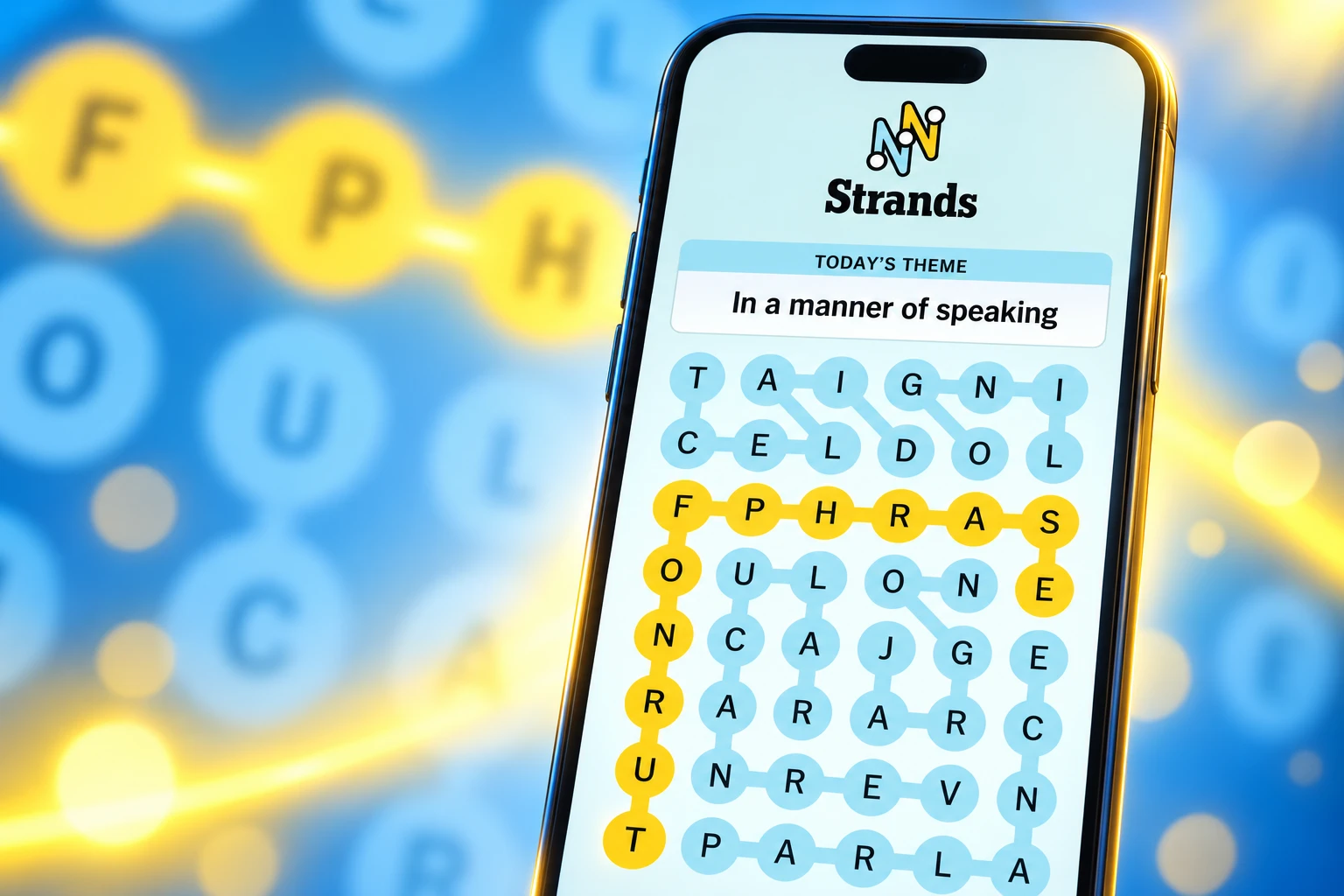
Strands 953 answers are LINGO, JARGON, DIALECT, PARLANCE, and VERNACULAR. The spangram TURNOFPHRASE is the category title that binds those five labels.

Monday’s NYT Strands puzzle, No. 953, hides LINGO, JARGON, DIALECT, PARLANCE, and VERNACULAR behind the spangram TURNOFPHRASE.
The Oct. 12 theme is “In a manner of speaking,” with a second nudge that reads “Time to talk.” The yellow word is the category title on a 48-letter board, and the five blue answers are the members of that set.
The Theme Words in Strands 953
Strands is a 6-by-8 word search in which every letter is used once. Theme words light up blue. The spangram lights up yellow and must touch two opposite sides of the grid. On this board the blue list is short, and every entry is a name English already uses for a way of talking.
THE FIVE BLUE ANSWERS
| Word | Letters | Job in English |
|---|---|---|
| LINGO | 5 | Casual label for a group’s speech |
| JARGON | 6 | Technical terms of a field |
| DIALECT | 7 | Regional or community variety |
| PARLANCE | 8 | A group’s manner of speaking |
| VERNACULAR | 10 | Everyday native speech |
Add the 12-letter spangram and the letter count is 5 + 6 + 7 + 8 + 10 + 12, which is 48, the full grid. There is no leftover tile and no seventh theme word.
English Splits These Five Words on Purpose
A thesaurus will happily cross-list them. A dictionary will not. Merriam-Webster treats jargon as the technical terminology of a special group, the sports-page sense and the academic-essay insult sitting in the same entry. Lingo is broader and ruder, covering strange speech, a foreign language, or the special vocabulary of a field, with a first known use in 1659.
Parlance is a manner or mode of speech, the “in computer parlance” construction, from Anglo-French speech and debate. Dialect, in the linguistic use, is a variety of a language tied to a place, a community, or a group, often with small shifts in words and sound. Vernacular is the home-born everyday tongue of ordinary people in a region, set against a standard, a liturgy, or a lab voice.
Those jobs overlap, and they are still not one job. Jargon shuts outsiders out on purpose. Vernacular is the speech those outsiders already have. Dialect can be mapped on a coast. Lingo is the shrug you give when you cannot be bothered to name the system. Parlance is the house style of a trade. The Times can drop all five on one board because the yellow word is wide enough to hold them.
Start at the Far-Left T
The spangram is TURNOFPHRASE, closed up the way Strands writes a short phrase that has to live in a letter path. Merriam-Webster defines the open idiom as a way of saying or describing something, which is also a fair description of what a spangram is supposed to do.
The path starts on the T that sits as the last letter in the far-left column, then runs up that edge and bends across the board until it hits the opposite side. That is the whole mechanical demand: two opposite edges, one yellow string, no reused tiles. Once that spine is out of the grid, the five blue words have to occupy the leftover clusters, which is why VERNACULAR and PARLANCE, the two longest blues, are the ones that tend to sit in the corners and along the remaining edges.
Early solvers who grab the yellow path first then sweep those leftover clumps. Hint lights show up when someone is still hunting the long blues after LINGO has already been banked, because a 5-letter casual word is easier to see than a 10-letter one that has been bent around a corner.
Three Filler Words Unlock Each Hint
Non-theme words still count. The Times Help Center says every 3 non-theme words unlock a hint, and the hint paints the letters of one remaining theme word. You can connect letters up, down, sideways, or on the diagonal, and you can change direction in the middle of a word. Double-tap the last letter on mobile to submit.
One published solve used this filler bank, in this order, to open the in-game hints. Any other four-letter-or-longer strings would have done the same work.
FILLER WORDS THAT BANKED FOUR HINTS
- Hint 1: HELP, CARE, NARC.
- Hint 2: CRAVE, RAVE, RUNT.
- Hint 3: TURN, LOIN, COUP.
- Hint 4: SEEN, RARE, LANCE.
Twelve valid extras divide into four hints, which is the full hint ladder for a five-word board if you choose to climb it. TURN is a tease, because it is also the first chunk of the spangram, and a solver who finds TURN in a dead-end cluster can still miss the longer yellow path that starts on that far-left T.
Editors Keep Returning to Words About Words
Strands opened on March 4, 2024, as a free daily on the web, with content edited by Tracy Bennett, who also edits Wordle. Juliette Seive, a research director on the Games team, made the original pitch. Heidi Erwin, a digital puzzle designer, still builds each 6-by-8 on a sticky note, placing the spangram first and fitting the theme words around it. An algorithm then checks that each answer lives in exactly one spot.
Language about language has been in the mix from the first weeks, and it keeps coming back when the editors want a board that rewards people who live in dictionaries.
LANGUAGE BOARDS IN THE BACK CATALOG
- March 11, 2024: Theme “To put it mildly,” spangram EUPHEMISMS, with DARN, FUDGE, GADZOOKS, GOLLY, HECK, JEEPERS, and SHOOT.
- March 20, 2024: Theme “Back and forth,” spangram PALINDROME, with CIVIC, KAYAK, LEVEL, MADAM, NOON, RACECAR, and ROTATOR.
- March 22, 2024: Theme “Animal sounds,” spangram HOMOPHONES, with CHORAL, DEAR, GRISLY, HOARSE, MOUSSE, MUSCLE, and WAIL.
- Oct. 11, 2026: Theme “They don’t make ’em like they used to,” spangram OLDFASHIONED, with ICEBOX, INKWELL, PAGER, TELEGRAM, and TYPEWRITER.
Sunday’s board named objects. Monday’s board named speech. The gadget set is the easier cousin, because an icebox is a thing you can picture; parlance is a manner you have to already know. In a June 26, 2024 company note, the Times said it was seeing 83 percent of players finding the spangram each day, with a completion rate around 81 percent, and ranked Strands third among its games by search, behind Wordle and Connections.
Strands embodies our mission to create thought-provoking human-made puzzles that resonate with our audience.
Jonathan Knight, head of Games, The New York Times Company
Zoe Bell, then executive producer of Games, traced newspaper word searches to 1968, when Norman E. Gibat printed them in a supermarket flyer in Oklahoma, and to Pedro Ocón de Oro’s “sopas de letras” in Spain. Strands keeps the letter soup and adds a theme, a yellow spine, and a zigzag path that can turn mid-word.
A 10-Letter Word on a 48-Letter Board
WordsRated, compiling daily boards through December 2025, found that solvers face between 4 and 8 theme words, with 6 the most common load and 4-word boards rare. Puzzle 953 sits on the 5-word rung. On those 5-word boards, 17.60% of players used hints, at an average of 2.38 hints, which is a lighter hint load than the 6-word majority.
The same tally counted 3,070 unique theme words, 80% of them used only once, and 86% of theme words running 4 to 8 letters. A 10-letter theme word is 4.00% of that pile. A 12-letter spangram is 9.40% of spangrams. VERNACULAR is the long blue outlier on this grid; TURNOFPHRASE is a normal-length yellow by the game’s own history.
PUZZLE 953 AT A GLANCE
- Grid: 48 letters in 6 columns and 8 rows, every tile used once.
- Blue answers: 5 theme words, one rung below the most common load of 6.
- Long blue: VERNACULAR at 10 letters, a 4.00% length class.
- Yellow answer: TURNOFPHRASE at 12 letters, spanning opposite edges.
The construction logic follows from those sizes. Erwin’s sticky-note method puts the 12-letter spine down first, because a path that must hit two opposite sides eats a quarter of the board before any blue word is placed. The leftover 36 letters then have to spell five related labels whose own lengths (5, 6, 7, 8, 10) pack without overlap. That is a tighter fit than a 6-word board of short concrete nouns, and it is why a language set this clean is a designer’s gift: the words already want to live together, even though a linguist would keep them in separate drawers.
Bennett’s daily edit still has to make the theme clue do some work without giving the yellow word away. “In a manner of speaking” points at speech without naming a register, and “Time to talk” only repeats the invitation. The solve, once you see the family, is to stop hunting objects and start hunting labels. The T at the bottom of the far-left column is the hinge the rest of the board was built around.

Edinburgh Opens a 2027 Tour Built for Time Trials

Korda Maps Auður From Meðalland to Irvine Bay

Apple Music Films Its New Logo in Mineral Oil

Oppo Prices the Pad Mini Above India’s iPad Mini

Austen Soaks Scotland Before Boelo Brings Weekend Gales

Volkswagen Sells the Osnabruck Plant to Clear a Board Fight

Apple’s Foldable iPhone Hinges on Samsung Display Supply

Tata Motors’ Iveco Tender Opens as Holders Still Decide

Saksham Gaur Finds He Is His Own Company’s Client

Onimusha Way of the Sword Preload Hits a Windows 11 Wall
-
 AUTO2 months ago
Volkswagen Sells the Osnabruck Plant to Clear a Board Fight
-
 NEWS2 months ago
Apple’s Foldable iPhone Hinges on Samsung Display Supply
-
 AUTO2 months ago
Tata Motors’ Iveco Tender Opens as Holders Still Decide
-
 BUSINESS2 months ago
Saksham Gaur Finds He Is His Own Company’s Client
-
 GAMING2 months ago
Onimusha Way of the Sword Preload Hits a Windows 11 Wall
-

 BUSINESS2 months ago
Hyderabad 22-Carat Gold Jumps After a False Bargain
-

 ENTERTAINMENT3 years ago
What is SD on Amazon Prime? – All You Need to Know
-

 NEWS2 months ago
iQOO 16 Locks 8,400 mAh While 100W Charging Holds