
AUTO
The Tesla Roadster That Flies Stays Off Public Roads
Tesla’s flying Roadster Rocket trim is not approved for public roads. The 2028 car cuts 2017 range to 300 miles and still has no price.

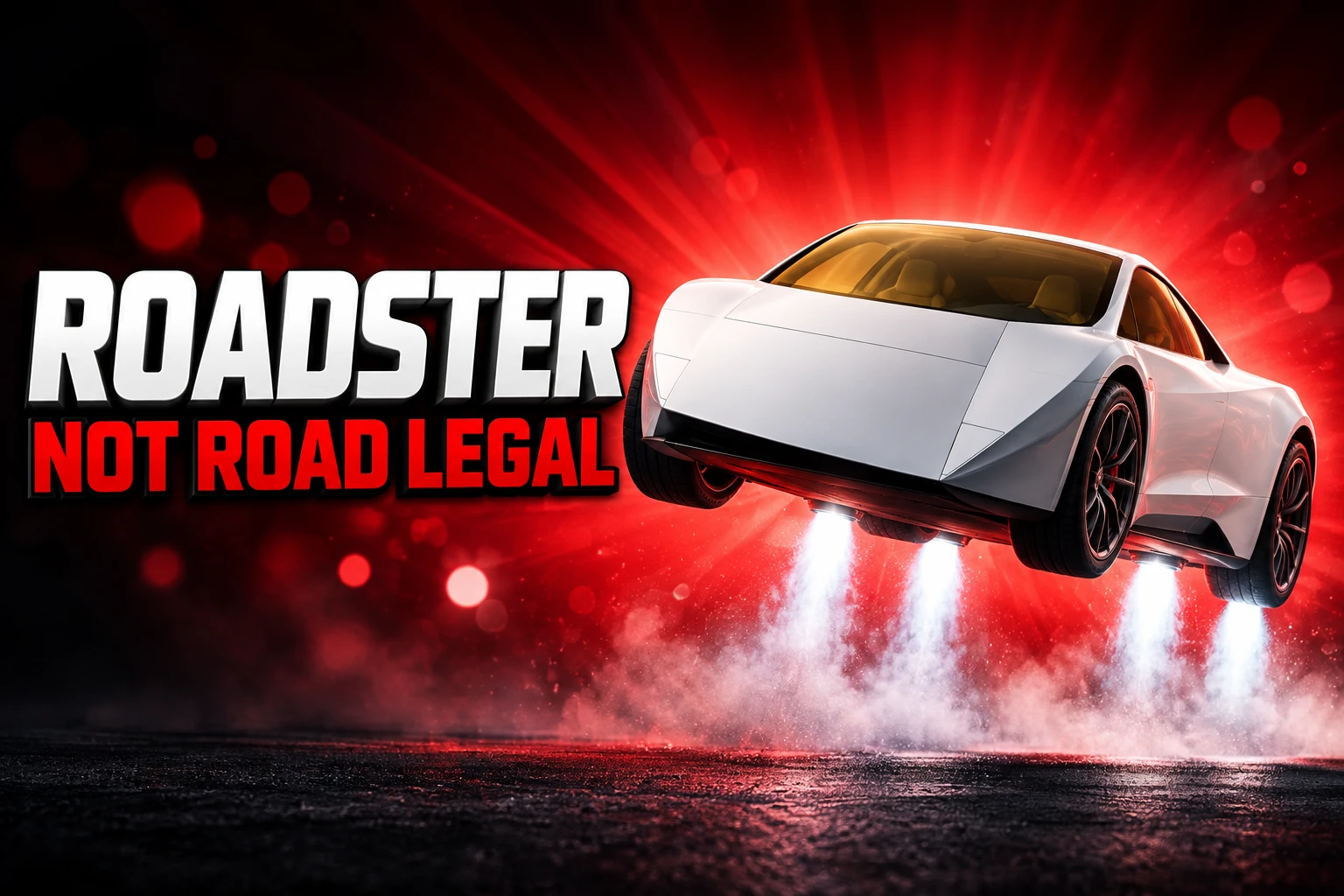
Tesla showed a second-generation Roadster at SpaceX’s McGregor site on October 15, 2026, then listed the flying Rocket trim as not approved for public roads. The white two-seater climbed an inverted ramp on suction fans, rolled in the air on cold-gas thrusters, and hopped a line of Tesla models. Production is set for 2028. There is still no price.
The show was the Rocket. The car Tesla will sell as “road ready” is a different machine, and a thinner one than the 2017 prototype that took the deposits.
The Flying Trim Is the One You Cannot Drive
Elon Musk told the crowd the prototype was the car that would be on the roads, and that it would “puff itself up” and do those moves whenever a driver wanted. Minutes later he walked it back. He said he was not sure it would be legal in every place, but that someone would be able to own such a car. When a guest shouted about street use, he said it depended on the street, and that it would be a viable car.
You know I’m not necessarily sure it’s legal in all jurisdictions. But there will be such a car that someone can own.
Elon Musk, Tesla CEO, at the McGregor reveal
Tesla’s own site is plainer than the stage. The three Roadster versions Tesla now lists split the hardware. Performance is a two-seat road car with active aero and a multi-mode suction fan. Thrust is a limited two-seater that adds rear cold-gas thrusters for a claimed run to 60 mph in under 1 second. Rocket is a single-seat, invite-only pack with extra thrusters around the body. Tesla’s note on Rocket is blunt: not approved for public road use, and it may not be offered in every region.
The dummy in the seat wore a space suit. Musk said it was not a real human. The hop cleared a Cybercab, a Cybertruck, a Tesla Semi, a Model Y and a Model 3. That is the clip Tesla wants shared. It is also the clip tied to the trim the company will not put on a public road.
Nine Years Cut the Range in Half
Tesla first showed a second-generation Roadster on November 16, 2017, at the Semi event, and said it would build the car in 2020. The published sheet was a four-seat EV with a 620-mile range and four seats in 2017, a 1.9-second run to 60 mph, a top speed over 250 mph, and a $200,000 base price. A Founders Series of 1,000 cars asked for $250,000 paid in full. A regular reservation was $50,000, the same cash Tesla still wants for Performance.
What Tesla now quotes is a two-seat car with 300 miles of range and a top speed exceeding 230 mph. That 300-mile figure is 48 percent of the old 620. Rear seats are gone. So is the price. The 2017 Founders buyers who paid $250,000 in full have not been told, in public, how those orders map onto Performance, Thrust or an invite-only Rocket.
THE 2017 SHEET AGAINST THE 2026 CLAIMS
| Item | November 2017 Tesla sheet | October 2026 Tesla claim |
|---|---|---|
| 0 to 60 mph | 1.9 seconds | Under 1.6s Performance; under 1s Thrust; under 0.59s Rocket |
| Top speed | Over 250 mph | Exceeding 230 mph |
| Range | 620 miles | 300 miles |
| Seats | 4 | 2, or 1 in Rocket |
| Base price | $200,000 | Not announced |
| To reserve | $50,000; Founders $250,000 | $50,000 Performance; $250,000 Thrust |
| Build year | 2020 | 2028 |
YouTuber Marques Brownlee, who has waited on a reservation for years, called the night a prank: a 4,000-pound-plus car doing flips, aiming at half the speed of sound, and shipping in 2028. Musk, on stage, said Tesla might try to jump Snake River Canyon, the gorge Evel Knievel failed to clear in a steam rocket. He also said he was not sure the Roadster moves the needle much on revenue.
Three Versions, Only One Aimed at the Street
Reservations reopened with the stream. Performance takes $50,000, $5,000 by card and $45,000 by wire within 10 days. Thrust takes $250,000, $5,000 now and $245,000 within 10 days. Rocket lists no deposit. Tesla still has not said what the cars will cost when they are configured.
WHAT EACH TRIM PUTS ON THE CAR
| Trim | Seats and pitch | Hardware Tesla names | Claimed 0 to 60 mph |
|---|---|---|---|
| Performance | 2, road ready | Active aero and multi-mode suction | Under 1.6 seconds |
| Thrust | 2, race ready, limited | Suction plus rear cold-gas thrusters | Under 1 second |
| Rocket | 1, air ready, invite only | Suction plus perimeter thrusters | Under 0.59 seconds |
At McGregor the prototype’s quicker timed run was a claimed 0.81 seconds to 60 mph, after a first pass Tesla put at one second. Lars Moravy, Tesla’s vice president of vehicle engineering, has said the two rear motors make more than a megawatt and more than 1,400 newton meters, and that the car is rear-wheel drive. Tesla’s site warns that the figures on the page reflect the Thrust add-on and that availability follows local law.
The Air Tanks Take Hours to Fill
The hops use cold gas, not burning fuel. Moravy said the flying car uses 10 thrusters fed from 600 liters of compressed air, about 250 kg of it, stored in carbon-fiber overwrapped pressure vessels. Tesla’s line is that it has gone from a Roadster in a rocket to a rocket in a Roadster, packing those tanks into every usable void. Thrust gets a 200-liter tank behind the cabin. Rocket adds 400 liters where a passenger seat would be, which is why that trim is a single-seater.
Tesla says the thruster pack makes four to five times the tires’ force, which is how it claims to beat the grip limit that caps a normal launch. The nozzles use electric actuators for small in-air corrections. Musk said the car has attitude thrusters and main thrusters at the rear, so it can roll and do “crazy gymnastics.”
THE HARDWARE BEHIND THE CLIP
- Ten nozzles: Four at the rear on Thrust for launch; Rocket adds perimeter jets for lift, yaw and roll.
- Two tanks: 200 liters on Thrust, 400 more on Rocket, 600 liters in total, about 250 kg of gas.
- The fill: Moravy said an external high-pressure nitrogen hookup now takes 2 to 6 hours on Thrust and 6 to 7 hours for the full 600 liters, with a goal of about 30 minutes.
- The catch in the lab: Musk says the car will puff itself back up on air; the filmed walkaround still describes a nitrogen truck and a long wait.
A launch that needs a same-day refill of several hours is a closed-course trick, even if Tesla later shortens the wait. Track use still looks like one hard shot, then a queue at a compressor, which is a thin basis for the “whenever you’d like” line from the stage.
The Suction Fan Is the Actual Road Car
The part that can reach a street without a special invite is the fan. Tesla says a multi-mode suction system under the floor, working with an active rear wing, can make up to 2 Gs of downforce, enough for the inverted-ramp demo and, on a circuit, more cornering grip than tires alone. All three trims get that pack. Only Thrust and Rocket get the jets.
Fan cars have a short, messy history. Brabham’s BT46B used a fan to win the 1978 Swedish Grand Prix and was then pulled. McMurtry’s Spéirling has already driven upside down on a similar idea. Tesla’s bet is that a road-legal version of that trick, plus a yoke, a huge center screen, and steer-by-wire, is enough of a halo once the rest of the lineup is meant to drive itself. Musk has called the Roadster the best of the last human-driven Teslas.
Design chief language on the night pointed at the SR-71 Blackbird and the F-35, with hidden lamps, a full-width tail light, Ano White paint, and gold-tinted glass. Interior shots show a left-hand yoke and the usual Tesla slab of screen. None of that needs SpaceX. The fan is the new road argument. The thrusters are the ad.
Musk Will Not Promise Every Street
A car that can hop a Semi is a product Tesla can film. A car that can hop a public street is a product insurers, tire rules and national safety codes have never had to rate. Tesla already fenced the full flight pack. Thrust, with rear jets only, sits in a grey band Tesla calls “race ready.” Performance is the one labelled for the road, and it is the one without the move that made the stream.
WHAT WE KNOW
- Rocket’s status: Tesla’s page says it is not approved for public road use and is invite only.
- The demo site: The hops ran at SpaceX’s McGregor test ground on October 15, 2026, after an October 1 date slipped for weather.
- The build year: Musk said Tesla enters production in 2028, then added “actually, for real.”
WHAT IS UNCONFIRMED
- A sale price: Tesla has not published one for any trim.
- 2017 orders: Tesla has not said how original $50,000 deposits or $250,000 Founders payments convert.
- Thrust on public roads: Musk would not give a clean yes; Tesla has not shown a regulator sign-off for rear thrusters.
On an earlier podcast he said safety was not the main goal, and that a buyer who puts safety first should not buy the Roadster. At McGregor he said it was not a safety-optimized car, but that it took the fun meter to 11 out of 10. That is a track-toy pitch. It is a weak street-car pitch, and Tesla’s Rocket footnote already treats it as such.
Production Starts in 2028, Still Unpriced
The second coming of this car has been a moving date since the first night.
THE DATES TESLA HAS NAMED
- November 16, 2017: Tesla shows the second-generation Roadster and aims production at 2020.
- June 9, 2018: Musk describes a SpaceX option of about 10 small thrusters, and says they might even let a Tesla fly.
- 2021 to 2024: Ship dates slide through 2023 and 2024, each time as hope rather than a lock.
- November 2025: The reveal is put on April 1, 2026, then slips again.
- October 1, 2026: An outdoor demo is postponed for weather.
- October 15, 2026: The McGregor show runs; Musk puts production in 2028.
That 2028 start is eight years later than the 2020 target Tesla printed in 2017. The company posted the stunt the same night with a two-word caption.
Real life, baby pic.twitter.com/3QEqn18wig
— Tesla (@Tesla) October 16, 2026
A hop over Tesla’s own lineup is a real piece of hardware, filmed on a rocket range, with tanks, nozzles and a fan that already has cousins in race cars. It is also a trim Tesla will not certify for the street, bolted to a 2028 car with no price, 300 miles of range, and a reservation bill that matches the 2017 deposit. The people who put down money for a four-seat, 620-mile supercar are still waiting to hear which of those three names, if any, that money now buys.

Edinburgh Opens a 2027 Tour Built for Time Trials

Korda Maps Auður From Meðalland to Irvine Bay

Apple Music Films Its New Logo in Mineral Oil

Oppo Prices the Pad Mini Above India’s iPad Mini

Austen Soaks Scotland Before Boelo Brings Weekend Gales

Volkswagen Sells the Osnabruck Plant to Clear a Board Fight

Apple’s Foldable iPhone Hinges on Samsung Display Supply

Tata Motors’ Iveco Tender Opens as Holders Still Decide

Saksham Gaur Finds He Is His Own Company’s Client

Onimusha Way of the Sword Preload Hits a Windows 11 Wall
-
 AUTO2 months ago
Volkswagen Sells the Osnabruck Plant to Clear a Board Fight
-
 NEWS2 months ago
Apple’s Foldable iPhone Hinges on Samsung Display Supply
-
 AUTO2 months ago
Tata Motors’ Iveco Tender Opens as Holders Still Decide
-
 BUSINESS2 months ago
Saksham Gaur Finds He Is His Own Company’s Client
-
 GAMING2 months ago
Onimusha Way of the Sword Preload Hits a Windows 11 Wall
-

 BUSINESS2 months ago
Hyderabad 22-Carat Gold Jumps After a False Bargain
-

 ENTERTAINMENT3 years ago
What is SD on Amazon Prime? – All You Need to Know
-

 NEWS2 months ago
iQOO 16 Locks 8,400 mAh While 100W Charging Holds