
NEWS
Alaska Bets the Hawaiian Deal on 2028 Suites
Alaska Air Group is betting 2028 Aurora and Leihōkū suites can lift premium sales, a day after the FAA delayed the 737-10 those transcon beds need.

Alaska Air Group unveiled 2028 lie-flat suites on September 29, a day after the FAA delayed the 737-10 those transcontinental beds require. The parent of Alaska Airlines and Hawaiian Airlines called it its most significant investment in premium travel, pairing new lie-flat Aurora Suites and Leihōkū products with a Premium Reserve cabin and three large lounges.
None of those seats is for sale until summer 2027, and none is scheduled to fly until 2028. The 2027 profit plan the company has been selling since the Hawaiian purchase is already mostly booked without them. What Investor Day actually priced in is the next wager: that high-yield long-haul traffic will pay for doors, beds and concierges once the metal arrives.
Aurora Suites Will Not Fly Until 2028
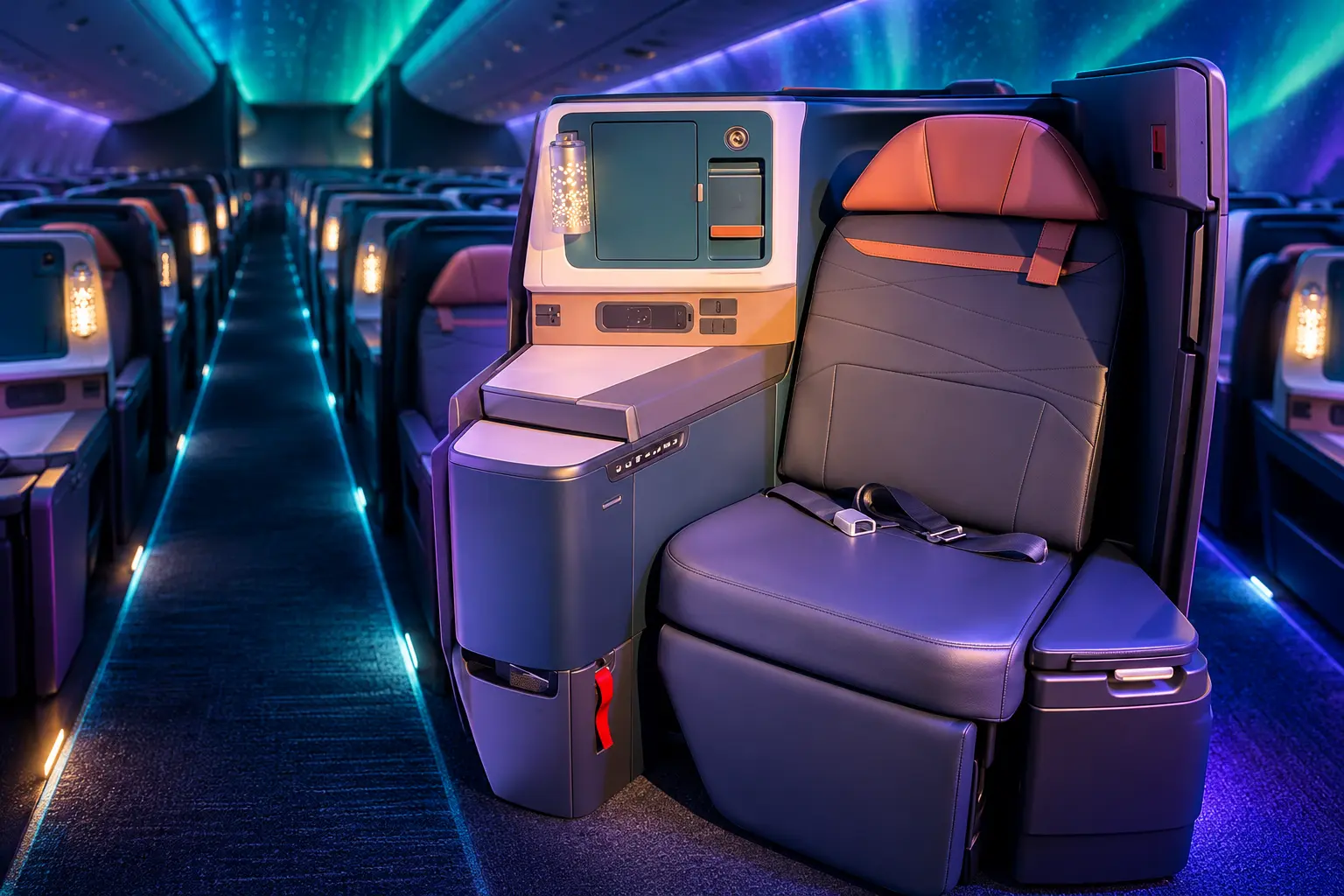
Aurora is the Alaska brand. Leihōkū, Hawaiian for “lei of stars,” is the Hawaiian one. Both are curb-to-cabin products: dedicated check-in, concierge service, chef-led meals, Starlink Wi-Fi for Atmos Rewards members, and a suite that lies flat. Premium Reserve sits between those suites and today’s Premium Class recliner, with 38 inches of pitch, a leg and calf rest, and a 16-inch 4K OLED screen.
On the 787-9, Alaska will fit 34 Aurora Suites and lift premium seating from 38 percent of the cabin to about 46 percent. Future 787-10s are drawn with 40 suites. Hawaiian will gut all 24 of its Airbus A330s from the first row to the last, putting 22 Leihōkū Suites on each jet and taking premium seating from 30 percent to about 40 percent. At least 25 Boeing 737-10 MAX jets, painted in the same aurora livery as the Dreamliners, will carry 12 Aurora Suites on selected transcontinental flights, the first lie-flat seats Alaska has ever put on a narrowbody.
HOW THE NEW CABINS BREAK DOWN
| Aircraft | Flagship suites | Premium Reserve | Privacy doors |
|---|---|---|---|
| Boeing 787-9 | 34 Aurora | 35 | Yes |
| Boeing 787-10 | 40 Aurora | 35 | Yes |
| Airbus A330 | 22 Leihōkū | 28 | Yes |
| 737-10 MAX (subfleet) | 12 Aurora | 12 | No |
The 737 suites still get direct aisle access, a 19-inch 4K screen, and Bluetooth charging. They do not get the sliding doors that close on the 787 and the A330. That is the trade for putting a bed in a single-aisle fuselage, and it is the detail that will matter on a red-eye to New York once someone is actually sitting in one.
Dining is the other brand split. Seattle chefs Renee Erickson and Brady Ishiwata Williams will write Aurora menus for Europe and Asia. Hawaiian executive chef Dell Valdez keeps Leihōkū on island ingredients, with wine pairings on longer sectors. In summer 2026 Hawaiian already began a chef-led Main Cabin pre-order with Maui’s Sheldon Simeon on most flights between Hawaiʻi and the continent.
We believe premium is more than a seat. It’s how guests feel from the moment they book their trip to the moment they arrive at the airport to when they’re in the air with us.
Ben Minicucci, CEO, Alaska Air Group, September 29, 2026 statement
The Hawaiian Merger Is Why the Suites Exist
Alaska did not have a widebody franchise to dress up until it bought Hawaiian. The $1.9 billion deal closed on September 18, 2024. Two years later the holding company still flies two brands on purpose, but it now files as one airline. The annual report records a single operating certificate in October 2025, 13 months after close. Atmos Rewards folded Mileage Plan and HawaiianMiles in 2025. In April 2026 Hawaiian’s reservations moved onto Alaska’s system, the HA code came off the market, and Hawaiian joined oneworld under the AS code.
Three of four integration milestones are done. Joint contracts with union workgroups are not. Minicucci graded the merger a “solid B” in August, ahead on money and unfinished on labor. The seats announced this week are how the company turns that operating mash-up into a product people will pay extra to sit in, especially on Hawaiian’s Pacific A330s, which have never had a true premium-economy cabin.
FROM PURCHASE TO THE FIRST SUITE
- September 18, 2024: Closes the $1.9 billion purchase of Hawaiian Holdings.
- August to October 2025: Launches Atmos Rewards and receives a single FAA operating certificate.
- April 2026: Cuts over to one passenger system and retires the HA flight code.
- January 7, 2026: Orders 105 Boeing 737-10s, plus options on 35 more, and five additional 787s, taking the firm 787 fleet to 17 with five already flying.
- Late 2027: Opens the Seattle lounge complex, months before the new seats fly.
- 2028: Begins Aurora, Leihōkū and Premium Reserve on 787s, A330s and the 737-10 subfleet.
Hawaiian’s own spend sits inside that calendar. In January the carrier published the Kahuʻewai Hawaiʻi Investment Plan, more than $600 million over five years for airport lobbies, A330 interiors, resident rewards and a Honolulu lounge. Diana Birkett Rakow, Hawaiian’s CEO, tied this week’s Leihōkū suites to that plan and to the claim that Hawaiian remains the preferred brand for travel to, from and within the islands. The group says 9.6 million visitors reach Hawaiʻi each year, 1.4 million residents depend on the flights, and 70 percent of those residents are now Huakaʻi by Hawaiian members.
The 737-10 Delay Hits the Transcon Plan
The narrowbody half of Aurora is a bet on an airplane the FAA has not certified. Alaska’s January order for 105 737-10s, with rights to 35 more, was the largest in the airline’s history and runs through 2035. Chief Operating Officer Jason Berry said in late September that the carrier still expected type approval by month’s end, first delivery next spring, and passenger service between April and mid-May 2027, with 22 jets in 2027 and 30 in 2028. He called the timeline “sporting” and added that Alaska was “not panicking yet.”
On September 28, FAA Administrator Bryan Bedford stopped that clock. A flight-management software issue, supplied by GE Aerospace, can drop automated flight guidance during a missed approach on some MAX software versions. Bedford told reporters he would hold the 737-10 until the agency is satisfied there is no problem, and he would not say whether a fix takes days, weeks or months.
We will be delaying the 10 until we’re satisfied that we don’t have an issue here.
Bryan Bedford, FAA Administrator, September 28, 2026, Reagan Washington National Airport
Alaska already flies MAX 8s and MAX 9s, and the January order lets it switch the 737-10 buy to another MAX model if it has to. That flexibility does not help the Aurora transcon subfleet. Those 12-suite cabins are designed for the larger 737-10. Only at least 25 of the 105 firm jets are slated to get them, which means most future 737-10s will still board with ordinary first-class recliners. The same type will sell two different products, and the lie-flat version depends on a certificate that did not arrive on the timetable Berry described.
In July the FAA did let Boeing resume issuing airworthiness certificates for 737 MAX and 787 jets after months of production review. That was a production step, not type approval for the 737-10. The suite announcement still went out 24 hours after Bedford’s delay, with 2028 intact on the slides.
JetBlue Mint, Delta One on selected domestic widebodies, and United Polaris on premium transcontinental metal already sell a bed on coast-to-coast routes. Alaska is walking into that market two years late, on a jet that is late itself, and without the privacy door those rivals put on their better suites.
Four Cabins Cut the Cheap Seats on Long-Haul Jets
The new stack is Suites, Premium Reserve, Premium Class, then Main Cabin. On a 787-9 that is an eight-point swing toward the front. On an A330 it is ten points. Chief Commercial Officer Andrew Harrison said the three new products close gaps on international, Hawaiʻi and premium transcontinental flying without merging the two brands into one livery.
THE FOUR-CABIN STACK
- Aurora or Leihōkū Suites: Lie-flat beds with direct aisle access, 19-inch 4K screens, concierge check-in and lounge access on qualifying flights.
- Premium Reserve: A new premium-economy cabin, 38-inch pitch, wider than Main Cabin, with a leg rest and 16-inch OLED screen, 35 seats on each 787, 28 on the A330, 12 on the premium 737-10.
- Premium Class: The existing recliner cabin, still in the mix as the step below Reserve.
- Main Cabin: The remaining coach seats, a smaller share of the 787-9 and A330 once the retrofits start in 2028.
Premium Reserve seats go on sale in summer 2027, a year before they are due to fly. That gap is how Alaska will test demand on paper before a single row is bolted in. Long-haul flying is supposed to grow from about 8 percent of capacity now to about 15 percent by 2030, which is exactly where a four-cabin widebody earns its keep, and exactly where a thinner Main Cabin will be felt by anyone still buying the back of the jet on Seattle-Tokyo or Honolulu-Osaka.
Free Starlink for Atmos members, paid for with T-Mobile, is already on Hawaiian’s Hawaiʻi flights and on the E175 regional fleet. The rest of Alaska’s fleet is due to finish the rollout in 2027, so the Wi-Fi promise lands before the new seats do.
Seattle’s Flagship Lounge Opens Before the New Seats
The ground product is on a tighter clock than the cabins. A nearly 41,000-square-foot complex in Sea-Tac’s expanded C Concourse is due in late 2027, billed as Seattle’s largest lounge. The main level is a 500-seat Alaska Lounge for guests who already qualify under current rules. Upstairs, a 200-seat Aurora Lounge is reserved for Aurora Suites passengers on intercontinental flights, with shower suites, wellness rooms, and made-to-order food with tableside service. The shared building gets an outdoor patio with a fireplace, work pods, a pizza oven, a coffee lab, and three bars.
Hawaiian’s Honolulu room is a nearly 13,000-square-foot lounge at the Mauka Concourse entrance in Terminal 1, due in early 2028, with about 200 seats, local coffee, a full bar, and work by Hawaiʻi artists. Access is meant to track today’s Plumeria Lounge, plus Leihōkū Suites guests. San Diego gets a 14,000-square-foot Alaska Lounge later in 2028. SFO’s lounge opened in 2024. Portland’s opened in June 2026.
THE LOUNGE BUILD
| Airport | Size | Opens | Who it is for |
|---|---|---|---|
| Seattle (C Concourse) | Nearly 41,000 sq ft | Late 2027 | 500-seat Alaska Lounge plus 200-seat Aurora Lounge |
| Honolulu (Mauka Concourse) | Nearly 13,000 sq ft | Early 2028 | About 200 guests, including Leihōkū Suites |
| San Diego | 14,000 sq ft | 2028 | Alaska Lounge |
Seattle is the hinge. Alaska says it already serves 110 destinations from there, and the long-haul map from that hub is still short. Five intercontinental cities are flying now: London, Rome, Reykjavik, Tokyo and Seoul. Paris and Athens are due in spring 2027. The target is at least 15 intercontinental destinations by 2030. The Aurora Lounge is built for that map. Until 2028, international suite guests will use a room that exists before the seat they bought exists.
Premium Sales Have to Carry the Earnings Target
Alaska Accelerate, launched in December 2024, still aims for $1 billion of extra profit by 2027, including $500 million of merger synergies. Management says it has captured roughly two-thirds of that total and remains on track for the rest. Those dollars cannot come from Aurora hardware. The hardware is a 2028 story. The Investor Day pitch is that the next earnings cycle will be less tied to domestic coach fares.
THE MIX ALASKA IS SELLING TO 2030
- Premium share: 35 percent of revenue now, with a goal for premium revenues to exceed 40 percent by 2030.
- Diversified share: Premium, international, loyalty and cargo at 53 percent now, approaching 60 percent by 2030.
- Atmos cash: Nearly $4 billion of annual cash flow from the program by 2030, after member growth moved from about 3 percent a year in 2019-2024 toward about 13 percent by 2027.
- Cargo: Revenue up about 60 percent since 2024, with a path to $750 million by 2030.
President and Chief Financial Officer Shane Tackett said the company has already booked most of the $1 billion target and that the next phase is about turning the new investments into a sturdier business. In interviews ahead of the event he also said the premium spend could add $3 to $4 a share and lift margins by 2 to 3 percentage points within a couple of years, a claim that only starts to be testable after 2028. The group now counts 422 aircraft, heading for 475 by 2030 and more than 550 by 2035, and it still presents itself as the youngest, most fuel-efficient major U.S. fleet.
We have captured roughly two-thirds of our $1 billion earnings target, and the next phase is about activating the investments that make our business more durable.
Shane Tackett, President and Chief Financial Officer, Alaska Airlines, September 29, 2026
The fact sheet for the day still lists Alaska as No. 1 in the Transportation Department’s on-time numbers through June 30, 2026, and as the largest airline on the West Coast and in Hawaiʻi. Reliability is the part of the bet that does not show up in a suite rendering. Retrofitting 24 A330s and a growing 787 fleet while accepting 737-10s, if they arrive, is an operations problem as much as a design one.
Premium Reserve goes on sale in summer 2027. The first Aurora and Leihōkū suites are still drawn for 2028, on widebodies Alaska already owns and on a 737-10 the FAA has not signed off.
Disclaimer: This article is news reporting on Alaska Air Group’s product and strategy announcements and is for information only. It is not investment advice, a recommendation to buy or sell ALK or any other security, or a forecast of earnings, margins or share price. Readers who may act on airline financial targets should consult a licensed financial adviser who can review their own holdings and risk. Figures and dates here reflect company statements and regulator comments as published around September 29, 2026, and both the 737-10 schedule and cabin retrofit timetable can change.

Edinburgh Opens a 2027 Tour Built for Time Trials

Korda Maps Auður From Meðalland to Irvine Bay

Apple Music Films Its New Logo in Mineral Oil

Oppo Prices the Pad Mini Above India’s iPad Mini

Austen Soaks Scotland Before Boelo Brings Weekend Gales

Volkswagen Sells the Osnabruck Plant to Clear a Board Fight

Apple’s Foldable iPhone Hinges on Samsung Display Supply

Tata Motors’ Iveco Tender Opens as Holders Still Decide

Saksham Gaur Finds He Is His Own Company’s Client

Onimusha Way of the Sword Preload Hits a Windows 11 Wall
-
 AUTO2 months ago
Volkswagen Sells the Osnabruck Plant to Clear a Board Fight
-
 NEWS2 months ago
Apple’s Foldable iPhone Hinges on Samsung Display Supply
-
 AUTO2 months ago
Tata Motors’ Iveco Tender Opens as Holders Still Decide
-
 BUSINESS2 months ago
Saksham Gaur Finds He Is His Own Company’s Client
-
 GAMING2 months ago
Onimusha Way of the Sword Preload Hits a Windows 11 Wall
-

 BUSINESS2 months ago
Hyderabad 22-Carat Gold Jumps After a False Bargain
-

 ENTERTAINMENT3 years ago
What is SD on Amazon Prime? – All You Need to Know
-

 NEWS2 months ago
iQOO 16 Locks 8,400 mAh While 100W Charging Holds