
NEWS
Stasher’s £3 Million Round Puts Hive Box in Europe
Hive Box is putting £1 million and 100 lockers into Stasher to cover the hours hotel luggage desks cannot staff.

Stasher has secured £3 million to grow its luggage storage marketplace and plant smart lockers across the UK and Europe. About £2 million (€2.3 million) is growth finance from lender Gilion. The other £1 million is equity from Hive Box, a Shenzhen locker operator.
Hive Box already runs a last-mile parcel grid measured in hundreds of thousands of machines. The cash, and the first cabinets, buy it a path into the hotels, stations and tourist centres that Stasher has mapped since 2015.
Two-Thirds of the Cheque Is a Loan
The round was presented as expansion capital for a London travel company. Read the split and it looks more like a hardware partnership sitting on top of borrowed growth money. Gilion is not a venture fund taking a board seat. It sells non-dilutive growth loans to European tech firms, with tickets from €0.5 million to €5 million, interest-only for two years, and more than €150 million already out the door.
Fredrik Johansson, investment director at Gilion, said Stasher is “a clear leader in its market, growing fast while keeping customer acquisition costs low in a very attractive segment.” That is a credit view. Cheap user growth is what a lender wants to see before it writes about £2 million against future bookings.
Hive Box is the only named equity cheque. It also makes the lockers, owns the IoT stack, and will remote-manage the units once they sit on Stasher’s booking app. The company is not a silent financial backer. It is the supplier, the software layer, and a shareholder at once.
THE FUNDING MIX
| Source | Amount | What it is |
|---|---|---|
| Gilion | About £2 million | Growth loan for marketplace and marketing |
| Hive Box | £1 million | Equity, plus hardware, IoT and remote management |
| Opening locker batch | 100 units | UK and Europe target by mid-2027 |
Stasher said the Gilion money will add marketplace locations and lift marketing, while the Hive Box side speeds unattended storage. Jacob Wedderburn-Day, chief executive and co-founder, said the firm will put capital into “adding more locations and reaching more travellers, while expanding our smart locker network where we know there is unmet demand.”
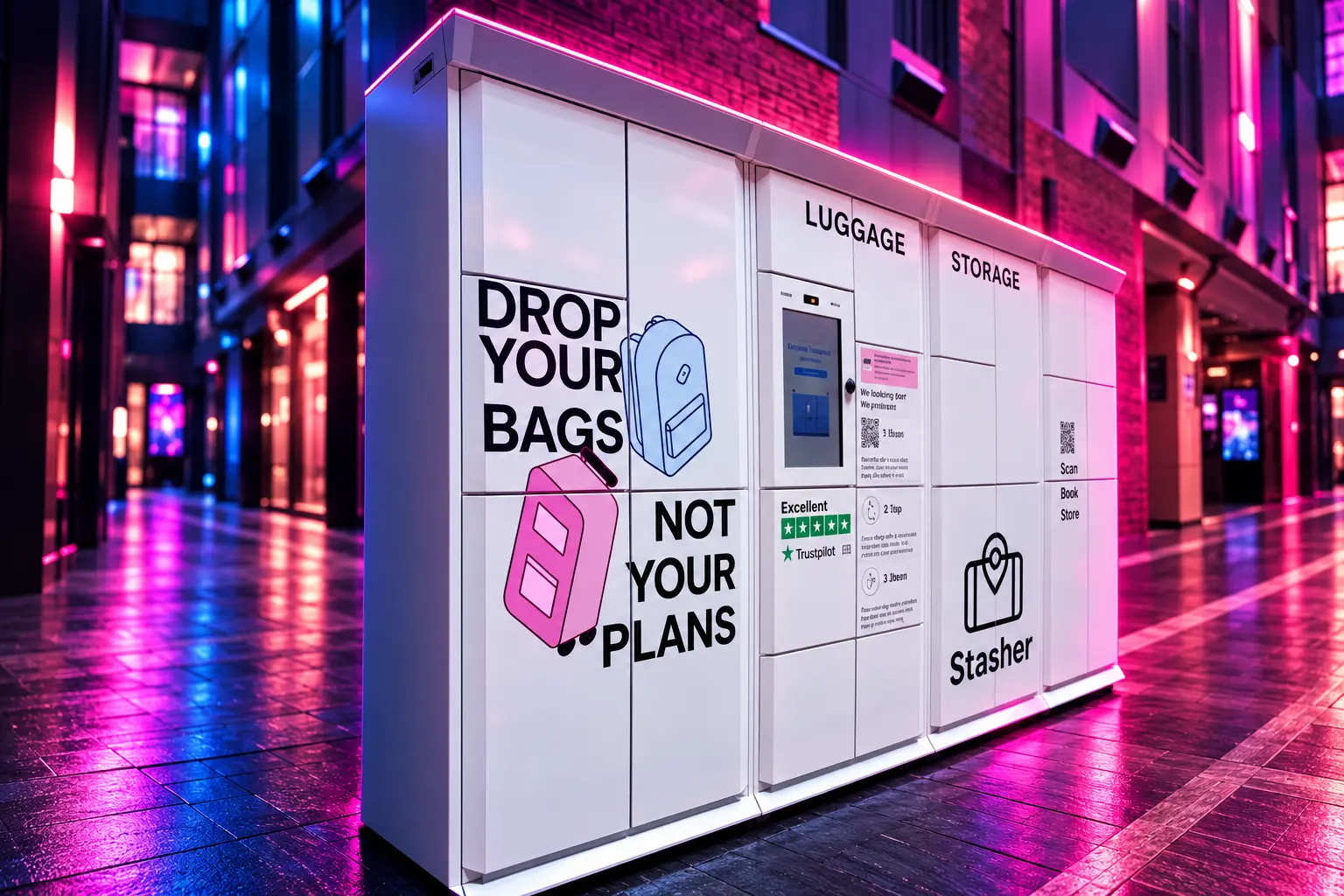
Hive Box Already Has Machines in Three Cities
On September 21, Hive Box said it had signed a cooperation deal in London and that the first lockers were already in use in London, Manchester and Edinburgh. The Shenzhen firm described itself as a last-mile operator with more than 400,000 smart locker units worldwide, covering 236,000 communities.
That scale is the point of the cheque. Stasher is a marketplace of hotels and local businesses with more than 10,000 locations in more than 1,200 cities. Hive Box is a factory and a network team used to dropping cabinets by the thousand. Tommy Xu, vice president of international business at Hive Box, said the two firms want “a scalable model for unattended luggage storage across the UK and Europe.”
a scalable model for unattended luggage storage across the UK and Europe
Tommy Xu, VP of international business, Hive Box
Hive Box said the opening 100 cabinets will go into hotels, railway stations, airports and tourist centres, with travellers storing and collecting bags by scanning a QR code. Idle lobby space becomes a self-service point that does not need a dedicated clerk. The same statement said the jointly deployed count is expected to rise to 1,000 or more later.
The company also spelled out why it thinks Europe is open. Some major railway stations have taken on-site lockers out over security worries. Staffed left-luggage desks keep short hours. Hotel bag rooms still depend on whoever is on the desk. Unattended boxes are the proposed fix for all three gaps.
Search Logs Point to the After-Hours Gap
Stasher is not guessing where to put steel. It said it will use more than ten years of booking and search data to choose sites. The filters are blunt, and they all point at limits in the original hotel-and-shop model.
THE PLACEMENT RULES
- Search heat: Cabinets go where travellers already look for luggage storage on the app, even if no host is listed there yet.
- Full rooms: Sites that already take bags and now hit capacity are first in line for extra unattended space.
- Closed desks: Demand that continues after staffed opening hours is treated as a locker problem, not a staffing one.
That last filter is the one hotel partners should watch. A Stashpoint in a Premier Inn or a shop still needs someone to take a bag, tag it, and hand it back. A locker in the same lobby does not. Hive Box pitched the hardware as a way for those businesses to offer 24-hour storage “without requiring dedicated staff,” and as extra service revenue from space that now sits idle.
The original marketplace does not disappear. Stasher still lists hotels and shops, and the loan is meant to add more of them. The lockers sit on top of that map, in the hours and postcodes the humans cannot cover. Hosts who already earn from leftover cupboards keep the daytime trade. Night arrivals, early trains, and full rooms go to the box.
Premier Inn Tried the Lockers First
Hive Box is not Stasher’s first locker experiment. Dedicated cabinets were already in the network before the Shenzhen cheque, including a hotel-chain trial that has moved past a single site.
THE LOCKER BUILD-OUT
- 2015: Jacob Wedderburn-Day and Anthony Collias found Stasher in London as a marketplace for leftover hotel and shop space.
- January 21, 2020: VentureFriends leads a $2.5 million round, with Johan Svanstrom, former Hotels.com president, among the angels.
- October 11, 2023: A Seedrs campaign raises £566,442 from 356 investors against a £425,002 target.
- November 2025: A locker pilot opens at Premier Inn London St Pancras.
- June 9, 2026: DHL Express starts a US storage tie-up at service points, aiming to grow from about 30 sites toward 100.
- September 21, 2026: Hive Box announces the London deal, the £1 million investment, and live lockers in London, Manchester and Edinburgh.
Stasher lockers now run at 17 Premier Inn properties across London, Edinburgh and Manchester. The company also lists lockers at Zedwell Trocadero in London and StayKula sites in Kensington and Birmingham, and it works with Staycity Aparthotels in the UK and Ireland. On Stasher’s own London board, Premier Inn lockers from £11.99 a day sit beside hotel bag storage that starts at £1.49 a bag. The unattended product is the premium SKU, not a discount bin.
Stasher said bookings across its smart locker network are growing by 108% month on month. That figure is the company’s own. If it holds, the case for more cabinets is simple: the machines already in the ground are filling faster than the staffed list next door.
Parcel Networks and a US Shipping Tie-Up
A second locker layer is already booked through someone else’s metal. Quadient opened its UK Parcel Pending grid to Stasher, putting luggage into more than 1,640 Parcel Pending lockers in London, Birmingham, York, Edinburgh, Newcastle, Cardiff and Manchester. Oscar Thanoyannis, Stasher’s commercial director, called it a way to grow the smart-locker footprint. Katia Bourgeais-Crémel, Quadient’s European parcel-locker chief, said the same cabinets already handle deliveries, returns, click and collect, and spare parts, and would now take bags as well.
Quadient said it had more than 25,700 units in the ground worldwide and wants 40,000 by 2030. Those are parcel lockers first. Stasher is renting space in a network built for Amazon-style drop-offs, which is a cheap way to look ubiquitous without pouring concrete. Hive Box is the opposite bet: purpose-built luggage cabinets, Stasher-branded, with Hive Box’s remote tools wired into the booking app.
The US push runs through shops, not lockers. On June 9, DHL Express said travellers could store bags at about 30 DHL ServicePoint sites, with a path toward around 100, and then ship souvenirs or extra bags through DHL. Anthony Collias, Stasher’s chief commercial officer and co-founder, said the tie-up was “an exciting step forward in expanding our footprint in the United States.” That is still the old model: a trusted counter, a member of staff, a room out the back.
So the company now runs three storage types at once. Hotels and shops take most of the 10,000-plus list. Parcel lockers and a handful of hotel cabinets cover the unattended slice already live. Hive Box is meant to turn that slice into a standard product in European travel hubs.
Forecourts Join the Queue for Unattended Bags
The next hosts on Stasher’s list are not concierges. The company told petrol retailers that urban forecourts, plus busy supermarkets and shopping centres, could take luggage lockers that Stasher installs and maintains. Parcel lockers are already common on forecourts. A luggage cabinet is being sold as a second box with a different customer: someone off a coach, a train, or a city-break checkout, not a driver picking up a parcel.
THE LOCKER RUN RATE
- Best site: Stasher said its busiest locker location is taking £2,500 a week.
- Hotel trial: 17 Premier Inn sites across London, Edinburgh and Manchester after the St Pancras pilot.
- Booking pace: Locker bookings up 108% month on month, per Stasher.
- Next hosts: Forecourts, supermarkets and shopping centres, with Stasher keeping install and upkeep.
A site doing £2,500 a week is the number that will get a fuel retailer to take the call. It is also the number that tells hotel partners what after-hours demand is worth if it no longer needs a night porter. Stasher still needs those hotels. The app’s trust pitch has always been a named front desk, not a steel wall. The lockers are being sold as a way for the same properties to stay open when the desk goes dark.
This deal has barely registered as a consumer story. The people being pitched are site owners. Travellers already open the app when they have a bag and a gap before check-in. The fight now is over who owns the square metres next to the pumps, the lobby sofa, and the station exit, and whether that square metre still needs a person attached to it.
What the First 100 Machines Are For
One hundred lockers by mid-2027 is a thin overlay on a network of more than 10,000 locations. It is not a replacement grid. It is a test of whether Stasher’s search logs can pick spots that pay like the £2,500-a-week site, and whether Hive Box can service them from Shenzhen as easily as it services a Chinese compound.
Wedderburn-Day framed the money as fuel after a long build, not as a rescue.
We’ve spent the last ten years building Stasher into a global network, and this funding gives us the firepower to accelerate the next stage of growth.
Jacob Wedderburn-Day, CEO and co-founder, Stasher
The next stage, as both companies describe it, is unattended storage at accommodation, transport hubs, visitor attractions and big leisure sites. Hive Box has already said it wants that joint count at 1,000 or more. Gilion’s loan is there so Stasher can keep adding human hosts and ads while the cabinets go in. If the lockers work, the Shenzhen shareholder owns a European demand map that no parcel-locker rival has, and Stasher owns 24-hour capacity without putting a clerk on every night shift. Mid-2027 is when that first 100-unit wager is supposed to be in the ground.

Edinburgh Opens a 2027 Tour Built for Time Trials

Korda Maps Auður From Meðalland to Irvine Bay

Apple Music Films Its New Logo in Mineral Oil

Oppo Prices the Pad Mini Above India’s iPad Mini

Austen Soaks Scotland Before Boelo Brings Weekend Gales

Volkswagen Sells the Osnabruck Plant to Clear a Board Fight

Apple’s Foldable iPhone Hinges on Samsung Display Supply

Tata Motors’ Iveco Tender Opens as Holders Still Decide

Saksham Gaur Finds He Is His Own Company’s Client

Onimusha Way of the Sword Preload Hits a Windows 11 Wall
-
 AUTO2 months ago
Volkswagen Sells the Osnabruck Plant to Clear a Board Fight
-
 NEWS2 months ago
Apple’s Foldable iPhone Hinges on Samsung Display Supply
-
 AUTO2 months ago
Tata Motors’ Iveco Tender Opens as Holders Still Decide
-
 BUSINESS2 months ago
Saksham Gaur Finds He Is His Own Company’s Client
-
 GAMING2 months ago
Onimusha Way of the Sword Preload Hits a Windows 11 Wall
-

 BUSINESS2 months ago
Hyderabad 22-Carat Gold Jumps After a False Bargain
-

 ENTERTAINMENT3 years ago
What is SD on Amazon Prime? – All You Need to Know
-

 NEWS2 months ago
iQOO 16 Locks 8,400 mAh While 100W Charging Holds