
NEWS
Qualcomm’s Sensing Camera Hides Faces From Wearable AI
Qualcomm’s sensing camera covers faces for on-device AI, then rides into camera earbuds that can reach the cloud without a phone.

Qualcomm has built an ultra-low-resolution sensing camera into its chip sensing hub that finds a face, then covers it before an AI agent can see who it is. The company said the system looks for simple cues, two eyes and a mouth, so an assistant can keep the scene and drop the identity.
That pitch landed in Maui on September 23, 2026, beside a new hearable chip that is explicitly built for camera earbuds. The privacy story is the easy headline. The product is a camera that can stay on.
A Camera That Finds Faces, Then Hides Them
Qualcomm described the sensing camera as a detector, not a recognizer. It locates a face in the frame, then obfuscates that patch so a multimodal agent still gets context such as a meeting room or a street, without a usable likeness.
The company said the feature is already in the wild with more than one partner, and it would not name them. The sensing hub is the always-on, low-power island on Snapdragon silicon, which is why the camera is kept so dim. A higher-resolution pipe would drain the battery and, Qualcomm argues, start to identify people.
Qualcomm would not give a pixel count. It did say the feed is “much, much, much lower” than full HD. In that briefing, the working example was not a portrait. It was a nearby person, useful, the company said, for someone with hearing loss who needs a cue that someone is there.
On-device processing is the other half of the sales talk. Qualcomm wants the blur and the scene label to happen on the earbuds, the phone, or another personal device, so raw faces do not have to travel. When data does leave, the company points to encryption in the same class it uses for mobile banking, and it still pushes to keep more of the work local.
Earbuds Get a Direct Line to the Cloud
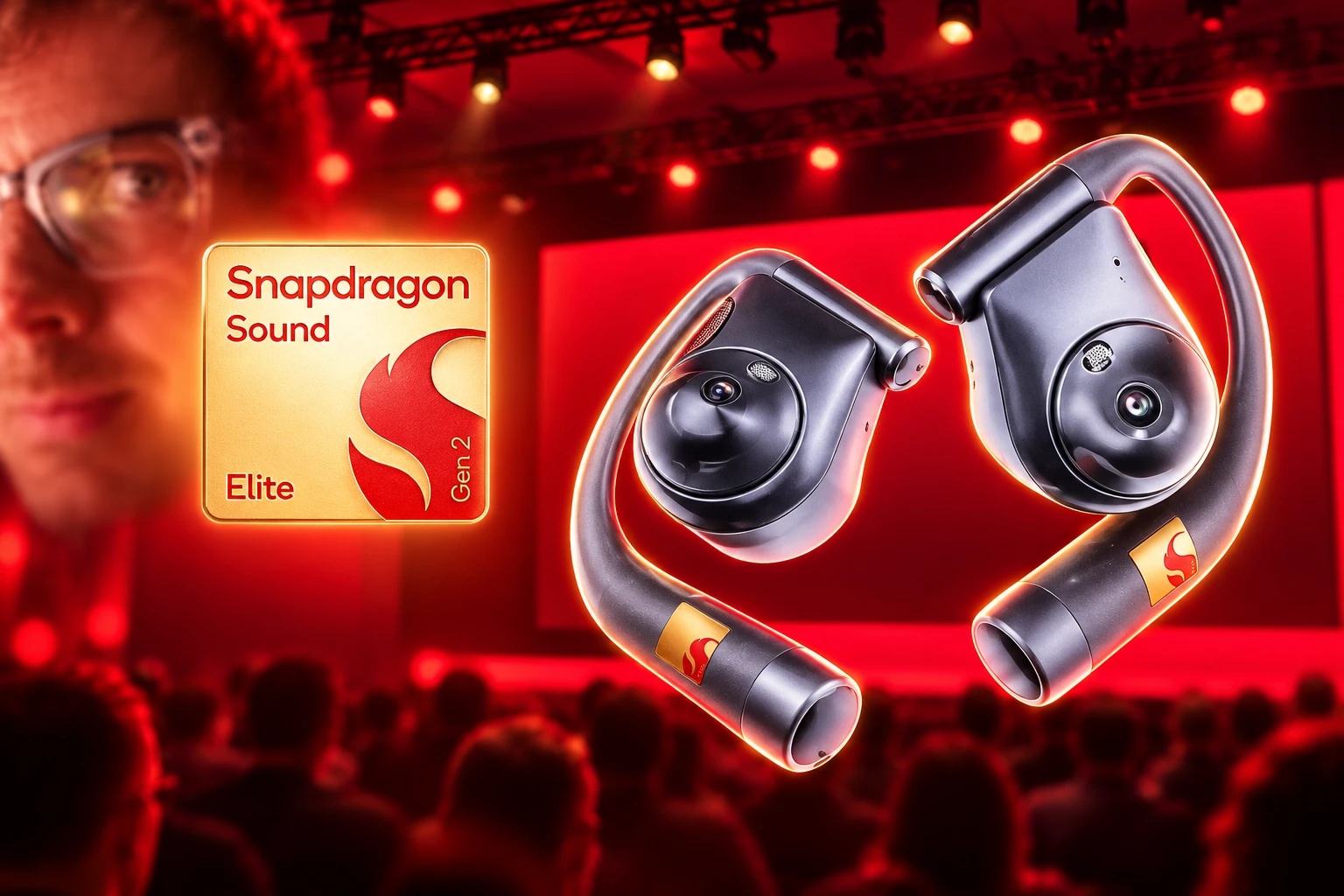
The same summit day brought camera-enabled earbuds and audio glasses into Qualcomm’s audio roadmap. Snapdragon Sound Elite Gen 2 is the first Sound platform Qualcomm calls purpose-built for personal AI, folding premium audio, on-device models, and micro-power Wi-Fi 6E into one hearable chip.
Ziad Asghar, senior vice president and general manager of XR, Wearables, and Personal AI, tied the chip to a Qualcomm Personal AI Report finding that up to 70% of users want advanced AI in wearables. He said those sessions will not always run through a screen, and that people will expect to speak to an assistant and get help in the moment, including translation, contextual help, personalized hearing, and “multimodal interactions that combine audio, vision, and AI.”
SOUND ELITE GEN 2 VERSUS S7 GEN 1
| Measure | Snapdragon S7 Gen 1 | Sound Elite Gen 2 |
|---|---|---|
| Peak AI compute in Qualcomm’s test | 64 GOPS | 128 GOPS |
| MACs per cycle | 128 | 256 |
| Clock used for that comparison | 250 MHz | 250 MHz |
| Power, idle Wi-Fi simulation | Baseline | Up to 40% lower |
| Platform footprint | Baseline | Up to 30% smaller |
Those figures are Qualcomm’s own comparisons, run in July and August 2026. The 2x AI claim is 128 GOPS against 64 GOPS at the same clock. The up to 40% power cut is a Wi-Fi-connected idle case, a design simulation of a 0.6 mA target against 1.0 mA, still waiting on final silicon measurements. Real runtime will belong to whoever builds the buds, the case, and the radios. The product brief lists up to 128 GOPS of AI acceleration on the eNPU, plus 5th-generation Adaptive ANC, aptX Lossless, and XPAN.
Micro-power Wi-Fi 6E is the quieter change. Earbuds on this platform can talk to cloud assistants and to Snapdragon Sound Apps & Agents without routing every turn through a phone. Qualcomm also listed hearing devices, open-ear designs, and “future multimodal wearables,” and it is handing OEMs reference designs to prototype faster.
Cleer showed an early look at an audio, vision, and AI wearable on a Snapdragon Sound platform. Qualcomm framed those cameras as a way to gather context on the user’s surroundings, rather than to capture photos. It did not announce a Cleer ship date or a retail name.
Why the Sensing Camera Stays This Blurry
Low resolution is doing two jobs at once. It keeps the sensing hub in a power band that can run while the main processor sleeps, and it is Qualcomm’s proof that the pipe cannot identify a stranger. The company is selling incapacity as a privacy feature.
WHAT THE SENSING CAMERA DOES
- Finds a face: It looks for two eyes and a mouth, then marks that region in the frame.
- Covers the patch: The identifiable area is obfuscated before an AI agent is allowed to use the image.
- Keeps the scene: The agent still gets context, such as a work setting versus a home, without a usable likeness.
- Stays dim on purpose: Qualcomm said the feed is much, much, much lower than full HD, and it would not give an exact resolution.
- Does not name the person: The stated job is presence, not identity, including a nearby-person cue for hearing loss.
That is a different camera from the Spectra path on phones that still shoots 8K video. The sensing camera is the always-on, ambient one. If it were sharp enough for a face unlock, Qualcomm’s privacy claim would collapse, and the battery math would too.
Qualcomm Sold This Trick on Phones First
The branding is not new. Snapdragon 8 Gen 1 shipped with an always-on front camera that ran at low power and low resolution inside the Sensing Hub, watching for a second face during shoulder surfing or holding the display in the right orientation. A year later, with Snapdragon 8 Gen 2, Qualcomm renamed it the always-sensing camera.
Chris Patrick, then senior vice president and general manager for handsets, said the company realized that “always-on” sounds to people like “always recording.” He also said the frames did not go to the file system, and that the low resolution was as much about power as privacy, because OEMs will not turn on a background camera that costs them battery.
THE SENSING CAMERA, FOUR SUMMITS APART
- 2021: Snapdragon 8 Gen 1 ships an always-on front camera in the Sensing Hub for presence checks, not a photo roll.
- 2022: Qualcomm renames the feature always-sensing after always-on reads as always recording, and keeps the pipe off the file system.
- June 26, 2026: CEO Cristiano Amon says 6G will “transform all of us into walking cameras,” with glasses sending what people see to AI models for a fast reply.
- September 23, 2026: The same always-sensing idea is briefed as a face-covering camera for agents, and Sound Elite Gen 2 is announced with camera-enabled earbuds in the form-factor list.
Four years after the rename, the vocabulary is identical and the hardware has moved from a phone notch to an ear. Amon’s walking-cameras line sits on the same calendar as a product that puts a lens where other people cannot see it.
The Face Blur Is Optional for Partners
Asghar made the silicon case in Maui while defending smart glasses against a public that has already watched face-worn cameras walk into pubs, trains, and lawsuits. He treated the panic as a form-factor problem, not a new kind of surveillance, and he pointed at the phones already in every pocket.
For multimodal AI, I don’t really need to send all these faces for AI processing. What I really need to do is to be able to send the context: ‘Oh, I’m sitting in a conference room over here, it’s a work-like setting, it’s not my home.’ For that, I can detect the face and I can cover it up. That technology is something that we have integrated into our products and we are sharing with our partners.
Ziad Asghar, SVP and GM of XR, Wearables, and Personal AI, Snapdragon Summit
He was careful on the next point. Qualcomm provides the enabling technologies, he said, and the end device experience is developed by the customer. So far, he said, all of his glass customers ship LEDs that light when a picture is taken. He argued that a product with doubts about privacy “may not do very well,” so it is in the customer’s interest to work with Qualcomm on the tools.
That is a market hope, not a chip lock. If a partner wants raw frames to train a model, or if local cover-up adds latency to visual search, the blur can stay off. Qualcomm can share a face detector. It cannot, on the record it gave this week, force an OEM to use it.
Asghar also said younger users already live with cameras in public because of vlogging, and that “some of the concern honestly, in my opinion, is just because it’s a new form factor.” A phone still has to be lifted and aimed. An earbud camera does not.
Apple’s Camera AirPods Still Sit in 2027
Apple has spent 2026 in the same category without shipping it. Leaked footage in a macOS Tahoe 26.7 build showed AirPods used with Visual Intelligence, with a wearer holding up a book and a voiceover about saving what you see. Code around that build describes a camera sensor used as a pair across the two buds, for Siri and Visual Intelligence, not for a Camera-app roll of photos and video.
Separate reports have described a small LED that would light when visual data is sent to the cloud, and they have bounced the launch between a 2026 window and 2027. Apple has not confirmed a product, a date, or a resolution. The leaked design is still a camera in the stem, sold as an assistant’s eyes.
Qualcomm’s advantage is not a finished bud you can buy tomorrow. It is a platform Android audio brands can design to now, with a privacy script already written, while Apple’s camera AirPods remain a 2027 rumor. Cleer’s demo is still a concept. The chip, the reference designs, and the face-cover story are what Qualcomm put on the table this week.
A Camera in the Ear Is Harder to See
Glasses have to win space on a face, and they advertise a lens even when a recording LED is off. Earbuds already sit in the ear for commutes, calls, and gym hours, which is why a camera there is a smaller social object and a worse one for bystanders who never get a raised phone as a warning.
WHAT IS ON THE RECORD, AND WHAT IS NOT
- On the record: A sensing camera in the hub detects a face and covers it, at a resolution Qualcomm calls much, much, much lower than full HD.
- On the record: Sound Elite Gen 2 supports camera-enabled earbuds, ships reference designs, and was shown with a Cleer concept.
- Not named: The partners Qualcomm says already use the sensing camera.
- Not shipping: A priced camera-earbud SKU, a forced blur for every OEM, or an Apple camera AirPod you can order.
The hearing-loss cue is the cleanest use Qualcomm offered, because presence is the whole point and identity is the thing it claims to throw away. Translation, scene-aware assistants, and phone-free cloud sessions are the rest of the pitch, and they only work if the camera is allowed to look.
Qualcomm built a camera that is bad at faces on purpose, then put it on a hearable chip that can stay on and call the cloud without a phone. The cover-up is in the silicon. Whether it is on when the bud leaves the factory is still the OEM’s call.

Edinburgh Opens a 2027 Tour Built for Time Trials

Korda Maps Auður From Meðalland to Irvine Bay

Apple Music Films Its New Logo in Mineral Oil

Oppo Prices the Pad Mini Above India’s iPad Mini

Austen Soaks Scotland Before Boelo Brings Weekend Gales

Volkswagen Sells the Osnabruck Plant to Clear a Board Fight

Apple’s Foldable iPhone Hinges on Samsung Display Supply

Tata Motors’ Iveco Tender Opens as Holders Still Decide

Saksham Gaur Finds He Is His Own Company’s Client

Onimusha Way of the Sword Preload Hits a Windows 11 Wall
-
 AUTO2 months ago
Volkswagen Sells the Osnabruck Plant to Clear a Board Fight
-
 NEWS2 months ago
Apple’s Foldable iPhone Hinges on Samsung Display Supply
-
 AUTO2 months ago
Tata Motors’ Iveco Tender Opens as Holders Still Decide
-
 BUSINESS2 months ago
Saksham Gaur Finds He Is His Own Company’s Client
-
 GAMING2 months ago
Onimusha Way of the Sword Preload Hits a Windows 11 Wall
-

 BUSINESS2 months ago
Hyderabad 22-Carat Gold Jumps After a False Bargain
-

 ENTERTAINMENT3 years ago
What is SD on Amazon Prime? – All You Need to Know
-

 NEWS2 months ago
iQOO 16 Locks 8,400 mAh While 100W Charging Holds