
LIFESTYLE
Scotland’s National Unicorn Still Stands in Gold Chains
Scotland’s national animal is a unicorn bound in gold, a royal boast that outlived the 1603 union and still faces England’s lion on the arms.

Scotland’s national animal is a unicorn, and on the royal arms that unicorn is bound in a gold chain. Scotland.org, the national brand site, presents the horse-like creature as the country’s emblem, a sign of purity, power and stubborn independence.
Look at the supporters of the shield, though, and a gold chain runs from a coronet at its throat, between its forelegs and over its back.
A Gold Chain Around an Untameable Neck
The National Trust for Scotland says Scottish unicorns in heraldry are always shown with gold chains wrapped around them. The Trust’s reading is a boast, not a surrender: the chain showed that Scottish kings had the strength to tame the untameable.
These proud, untameable creatures are fiercely independent and famously difficult to capture or conquer, which will sound familiar to anyone who has read their Scottish history.
James Walsh, National Trust for Scotland
VisitScotland, the national tourism body, makes the same claim in plainer words. The unicorn was held to be the strongest of animals, wild and untamed, and humble only before a virgin maiden. The gold binding, VisitScotland says, may show that Scottish kings were strong enough to hold even that beast.
A popular reading treats the chain as England locking Scotland down after the crowns joined. That is the wrong century and the wrong king. James III was already putting a crowned, chained unicorn on gold in the 1480s, more than a hundred years before a Stewart sat in London.
The chain is part of the blazon, not a later graffiti. It is a coronet around the neck with a chain fixed to it, passed between the forelegs and thrown back over the spine, the heraldic recipe for a creature too dangerous to walk free.
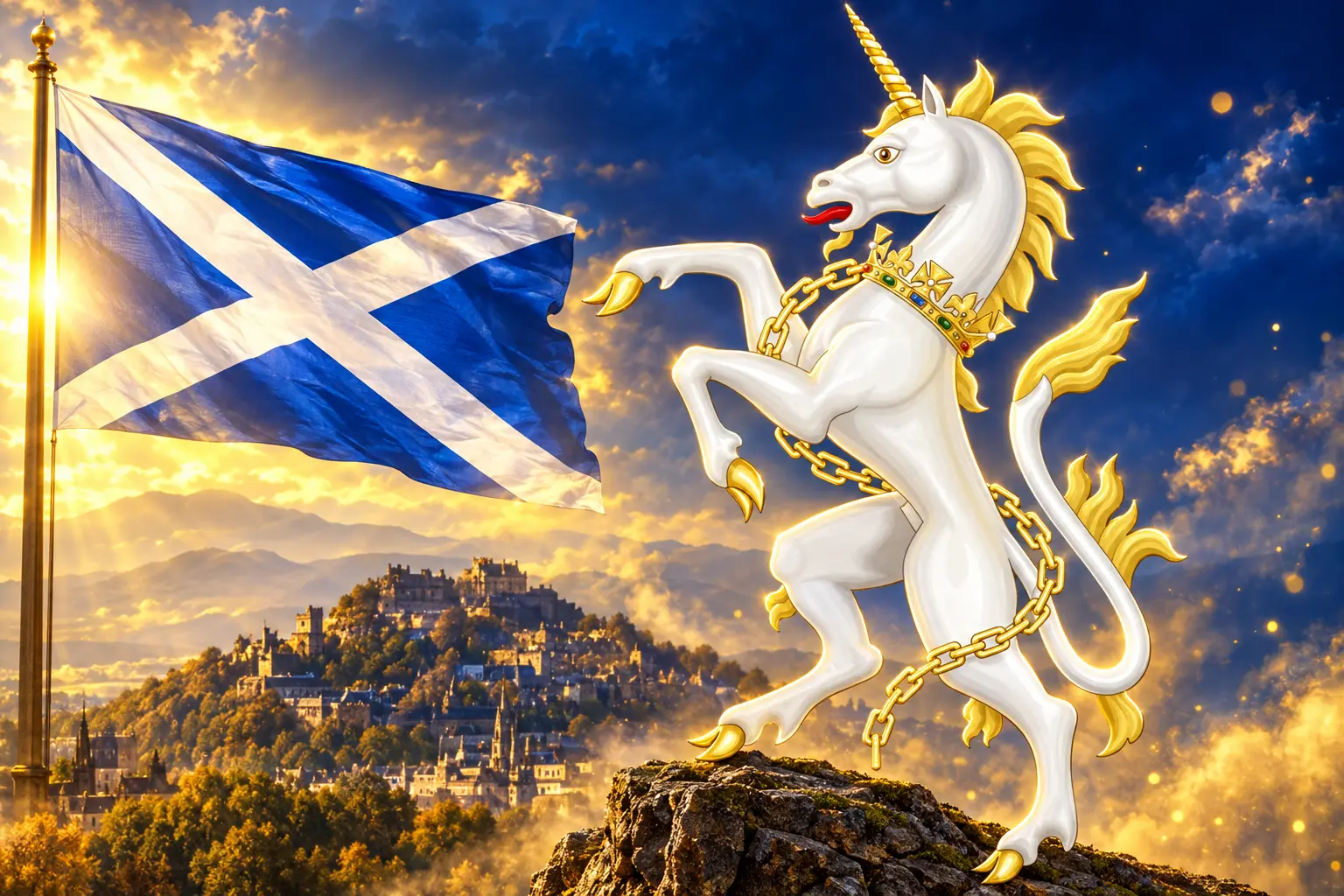
James VI Sat the Unicorn Beside England’s Lion
Until the Union of the Crowns, the Scottish royal arms were supported by two unicorns. On 24 March 1603, James VI of Scotland also became James I of England. One unicorn came off. The English lion came on.
The two beasts already had a legend as natural enemies, a fight for the title of king of beasts that later leaked into a nursery rhyme: the lion and the unicorn were fighting for the crown, and the lion beat the unicorn all around the town. Lewis Carroll later walked both animals through Through the Looking-Glass. On the actual arms the fight was settled by placement, not by a knockout.
James did not use one design for both kingdoms. An elegant split, described in the Heraldry Society’s account of the Royal Arms as used in Scotland, put the Scottish unicorn on the dexter, the honour side from the shield bearer’s point of view, crowned and holding a lance with St Andrew’s cross. South of the border the English lion takes that honour side and the unicorn stands to sinister.
HOW THE ARMS CHANGED IN 1603
| Version of the arms | Honour side (dexter) | Other side (sinister) |
|---|---|---|
| Scotland before 1603 | Unicorn | Unicorn |
| Arms as used in Scotland after 1603 | Crowned Scottish unicorn | Crowned English lion |
| Arms as used in England after 1603 | Crowned English lion | Scottish unicorn |
The Scottish version still loads the frame with thistles and keeps the unicorn where precedence sits. The English version does the reverse. Both still show the chain.
The 18-Shilling Gold Unicorn
Long before anyone printed “national animal” on a tourism page, the beast was money. The British Museum holds a gold unicorn of James III, struck about 1484-5. The obverse is a unicorn with a crown around its neck, supporting the shield of the lion rampant. The reverse is a wavy star on a cross. It weighed 3.780g and was first worth 18 shillings Scots.
By the 1520s the same coin had been raised to 20 shillings as gold prices moved. Issues ran until 1525, through James IV and into James V, who then replaced it with the gold crown. Because the design was handsome, Scottish kings used it as a diplomatic gift. In 1503 James IV gave 100 unicorns to Lord Dacre, the English ambassador.
THE UNICORN ON SCOTTISH GOLD
- Twelfth century: Scotland.org and VisitScotland say William I, also called William the Lion, put a unicorn on the Scottish royal coat of arms.
- 1484-5: James III issues the gold unicorn coin at 18 shillings Scots.
- 1503: James IV gives 100 unicorns to Lord Dacre.
- 1525: The last gold unicorns are issued; James V moves to the gold crown.
- 1538: James V’s King’s Fountain at Linlithgow Palace is built with a stone unicorn among its carvings.
- 24 March 1603: James VI becomes James I of England; one unicorn on the arms is replaced by the English lion.
William I’s nickname is the joke hiding in the record. The king later credited with adopting the unicorn was already known as the Lion. Scotland ended up with both beasts, then had to watch them stand on the same shield.
Why Is the Unicorn Scotland’s National Animal?
Celtic stories treated the unicorn as a mix of purity and force, innocence and male power, the animal that would not be taken. VisitScotland says those tales of dominance and chivalry are a reason it was chosen, and that Scots would fight to remain unconquered as the beast would. Scotland.org adds bravery, strength and determination, and notes that many people once believed unicorns were living creatures.
The other reason is the neighbour. English royalty had taken the lion. Folklore already set lion against unicorn. Putting the enemy of the lion on the Scottish shield was a heraldic reply that needed no speech from a parliament. After 1603 that reply had to live on the same arms as the lion it was meant to answer.
Brand Scotland’s site says unicorns first featured around the 12th century on the royal coat of arms. That is the official tourism dating. It is not the same thing as a surviving object from William I’s reign, and it is not a modern statute that names a national animal in the way a parliament names a flag.
WHAT WE KNOW
- The designation: Scotland.org and VisitScotland both present the unicorn as Scotland’s national animal, and it remains a supporter of the royal arms.
- The first hard object: James III’s gold unicorn, from about 1484-5, is a dated royal use of the chained beast.
- The 1603 change: Two unicorns became one unicorn and one English lion, with different honour sides in Scotland and in England.
WHAT IS UNCONFIRMED
- A single adoption year: No surviving William I object has been produced for the 12th-century claim, and heritage writers do not agree on the first carving.
- A founding text for the day: National Unicorn Day is marked on 9 April, but no proclamation or named founder is documented.
The gap between those lists is the point visitors trip over. The unicorn is official in the sense that the state brand and the tourism board say so, and in the sense that it still holds up the royal shield. It is not official in the sense of a dated Act that picked it over the golden eagle or the red deer.
Stone Unicorns Still Guard Palaces and a Warship
The living animal was never the product. The product is masonry, tapestry and a ship’s prow. VisitScotland publishes places recommended for unicorn-spotting for anyone willing to look up.
WHERE THE UNICORNS STAND
| Place | What you see | Setting |
|---|---|---|
| Palace of Holyroodhouse, Edinburgh | Unicorn on the gatepost and at the Queen’s Gallery gatehouse | The monarch’s official residence in Scotland |
| Edinburgh Castle | Unicorn by the National War Museum and St Margaret’s Chapel | The fortress on the city’s rock |
| Linlithgow Palace | Unicorn on the King’s Fountain, built for James V in 1538 | Birthplace of Mary, Queen of Scots |
| Stirling Castle | Hunt of the Unicorn tapestries; a unicorn on the Great Hall | A favoured Stewart royal seat |
| HM Frigate Unicorn, Dundee | Unicorn figurehead on a wooden warship launched in 1824 | VisitScotland calls it Scotland’s only surviving wooden warship, and one of the six oldest ships in the world |
| Mercat crosses, including Prestonpans and Culross | Unicorn finial on the old market cross | The civic heart of burghs |
Mercat crosses matter because they were not palaces. They were the marker of trade in ordinary towns, the place of proclamations. Putting a unicorn on the pillar put the royal beast in the middle of the market. Prestonpans, east of Edinburgh, still has that finial. Culross has another. The National Trust for Scotland tells visitors to look up in Dunfermline and Falkland as well.
At Falkland Palace the Trust preserves a painted panel of Mary, Queen of Scots’ coat of arms: two unicorns, saltires in their grip, the pre-1603 arrangement frozen on wood. The later compromise lives on the national arms. The older double unicorn still hangs in Fife.
National Unicorn Day Follows a Scientific Rebuke
For a long stretch of European history the unicorn was not a joke. Horns sold by apothecaries, later shown to be narwhal tusks, were treated as proof. The National Trust for Scotland notes that in 1825 the French naturalist Georges Cuvier tried to close the file. An animal with a split hoof, he said, could never grow a single horn from its head.
Scotland did not take the animal off the arms. It gave it a calendar slot. National Unicorn Day is 9 April each year, a date Scotland.org and VisitScotland both advertise, with no documented founder and no royal warrant behind it. The day rode in on the same modern unicorn wave that put the word on children’s lunchboxes and, later, on billion-dollar start-ups.
HOW THE MYTH STAYED IN PUBLIC
- The science: Cuvier’s 1825 objection treated a cloven-hoofed one-horned horse as an anatomical dead end.
- The day: 9 April is now marked as National Unicorn Day on the national brand site.
- The tourism brief: VisitScotland still sends visitors to palaces, crosses and the Dundee warship rather than to a zoo.
The rainbow version of the unicorn and the chained heraldic one now share a name and almost nothing else. One is a stationery motif. The other is a white supporter with a coronet at the throat, still posted at Holyroodhouse for anyone walking up to the palace gate.
Frequently Asked Questions
When Did Unicorns First Appear on Scottish Royal Arms?
Katie Stevenson, then keeper of Scottish history and archaeology at National Museums Scotland, said the first traceable use came in the 15th century, when James I, King of Scots, adopted the unicorn as a royal symbol, though it may have been used earlier. A weather-worn carving of unicorn supporters over the gateway at Rothesay Castle is held to date no later than the reign of Robert III, who died in 1406.
Why Do Scottish Unicorns Wear Gold Chains?
Unicorns chained in this fashion belong on the arms of the Scottish and British monarchs. Nobles such as the Earl of Kinnoull needed special permission even to bear the unicorn, chained or not. The chain is a claim that the crown could hold a beast legend treated as stronger than a lion, and it was already on James III’s gold before any union with England.
Did People in Scotland Believe Unicorns Were Real?
For centuries, educated Europe treated the horn as a real drug against poison. Spiral “alicorns” sold by apothecaries were narwhal tusks, and in 1636 the Danish scholar Ole Worm matched those horns to the Arctic whale. Cuvier’s 1825 anatomical objection arrived after Scottish kings had already put the unicorn on coins and on James V’s fountain at Linlithgow.
What Is National Unicorn Day?
It falls on 9 April each year. No founder, campaign or royal proclamation for that date has been documented. In 2017 VisitScotland marked it with a 2.1 metre (7 ft) willow unicorn by the artist Woody Fox at the Crawick Multiverse in Dumfries and Galloway.
Where Else Do Unicorns Appear in Scottish Collections?
Beyond the palaces and mercat crosses, the National Trust for Scotland holds a silver gilt cup chased with a unicorn in the wine cellar at Brodick Castle, a gilt military gorget with Hanoverian arms at Castle Fraser, a Dutch oak cupboard with a unicorn panel at Crathes Castle, an alms plate with a unicorn beneath a tree at Culross Palace, and that Falkland panel of Mary, Queen of Scots’ two-unicorn arms.
The unicorn on the royal arms still has that chain passing between its forelegs and over its back, more than four centuries after James sat it beside the lion. The gatepost at Holyroodhouse is the same animal in stone, horn up, collar on, waiting for the next person who thinks Scotland picked a fairy tale.

Edinburgh Opens a 2027 Tour Built for Time Trials

Korda Maps Auður From Meðalland to Irvine Bay

Apple Music Films Its New Logo in Mineral Oil

Oppo Prices the Pad Mini Above India’s iPad Mini

Austen Soaks Scotland Before Boelo Brings Weekend Gales

Volkswagen Sells the Osnabruck Plant to Clear a Board Fight

Apple’s Foldable iPhone Hinges on Samsung Display Supply

Tata Motors’ Iveco Tender Opens as Holders Still Decide

Saksham Gaur Finds He Is His Own Company’s Client

Onimusha Way of the Sword Preload Hits a Windows 11 Wall
-
 AUTO2 months ago
Volkswagen Sells the Osnabruck Plant to Clear a Board Fight
-
 NEWS2 months ago
Apple’s Foldable iPhone Hinges on Samsung Display Supply
-
 AUTO2 months ago
Tata Motors’ Iveco Tender Opens as Holders Still Decide
-
 BUSINESS2 months ago
Saksham Gaur Finds He Is His Own Company’s Client
-
 GAMING2 months ago
Onimusha Way of the Sword Preload Hits a Windows 11 Wall
-

 BUSINESS2 months ago
Hyderabad 22-Carat Gold Jumps After a False Bargain
-

 ENTERTAINMENT3 years ago
What is SD on Amazon Prime? – All You Need to Know
-

 NEWS2 months ago
iQOO 16 Locks 8,400 mAh While 100W Charging Holds