
NEWS
Museum Restores the Face of Inveresk’s Beheaded Migrant
Scientists have restored the face of a southern British man beheaded after death at Roman Inveresk, a grave that records Rome’s brief Scottish frontier.

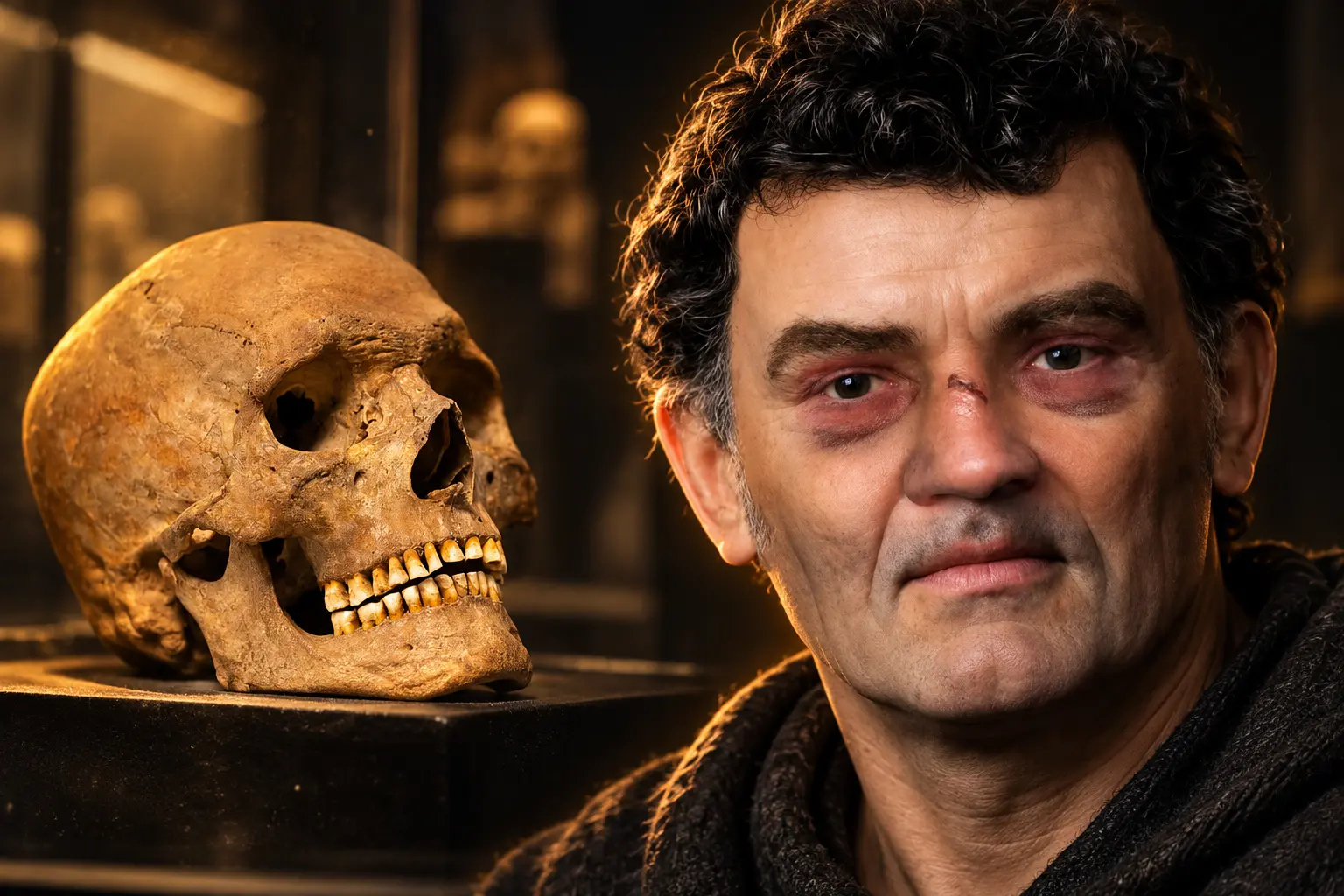
National Museums Scotland has put a face on a man who died at Inveresk, near Edinburgh, between AD 140 and 165. He was in his early 50s, born in southern Britain, and had walked hundreds of miles to the Firth of Forth.
His skull will sit beside that digital likeness in Roman Scotland: Life on the Edge of Empire. Four of the six adult men buried around the fort, including him, had their heads cut off after they died.
His Right Arm Could Not Swing a Sword
Museum osteoarchaeology found a thick growth of bone around his right elbow, likely from septic arthritis, that would have left him with little use of that arm. A broken nose had healed. Several other injuries marked the skeleton. He was not a soldier at the time of death, because he could not have swung a sword.
Dr Chris Rynn, a craniofacial anthropologist and forensic artist, built the portrait from that skull and from the science sitting behind it. An osteoarchaeological assessment at the museum was combined with older isotope work led at Durham University and with ancient DNA research by a team at the University of York and Harvard Medical School.
Dr Fraser Hunter, principal curator of prehistory and Roman archaeology at National Museums Scotland, has handled the Inveresk finds for years. The face, he said, is the first time one resident has looked back.
I have worked with the finds from Roman Inveresk for years, but this facial reconstruction finally gives me a sense of what one of its inhabitants looked like. Archaeology tells us about people who had hopes and fears just like us, and it is a privilege to present a vision of this resident of Inveresk using contemporary scientific techniques. We cannot know how exactly he looked, but we think his family and friends would have spotted the likeness.
Dr Fraser Hunter, principal curator of prehistory and Roman archaeology, National Museums Scotland
Rynn’s method is forensic before it is painterly. Soft tissue depths and muscle are modelled to the bone; eyes, nose, mouth and ears are estimated from skull shape. Hair, skin and the last polish of a living face are where art fills gaps the bone cannot close. Hunter’s caution sits on that last layer. The elbow, the nose and the cut that took the head do not.
Four of the Six Adult Men Were Beheaded After Death
The graves are not a new discovery. CFA Archaeology dug them between August and November 2010 on the site of the new Musselburgh Primary Health Care Centre, south of Inveresk Road, in the civil ground around the fort. Human burials from Roman Scotland are scarce. This group is scarcer still.
Six Roman inhumations came out of discrete pits, all adult men, two of them young and four middle-aged or older. A horse was buried in its own pit at about the same time. Four disarticulated skulls lay at the base of later midden, two of them close to the grave that held the reconstructed man. The 2020 field report records that four of the six Roman burials were decapitated, each skull set back in the pit in a different place.
THE SIX ROMAN MEN AT INVERESK
| Catalogue | Age class | Head after death | Where the skull lay |
|---|---|---|---|
| Skeleton 235 | Middle-aged to older male | Cut off | Between the legs |
| Skeleton 316 | Middle-aged to older male | Cut off | Behind the back |
| Skeleton 323 | Young adult male | Left on the neck | In place, tilted right |
| Skeleton 420 | Adult male | Cut off | At the foot of the grave, facing the feet |
| Skeleton 451 | Middle-aged to older male | Left on the neck | In place, inclined left |
| Skeleton 630, the reconstructed man | Middle-aged to older male | Cut off | Beside the right hip, right hand on the skull |
Radiocarbon on four of the bodies sits inside the Antonine decades even at the wide 95 percent bands. Skeleton 630, the man with the ruined elbow, dates to cal AD 70 to 230 at 95 percent probability and to cal AD 130 to 220 at 68 percent. The horse dates to cal AD 80 to 260. The field report ties the group to the fort’s occupation around AD 142 to 165. None of the six had clear grave goods. A few sherds, a hobnail, an iron pin and some animal bone look like backfill, not offerings.
Why the Heads Came Off Is Still Unsettled
National Museums Scotland will not pick a single motive. The cut may have answered supernatural worry, or beliefs about how these men died, or it may have been punishment. The heads were removed after death, which already separates Inveresk from later cemeteries where a sword blow killed the person.
Across Roman Britain, decapitation burials are a minority rite, about 2 to 3 percent of inhumations in the tally used by the Cambridge Archaeological Unit at Knobb’s Farm in Cambridgeshire. Most securely dated English examples sit in the 4th century. Robert Philpott’s older survey put the share of 4th-century burials at around 2.5 percent, with a cemetery range from 1.6 percent to 31.4 percent. Inveresk, if it belongs with the fort, is 2nd century, among the earliest known cases in Britain and the first in Scotland. Four heads from six men is not a scatter. It is the rite for this group.
WHERE EXPERTS DISAGREE
- Museum reading: Dr Jess Thompson, curator of osteoarchaeology at National Museums Scotland, treats the Inveresk cuts as an exceptional survival whose meaning is still open, and names afterlife fear, the manner of death, or punishment as live options.
- Later judicial cases: At Knobb’s Farm, osteology on 17 decapitated bodies in three small late Roman cemeteries led the excavators to argue that some people were killed by the sword, two of them likely kneeling, which fits execution better than a funeral.
- Not always an outcast: Belinda Crerar’s Cambridge thesis on the rite in the 3rd and 4th centuries found that decapitated people were often buried by the same rules as their neighbours, which weakens the habit of calling every such grave deviant.
The Inveresk poses do not look like a single drill. One skull sits between the legs, one behind the back, one at the foot of the grave, one under the owner’s own right hand. If the aim was to stop a ghost walking, the method was local and improvised. If it was a sentence, the court left no writing.
READINGS STILL IN PLAY
- Afterlife care: The head is moved so the dead cannot reassemble, a fear recorded in later folklore even when Latin authors stay quiet.
- A shared identity: Four migrants receive the same rare rite, which may mark how they died, what they did, or the unit they served, not a birthplace they did not share.
- Penalty: Beheading was a Roman legal death, but the museum’s finding that the Inveresk cuts came after death sits badly with a killing blow.
Thompson put the scientific stake in plainer words than the portrait. The burials are rare survivals from Roman Scotland, and an interdisciplinary reading of the bones is how anyone gets at where these men had come from, what they were doing on the frontier, and what became of them. Rynn’s reconstruction, she said, joins that science to an artistic vision so a visitor meets a person rather than a case number.
Lead in His Teeth Came From English Ore
The face will pull the queue. The teeth already answered the travel question. Joanna Moore, Janet Montgomery and colleagues at Durham University ran carbon, nitrogen, oxygen, strontium and lead isotopes on seven of the Musselburgh skeletons and published the results in the Journal of Archaeological Science: Reports.
Diet among the Roman dead was ordinary for the province, a terrestrial C3 protein signal with mean δ13C of -20.4‰ and δ15N of +11.1‰. Origins were not ordinary. Oxygen, strontium and lead show the Roman individuals as a mixed set of incomers. Decapitation here went with migration into the Lothians, but not with one shared childhood map. Something other than a single hometown bound them.
WHAT THE LABS MEASURED ON SKELETON 630
- Age and sex: Male, middle-aged to older adult, the bracket the museum now reads as the early 50s.
- Oxygen: A drinking-water value of -5.3‰, too high for the Lothians and for most of eastern Britain, and a fit with western or southern Britain.
- Strontium: 0.7098, a common British ratio that does not pin a county on its own.
- Lead: Enamel lead of 6.57 ppm, the highest in the Musselburgh group, with isotope ratios that sit with contemporary English burials and the English ore field, evidence he spent his childhood within southern Britain.
Another decapitated man in the same cemetery, Skeleton 235, carries lead isotope ratios that point to a childhood outside Britain, in a part of Europe with younger lead, such as Spain or Italy. Skeleton 323, a young man whose head was not removed, has a low lead load of 0.35 ppm, in the range of natural background. The reconstructed man is the southern British incomer with the wrecked elbow. He is not the whole story of the graveyard.
A portrait always invites a fight over skin and hair, as if complexion were the proof of origin. The harder evidence is already in. Ancient DNA work at York and Harvard places this man in southern Britain, and the Durham series shows the Inveresk graves were not a local clan. Iron Age burials on the same ground, by contrast, look isotopically local to the Musselburgh area. The people who lost their heads were the people who had arrived.
Inveresk Rose and Fell With the Antonine Wall
He died in a window that barely outlasted a reign. Emperor Antoninus Pius ordered a new northern line after AD 139 to 140. Construction of the Antonine Wall, turf on a stone base across the Forth-Clyde isthmus, started around AD 142. Inveresk was one of the coastal forts that sat off the east end of that line, a supply and garrison post on the Forth rather than a wall turret.
Too many maps still stop at Hadrian’s Wall. National Museums Scotland’s own primer on the period is blunt that the Roman world stretched much further north, into the central belt and at times deep into the north-east, for stretches across almost four centuries. Inveresk is what that northern peak looked like on the ground: a stone fort with a busy town against its east rampart, fields, middens, and a temple to Mithras that is the most northerly yet found anywhere in the empire.
The wall did not hold. Decision to give it up came in or around AD 158, and abandonment may have stretched past 158 for six years or more, into AD 164 or later, before Hadrian’s Wall was restored as the working frontier. Inveresk’s datable pottery is Antonine. The fort is read as founded after the invasion and empty around AD 160 to 165, when the northern garrisons fell back. The man in grave 631 died inside that short occupation. His ruined arm means he was not on the rampart at the end. He was still buried as one of the fort’s people.
THE ANTONINE YEARS THAT FRAME THE GRAVE
- AD 139 to 140: Antoninus Pius launches the reconquest of southern Scotland under governor Lollius Urbicus.
- About AD 142: Work begins on the Antonine Wall; Inveresk is established as a coastal fort with a growing civil settlement.
- The 140s: The Inveresk Mithraeum is fitted with two carved stone altars, later recovered and conserved for this exhibition.
- About AD 158 to 164: Rome decides to abandon the wall; garrisons pull back toward Hadrian’s Wall.
- AD 140 to 165: The reconstructed man dies at Inveresk, is beheaded after death, and is buried in pit 631.
Samian bowls dumped in the fort’s midden carry personal names scratched on the bases. Those names, with the isotopes, are why the excavators described a garrison and town of mixed origin, the pattern anyone should expect of the Roman army and the people who followed it. The reconstructed man is one of those followers, or a veteran the elbow had already retired, or a craftsman, trader or dependent the bone cannot rank. The sword test only tells us what he was not, at the end.
What Visitors Will See Beside His Skull
The likeness and the bone will be shown together. That is the oddity the show is willing to stage. A face modelled for recognition will hang beside the skull that was taken off and laid against his hip, the right hand placed on it as if to keep it there.
Roman Scotland: Life on the Edge of Empire opens on 14 November 2026 and runs to 18 April 2027 at the National Museum of Scotland on Chambers Street, Edinburgh. Advance adult tickets are £13.50, or £15 on the day. Over-65s pay £12.50 in advance. Children aged 5 to 15 pay £9. Members enter free, and a members’ preview runs on Friday 13 November from 8:30 to 17:00. Membership itself is advertised from £45 a year.
The museum has already said the show will put Inveresk at the centre of a bigger argument: Rome did try to hold Scotland, more than once, and the question is how local groups met that invasion, from fighting to deals. Loans from across Europe sit with finds that have not been shown together before. School sessions are already on the books, including a workshop that asks what it was like for people in Inveresk and Musselburgh when the army made camp.
The Northernmost Mithras Temple Reaches the Gallery
The face is the new object. The altars are the centrepiece the museum has been building toward since winter. Two stone altars from the Inveresk Mithraeum, newly conserved, will go on display for the first time. They date to the 140s, when southern Scotland was reoccupied, and they are the only altars of their kind found in Scotland. Hunter has called them sumptuous work, with traces of paint and lighting effects cut into the design, the beliefs of a frontier garrison carved at high cost.
Around the fort lay a town of soldiers and their families, traders, craftworkers and enslaved people. Locals on occupied land had to deal with that influx. Hunter, announcing the exhibition in February 2026, said it is the first to explore Roman attempts to conquer Scotland in detail, asking why they failed, what they did to the people already there, and what they left. The Inveresk material, he said, takes visitors past the soldiers and into a mixed frontier community at the peak of the occupation.
That community buried a southern British man with a wrecked right arm and a healed nose, then cut off his head and put it back under his hand. Almost 2,000 years later the same institution that holds his skull has given him a face and set the two things side by side. Visitors can decide whether that is a reunion or a second display of the same head.

Edinburgh Opens a 2027 Tour Built for Time Trials

Korda Maps Auður From Meðalland to Irvine Bay

Apple Music Films Its New Logo in Mineral Oil

Oppo Prices the Pad Mini Above India’s iPad Mini

Austen Soaks Scotland Before Boelo Brings Weekend Gales

Volkswagen Sells the Osnabruck Plant to Clear a Board Fight

Apple’s Foldable iPhone Hinges on Samsung Display Supply

Tata Motors’ Iveco Tender Opens as Holders Still Decide

Saksham Gaur Finds He Is His Own Company’s Client

Onimusha Way of the Sword Preload Hits a Windows 11 Wall
-
 AUTO2 months ago
Volkswagen Sells the Osnabruck Plant to Clear a Board Fight
-
 NEWS2 months ago
Apple’s Foldable iPhone Hinges on Samsung Display Supply
-
 AUTO2 months ago
Tata Motors’ Iveco Tender Opens as Holders Still Decide
-
 BUSINESS2 months ago
Saksham Gaur Finds He Is His Own Company’s Client
-
 GAMING2 months ago
Onimusha Way of the Sword Preload Hits a Windows 11 Wall
-

 BUSINESS2 months ago
Hyderabad 22-Carat Gold Jumps After a False Bargain
-

 ENTERTAINMENT3 years ago
What is SD on Amazon Prime? – All You Need to Know
-

 NEWS2 months ago
iQOO 16 Locks 8,400 mAh While 100W Charging Holds