
ENTERTAINMENT
The Flannan Keepers Were Lost to a Wave, Then a Story
The Flannan Isles lighthouse keepers vanished after a west-landing wave, while the haunted log and untouched meal were added years later in print.

Superintendent Robert Muirhead closed the Flannan Isles case on 8 January 1901 as a wave accident at the west landing. James Ducat, Thomas Marshall and Donald McArthur, the Flannan Isles lighthouse keepers on duty, were already gone. Their bodies were never found.
The version that still travels, with a praying log and a meal left untouched, was written later. Moore’s letter and Muirhead’s report describe a tidied kitchen, a wrecked west landing, and a light that failed on the night of 15 December 1900.
Joseph Moore Walked Into an Orderly Kitchen
The light stood on 38-acre Eilean Mòr, the largest of the Flannan Isles, 16 miles from the nearest point on Lewis and about 21 miles west of the island. David Alan Stevenson designed the 23-metre white tower. George Lawson of Rutherglen built it after the Board of Trade sanctioned the work in 1896, and the lamp was first shown on 7 December 1899, a little over a year before the keepers vanished.
Ducat was principal. Marshall was second assistant. McArthur, the occasional keeper, was covering for first assistant William Ross, who was on sick leave. Joseph Moore, the other assistant, was on shore duty at Breasclete on Lewis.
The steamer Archtor, with Captain Holman, passed at midnight on 15 December and could not see the light. The Northern Lighthouse Board’s own account says that sighting did not reach the Board until after the tender Hesperus found the station empty. Captain Harvie tried to land on 20 December, was beaten back by the sea, and came in about noon on 26 December, eleven days after the last morning on the slate.
No flag flew. No one answered the steam whistle, the siren, or a rocket. Moore went up the 160 steps alone. The entrance gate and the outer doors were closed. The kitchen door was open. The fire had been out for days. The beds were empty, he wrote, “just as they left them in the early morning.”
The lamp was cleaned. The fountain full. Blinds on the windows etc. We left and proceeded on board the steamer.
Joseph Moore, assistant lightkeeper, letter of 28 December 1900, Northern Lighthouse Board
Harvie’s telegram said the clocks had stopped. Muirhead later recorded that the last log entries were for 13 December, and that readings for 14 December and 9 a.m. on 15 December, including the time the light had been put out that morning, sat on a slate ready to be copied. The lamp was trimmed, the oil fountains filled, the lens and machinery cleaned, the pots washed, the kitchen tidied. Forenoon work on Saturday 15 December had been finished. The men were gone after that.
Moore went back ashore with buoymaster Allan MacDonald and seamen Lamont and Campbell, lit the lamp that night, and walked the island the next day. He found no trace of the three.
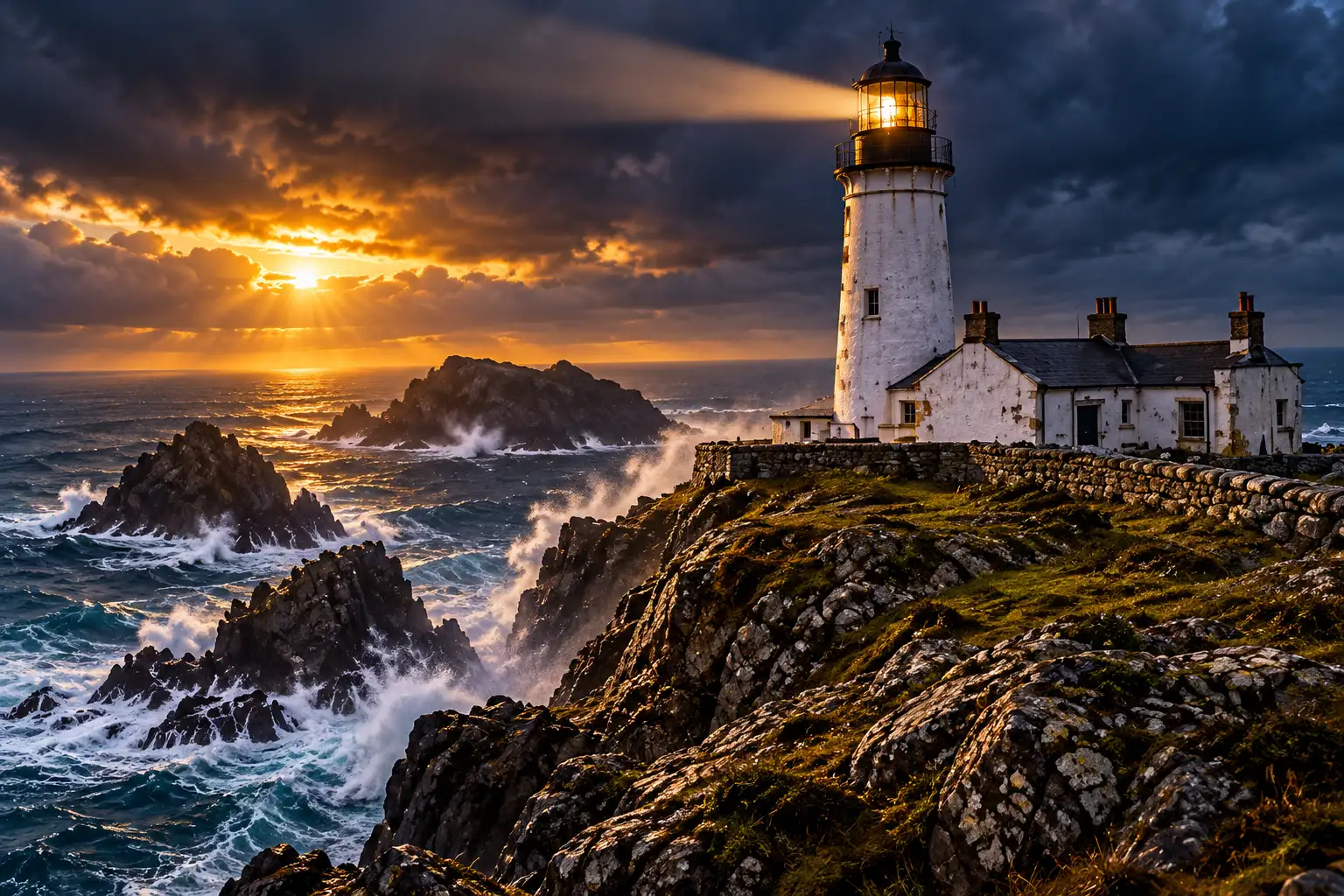
Sea Damage Reached 110 Feet at the West Landing
The east landing was untouched. Ropes coiled there after the relief on 7 December still lay in the shelter. The west side was different. Muirhead, who had recruited all three men, landed on 29 December and got down to the crane platform, 70 feet above the sea. He could not reach the landing itself for the swell.
The crane put up that summer was still lashed to the rock. There was no sign the men had been working on it. A wooden box that held mooring ropes, landing ropes, derrick ropes and crane handles, set in a crevice 40 feet above the crane deck, 110 feet above the sea, was gone. The ropes lay coiled in the rocks and around the crane legs. None of the coils had been left unfastened.
LANDING EVIDENCE ON EILEAN MÒR
| Place | Height above the sea | What was found |
|---|---|---|
| Crane platform | 70 feet | New crane unharmed and lashed; the older crane had been lost the previous winter |
| Rope and tackle box | 110 feet | Box gone; coiled ropes in rock crevices and around the crane legs |
| Iron railings | Path from the tramway to the steps | Displaced and twisted; the boat handrail carried away |
| Block of stone | Moved onto the concrete path | Upwards of 20 cwt, dislodged from higher up |
| Life buoy | 110 feet | Torn off its ropes; canvas still stuck to the lashings |
| East landing | Sheltered side | Ropes still coiled from the 7 December relief |
Muirhead first thought someone had taken the life buoy to use it. The lashings had not been undone. Sea pouring through the railings at 110 feet had ripped the buoy away and left canvas on the ropes. A block of stone weighing upwards of 20 cwt had been shifted onto the path. In Muirhead’s report of 8 January 1901 he wrote that some of this was hard to accept until you stood there.
I am of opinion that the most likely explanation of the disappearance of the men is that they had all gone down on the afternoon of Saturday, 15 December to the proximity of the West landing, to secure the box with the mooring ropes, etc and that an unexpectedly large roller had come up on the Island, and a large body of water going up higher than where they were and coming down upon them had swept them away with resistless force.
Robert Muirhead, superintendent, Northern Lighthouse Board, 8 January 1901
Moore told him the men wore sea boots and oilskins or waterproofs only when they went down to the landings. Ducat had gone out in sea boots and a waterproof. Marshall had gone in sea boots and oilskins. McArthur’s wearing coat was still inside, which, Moore wrote, showed he had gone out in shirt sleeves, as he did on other days. Wind, Muirhead judged, would have pushed them inland. Water coming down the rock face would have taken them seaward.
Walter Aldebert, principal keeper on the same rock from 1953 to 1957, later photographed spray striking the lamp house about 100 metres up, close to the light’s 101-metre elevation, and once stood in receding water after a wave rolled over the island at 77 metres. The west landing sits in a geo, a narrow cleft. In a big sea, water can rush the cave and burst back out.
The Famous Log Entries Were Never Written
The Board’s file is dry. The story that stuck is not. In 1912 the Northumberland poet Wilfrid Wilson Gibson published “Flannan Isle,” a ballad that put an untouched meal and a chair on the floor into a kitchen Moore had found washed and set in order.
Aye: though we hunted high and low, And hunted everywhere, Of the three men’s fate we found no trace Of any kind in any place, But a door ajar, and an untouched meal, And an overtoppled chair.
Wilfrid Wilson Gibson, “Flannan Isle,” 1912
Gibson also gave the rock a false past of keepers gone mad and a man dead at the foot of the lantern. The station had been lit for a little over a year. Those deaths had not happened.
A later set of “log” lines did more damage. They have Marshall writing that Ducat was irritable, that McArthur was crying and praying, and that on 15 December, at 1 p.m., the storm had ended: “Sea calm. God is over all.” Keepers did not put a principal’s mood into the official log, and they did not let a junior write it. Moore said the log was in Ducat’s hand and stopped on 13 December. The 15 December notes were weather and lamp times on a slate.
HOW THE HAUNTED LOG GOT INTO PRINT
- 7 December 1899: The Flannan lamp is shown for the first time.
- 15 December 1900: Morning work is finished and entered on the slate; Archtor finds the light dark at midnight.
- 26 December 1900: Hesperus lands Moore and the empty station is found.
- 8 January 1901: Muirhead files the wave finding.
- 1912: Gibson’s ballad adds the meal and the tumbled chair.
- 1929: True Strange Stories prints the crying-and-praying “log” under the name Ernest Fallon.
Historian Mike Dash, who spent years on the file for Fortean Studies in 1998, traced those lines to the 1929 pulp piece. Fallon appears to have been a one-off name. Dash later tied the article to journalist John L. Spivak, who was selling copy to a magazine that wanted fear on the page. Vincent Gaddis ran the same text in 1965 in Invisible Horizons, and from there it hardened into “evidence.” Dash said the lines do not fit, because they carry personal detail that would be irrelevant in a normal logbook.
The Northern Lighthouse Board, answering a later records request, said it does not hold the log and no one there knows where it is. Recaps in 2026 still open on the set table and the last pious line. Strip those out and the remaining account is the one Muirhead filed: a working station, a wrecked west landing, three missing men.
Why Did All Three Men Leave the Light?
That is the gap the wave finding does not close. On a rock station the standing rule was that the light should not be left with no one inside. Whoever went last, Muirhead noted in the wider record of the case, broke that rule. Two men in landing gear fit a job at the box. A third man in shirt sleeves fits a rush from the kitchen. It does not fit the rule.
Marshall had been fined five shillings after landing gear was lost in a gale, a hard hit on a keeper’s pay. John Love, working from the service record, put that fine on Marshall and argued he would have gone out again rather than lose more kit. The ropes in the west box were the same gear a boat needed if a relief had to land. Fear of another fine and fear of being cut off can sit in the same decision.
WHAT THE FILE STILL CANNOT SETTLE
- The third man: McArthur’s coat was on its peg, so he left in a hurry, but the file cannot show whether he was called, or saw a sea coming, or ran after the others.
- The manning rule: one keeper was meant to stay with the lamp; all three were gone, and the report treats that as a breach as well as a loss.
- The bodies: none came ashore, which fits a roller taking men seaward and does not prove it.
- The minutes: no one saw the west landing after 9 a.m. on 15 December, so the last act is inferred from clothes, the slate, and the wreckage.
Other guesses have had a long life: a fight, a secret boat, something off the old Lewis tales about the Seven Hunters. None of those left a mark on the station Moore searched. The kitchen was clean. The east gear was as it had been left on 7 December. The west rock had been hit by water high enough to move stone and tear a life buoy from its ropes. The film The Vanishing, released in 2018, put a crime on that silence. The 1901 paper trail does not.
Mary Ducat Waited at the Shore Station on Lewis
Ducat was born on 11 August 1856, the son of a ploughman, and joined the Commissioners of Northern Lighthouses on 21 November 1878, aged 22. He had been principal since April 1896, after years at other lights, the longest of them the Rhinns of Islay. He married Mary Grierson on 9 June 1882. She came from a keeper family; they had met around Inchkeith. He was 44 when the west landing took him.
He left four children and a widow: Louisa, 16; Robert, 13; Annabella, 9; Arthur, 6. The shore houses at Breasclete, built with the station at a cost of £3,526, were where those families lived while the men rotated on the rock. Marshall, who had come into the service on 27 April 1896 at 27 after work as a seaman and as an occasional keeper on Ailsa Craig, was unmarried and was survived by his father, brother and sister. McArthur, who does not appear in the permanent register as a full keeper, left a wife and two children who have been harder to pin in the files.
The lightkeeper registers in Edinburgh mark Ducat and Marshall in red ink: disappeared on or about 15 December 1900. All three names sit on the same page of the Carloway death register. The cause is written probably drowning.
Moore had to go back up the rock and keep the lamp going. Muirhead found him nervous, which is the one human note the superintendent allowed himself in a report otherwise built from clothes, coiled rope, and a stone on a path. James Ferrier was moved from Stornoway, John Milne from Tiumpan Head, and storekeeper Donald Jack was sent out so the light would not fail again while the Board looked for permanent men.
Keepers Left the Rock for Good in 1971
The station cost £6,914, landings and stairs included. The light sits 101 metres above the sea, flashes two white every 30 seconds, and is charted at 20 nautical miles. There is no public access. The Board’s station notes record that the Flannan lamp was automated on 28 September 1971, the same season a concrete helipad was poured so a party could still land when a boat could not. NLV Pharos now makes the inspection visit. The shore houses at Breasclete passed out of keeper use once the rock no longer needed a roster.
THE LIGHT ON EILEAN MÒR
- First lighting: 7 December 1899, a 23-metre white tower by David Alan Stevenson.
- Signal: two white flashes every 30 seconds from 101 metres, range 20 nautical miles.
- Manned years after the loss: keepers stayed on the rock until 28 September 1971.
- Access: none for the public; the Board’s tender makes the maintenance call.
More than 125 years after Moore opened that kitchen door, the official finding is still the one on Muirhead’s desk: a large sea at the west landing, three men in the wrong place, no one left to rewind the clock. The last minutes were not witnessed. The meal on the table, the chair on the floor, and the line about God over all were not in the room he entered. The lamp on Eilean Mòr still throws two white flashes every 30 seconds, and no keeper climbs the stair to light it.
Frequently Asked Questions
Does Anyone Still Hold the 1900 Keepers’ Log Book?
The Northern Lighthouse Board has said it does not hold the Flannan log and that no one there knows where it is. Historian Mike Dash reported that the volumes appear to have been lost around the 1901 inquest, which is why later writers could invent entries without a public original to check them against.
Can the Public Visit Flannan Isles Lighthouse?
The Board lists public access as no. The rock is a working aid to navigation, and landing still depends on the same west and east clefts that wrecked gear in 1900, so casual visits are not part of the station’s routine.
What Was Donald McArthur’s Job Title at the Station?
McArthur was the occasional keeper, a substitute brought in when a regular man was off. He was covering for first assistant William Ross, who was on sick leave, and he was not entered in the permanent lightkeeper register in the way Ducat and Marshall were.
How Is the Light Kept Going With No Keepers?
Since 28 September 1971 the Flannan lamp has been a major automatic light. The Board’s tender NLV Pharos makes an annual inspection and maintenance visit, and the old keeper roster on Eilean Mòr has not been restored.

Edinburgh Opens a 2027 Tour Built for Time Trials

Korda Maps Auður From Meðalland to Irvine Bay

Apple Music Films Its New Logo in Mineral Oil

Oppo Prices the Pad Mini Above India’s iPad Mini

Austen Soaks Scotland Before Boelo Brings Weekend Gales

Volkswagen Sells the Osnabruck Plant to Clear a Board Fight

Apple’s Foldable iPhone Hinges on Samsung Display Supply

Saksham Gaur Finds He Is His Own Company’s Client

Tata Motors’ Iveco Tender Opens as Holders Still Decide

Onimusha Way of the Sword Preload Hits a Windows 11 Wall
-
 AUTO2 months ago
Volkswagen Sells the Osnabruck Plant to Clear a Board Fight
-
 NEWS2 months ago
Apple’s Foldable iPhone Hinges on Samsung Display Supply
-
 AUTO2 months ago
Tata Motors’ Iveco Tender Opens as Holders Still Decide
-
 BUSINESS2 months ago
Saksham Gaur Finds He Is His Own Company’s Client
-
 GAMING2 months ago
Onimusha Way of the Sword Preload Hits a Windows 11 Wall
-

 ENTERTAINMENT3 years ago
What is SD on Amazon Prime? – All You Need to Know
-

 BUSINESS2 months ago
Hyderabad 22-Carat Gold Jumps After a False Bargain
-

 NEWS2 months ago
iQOO 16 Locks 8,400 mAh While 100W Charging Holds