
NEWS
Ribose Was Already Dissolving Earth’s Borate Minerals
Ribose can dissolve calcium borate minerals and keep boron in water, a UNSW study finds, so organics were changing rocks before life.

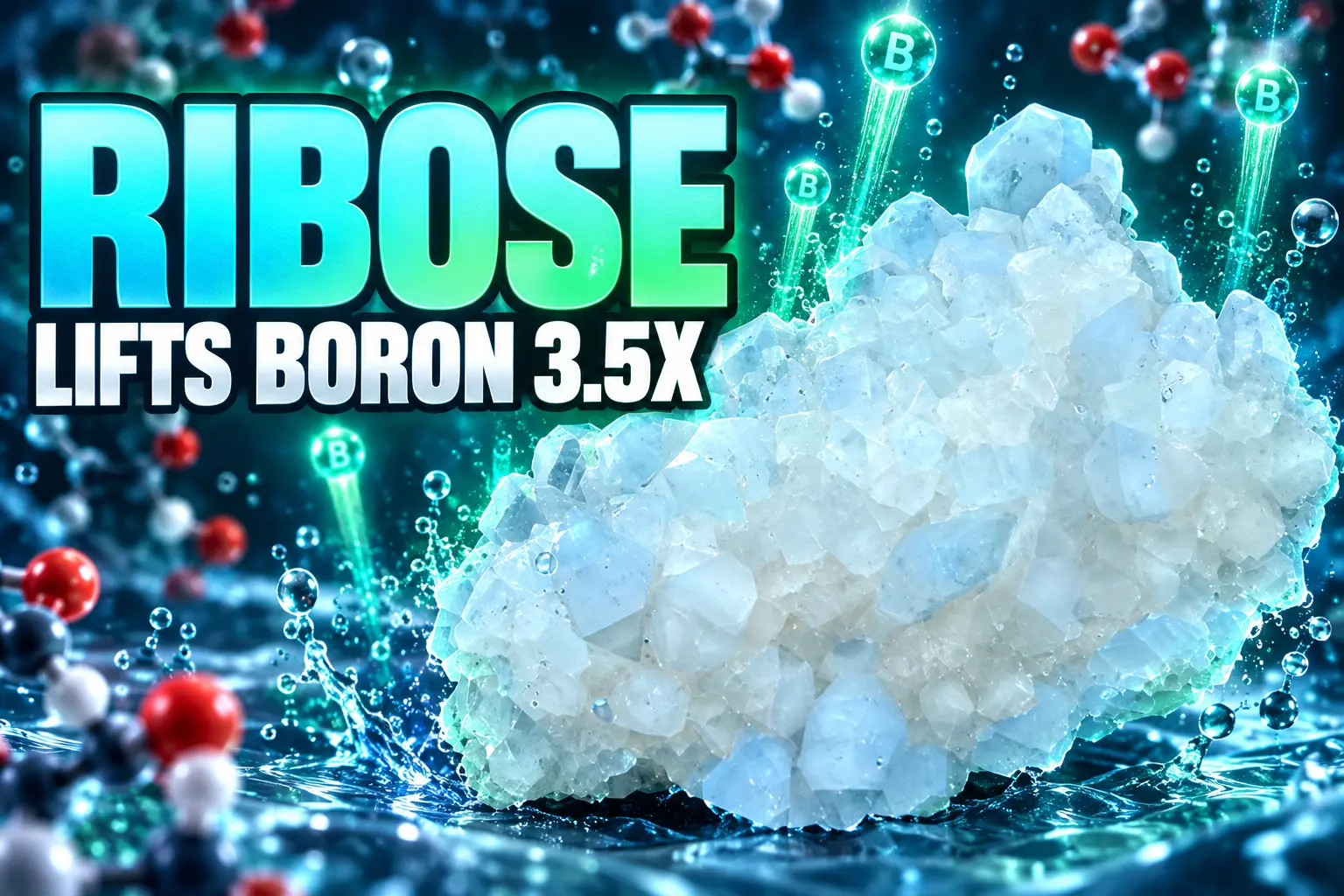
A UNSW-led team found that ribose can raise dissolved boron from colemanite about 3.5 times, even when calcium would otherwise lock the element in rock. The paper, posted by Scientific Reports on 22 September 2026, tests real borate minerals instead of bottled reagents and shows the sugar changing the water around it. That finding sits inside origin-of-life chemistry, but the new measurements are about rocks and dissolved ions, not a proof that life arrived from space.
Luke H. Steller, Dev C. Chauhan, Martin J. Van Kranendonk and Albert C. Fahrenbach work through the Australian Centre for Astrobiology at UNSW Sydney, with Van Kranendonk also at Curtin University. For two decades, origin-of-life flasks have used high borate doses because borate binds ribose and slows the sugar’s collapse into brown tar. The gap they chased is simpler: those doses do not match the boron that actually stays dissolved beside natural borate minerals.
Four Minerals, One Sugar and a 3.5-Fold Jump
The team mixed powdered borate minerals with water at pH 9.3 and 25 C, then measured boron in the liquid with 11B and 1H NMR. Ribose went into those slurries at 100 mM. Dissolved boron rose for every mineral they tried, and the biggest lift came from the calcium-rich ones that chemists usually treat as stubborn.
THE FOUR MINERALS IN THE SLURRIES
- Colemanite: A calcium borate, the least generous of the set until ribose was added.
- Ulexite: A mixed calcium-sodium borate, also a strong responder.
- Borax: A sodium borate that already dissolves more readily than the calcium pair.
- Kernite: Another sodium borate, used as a sodium-only control beside borax.
On colemanite, 100 mM ribose produced about 3.5 times more soluble boron than the mineral-water mix alone. Ulexite moved in the same direction. Borax and kernite also released more boron, but the paper’s point is the calcium pair, because calcium is the ion that usually drags borate back out of water as a solid.
Glucose Dissolved Less Rock Than Ribose
To test whether any sweetener would do, they ran the same colemanite experiment with glucose and with sucrose. Sucrose barely moved the solubility. Glucose more than doubled dissolved boron and still lagged ribose. That order matches how tightly each sugar binds borate. Ribose forms cyclic borate esters with stability constants of log β1 = 2.26 and log β2 = 4.80. Glucose sits lower, at log β1 = 1.8 and log β2 = 3.05. Sucrose does not make the same cyclic ester. The crystal is not being chewed by sugar in general. It is being pulled apart by a specific complex that keeps borate away from calcium.
Soluble Boron Hit a 150 mM Ceiling
More ribose did not mean unlimited boron. Release from colemanite stayed linear up to 300 mM ribose, then flattened. At 600 mM ribose and 25 C, dissolved boron still sat at about 150 mM, even though 0.5 g of colemanite in 5 ml of water could theoretically supply 2 M if the whole solid went into solution. The sugar can open a mineral, then it hits a wall. That ceiling is one reason the authors doubt flask recipes that push soluble boron past 250 mM in any early-Earth setting where calcium is also present.
Origin-of-Life Labs Have Been Using Too Much Boron
Since a 2004 Science paper by Ricardo and colleagues, borate has been a standard fix for ribose’s short life in alkaline water. That work found ribose falling apart in minutes without borate and lasting for days with it. Mixes that used ulexite, kernite or colemanite stayed clear for 2 months, while calcium hydroxide slurries at pH about 12 browned within an hour. The logic stuck. What also stuck were reagent bottles.
Steller’s group tabulated later RNA-world experiments and found soluble boron running from 30 to 800 mM, usually as boric acid or sodium tetraborate. Modern places that actually hold borate minerals sit much lower. In boron-rich lakes, hot springs and volcanic systems, average dissolved boron runs from 10 to 40 mM. Thick crusts can sit metres from pools that still only measure about 10 mM in the water. The solid is there. The dissolved ion is not.
BORON IN FLASKS VERSUS BORON IN THE FIELD
| Setting | Dissolved boron |
|---|---|
| Typical origin-of-life lab mix | 30 to 800 mM |
| Puga hot-spring fluids | about 10 mM |
| Andean Puna Plateau brines | 40 mM |
| Deep-sea hydrothermal fluids, maximum | 5.5 mM |
| Ribose-colemanite plateau at 25 C | about 150 mM |
The oldest boron mineral preserved from the Archean, the stretch of Earth history older than 2.5 billion years, is tourmaline, with grains dated to 3.7 billion years. Tourmaline is a hard borosilicate. It does not weather into a handy dissolved supply. If the early surface held borates at all, they were more likely colemanite or tincalconite, the same family the new slurries used. That is why bottled 500 mM borate is a convenient NMR sample and a poor groundwater.
Why Calcium Kept Boron Locked in Rock?
Calcium is efficient at stripping borate from water. Industry even uses that precipitation to clean boron out of wastewater. Formose chemistry, the alkaline route that can make ribose from formaldehyde and glycolaldehyde, also wants calcium as a catalyst. The same ion that helps build the sugar helps bury the boron that would protect it.
Ribose-borate complexes interrupt that burial. In the new runs, the complexes stopped calcium from pulling borate back into a solid, so the ion stayed available for later reactions. When they cut the sugar to 30 mM, a 1:2 ratio against soluble boron, only 35 percent of the available boron left the solution. The rest stayed dissolved. Steller put the field implication in plain language in a first-person account of the work.
We found that ribose helps borate minerals dissolve and inhibits the formation of solid grains.
Luke H. Steller, astrobiologist, University of New South Wales
He and his co-authors also wrote that tests on real minerals, including borate crusts from Puga, show how higher boron in fluids could have existed before life, because the sugar itself helps keep the element in the water. Borate still protects ribose. The new half of the pairing is that ribose keeps borate from vanishing into calcium solids. The molecule is not a passenger waiting for a mineral weather report. It is changing the report.
Puga’s Springs Hold 10 mM Beside Thick Crusts
Puga sits in Ladakh in the Indian Himalayas, a geothermal strip about 4 km by 1 km where near-neutral water comes out at about 70 C. Borax, kernite and tincalconite crust the ground around the pools. In an earlier study, Steller and Van Kranendonk mapped boron isotopes in the Puga geothermal system and reported one of the lowest modern boron-isotope values on record, δ11B = -41.0‰ in diatom-rich sediment, a fractionation they tied to tetrahedral borate going into amorphous silica rather than to simple evaporation.
The 2026 paper returns to that ground as a working analogue, not as a time machine. Spring fluids there sit at an almost constant 10 mM boron even though soluble borate minerals are piled beside the water. If you only counted the crust, you would invent a rich dissolved reservoir. If you only counted the fluid, you would say boron is scarce. Ribose is one way those two readings can diverge, because the organic molecule can hold borate in the liquid and slow the return to crust.
The authors are careful about scale. They do not picture a planet glazed in sugar. Ribose was probably patchy. Other organics, including ethylene glycol and glycerol, also bind borate, and those effects on real deposits are still open. Puga is the place they can stand today and see boron-rich rock, boron-poor water, and a reason to ask what dissolved carbon would have done to that pair.
Bennu Closed the RNA Ingredient List
The UNSW paper does not claim the ribose in its flasks fell from the sky. It sits beside a separate, cleaner inventory from asteroid Bennu. OSIRIS-REx delivered 121.6 g of Bennu regolith to Earth on 24 September 2023, curated under high-purity nitrogen at NASA’s Johnson Space Center. On 2 December 2025, Yoshihiro Furukawa of Tohoku University and colleagues reported sugars in a 603.4 mg aliquot of that powder, sample OREX-800107-108, in Nature Geoscience.
They found all four aldopentoses in Bennu samples, plus glucose and galactose. 2-Deoxyribose, the DNA sugar, stayed below detection. Daniel Glavin, OSIRIS-REx project scientist, said the team had identified six different sugars including ribose and glucose, and called glucose the first find of that sugar in any astromaterial. Furukawa said nucleobases and phosphates were already in the Bennu material, so ribose meant every RNA component was present in the same asteroid.
SUGARS MEASURED IN BENNU AND TWO METEORITES
| Sugar | Bennu (nmol per gram) | Murchison | NWA 801 |
|---|---|---|---|
| Ribose | 0.097 ± 0.014 | 0.17 | 0.03 |
| Arabinose | 0.11 ± 0.03 | 0.8 | 0.073 |
| Xylose | 0.079 ± 0.033 | 1.2 | 0.04 |
| Lyxose | 0.018 ± 0.007 | 0.044 | 0.015 |
| Glucose | 0.35 ± 0.05 | not analysed | not analysed |
| Galactose | 0.014 ± 0.004 | not analysed | not analysed |
Those Bennu numbers are traces, not a syrup. They still close a gap that meteorite work had left messy, because falls sit in soil and rain before anyone bags them. NASA had already logged ribose in Murchison and NWA 801 in 2019, with heavy carbon pointing off Earth, and Furukawa noted then that sugars had been the missing piece among the main building blocks. Steller, writing about the bombardment era, cited estimates of around a million tonnes of carbon arriving each year, and pointed to the Murchison fall in Victoria in 1969, when locals described a kerosene-like smell from the stone.
Organic Molecules Were Changing Rocks Before Cells
The phrase the UNSW group uses is prebiotic organo-mineralization: organic compounds altering how minerals dissolve and precipitate before any organism exists. If ribose can hold borate in water and stall calcium-driven solids, then carbon-bearing molecules were already picking which elements stayed dissolved. The paper flags silica and calcium as the next obvious targets, because both are common and both already interact with boron in hot-spring deposits.
Among prebiotic chemists the paper is being treated as a methods correction. A NASA-linked research network circulated it on 25 September 2026 as a Fahrenbach-lab result on mineral solubility, not as a claim that life hitchhiked on a meteorite. That reading fits the data. The protection of ribose by borate is old. What is new is the reverse current, a sugar raising boron from rock and keeping it there, measured on minerals that actually exist in evaporites and sinters.
THE RIBOSE-BORATE TIMELINE
- 9 January 2004: Ricardo and colleagues show borate minerals keep ribose from browning, while alkaline mixes without borate degrade in minutes.
- 18 November 2019: Furukawa’s team reports ribose and other bio-essential sugars in the Murchison and NWA 801 meteorites.
- 24 September 2023: OSIRIS-REx delivers 121.6 g of Bennu regolith to Johnson Space Center.
- 2 December 2025: Furukawa and colleagues publish ribose, glucose and four other sugars from a 603.4 mg Bennu aliquot.
- 22 September 2026: Steller, Chauhan, Van Kranendonk and Fahrenbach show ribose raising borate-mineral solubility and blocking calcium precipitation.
The authors are not offering a complete path from a meteoritic sugar to an RNA strand. They are telling experimentalists to stop treating the organic and the mineral as separate ingredients. In water with calcium and a borate rock, the sugar changes how much boron stays dissolved, and the boron changes how long the sugar lasts. Any later origin-of-life mix that still starts from a reagent bottle, rather than from that pairing, is testing a cleaner world than the one the slurries describe.
Frequently Asked Questions
What Is Ribose and Why Does RNA Need It?
Ribose is a five-carbon sugar that sits in the backbone of RNA, linking the phosphate groups that carry the nucleobases. In plain water it exists as a mix of five- and six-membered rings, but once it binds borate under alkaline conditions it is held as the five-membered furanose form, which is the ring RNA uses. That is why a mineral chemistry problem, how to keep ribose intact, is also an RNA problem.
Did This Study Prove That Life Came From Space?
No. Steller and colleagues tested how ribose and borate minerals behave in water; they did not track a meteorite onto the Hadean surface. Bennu and earlier meteorite work show that ribose can form beyond Earth, and the 2019 Murchison and NWA 801 detections already carried carbon-isotope evidence for an extraterrestrial source, but those facts are an inventory, not a birth certificate for cells.
What Is the RNA World Hypothesis?
It is the idea that RNA-like molecules ran both information storage and catalysis before DNA and proteins split those jobs. The weak point has always been supply: the formose reaction can make ribose from formaldehyde and glycolaldehyde with calcium at high pH, yet those same hot, alkaline conditions also caramelize the product unless something such as borate locks it down.
How Does Borate Stop Ribose From Falling Apart?
Borate forms 1,2- and 2,3-cyclic esters with ribose, in 1:1 and 2:1 complexes, which block the open-chain aldehyde that feeds breakdown and isomerisation. Freshwater borate has a pKa of 9.2, and seawater sits near 8.6, so the protecting anion is favoured in alkaline pools. Ricardo’s 2004 mixes showed the practical difference: minutes to brown goop without borate, days of stability with it, and no browning for 2 months when borate minerals were the source.
Why Do Scientists Keep Going Back to Puga?
It is one of the few working boron-rich hot-spring fields with intact borate sinters, kept that way by very low rainfall, so the highly soluble salts are not washed off. The 4 km by 1 km field offers fluids, crusts and sediments in one place, including the -41.0‰ boron-isotope signal in silica-rich sediment, which is why it is used as a stand-in for mineral-rich settings that may have existed on early Earth rather than as a claim that life began in Ladakh.

Edinburgh Opens a 2027 Tour Built for Time Trials

Korda Maps Auður From Meðalland to Irvine Bay

Apple Music Films Its New Logo in Mineral Oil

Oppo Prices the Pad Mini Above India’s iPad Mini

Austen Soaks Scotland Before Boelo Brings Weekend Gales

Volkswagen Sells the Osnabruck Plant to Clear a Board Fight

Apple’s Foldable iPhone Hinges on Samsung Display Supply

Tata Motors’ Iveco Tender Opens as Holders Still Decide

Saksham Gaur Finds He Is His Own Company’s Client

Onimusha Way of the Sword Preload Hits a Windows 11 Wall
-
 AUTO2 months ago
Volkswagen Sells the Osnabruck Plant to Clear a Board Fight
-
 NEWS2 months ago
Apple’s Foldable iPhone Hinges on Samsung Display Supply
-
 AUTO2 months ago
Tata Motors’ Iveco Tender Opens as Holders Still Decide
-
 BUSINESS2 months ago
Saksham Gaur Finds He Is His Own Company’s Client
-
 GAMING2 months ago
Onimusha Way of the Sword Preload Hits a Windows 11 Wall
-

 ENTERTAINMENT3 years ago
What is SD on Amazon Prime? – All You Need to Know
-

 BUSINESS2 months ago
Hyderabad 22-Carat Gold Jumps After a False Bargain
-

 NEWS2 months ago
The Frame Pro’s $1,200 Labor Day Cut Needs a Soundbar