
NEWS
NASA Pays for Dragon, Then Bets Crew Access on Starliner
NASA will fly Starliner uncrewed in December 2026, with crew in 2028, after paying SpaceX $946 million to keep Dragon through 2030.

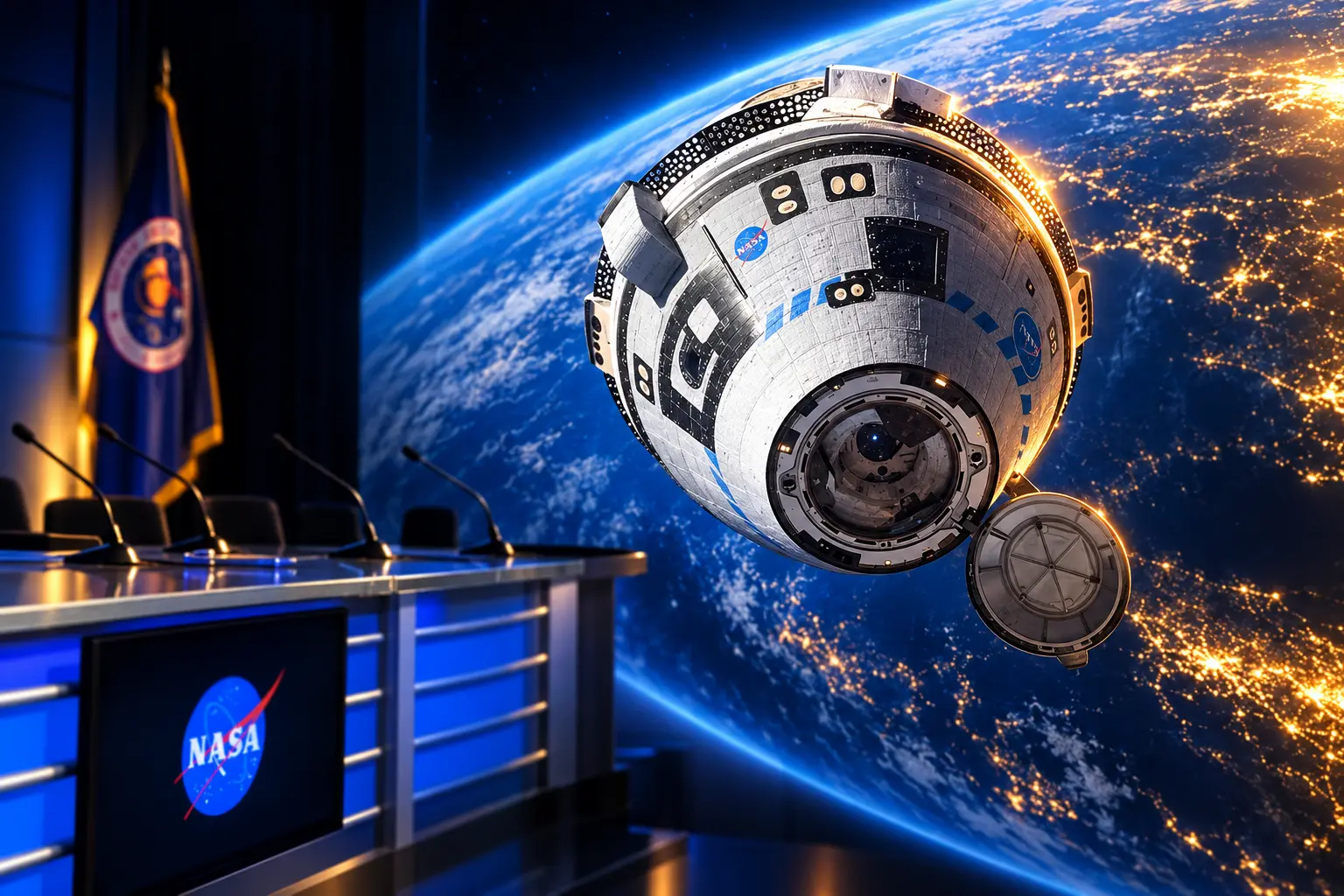
NASA set Boeing’s Starliner for an uncrewed cargo flight no earlier than December 2026, and kept astronauts off until 2028. Administrator Jared Isaacman named that plan on Sept. 28, 10 days after the agency added $946 million so SpaceX can keep flying Crew Dragon through 2030.
The next Starliner trip will test some propulsion fixes from the 2024 crew flight test. It will not fly the thruster valve redesign NASA still requires before anyone boards again.
Starliner-1 Will Fly With the Thruster Fix Unfinished
Isaacman, joined at Kennedy Space Center by Low Earth Orbit Program manager Dana Weigel, astronaut Woody Hoburg, and Boeing Commercial Crew program manager John Mulholland, gave the first detailed return-to-flight plan since the Crew Flight Test. NASA wants Starliner-1 in the December 2026 or January 2027 timeframe, carrying cargo to the International Space Station. Starliner-2, with people, is planned for 2028. Mulholland put that crewed mission in the middle of 2028.
Weigel said teams now know what broke in 2024. Seal material in the helium system broke down after long contact with oxidizer, so Boeing changed the material and picked seals at the larger end of the tolerance range. Crew-module thruster corrosion came from leftover hydrazine reacting with carbon dioxide in air. Boeing added flush and purge steps and is replacing the valves on all 12 crew-module reaction-control thrusters on each of its two spacecraft. Thermal changes on the service module are meant to keep those thrusters cooler, a driver of the in-flight trouble.
The service-module thruster problem that traces to the valve poppet is a different job. Weigel said it cannot be fully fixed with the hardware that will fly next.
On the mechanical side, we’re not able to address that with the current design. That’s what’s driving the need to do a modification to the poppet. That will take some time, but those design modifications will be implemented on the crewed vehicle before we fly crew.
Dana Weigel, manager of NASA’s Low Earth Orbit Program, Sept. 28 briefing
Mulholland said corrective-action plans are in place for the eight recommendations from the Program Investigation Team, and that 19 of 21 in-flight anomalies from the crew test are closed, with the last two expected to close in October. Some of those fixes still need a demonstration in space on Starliner-1. Isaacman, in a follow-up the same day, said NASA will gather data on the partial fixes already on that uncrewed ship and expects surprises in the propulsion system.
STARLINER CHANGES STILL ON THE BOOKS
- Crew-module valves: Boeing is replacing valves on all 12 reaction-control thrusters on each of two spacecraft and adding steps to stop corrosion.
- Service-module poppets: A redesign of the thruster poppets is planned for the crewed vehicle, not as a complete fix on Starliner-1.
- Helium seals: New seal material and tighter tolerances replace parts that broke down after long oxidizer exposure.
- Later crew-ship work: A parachute-joint change, NASA-supplied upgraded batteries, and a higher-rate recorder for thruster chamber pressure are queued before Starliner-2.
Mulholland also said NASA has approved about 90 percent of Starliner’s crew-rating requirements. That share is not a ticket to put people on the December flight. Weigel was plain: Starliner-1 will not clear the vehicle to carry crew.
Two Extra Starliner Missions Are Options, Not Orders
NASA and Boeing also announced contract changes that add money for crew-rating work and for Starliner’s longer role in low Earth orbit. The 2025 modification had turned the fifth and sixth Starliner missions into options, cutting ordered flights from six to four. The Sept. 28 changes restore NASA’s right to buy those two flights again.
Weigel drew a harder line than the Boeing write-up. “We are restoring our ability to order flights five and six. I’m not authorizing them at this time,” she said, with that call coming closer to the date NASA actually needs the seats. Isaacman still described Starliner-2 as the first of as many as five crewed Starliner missions under the current plan, and said NASA expects about one crewed trip to low Earth orbit every six months.
Those two statements sit on a short calendar. A first crew flight in 2028 and a station NASA still plans to close in 2030 do not leave much room for five crewed runs, even at a six-month cadence. The agency is talking like a long-term customer while holding back the last two orders.
Isaacman tied the whole bet to SpaceX walking away from the capsule that actually works.
NASA’s Commercial Crew Program was built to give America multiple ways to put astronauts into orbit.
Dragon has been an extraordinary success, and we want Starliner to become another reliable option.
Boeing and NASA have worked through the findings from Crew Flight Test, and… pic.twitter.com/vWCuRmchRs
— NASA Administrator Jared Isaacman (@NASAAdmin) September 28, 2026
“I do not think it’s a secret that SpaceX intends to sunset older platforms like Falcon and Dragon as they concentrate on their next generation capability, Starship,” he said. Given the years already spent on Starliner and the public money in it, he called the Boeing vehicle the fastest path to keep reliable crewed access to low Earth orbit. Dragon, he added, has been an extraordinary success, and NASA wants Starliner to become another reliable option.
$946 Million Keeps Crew Dragon Flying Through 2030
The fastest path language landed 10 days after NASA did the thing a backup is supposed to make unnecessary: it bought more of the primary. On Sept. 18 the agency awarded SpaceX a firm-fixed-price modification worth $946 million for three extra Crew Dragon missions, listed as Crew-15, Crew-16, and Crew-17. The package covers ground work, launch, in-orbit operations, return and recovery, cargo on each flight, and a lifeboat while Dragon is docked. The work runs through 2030, with mission-readiness dates in 2027 and 2028, and lifts SpaceX’s Commercial Crew Transportation Capability contract to $5.92 billion across 17 missions.
Crew-12 was already at the station when that award went out. Crew-13 is due to launch on Thursday, Oct. 1. SpaceX has been NASA’s certified U.S. crew carrier since November 2020. Boeing has not held that rating since the 2024 test.
NASA’S TWO CREW CONTRACTS, SIDE BY SIDE
| Vehicle | NASA contract | Crew rating | Next station flights |
|---|---|---|---|
| SpaceX Crew Dragon | $5.92 billion, 17 missions | Certified November 2020 | Crew-13 on Oct. 1; Crew-15 through Crew-17 added, through 2030 |
| Boeing Starliner | $4.2 billion award in 2014; cut to $3.7 billion in 2025; options for two more flights restored Sept. 28 | Not crew-rated after the 2024 test | Uncrewed cargo, December 2026 or January 2027; crew in 2028 |
The original 2014 split still shapes the argument on the ground. NASA paid Boeing $4.2 billion and SpaceX $2.6 billion to finish and fly competing crew ships on fixed-price deals. Boeing took the larger public check, then absorbed the overruns. By its 2024 annual filing the company had booked a $523 million reach-forward loss on Commercial Crew that year and about $2 billion in Starliner losses in total. Extra NASA money to finish a vehicle that already ran hot on a fixed-price contract is a hard sell, and it was the first objection that followed Isaacman’s announcement.
SpaceX, for its part, has already flown more NASA crew missions than the six it was first hired to fly. The new $946 million is how NASA keeps seats through the station’s last years while Starliner is still in the shop. Isaacman’s sunset warning and NASA’s latest Dragon check can both be true. One is a speech about 2030. The other is how crews will actually rotate until then.
The Inspector General Already Flagged a Tight Window
The NASA Office of Inspector General got there in June. In audit IG-26-011, the office found that since 2014 NASA had invested more than $9.8 billion to rebuild U.S. crew transport, about $8.7 billion on the two capability contracts and $1.1 billion in related program funds as of April 2026. SpaceX certified in 2020. Boeing, after two orbital tests and the crewed test, still had not. Helium leaks, propulsion failures, and parachute problems were the three issues that had blocked a crew rating, and as of March 2026 the helium and propulsion work was still open.
The audit said NASA had been too sure of Boeing’s heritage hardware, had accepted unreal schedules, and had not used its contract data rights well enough when training runs failed. It also said the agency did not have enough flights on contract to keep the station fully crewed through 2030, so it would have to buy more from Boeing or SpaceX. The Sept. 18 Dragon award is that purchase. Flying Starliner-1 as cargo instead of crew, the inspectors wrote, would cost NASA extra on a mission that had been sold as a crew flight.
WHAT THE JUNE 2026 AUDIT PUT ON PAPER
- Questioned Boeing bills: Inspectors questioned $127.9 million in Boeing payments tied to Starliner-3 milestones that started years before a flight was in reach, on top of $43 million questioned in a 2019 review.
- Stopgap SpaceX cost: NASA had already spent $17 million to speed up SpaceX flights that were meant to be Starliner’s.
- Delay count: Boeing’s tests since 2020 had added 6 years of delay, on a program with over 11 years already invested and about 4 years of station operations left when the audit landed.
- Mishap lag: NASA did not class the 2024 test as a Type A mishap until February 2026, even though the crew never rode the ship home, a core test goal.
NASA concurred with all six recommendations, including holding Starliner-3 milestone pay until the vehicle is crew-rated. Isaacman had already moved on the mishap itself. On Feb. 19, in news release 26-019, he announced NASA was formally declaring a Type A mishap, the agency’s highest class, after a Program Investigation Team report finished in November 2025. He said NASA had let the goal of having two crew providers shape engineering and operations during and after the mission. The most troubling failure, he told the workforce, was not hardware. It was decision making and leadership that, if left unchecked, could create a culture incompatible with human spaceflight.
No one was hurt. The ship got control back before docking. Isaacman said the Type A label still fit because of the lost automated maneuvering as the crew neared the station, and because of the money damage that followed. For a test flight, that is as harsh as NASA’s paperwork gets.
Six Atlas Rockets Remain, and Vulcan Is Uncertified
Starliner also has a rocket problem that the December cargo run cannot solve. Weigel said NASA intends to use all six remaining Atlas V vehicles. United Launch Alliance no longer builds Atlas V, and she warned that the leftover cores have limited-life parts, so risk grows as they sit. After that stock is gone, Starliner has to fly on Vulcan Centaur. The Sept. 28 contract changes include work to certify Vulcan for human flight. That is a second rating campaign stacked on a spacecraft that still lacks the first.
The 2024 test is why all of this is happening in this order. On June 5, 2024, Starliner launched NASA astronauts Butch Wilmore and Suni Williams toward the station. Five of the spacecraft’s thrusters failed, and the crew had to fly parts of the approach by hand. The ship also developed five helium leaks, one of them already known before liftoff. NASA decided Starliner was not fit to bring the astronauts home. They came back on a SpaceX Dragon after more than nine months in orbit. Starliner returned empty in September 2024.
From 2006 through 2024, before and after shuttle retirement, NASA bought 68 Soyuz seats for more than $3.6 billion. Commercial Crew was supposed to end that single-path era with two U.S. vehicles. One of those vehicles has done the job since 2020. The other is still trying to finish a test it started in 2024, on a rocket family that is out of production.
Why Astronauts Stay Off Starliner Until 2028
Hoburg will command Starliner-2. He flew as pilot on NASA’s SpaceX Crew-6 station mission and has been training on Starliner. Isaacman said he knows the vehicle and has the technical and operational judgment the commander’s seat needs. Hoburg did not sell the hardware as the thing that worries him.
So what keeps me up at night? It’s not the hardware, it’s the underlying pattern.
Woody Hoburg, NASA astronaut, Sept. 28 briefing
He pointed to the investigation team’s finding of weak systems engineering and integration, gaps in hardware qualification, and helium and crew-module thruster hardware that was damaged on the ground before launch. “We’ve been relatively hardware poor and test poor, and we needed to be test rich,” he said. He expects Starliner-1 to throw anomalies. What he wants to see is a flatter learning curve, major problems giving way to smaller ones.
That is why 2028 is the crew date even if the cargo flight leaves on time. NASA will take Starliner-1 data, finish the remaining investigation recommendations, put the poppet redesign on the crewed ship, and only then fly people. Weigel’s aim is that Starliner-2 is a normal crew swap, not another test, with four people on board and likely some from partner agencies. Isaacman said NASA will not put another crew on Starliner until the technical causes are understood and corrected, the propulsion system is fully qualified, and the investigation recommendations are in place. He said that in February. The September schedule is that policy on a calendar.
Woody Hoburg Is Training for a Short Station Run
NASA has said it will operate the station through 2030 and then hand low Earth orbit to commercial destinations. A Government Accountability Office review this year said the agency plans to deorbit the ISS by the end of 2030. If Starliner-2 flies in mid-2028, Hoburg’s first command, and any flights after it, land in the station’s last two years. Isaacman also talked about future commercial destinations. Those outposts will need a crew vehicle once Dragon is parked. Starliner is the ship NASA is pointing at. It is still the ship that cannot yet take them there.
WHAT WE KNOW
- The next flight: Starliner-1 is uncrewed cargo, aimed at December 2026 or January 2027, and will not by itself restore a crew rating.
- The crew date: Starliner-2 is planned for 2028, with Hoburg in command, after a poppet redesign and remaining investigation work.
- The working taxi: NASA added $946 million for three Dragon crew missions through 2030, raising SpaceX’s contract to $5.92 billion across 17 flights.
- The station clock: NASA still plans to use the ISS through 2030, then retire it.
WHAT IS UNCONFIRMED
- A launch day: December 2026 or January 2027 is a window, not a count.
- Flights five and six: NASA can order them again and has not authorized them.
- Vulcan crew rating: Work is in the contract; the rocket is not yet cleared to fly Starliner with people.
- How many crews actually fly: Isaacman’s “as many as five” is a plan, not a filled manifest.
Thursday’s Crew-13 launch will send the next NASA astronauts to the station on Dragon, the same type of ship that brought Wilmore and Williams home. Starliner is at Kennedy, booked for cargo, with a thruster redesign still waiting for a crew that cannot fly until 2028.

Edinburgh Opens a 2027 Tour Built for Time Trials

Korda Maps Auður From Meðalland to Irvine Bay

Apple Music Films Its New Logo in Mineral Oil

Oppo Prices the Pad Mini Above India’s iPad Mini

Austen Soaks Scotland Before Boelo Brings Weekend Gales

Volkswagen Sells the Osnabruck Plant to Clear a Board Fight

Apple’s Foldable iPhone Hinges on Samsung Display Supply

Tata Motors’ Iveco Tender Opens as Holders Still Decide

Saksham Gaur Finds He Is His Own Company’s Client

Onimusha Way of the Sword Preload Hits a Windows 11 Wall
-
 AUTO2 months ago
Volkswagen Sells the Osnabruck Plant to Clear a Board Fight
-
 NEWS2 months ago
Apple’s Foldable iPhone Hinges on Samsung Display Supply
-
 AUTO2 months ago
Tata Motors’ Iveco Tender Opens as Holders Still Decide
-
 BUSINESS2 months ago
Saksham Gaur Finds He Is His Own Company’s Client
-
 GAMING2 months ago
Onimusha Way of the Sword Preload Hits a Windows 11 Wall
-

 BUSINESS2 months ago
Hyderabad 22-Carat Gold Jumps After a False Bargain
-

 ENTERTAINMENT3 years ago
What is SD on Amazon Prime? – All You Need to Know
-

 NEWS2 months ago
iQOO 16 Locks 8,400 mAh While 100W Charging Holds