
NEWS
NASA Uses Scottish Cliffs to Test Mars Spot Claims
NASA’s Goddard team sampled 1.2-billion-year-old Stoer rocks in Scotland to test whether Jezero’s reduction spots need microbes, or only chemistry.

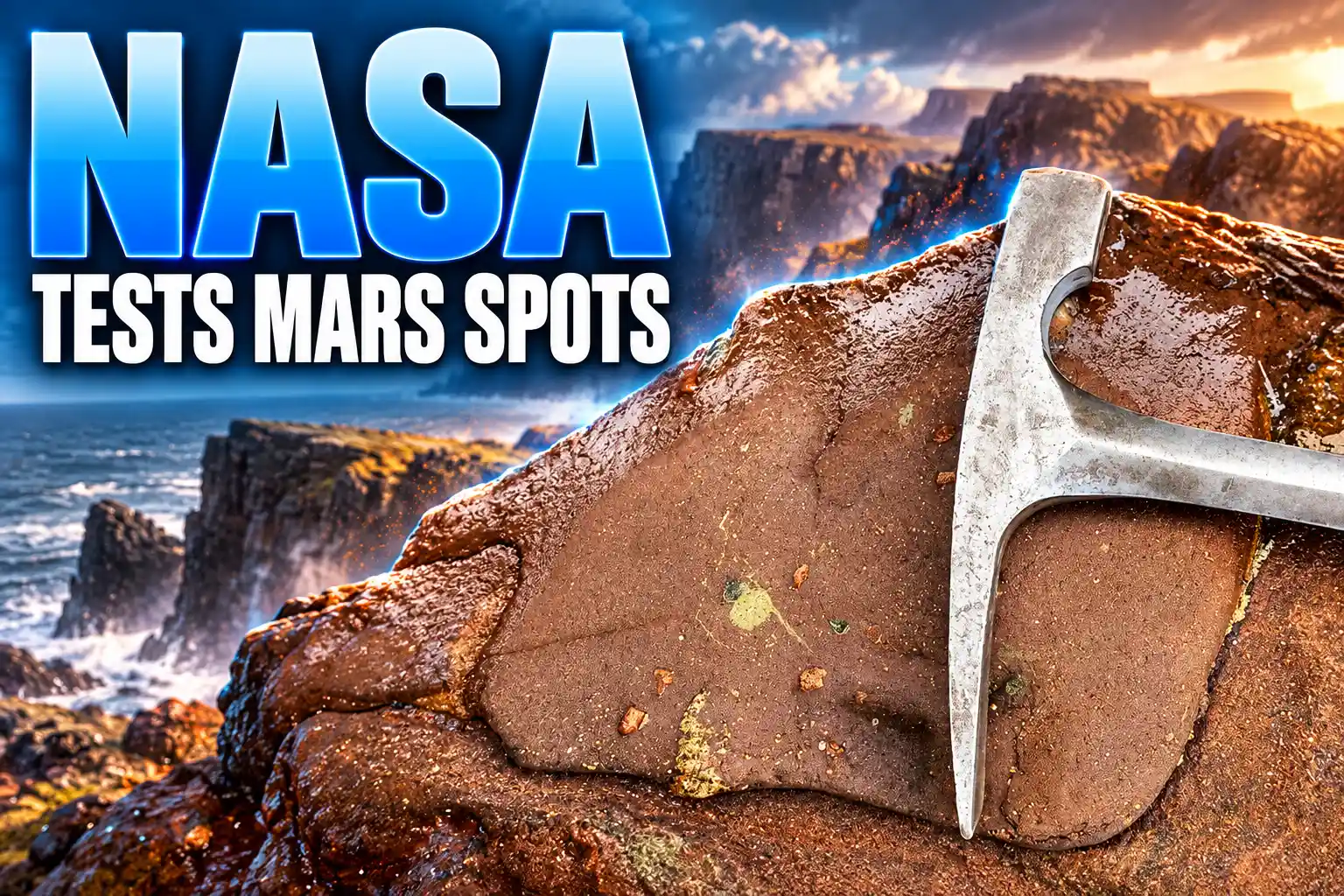
NASA scientists spent the summer of 2026 on the Stoer cliffs, sampling red sandstone marked by gray-green reduction spots. The Goddard Instrument Field Team went to Clachtoll to work a Mars problem that rover data cannot close.
Those spots match a class of marks Perseverance found in Jezero Crater. On Earth they can record microbes. They can also form with no life at all.
They Timed Every Climb to a Highland Tide
Field lead Mike Thorpe of NASA’s Goddard Space Flight Center worked the Bay of Stoer with Adrian Broz of Purdue University, Amy McAdam, and Fuen Cañadas Blasco, also of Goddard. The water at that ledge moves 11 to 15 feet with the tide. A tidepool sat on the cliff top while they hunted the pale patches in the red bed.
The team is based in Greenbelt, Maryland, and specialises in planetary analog research, using harsh ground on Earth to read other worlds. In the Clachtoll region of Assynt they hiked coasts and cliffs with handheld instruments on their backs, checking mineral and chemical makeup on the spot before bagging rock.
Clachtoll is a crofting village on the Sutherland coast about 100 miles north of Inverness. Access was not a postcard walk. NASA said the climbs timed between high tides had to finish while the slopes were still dry, a hard ask in wet Highland weather.
NASA’s own solar system account put the hedge in public view. Perseverance had found greenish reduction spots on Mars. On Earth, spots like those can be formed by microbes, so the team went to Scotland to look closer.
Searching for clues about Mars’ ancient past… right here on Earth.
Our Perseverance rover found greenish "reduction spots" on Mars. On Earth, spots like these can be formed by microbes, so NASA scientists headed to Scotland to take a closer look.https://t.co/Uk88kue5yT pic.twitter.com/D1mjOwt5ku
— NASA Solar System (@NASASolarSystem) September 29, 2026
Deputy field lead Hemani Kalucha stood with Broz and Cañadas Blasco at Clachtoll Bay holding pieces that already showed the gray-green marks. The samples are home. The argument they were collected to test is not.
The Jezero Spots That Sent Them North
In July 2024, Perseverance found leopard spots on a reddish rock nicknamed Cheyava Falls while it worked the Bright Angel formation on the edge of Neretva Vallis, an old river valley a quarter-mile (400 meters) wide that once fed Jezero Crater. The arrowhead-shaped rock measures 3.2 feet by 2 feet (1 meter by 0.6 meters).
PIXL and SHERLOC, the rover’s X-ray and Raman instruments, mapped reaction fronts the team called leopard spots. The chemistry pointed to vivianite, a hydrated iron phosphate, and greigite, an iron sulfide. On Earth, vivianite turns up in sediments, peat, and around rotting organic matter. Some microbes can make greigite.
On Sept. 10, 2025, a peer-reviewed Cheyava Falls study led by Joel Hurowitz of Stony Brook University, a Perseverance scientist, placed a potential biosignature in Sapphire Canyon, the core drilled from that rock. NASA defines a potential biosignature as a substance or structure that might have a biological origin but still needs more work before anyone can say life was, or was not, there.
The Bright Angel mudstones hold clay and silt, plus organic carbon, sulfur, rusted iron, and phosphorus. Hurowitz said that mix could have fed microbial metabolisms. He also said seeing the chemistry was not the same as having a biosignature.
Astrobiological claims, particularly those related to the potential discovery of past extraterrestrial life, require extraordinary evidence. Getting such a significant finding as a potential biosignature on Mars into a peer-reviewed publication is a crucial step in the scientific process because it ensures the rigor, validity, and significance of our results. And while abiotic explanations for what we see at Bright Angel are less likely given the paper’s findings, we cannot rule them out.
Katie Stack Morgan, Perseverance project scientist, NASA Jet Propulsion Laboratory
The minerals can form without life, through high heat, acid, or binding by organic compounds. Bright Angel does not show those high temperatures or acidic conditions. Whether the organics on hand could drive the reaction in the cold is still open. Nicky Fox, associate administrator for NASA’s Science Mission Directorate, said the data were being put out so other researchers could confirm or refute the biological reading.
THE PATH TO SCOTLAND
- February 2021: Perseverance lands in Jezero Crater and starts caching rock.
- July 2024: The rover finds leopard spots on Cheyava Falls in the Bright Angel formation.
- Sept. 10, 2025: Hurowitz and colleagues publish the potential biosignature result; Sapphire Canyon becomes the mission’s leading candidate.
- Summer 2026: The Goddard Instrument Field Team samples reduction spots in the Stoer formation.
- Sept. 29, 2026: NASA posts the fieldwork note after the rocks have reached home labs.
Sapphire Canyon is one of 27 rock cores Perseverance has taken since it landed in February 2021. Rover tools cannot slice a core the way a bench instrument can. That limit is why a wet Scottish cliff suddenly mattered.
Why Reduction Spots Can Form Without Life
Reduction spots are pale, often round patches where red rock has lost its rust colour because iron has switched from Fe(III) to Fe(II). NASA’s own caption on the Stoer outcrop is blunt: the marks are sometimes evidence of ancient microbes interacting with the rock, but they can be formed in other ways too. That hedge is the reason for the trip.
In red beds, the spots can sit as almost perfect spheres with sharp edges. Some have dark cores enriched in vanadium, copper, uranium, or sulfur. John Parnell and colleagues at the University of Aberdeen, writing on reduction spheroids with metal-rich cores, argued that iron-reducing bacteria are the best explanation for many of those pale spheres, and that the colour contrast itself is a practical target in the search for life in old rock, on Earth or Mars.
WAYS A RED ROCK LOSES ITS COLOUR
- Microbial iron reduction: Bacteria strip Fe(III) from grain coatings and leave a bleached halo; a 2026 lab study led by Sean McMahon grew millimetre-to-centimetre bleached spots within weeks in inoculated slurries, and saw none in sterile controls.
- Organic decay: Rotting tissue can set up a local reducing pocket during early burial, pulling iron out of the red pigment.
- Metal-rich cores: Dark centres often concentrate vanadium, copper, uranium, nickel, sulfur, or arsenic, a pattern Parnell’s group ties to subsurface microbes using metals as electron acceptors.
- Inorganic fluids: Other red beds show bleaching from reducing waters, including CO2-rich fluids, and from pH shifts when pyrite breaks down, so a pale spot is not proof of a cell.
McMahon’s paper still asked for tests of nonbiological mimics, and for traits that split biogenic spots from abiotic ones. That is the gap the Stoer collection is meant to feed. A rover can see a spot. It cannot yet run the disambiguation.
THE TWO ROCKS UNDER COMPARISON
| Feature | Cheyava Falls, Jezero Crater | Stoer Formation, Scotland |
|---|---|---|
| Setting | Ancient riverbed in Bright Angel, Neretva Vallis | Old lakes and rivers on the Sutherland coast |
| Host rock | Reddish clay-silt mudstone with organic carbon, sulfur, rusted iron, phosphorus | Red sandstone, mudstone, and siltstone with clay minerals |
| The marks | Leopard spots tied to vivianite and greigite | Gray-green reduction spots in red beds |
| Spot scale | About 200 μm to 1 mm, lighter cores, darker rims | Field-visible patches hunted by eye and handheld instruments |
| Independent proof of life | None; still a potential biosignature | Known microbial evidence from 1.2 billion years ago |
| Open question | Whether the redox fronts needed cells | Which lab traits split biology from chemistry, then apply that split to Mars |
The Stoer side of that table is the control. Jezero still has no second line of evidence. Scotland does.
Stoer Keeps a Record Older Than Land Plants
NASA wanted a pairing that is rare on Earth. The Stoer rocks formed in settings comparable to ancient Martian lakes and rivers, and they also hold evidence of microbial life from 1.2 billion years ago, before land plants existed. Both worlds carry layered mudstones and siltstones rich in clay, the kind of sediment that can keep a chemical memory of wet ground.
Mars is dry now. Its crust still records running water. Jezero was a lake with a river system, and later work on the crater has added a Jezero groundwater carbonate record on top of the lake and river story. Learning how ancient life shows up in Scottish clay-rich beds is how the team hopes to read habitability, and how a biosignature might be preserved and found, on Mars.
The Stoer sequence is part of the wider Torridonian rocks of the north-west Highlands, long used by geologists as a window on early non-marine life. Reduction spots in Mesoproterozoic red beds have been offered before as a possible deep-biosphere signal from a time when such evidence is otherwise scarce. NASA is not claiming a new Earth fossil from this visit. It is using a known biological archive as a yardstick.
That yardstick is imperfect on purpose. If the same grey-green patch can be grown by a colony in a slurry, and also bleached by an acid shift around pyrite, then a pretty spot on Mars is not a verdict. It is a sample request.
What NASA Carried Home From Clachtoll
Handheld readings in the rain were only the first cut. The team looked at the wider outcrop for clues to the old environment, then chose rock for labs that cannot fit in a backpack. Caela Barry of Goddard, who wrote the agency note, said an interdisciplinary group is now preparing deeper analysis of the chemical and mineral traces of ancient life left in Stoer’s rocks.
THE GROUPS ON THE CLACHTOLL TRIP
- NASA Goddard: The Instrument Field Team, including Thorpe, Kalucha, McAdam, Cañadas Blasco, Dina Bower, Jessie Wilde, and Pedro Cota, who made the field photographs.
- NASA Johnson: S. J. Ralston, with the Houston centre listed as a collaborator.
- U.S. universities: Purdue (Adrian Broz), the University of Maryland, and Stony Brook University, home to Hurowitz’s rover work on the Mars side of the same problem.
- U.K. universities: The University of Glasgow and the University of Cambridge, with William McMahon among those photographed at Split Rock.
Alex Jones, David Davis, and Zachary Dickeson also appear in the Split Rock group picture. NASA did not publish a sample inventory or a named instrument list from the cliffs. What is public is the target: reduction spots in red sandstone, collected as a paired data set for Mars.
Follow-on work is meant to sharpen rover data, help mission teams plan new investigations, and ready the community for possible Martian sample analysis later. In other words, the bags from Clachtoll are a rehearsal for a fight that will be won or lost on chemistry, not on a colour photograph.
Labs Will Try to Split Biology From Chemistry
Goddard’s note is careful about what the summer proved, which is nothing yet about Mars. The rocks are in labs in the United States and beyond. The tools waiting for them are the ones a rover cannot carry: higher-resolution mineral maps, isotope work, organic assays, and the slow business of comparing a spot whose biology is known with a spot whose biology is not.
Parnell’s group already argued that Raman work on quartz grains across a spheroid can pick up the colour contrast of selective reduction, and that iron-rich Martian soils make Fe(III) reduction one of the better energy bets for life there. McMahon’s 2026 experiment added a simpler point. Microbes can bleach ferruginous sediment on a lab bench, fast. Sterile pots stay red.
Neither result closes Jezero. Stack Morgan still will not rule out abiotic paths at Bright Angel. The Scottish cores exist so that, when someone claims a spot is enough, another lab can ask which Stoer traits the Mars rock actually shares.
WHAT WE KNOW
- The field trip: Goddard’s analog team sampled Stoer reduction spots at the Bay of Stoer and Clachtoll in the summer of 2026, after the Sept. 10, 2025 Jezero paper.
- The Earth archive: Stoer holds microbial evidence from 1.2 billion years ago in lake-and-river rocks that resemble Martian mudstones and siltstones.
- The Mars claim: Sapphire Canyon remains a potential biosignature, with vivianite and greigite in leopard spots, and abiotic routes still on the table.
WHAT IS UNCONFIRMED
- Lab results: No public mineral or organic findings from the 2026 Stoer bags have been released.
- A disambiguation test: There is still no agreed checklist that separates a microbe-made spot from a chemistry-only bleach, on Earth or on Mars.
- Jezero’s last word: Rover data have not shown that Cheyava Falls required cells, only that the chemistry is hard to make without a reducing reaction.
Going to a coast where the biology is already in the literature is how you keep a biosignature claim from running ahead of the rock. A Mars-life headline that outruns the chemistry is an old trap. The Stoer work treats last year’s spots as unfinished business, which is the honest reading of Stack Morgan’s sentence.
Goddard Built a Team for Earth’s Hard Places
The Goddard Instrument Field Team exists for this kind of ground. In 2025 it split across Iceland on ice, muddy riverbeds, and hydrothermal deposits, the same analog method now pointed at a Highland tide line. Scotland was not a detour from Mars. It was the next calibration site after Jezero’s spots became the mission’s best, and most fragile, claim.
Hurowitz’s paper noted that Bright Angel includes some of the youngest sedimentary rocks Perseverance has studied, which would stretch the window of Martian habitability if the spots ever hold up. That is a large claim to hang on millimetre stains. The Stoer cliffs give the community a place where similar stains sit in rock whose wet history, and whose microbes, can be walked around at low tide.
The bags from Clachtoll are now in labs in the United States and Europe, under instruments no rover can carry.

TCS Opens Q2 as Mid-Cap IT Keeps the Growth

Bitcoin’s Jobs Rally Fails While December Hike Odds Hold

The Heat Turn a Bucks Rematch Into Vice City Night

The G7 Opens Diesel Tanks While Carriers Head East

Kia Bets Fortuner Money on a Made-in-India Sorento

Volkswagen Sells the Osnabruck Plant to Clear a Board Fight

Tata Motors’ Iveco Tender Opens as Holders Still Decide

Saksham Gaur Finds He Is His Own Company’s Client

Onimusha Way of the Sword Preload Hits a Windows 11 Wall

The Frame Pro’s $1,200 Labor Day Cut Needs a Soundbar
-
 AUTO4 weeks ago
Volkswagen Sells the Osnabruck Plant to Clear a Board Fight
-
 AUTO1 month ago
Tata Motors’ Iveco Tender Opens as Holders Still Decide
-
 BUSINESS1 month ago
Saksham Gaur Finds He Is His Own Company’s Client
-
 GAMING1 month ago
Onimusha Way of the Sword Preload Hits a Windows 11 Wall
-
 NEWS4 weeks ago
The Frame Pro’s $1,200 Labor Day Cut Needs a Soundbar
-

 NEWS1 month ago
Apple’s Foldable iPhone Hinges on Samsung Display Supply
-

 BUSINESS4 weeks ago
SEBI Reopens How F&O Settles After the Closing Auction
-

 BUSINESS1 month ago
The Rs 4.66 Lakh Crore IPO Queue Is Mostly Paper