
NEWS
Syracuse Students Walk the Cliffs That Taught Deep Time
Syracuse geology students reached Siccar Point in James Hutton’s 300th year, walking the unconformity that still trains the science in person.

Syracuse University geology students stood on James Hutton’s Siccar Point unconformity in July 2026, 300 years after the Scottish farmer who founded their science was born. Professors Scott Samson and Linda Ivany led the Department of Earth and Environmental Sciences group through Glasgow, the Isle of Arran and Edinburgh, with alumni along for the walk.
The stop east of Edinburgh is in every geology textbook. Samson told the students that few people ever see it in person. In Hutton’s 300th year, Scotland finally built a path to the viewpoint, and the Syracuse group still had to climb down and put real rocks in time order.
Syracuse Walked Hutton’s Coast in His 300th Year
The July trip was the department’s fourth international excursion in recent years, after British Columbia, Iceland and Newfoundland. Students read papers on the sites before they flew. In Scotland the work shifted to outcrops, the same move Hutton made when he left the study for the shore.
Samson, a professor in Earth and Environmental Sciences, puts Hutton in blunt company. “He is to geology what Darwin is to biology and what Isaac Newton is to physics and mathematics,” he said. Hutton argued that Earth was far older than the common 18th-century clock, and that processes still visible in mud, sand and uplift could explain its history.
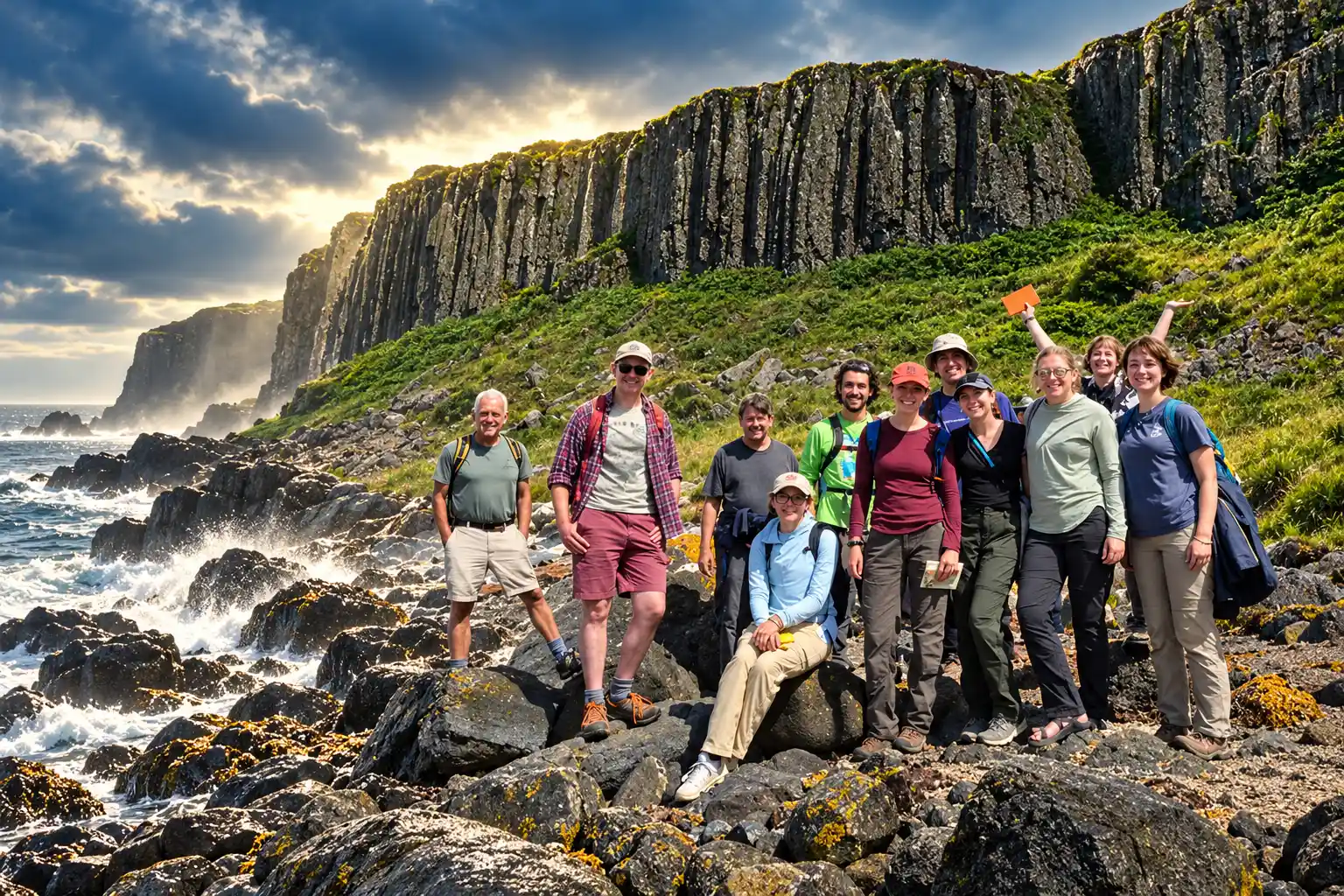
A photo from 22 July 2026 shows the group at Drumadoon on Arran. Another, on the College of Arts and Sciences site, puts seven undergraduates on the Siccar Point contact itself: Zoë Power, Caryse Oliver, Chris Paradis, Emma Matthews, Tava Nicoll, Ryan Oliver-Meehan and Emerson Long.
HUTTON’S DATES AND THE 2026 WALKS
- 3 June 1726: James Hutton is born in Edinburgh.
- 1787: Hutton finds an unconformity on the north coast of Arran, his first clear join between older Highland rocks and younger sediment.
- June 1788: Hutton, John Playfair and Sir James Hall of Dunglass take a boat to Siccar Point and land on the contact that becomes the type example.
- 29 May 2026: A ceremony at Cove opens the Deep Time Trail above that same foreshore.
- 22 July 2026: Syracuse students work the Drumadoon volcanic rocks on Arran during the department field study.
Hutton died in 1797. The science he opened still sends classes to the two contacts he used as proof, first Arran, then the Berwickshire cliff.
Four Days in Lochranza, Then the Famous Contact
Arran was the long stay. The group based itself for four days in Lochranza, a village on the north of the island, at a field station, and worked with a local geology expert on the classic stops. Arran is sold as a geological miniature of Scotland because Highland and Lowland rocks sit close enough to walk in a day.
On Arran the students looked at rippled sandstone from an old tidal flat. Emma Matthews, Tava Nicoll and Zoë Power were photographed on that surface. At Drumadoon they stood under a quartz-feldspar porphyry sill whose columns rise about 30 metres. In Edinburgh they found fossils of 300-million-year-old plants in rocks later covered by lava.
Siccar Point was the reason Ivany said they came. Dark, steep beds meet almost flat red sandstone on a North Sea headland, a gap in the record you can put a hand on. “This set of rocks changes your whole world view,” Ivany said. “His insight completely transformed the study of our planet. This place is why we came on this trip.”
Hutton’s line, taught in the same breath as the outcrop, is still the one on the boards: “We find no vestige of a beginning, no prospect of an end.” He was looking at cycles of sediment, uplift, mountains and wear, not a world with a fixed stop date.
A New Trail Reaches the Textbook Rocks
Weeks before the Syracuse group arrived, the Edinburgh Geological Society and its partners opened a public walk to the viewpoint that had been a steep, unmarked drop. The 1.3 km Deep Time Trail is mostly level grass from the nearest road to a new stone lookout above the unconformity. A second viewpoint sits 200 metres to the south. Visitors are asked to read the rocks from there rather than scramble the slope.
The Scottish Geology Trust, the Edinburgh Geological Society and the James Hutton Institute raised over £150,000 for the work, including a crowdfunder that drew more than 600 donations. Community benefit money from the Co’path & Cove Fund and the Drone Hill Community Fund added approximately £77,000 in community funding, about half the bill. Planning approval came through in March 2026. Builders then had a short window before the 29 May ceremony at Cove, in the Cockburnspath & Cove council area.
THE DEEP TIME TRAIL IN FIGURES
- Walk length: About 1.3 km of coastal grass, laid out as a step-free route to the new viewpoint.
- Community share: Approximately £77,000 from two local community funds, about half of project costs.
- Full raise: Over £150,000 from trusts, the institute and more than 600 individual donations.
- Opening day: 29 May 2026 at Cove, with Dunbar Rowing Club boats in the water Hutton once used.
Angus Miller, promotion coordinator for the Edinburgh Geological Society, has spent years trying to get people to that cliff without a textbook in the way.
Standing at Siccar Point, you feel the weight of Hutton’s insight in a way that no textbook can replicate. This trail has been years in the making, and to see it open on the 300th anniversary of his birth is a genuinely moving moment. We hope visitors leave with not just a greater understanding of geology, but a real sense of wonder at the vastness of time beneath their feet.
Angus Miller, Promotion Coordinator, Edinburgh Geological Society
Suzie Fletcher, co-chair of the Cockburnspath & Cove Community Council, called the point a best-kept secret even for people who live nearby. The trail is a bet that a farmer’s proof from 1788 still has to be seen, not summarised.
Hutton Found His First Unconformity on Arran
Siccar Point is the famous picture. Arran is where Hutton got there first. In 1787, on the island’s north shore near Lochranza, he saw younger sediment resting on much older, worn Highland rock. That join is less photographed than the Berwickshire cliff and easier to miss in the tide. It is the same argument in a quieter outcrop.
The Scottish Geology Trust’s Arran guide is blunt about why first-year classes still fill the island. You can walk more than 100 million years of rock in about three kilometres on the east coast, from Devonian through Permian, desert to swamp and back to desert as Scotland crossed the equator. Cambridge ran its own first-year Arran trip in 2026, mapping Glen Sannox and walking the same Drumadoon sill. Syracuse flew into a classroom the British course already treats as standard.
WHAT THE ISLAND STACKS IN ONE WALK
- The 1787 join: Hutton’s first unconformity, older Highland rock against younger sediment on the north coast.
- Drumadoon: A quartz-feldspar porphyry sill with columns about 30 metres high, the Syracuse group photo site.
- Tidal sandstone: Rippled beds that preserve an old flat, where Matthews, Nicoll and Power were photographed.
- East-coast section: A short walk through more than 100 million years from Devonian to Permian environments.
The local expert who led the Syracuse days is unnamed in the university write-up, which is a tell of its own. The island’s teaching infrastructure, the field station and the people who know which tide uncovers which bed, is what makes a four-day stay possible. The famous names on the trip were visiting a system that already runs for British undergraduates every spring.
The Students Had to Put the Specimens in Order
The course did not end at the viewpoint. Samson tested the group on specimens they had already seen in place. “They had to put specimens in order from oldest to youngest based on what we had learned at the geological outcrops,” he said. They had to defend the order with evidence from the field, not from a caption.
That exercise is the old science in miniature. Hutton did not win the argument with a sketch. He took Playfair and Hall by boat in June 1788 because he needed a contact a sceptic could stand on. Playfair’s account of the 1788 landing still carries the dizziness. “The mind seemed to grow giddy by looking so far back into the abyss of time,” he wrote, “and whilst we listened with earnestness and admiration to the philosopher who was now unfolding to us the order and series of these wonderful events, we became sensible how much further reason may sometimes go than imagination may venture to follow.”
Christopher Paradis, class of 2028, is an environmental geoscience major in Arts and Sciences and an environment, sustainability and policy major in the Maxwell School. He said the trip settled a career question. “This experience has absolutely confirmed for me that I want to study a science that puts me out in the field as often as possible.” Riverbeds, pasture and coastal cliffs, he said, made the time spans from coursework feel like ground he had walked.
Why Geology Degrees Still Send People Outside
US geoscience departments have been rewriting majors under falling enrollment and tighter budgets. The one requirement that has not slipped out of the core is going outside. Ken L. Ferrier, Eva M. Golos and Marianne Haseloff at the University of Wisconsin-Madison compiled course rules for geology-type majors at 50 R1 universities in March and April 2024, then published the snapshot in 2026. An introductory geoscience course is required by 96% of those programs. A field geology required by 78% of programs is next, as a summer field camp, a field-methods course, or both.
After that, agreement collapses. Structural geology is required by 58%, petrology by 56%, sedimentology and stratigraphy by 54%, earth history by 52%, mineralogy by 50%. There is no universal geoscience curriculum. Field work is the nearest thing to one.
REQUIRED SUBJECTS IN 50 R1 GEOSCIENCE MAJORS
| Subject | Share of programs that require it |
|---|---|
| Introductory geoscience | 96% |
| Field geology (experience, methods, or both) | 78% |
| Structural geology | 58% |
| Petrology | 56% |
| Sedimentology and stratigraphy | 54% |
| Earth history | 52% |
| Mineralogy | 50% |
Those field courses are also the expensive ones. A published cost study of a week in the field, leaving tuition out, put gear, travel, lodging, lost wages and care for dependents between $1,271 and $2,007, and as high as $6,262. Summer field camp itself is often cited around $4,000 or more once tuition and camp fees land. Syracuse’s Scotland study is a cousin of that requirement: literature first, then a test on rocks that do not fit in a lab tray.
Twenty-Seven Visitors and None Had Been Before
Samson’s line about textbooks and empty clifftops had a measured echo two months before his students arrived. The Geological Society of America ran its first international geoheritage trip to Edinburgh and Siccar Point from 29 May to 4 June 2026, timed to the trail opening and Hutton’s birthday on 3 June. 27 people went. They ranged in age from 29 to 87. None of them had previously visited Siccar Point, or many of the other Hutton sites on the itinerary.
The society’s own post from the foreshore is the record of that week, field notebooks against the same red-on-grey join the Syracuse undergraduates later stood on.
Journeying through deep time at Siccar Point, Scotland ⛰️
GSA's recent field trip, Where Deep Time Began: James Hutton, Siccar Point, and Scotland’s Geological Heritage, explored one of geology’s most iconic sites—where James Hutton’s groundbreaking observations helped shape our… pic.twitter.com/f2cNdUPDhg
— geosociety (@geosociety) June 12, 2026
The public conversation around the 300th year still treats the boat trip as news. A widely shared retelling in July 2026 walked through the soot-factory fortune, the Berwickshire farms and the upright rock under flat red beds, then ran straight into replies that wanted a 6,000-year clock or a gap in Genesis to do the work instead. The argument Hutton picked with a common calendar is not a closed museum label. That is why a new trail, a GSA pilgrimage in which nobody had been before, and a Syracuse sequencing exam all landed on one headland in the same year.
Ivany can point at the contact and watch a world view move. Playfair felt giddy in 1788. Miller says no textbook replicates the weight. Paradis now wants a science that keeps him outside. The rocks have not been replaced. They have been given a path, a birthday, and another class with hammers.
Frequently Asked Questions
Who Was James Hutton and What Did He Argue?
Hutton was an Edinburgh-born physician who farmed in Berwickshire, ran a chemical works, and read his Theory of the Earth to the Royal Society of Edinburgh. He held that rock is worn to sediment, buried, lifted and worn again in cycles with no visible start or stop, a view he backed with unconformities on Arran in 1787 and at Siccar Point in June 1788 rather than with a single lab date.
What Rocks Meet at Hutton’s Unconformity?
At Siccar Point, steeply dipping early Silurian greywacke, laid down in an old ocean and later folded, is overlain by nearly flat late Devonian red sandstone, conglomerate and breccia. The missing interval between those two rock sets is about 65 million years, which is the time gap a visitor is looking at when the grey beds stand on end under the red ones.
Why Do Geology Classes Keep Using the Isle of Arran?
Arran sits astride the Highland Boundary Fault, so Highland metamorphic rock and Lowland sediment occur on one small island with short walks between them. North Glen Sannox, the Lochranza unconformity, the Drumadoon sill and the east-coast desert-to-swamp section give a first-year mapping syllabus without a long drive, which is why British departments still run Arran as a standard field week.
Do US Geology Majors Still Have to Attend Field Camp?
Most research-university geology majors still face a field requirement, often as a five- or six-week summer camp after junior year, sometimes split into two shorter courses. Tuition plus camp fees commonly run around $4,000 or more, and that figure does not count boots, flights, lost summer wages or care for dependents, which is the cost pressure sitting behind every international trip like Syracuse’s Scotland study.

Edinburgh Opens a 2027 Tour Built for Time Trials

Korda Maps Auður From Meðalland to Irvine Bay

Apple Music Films Its New Logo in Mineral Oil

Oppo Prices the Pad Mini Above India’s iPad Mini

Austen Soaks Scotland Before Boelo Brings Weekend Gales

Volkswagen Sells the Osnabruck Plant to Clear a Board Fight

Apple’s Foldable iPhone Hinges on Samsung Display Supply

Tata Motors’ Iveco Tender Opens as Holders Still Decide

Saksham Gaur Finds He Is His Own Company’s Client

Onimusha Way of the Sword Preload Hits a Windows 11 Wall
-
 AUTO2 months ago
Volkswagen Sells the Osnabruck Plant to Clear a Board Fight
-
 NEWS2 months ago
Apple’s Foldable iPhone Hinges on Samsung Display Supply
-
 AUTO2 months ago
Tata Motors’ Iveco Tender Opens as Holders Still Decide
-
 BUSINESS2 months ago
Saksham Gaur Finds He Is His Own Company’s Client
-
 GAMING2 months ago
Onimusha Way of the Sword Preload Hits a Windows 11 Wall
-

 ENTERTAINMENT3 years ago
What is SD on Amazon Prime? – All You Need to Know
-

 BUSINESS2 months ago
Hyderabad 22-Carat Gold Jumps After a False Bargain
-

 NEWS2 months ago
The Frame Pro’s $1,200 Labor Day Cut Needs a Soundbar