
NEWS
iPhone 18 Pro and Pixel 11 Pro Share a $100 Gap
The iPhone 18 Pro starts at $1,199, $100 above the Pixel 11 Pro, after both camps passed on a memory-driven price hike.

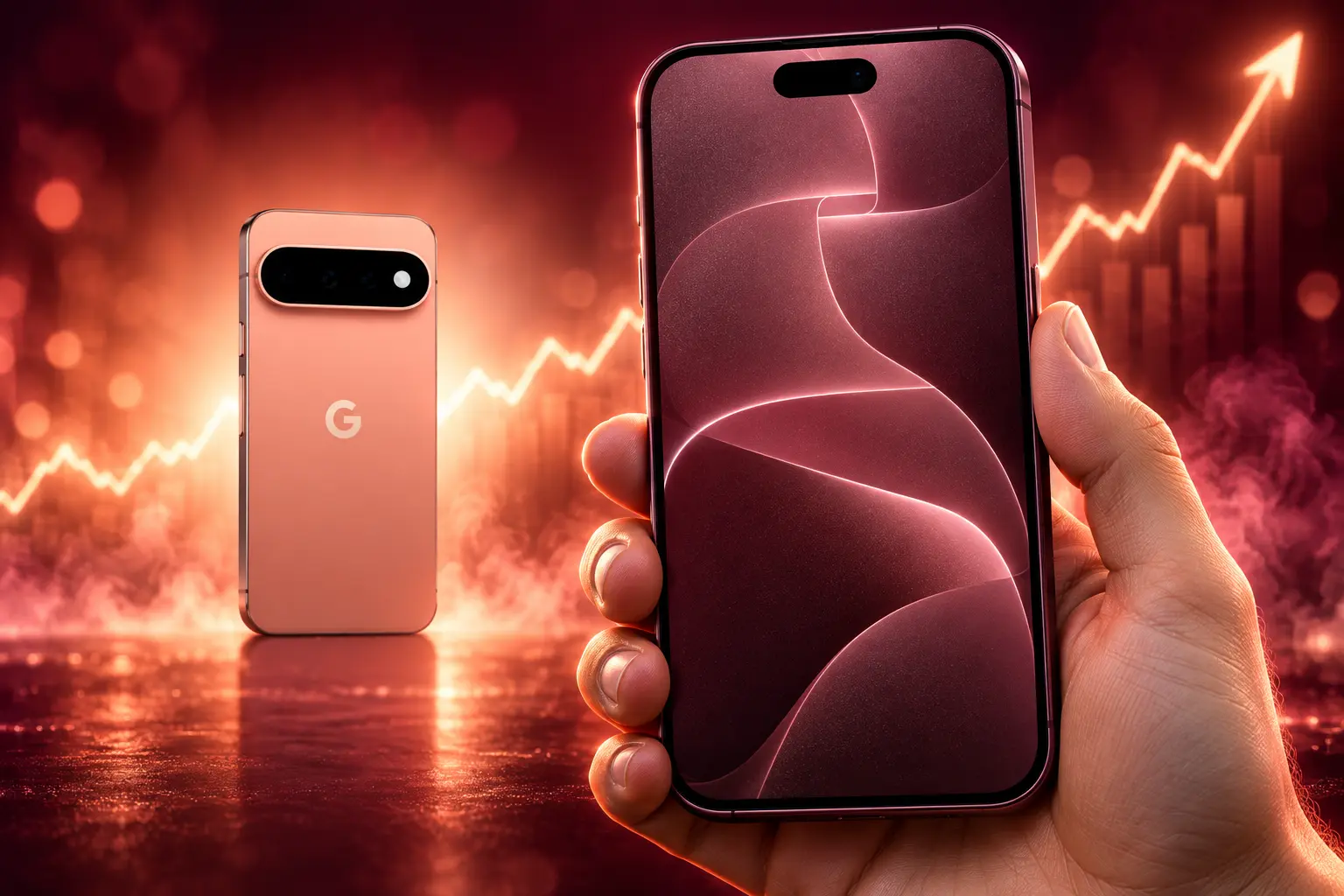
Apple’s iPhone 18 Pro starts at $1,199, $100 above last year’s Pro and $100 above Google’s Pixel 11 Pro. Google has sold that Pixel since August 20, and Apple’s phone reaches stores on September 18.
Matching hikes closed the old cheap-Pixel door. You now pick a hardware camera or an AI one at $1,099 and $1,199.
Both Flagships Climbed $100 in the Same Season
The iPhone 18 Pro opens at 256GB for $1,199. The iPhone 17 Pro opened at 256GB for $1,099. The Pixel 11 Pro also opens at 256GB, for $1,099, after Google dropped the 128GB SKU that let last year’s Pixel 10 Pro start at $999. At 256GB, that 10 Pro was already $1,099, so Google’s extra $100 is the lost low rung, not a higher 256GB sticker.
The Pixel 11 starts at $899. The Pixel 11 Pro XL starts at $1,299, the same as the iPhone 18 Pro Max. None of these phones take a memory card.
LAUNCH PRICES AT THE DOOR
| Phone | Launch start (US) | Storage at that price |
|---|---|---|
| Pixel 10 Pro | $999 | 128GB |
| Pixel 11 Pro | $1,099 | 256GB |
| iPhone 17 Pro | $1,099 | 256GB |
| iPhone 18 Pro | $1,199 | 256GB |
Tim Cook said in June that price increases were unavoidable. “There’s less supply at a time when consumers want devices and the memory guys are passing along huge price increases,” he said, after AI data centers pulled DRAM and NAND toward high-bandwidth memory. He called the squeeze a hundred-year flood on a later earnings call.
WHAT MEMORY COSTS AT LAUNCH
- Mobile DRAM: LPDDR5 96Gb sat near $165 in September, up about $25 from June, per TechInsights DRAM and NAND launch pricing.
- Phone storage: 256GB TLC UFS NAND sat near $82, up about $14 from June, with both lines still rising into 2027.
- Bill of materials: Memory now takes more than 30% of a premium phone’s parts cost, and about 60% on devices under $400.
People who already own an iPhone 17 Pro are treating that $100 as optional. The extra money buys camera hardware most of them will not notice in daylight, so a lot of 17 Pro owners are sitting this cycle out.
Six Laser-Cut Blades in the Main Camera
Apple’s bet is glass and metal. The 48-megapixel Fusion Main camera is the first with variable aperture on iPhone 18 Pro, using six laser-cut blades that move among ƒ/1.48, ƒ/1.8, ƒ/2.8, and ƒ/4.0. Wide open, it grabs more light at night. Stopped down, it keeps a group in focus.
The Camera app can set those four stops by hand, and it also moves the blades on its own between 1x and 3.9x, reviewer Patrick Holland confirmed. Apple opened an API so other camera apps can use the full range between ƒ/1.48 and ƒ/4, and those apps have already started doing that rather than stopping on the four named settings.
With iPhone 18 Pro, we’ve made advancements to the areas our users care about most: camera, performance, battery, and intelligence.
Greg Joswiak, senior vice president of Worldwide Marketing, Apple
The rest of the rear module is 48-megapixel across the board: an ultrawide and a tetraprism telephoto with 4x optical and 8x optical-quality zoom, plus digital zoom up to 40x. The front camera is 18-megapixel Center Stage, with automatic framing when more people walk in. Video tops out at 4K Dolby Vision, including 120 fps on the main lens, plus ProRes and Apple Log 2 if you record out to a drive.
Early day-and-night use makes the aperture feel like a night tool. In sun, the blades do not change the photo the way a new chip or a bigger battery does. Apple also added Apple Reference Image, which keeps an unaltered frame so you can see whether a picture was edited later, a pointed move in a year when both companies let AI rewrite photos.
Generated Pixels at 120x and a Two-Minute Clip
Google’s bet is software that keeps shooting after the glass runs out. The Pixel 11 Pro and Pro XL pair a 50-megapixel main camera with a 48-megapixel ultrawide and a redesigned 48-megapixel 5x telephoto. Google says that telephoto sensor takes in 30% more light than last year’s, and it now does Portrait mode at 5x.
Tensor G6 plus Google’s imaging models push Super Zoom to 30x and Pro Zoom to 120x. The company warns that 120x results vary, and the long end uses generated detail to fill what the lens cannot resolve. That is the opposite of Apple’s signed reference frame: one camp proves the pixels, the other invents them at distance.
WHAT GOOGLE ADDED BEHIND THE CAMERA BAR
- Magic Capture: One tap records a short clip, then Gemini picks stills, crops, and cleans blur while you watch the scene instead of the shutter.
- Camera Looks: Built-in color profiles for people who hate editing later. Reviewer Andrew Lanxon called it a welcome step that Google still does not fully use.
- Night Sight: The new image signal processor plus the sensors make Night Sight up to 4.5 times faster at the same quality, Google said.
- Front camera: 42 megapixels, more than double the iPhone’s 18-megapixel selfie camera, plus Live Translate that can handle American Sign Language through the lens.
Magic Capture is a concert trick more than a grocery-line trick. The 120x mode is a wildlife brag that still looks soft when you zoom the file. The hardware win on this phone is the brighter telephoto and the faster night pipeline, not the poster-number zoom.
What the Two Phones Feel Like in the Hand
Both are 6.3-inch OLED slabs with a 120Hz refresh rate and IP68 sealing. Apple rates that seal at 6 meters for 30 minutes. The Pixel is the thinner, lighter one. The iPhone is the denser brick with a smaller cutout up top.
The 18 Pro uses an aluminum unibody and a monotone finish in black, silver, glacier, and burgundy, dropping last year’s two-tone look. Ceramic Shield 2 covers the front, the same family as the 17 Pro. The Dynamic Island is smaller and can show three Live Activities at once, still handling Face ID. There is no fingerprint reader.
The Pixel 11 Pro puts edge-to-edge glass across the camera bar and ships in canyon, fog, olive, and matte obsidian. Corning Gorilla Glass Victus 2 sits up front, with an ultrasonic fingerprint sensor under the screen and face unlock that leans on the selfie camera. HiLight, the LED ring around the flash, glows for calls and Gemini. In use it has been a thin extra, not a reason to buy.
SIZE, SCREEN, AND BUILD
| Spec | iPhone 18 Pro | Pixel 11 Pro |
|---|---|---|
| Weight | 211 g | 204 g |
| Size | 150 x 71.9 x 8.75 mm | 152.4 x 71.1 x 7.6 mm |
| Display | 6.3-inch OLED, 2622 x 1206, 460 ppi | 6.3-inch OLED, 2856 x 1280, 496 ppi |
| Peak brightness | 3,000 nits outdoor | 3,600 nits |
| Protection | Ceramic Shield 2 | Gorilla Glass Victus 2 |
| Unlock | Face ID | In-screen fingerprint and face unlock |
The Pixel should be easier to read in hard sun. The iPhone’s smaller island is the kind of change you stop seeing by lunch, which matches what early 18 Pro Max units have felt like in hand. Last year’s Pro cases still clip onto this year’s Pro, so the body did not jump size.
The Vapor Chamber Finally Gives the Chip Room
The A20 Pro is built on a 2-nanometer process. Apple says it has 50% more memory bandwidth than A19 Pro, a 7-core GPU up to 40% faster, and a Dual 16-core Neural Engine with 32 cores, double the on-device AI of A19 Pro. Packaging puts the die beside the memory so the chip can sit on a new vapor chamber with three times the surface area of the 17 Pro’s, which Apple says yields up to a 40% gain in sustained performance, a different 40% from the GPU claim.
That cooling is the gaming argument. Patrick Holland said 18 Pro Max play has been a blast, with the phone getting warm while it pulls down game files as large as 28GB or while it charges, not in regular play. The iPhone 18 Pro technical specifications still list Face ID, the Action button, and Camera Control, and Apple’s store sells console-quality games that also run on Mac and Apple TV once you buy them.
Tensor G6 is Google’s fastest Pixel chip, with 50% more TPU compute than Tensor G5. Google says it runs on-device AI up to 3.5 times faster while using up to 3.5 times less energy, loads pages 25% faster, and opens apps 15% quicker. Daily use is smooth. Ten minutes of games is enough to make the back warm, and managing editor David Lumb found it struggles when graphics settings go up. If you buy a phone to play, the iPhone is the one that holds frame rate.
Apple rates typical use on the 18 Pro at up to 24 hours and video playback at up to 36 hours on eSIM-only models. Wired charging can reach 50% in about 15 minutes with a 60W-capable adapter that supports adjustable voltage. MagSafe hits 50% in 30 minutes with a 35W or higher puck. In a 30-minute wired fill test, the 18 Pro went from empty to 82%. The Pixel 11 Pro, starting at 55% in the same kind of test, reached 88% on 30W wired charging. The Pro XL adds 45W. Both do 25W wireless charging, Qi 2.2 on the Pixel and MagSafe or Qi2 on the iPhone. The Pixel lists a 5,115 mAh cell. Apple does not publish milliamp-hours.
Extra Tools Only One Software Camp Gets
The 18 Pro ships with iOS 27, Siri AI in beta, and the next round of Apple Intelligence. Focus Tracking follows a subject in the Camera app. Spatial Reframing, Extend, and Clean Up can still rewrite a photo after the fact, which is why the reference frame exists. Voice-to-text is tighter. The island can juggle a timer, a car on the way, and a score at once. US models are eSIM only.
The Pixel 11 Pro ships with Android 17 and Gemini Intelligence. Rambler strips filler words when you dictate a message. Live Translate can work in sign language through the camera. Ask Photos to edit in plain language and it will, without hunting sliders. Pro phones include six months of Google AI Pro, with higher Gemini limits, 5TB of cloud storage, and Google Health Premium. Google also cites a Counterpoint scorecard that ranked Pixel’s AI privacy ahead of last year’s iPhone 17 Pro and this year’s Galaxy S26 Ultra, on out-of-the-box software.
Those extras do not travel. Buy the iPhone and you get Pro controls, Reference Image, and the App Store’s paid games. Buy the Pixel and you get Magic Capture, 120x Pro Zoom, a fingerprint reader, and seven years of Android, security, and Pixel Drop updates. The $100 gap does not buy you the other list.
October 23 Is When the Foldable Arrives
Apple staged both phones at its Surprise and Shine event on September 9, with new chief John Ternus hosting after Cook’s handoff. The foldable iPhone Duo took the lights. The 18 Pro is the phone you can actually buy this week.
THE FALL PHONE CALENDAR
- August 12, 2026: Google unveils Pixel 11, Pixel 11 Pro, and Pixel 11 Pro XL, with preorders the same day.
- August 20, 2026: Pixel 11 Pro reaches the Google Store and retail partners.
- September 9, 2026: Apple announces iPhone 18 Pro, iPhone 18 Pro Max, and iPhone Duo.
- September 12, 2026: iPhone 18 Pro preorders open.
- September 18, 2026: iPhone 18 Pro and Pro Max arrive in stores.
- October 16, 2026: iPhone Duo preorders open at $1,999 for 256GB.
- October 23, 2026: iPhone Duo goes on sale in more than 70 countries.
There is no base iPhone 18 in this wave. The Duo waits until October 23 at $1,999, and that wait collides with limited display supply for Apple’s foldable, which already caps how many units can ship. Until then the 18 Pro is Apple’s in-stock flagship, $100 above a Pixel that has been on shelves since August, both of them priced for the memory bill as much as for the new cameras.
Frequently Asked Questions
Does the iPhone 18 Pro Have a Physical SIM Card?
US iPhone 18 Pro models are dual eSIM only, with no SIM tray, and they can keep two lines active while storing eight or more eSIM profiles. Apple also ships eSIM-only units in Bahrain, Canada, Guam, Japan, Kuwait, Mexico, Oman, Qatar, Saudi Arabia, the UAE, and the US Virgin Islands, and those trays-free phones gain about two extra hours of video playback from the space the plastic card used to occupy.
How Long Does Google Update the Pixel 11 Pro?
Google includes seven years of OS, security, and Pixel Drop updates on Pixel 11, Pixel 11 Pro, and Pixel 11 Pro XL. Pro models also include six months of Google AI Pro, which stacks higher Gemini usage, 5TB of cloud storage, and Google Health Premium on top of that support window.
What Is Apple Reference Image on iPhone 18 Pro?
In Reference mode the new main sensor signs every pixel it sees, and Private Cloud Compute turns that signed data into an unalterable reference photo. You view it in Photos next to the regular shot, like a digital negative, and Apple is adding SynthID metadata plus APIs in iOS, iPadOS, and macOS 27 so other apps can show the same pair.
Can the Pixel 11 Pro Record 8K Video?
Yes. Pixel 11 Pro and Pro XL record 8K at 30 fps, plus 4K at 60 fps, 10-bit HDR, and 240 fps slow motion, while the iPhone 18 Pro’s own video stack stays in 4K Dolby Vision, including 120 fps on the main camera and ProRes RAW to an external recorder.
How Much RAM Is in the Pixel 11 Pro?
The 256GB Pixel 11 Pro ships with 12GB of RAM. Step up to 512GB or 1TB and Google puts 16GB in the phone. Apple still does not publish RAM on iPhone 18 Pro, which starts at 256GB and climbs through 512GB, 1TB, and 2TB.

Edinburgh Opens a 2027 Tour Built for Time Trials

Korda Maps Auður From Meðalland to Irvine Bay

Apple Music Films Its New Logo in Mineral Oil

Oppo Prices the Pad Mini Above India’s iPad Mini

Austen Soaks Scotland Before Boelo Brings Weekend Gales

Volkswagen Sells the Osnabruck Plant to Clear a Board Fight

Apple’s Foldable iPhone Hinges on Samsung Display Supply

Saksham Gaur Finds He Is His Own Company’s Client

Tata Motors’ Iveco Tender Opens as Holders Still Decide

Onimusha Way of the Sword Preload Hits a Windows 11 Wall
-
 AUTO2 months ago
Volkswagen Sells the Osnabruck Plant to Clear a Board Fight
-
 NEWS2 months ago
Apple’s Foldable iPhone Hinges on Samsung Display Supply
-
 AUTO2 months ago
Tata Motors’ Iveco Tender Opens as Holders Still Decide
-
 BUSINESS2 months ago
Saksham Gaur Finds He Is His Own Company’s Client
-
 GAMING2 months ago
Onimusha Way of the Sword Preload Hits a Windows 11 Wall
-

 ENTERTAINMENT3 years ago
What is SD on Amazon Prime? – All You Need to Know
-

 BUSINESS2 months ago
Hyderabad 22-Carat Gold Jumps After a False Bargain
-

 NEWS2 months ago
iQOO 16 Locks 8,400 mAh While 100W Charging Holds