
BUSINESS
Diageo Faces a Three-Week Strike Over 10 Fife Jobs
Unite will try to halt Diageo’s Cameronbridge plant from 28 September over 10 jobs at a distillery the company already runs below capacity.

More than 100 workers at Diageo’s Cameronbridge distillery will walk out on 28 September after a union ballot over planned job cuts. The Fife plant is Europe’s largest grain distillery and feeds blends such as Johnnie Walker. Diageo says the live proposal is up to 10 roles because it already runs lower volumes.
Unite says those successive walkouts, running until just before 6am on 15 October, will bring the site to a standstill. That is a loud threat at a company that is trying, by its own account, to make less spirit.
The Walkout Begins on 28 September
All Unite members at the Leven site are due to leave together on Monday 28 September. After that, distillation and process controllers, machine operators, technicians, quality analysts, process chemists and engineers will take turns through almost three weeks of action.
GMB Scotland voted the same way on 9 September, with 75% of balloted members in favour on a 73% turnout. Around 200 people work at Cameronbridge. About 100 Unite members are booked to strike. Unite Scotland has around 150,000 members.
THE ROAD TO THE 28 SEPTEMBER WALKOUT
- 25 August 2026: Unite opens a strike ballot of around 100 Cameronbridge members over job cuts and consultation.
- 9 September 2026: The Unite ballot closes and GMB Scotland records a 75% yes vote on 73% turnout.
- 17 September 2026: Unite locks the dates, with a full walkout on 28 September and group action through 15 October.
- 28 September 2026: The first shift is due to stop unless Diageo changes course.
Diageo says it is disappointed and still wants talks. A person close to the company has said it has consulted for months and has not had a union counter-offer. Unite calls that consultation a failure.
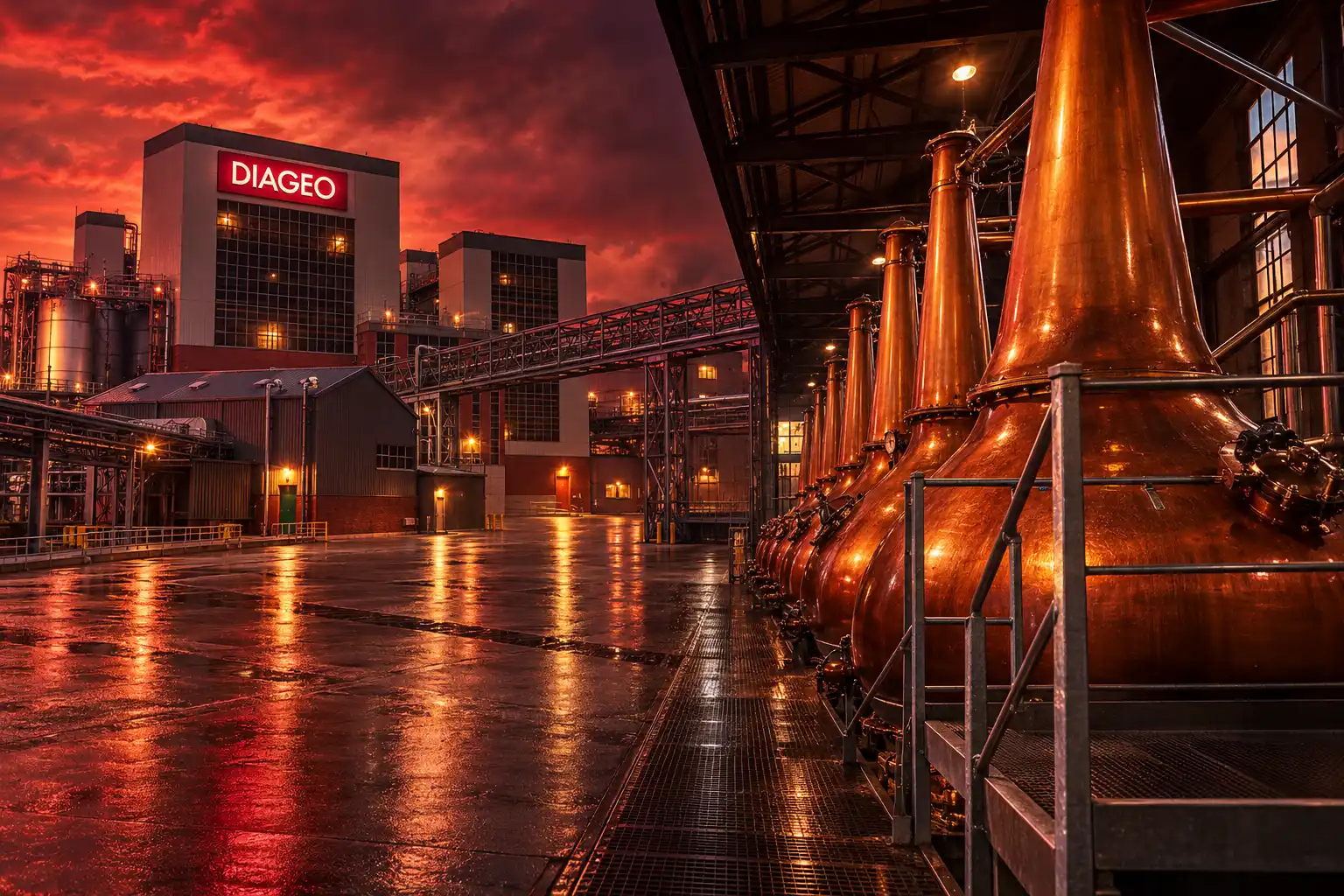
Diageo Already Runs Reduced Volumes
The company’s public line is short. It is not defending a full-tilt grain plant. It is defending a smaller one.
We are disappointed by the decision to strike. The proposal to remove up to 10 roles at Cameronbridge Distillery is necessary as we maintain reduced production volumes to protect the long-term competitiveness of our business. We remain committed to engaging constructively.
Diageo spokesperson, 17 September 2026
That is the twist the strike has to live with. A three-week halt is meant to hurt output. Sir Dave Lewis, Diageo’s chief executive, is already cutting output and cost after a weak year in spirits. Grain whisky sits in casks for years before it reaches a Johnnie Walker bottle, so a short stoppage does not empty shelves next month.
White spirits are a different problem. The same Fife site filters Smirnoff and, after a £16 million upgrade for the plant’s 200th year, has capacity for 3.2 million bottles of gin a week (900,000 litres) on two 22,000-litre stills. Gin and vodka do not wait in warehouses. If controllers and operators walk out in sequence, that is the flow that stops first.
Why Unite Balloted on Safety as Well as Jobs
Unite’s case is that Diageo wants fewer people on the same work. The union says production operators and cask handlers would carry extra load if roles go and output does not, and that this puts safety at risk. Diageo’s phrasing is the reverse: volumes are already down, so the roster should follow.
Sharon Graham, Unite’s general secretary, has tied the Fife ballot to a wider Scottish cull rather than to 10 posts on one site.
Unite has repeatedly warned Diageo that there is no justification for slashing hundreds of jobs across its operations when it is raking in hundreds of millions of profit. We are backing our members at Cameronbridge all the way in their fight for jobs, pay and conditions.
Sharon Graham, Unite general secretary, 17 September 2026
Dougie Orchardson, a Unite industrial officer, said in August that there was “no business case to slash jobs” and that members’ safety was at risk “because Diageo plans to maintain the same level of production.” Dougie Maguire, Unite’s deputy Scottish secretary, later called it “last orders for Diageo” and said the firm still had time to step back.
Ten Roles, 70 Under Review, Hundreds in the Argument
The two sides are not even counting the same pile of jobs. Unite says over 70 roles are under review at Cameronbridge and that Diageo plans to cut hundreds of posts across Scotland. Diageo says the live cut in grain distilling is 10 of 72 posts, and that only eight people are affected because two jobs are empty. Lewis has refused to put a group-wide number on further cuts, saying Europe is still in consultation.
HOW THE TWO SIDES COUNT THE JOBS
| Count | Unite / GMB | Diageo |
|---|---|---|
| Cameronbridge workforce | About 200 | About 200 |
| Roles in play at the plant | Over 70 under review | Up to 10, eight after vacancies, of 72 in grain distilling |
| Scotland | Hundreds of jobs, plus 172 Highland staff at risk and 38 possible losses | About 3,000 staff in distilleries and bottling; no new Scotland total given |
| Group, year to 30 June 2026 | Used as proof the cuts have already started | About 2,000 roles already gone |
Both of the Cameronbridge figures can be true at once. Seventy-plus jobs can sit in a review while the company only proposes to delete 10. The Scotland-wide “hundreds” is a different claim again, and it is the one Graham is using to justify stopping Europe’s biggest grain plant over a single-digit cut.
Severance Reached $514 Million in a Year
Lewis is not hiding the scale of the reset. For the year ended 30 June 2026, Diageo posted net sales of $19,643 million, down 3.0% from $20,245 million. Organic net sales fell 2.0%, or $386 million. Reported operating profit fell 27.2% to $3,156 million from $4,335 million, after exceptional charges. Operating profit before exceptional items rose 2.0% to $5,683 million.
DIAGEO’S YEAR TO 30 JUNE 2026
- Severance: $514 million, up from $73 million, inside a $908 million restructuring charge.
- Plan cost: a $1.2 billion two-year restructuring plan that the company says will yield about $1 billion of savings, including $850 million from a new operating framework from fiscal 2027.
- US spirits: net sales down 11.5%, with North America Scotch down 1.1%, Johnnie Walker up 1.0% and Buchanan’s down 7.3%.
- Dividend: 50 cents a share, against 103.48 cents the year before, under a policy set on 25 February 2026.
Free cash flow rose $463 million to $3,211 million. Volume was 227.1 million equivalent units, against 230.1 million. Unite points instead at Diageo Scotland’s registered accounts, which showed after-tax profit of £595 million for 2025 and £736 million for 2024. That is the number Graham means when she says the company is “raking in hundreds of millions of profit.”
Lewis said Europe, Latin America and Africa had held up, and that North America and Chinese white spirits had not. The reported profit drop is the charge, not a collapse in the stills. Organic profit still rose. That is why the union calls the Fife cuts needless, and why the company calls them part of keeping a smaller plant viable.
The Fife Plant That Feeds Johnnie Walker and Tanqueray
Cameronbridge, founded in 1824, is easy to miss on a Scotch tourist map. It is a column-still factory on the River Leven, not a pagoda-roof malt works. After Diageo shut Port Dundas in 2010 it became the group’s last wholly owned grain distillery. The grain spirit inside Johnnie Walker, J&B, Bell’s, Buchanan’s and other blends is the unfashionable bulk that makes those labels pour at supermarket prices.
The plant is also a white-spirits factory. Operations director Alex Robertson has called Fife part of Diageo’s global supply chain and pointed to the gin investment as proof the company still wants the site. The Courier was allowed inside last year; the stills run around the clock.
WHAT CAMERONBRIDGE ACTUALLY MAKES
- Grain whisky: the fillings that go into Diageo blends, including Johnnie Walker and Buchanan’s.
- Gin: Tanqueray production on two 22,000-litre stills, with weekly capacity of 3.2 million bottles after the £16 million upgrade.
- Vodka: one of the group’s largest Smirnoff filtration operations.
- The strike roster: controllers, operators, technicians, analysts, chemists and engineers taking successive days, which Unite says stops the whole works.
If the walkout holds, the aged-whisky story is the one that travels. The operational pinch is more likely on gin and vodka that leave Fife without a decade in oak. That is a narrower lever than “Johnnie Walker runs dry,” and a sharper one than 10 posts on a 200-person site would suggest on paper.
GMB Says 38 Highland Jobs Could Go
Cameronbridge is not the only Scottish file on Lewis’s desk. GMB Scotland said in early August that 172 distillery staff across the Highlands and Islands had been put at risk, and that 38 jobs could go, naming Cardhu, Port Ellen and Dufftown among the sites. Up to 38 workers there are a rural cut, not a Fife one, and they sit in a separate consultation.
Diageo paused production at Roseisle Maltings near Elgin in November 2025, saying it needed to match capacity with demand and with stocks already maturing. Staff were moved, not dismissed, and the company said the halt would last until at least June 2026, with future output under review. Claims that Strathmill, Glen Spey and Roseisle are now all silent “for the foreseeable future” have not been put on the record by Diageo in this dispute.
WHAT WE KNOW
- Dates: Unite’s Cameronbridge action is set from 28 September until just before 6am on 15 October.
- Company offer: up to 10 grain-distilling roles, eight after vacancies, with volumes already reduced.
- Already cut: about 2,000 group roles in the year to 30 June 2026, and $514 million of severance.
WHAT IS UNCONFIRMED
- Paused malt sites: whether Strathmill, Glen Spey and Roseisle are idle now, beyond the 2025 Roseisle notice.
- Scotland total: Lewis has not published a final Scottish redundancy number while Europe is in consultation.
- White-spirit cover: whether managers could keep gin and vodka running if the sequenced strike holds.
The 28 September start is 10 days off. Diageo still describes a 10-role cut at a slower plant. Unite still describes a standstill at the engine room of its blends, and a safety fight if the people go and the litres do not. Those two stories will share the same gatehouse until one of them moves.

Edinburgh Opens a 2027 Tour Built for Time Trials

Korda Maps Auður From Meðalland to Irvine Bay

Apple Music Films Its New Logo in Mineral Oil

Oppo Prices the Pad Mini Above India’s iPad Mini

Austen Soaks Scotland Before Boelo Brings Weekend Gales

Volkswagen Sells the Osnabruck Plant to Clear a Board Fight

Apple’s Foldable iPhone Hinges on Samsung Display Supply

Saksham Gaur Finds He Is His Own Company’s Client

Tata Motors’ Iveco Tender Opens as Holders Still Decide

Onimusha Way of the Sword Preload Hits a Windows 11 Wall
-
 AUTO2 months ago
Volkswagen Sells the Osnabruck Plant to Clear a Board Fight
-
 NEWS2 months ago
Apple’s Foldable iPhone Hinges on Samsung Display Supply
-
 AUTO2 months ago
Tata Motors’ Iveco Tender Opens as Holders Still Decide
-
 BUSINESS2 months ago
Saksham Gaur Finds He Is His Own Company’s Client
-
 GAMING2 months ago
Onimusha Way of the Sword Preload Hits a Windows 11 Wall
-

 ENTERTAINMENT3 years ago
What is SD on Amazon Prime? – All You Need to Know
-

 BUSINESS2 months ago
Hyderabad 22-Carat Gold Jumps After a False Bargain
-

 NEWS2 months ago
iQOO 16 Locks 8,400 mAh While 100W Charging Holds