
BUSINESS
Merchants Pay UPI MDR While PhonePe and Google Pay Collect
India’s 0.4% UPI MDR starts October 15 as a fee on shops, with PhonePe and Google Pay still handling most volume.

New Delhi on September 17 rejected claims that a 0.4% UPI MDR on high-value shop payments was imposed under U.S. pressure. The National Payments Corporation of India set the charge on September 15 for person-to-merchant transfers above ₹2,000, from October 15.
The Department of Financial Services said the fee will fund domestic apps and protect India’s control of its payment system. Walmart-owned PhonePe and Google Pay still handle about 46% and 32% of UPI volume, so they will collect a large share of any app-side cut unless a long-delayed 30% cap is enforced.
MDR Starts at ₹2,000, With a ₹300 Cap
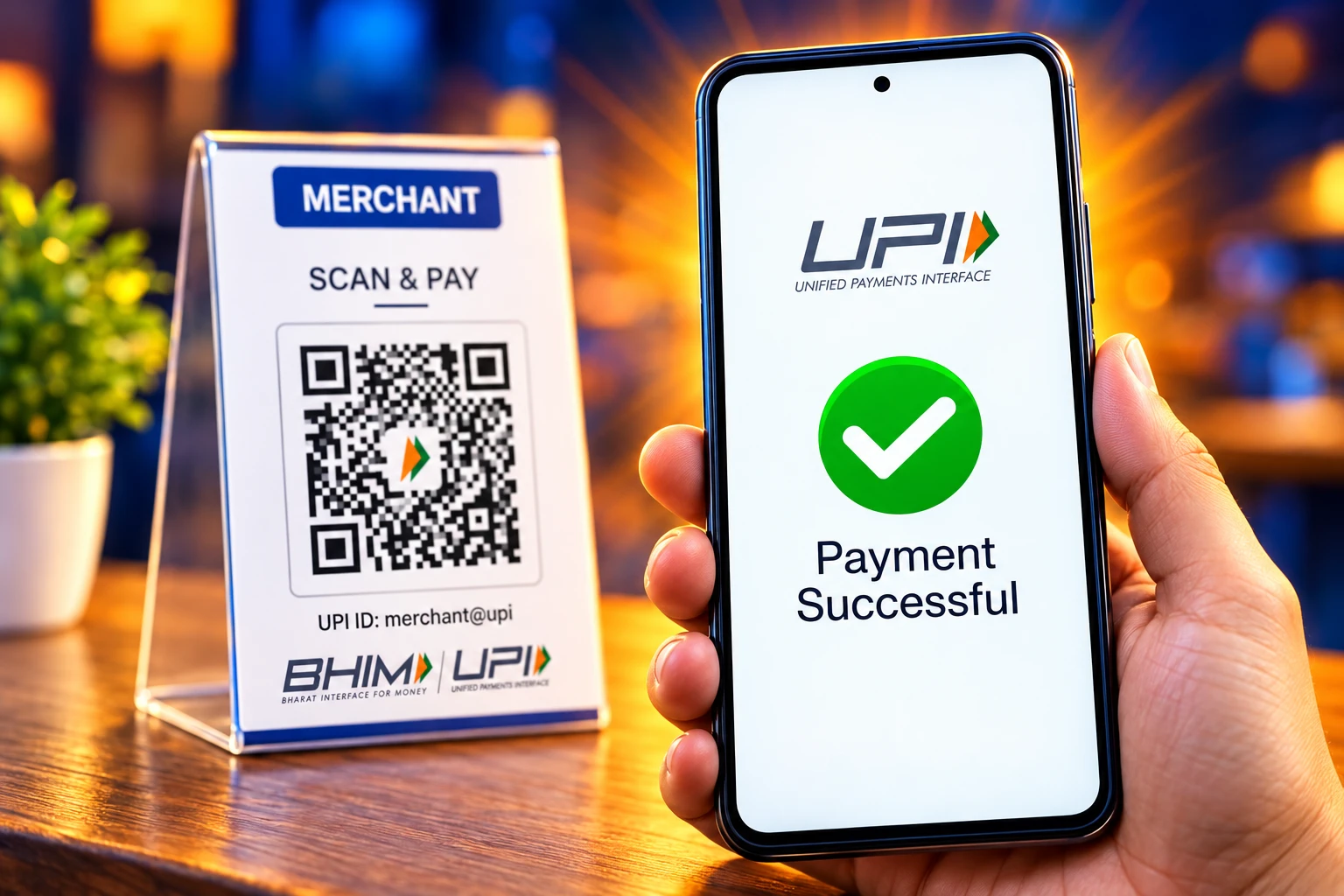
The merchant discount rate is a fee the shop’s bank deducts when a customer pays by UPI. It is not taken from the payer’s account. The finance ministry said banks have been told not to let shops pass the cost to customers, and UPI apps may not add platform fees or hidden charges.
Person-to-person transfers stay free at any size. The ministry said those transfers make up 70% of UPI value, so most of the money that moves on the system never meets the new rate. Person-to-merchant payments up to ₹2,000 stay free as well, which the ministry put at about 96% of merchant transfers, leaving about 4% of shop payments inside the charge.
The ministry also said the levy is neither a tax nor a government charge. NPCI and the government do not keep it. It is shared among banks, payment service providers and UPI apps, and a slice equal to 5% of collections is earmarked for a fund meant to spread UPI among small shops.
UPI MDR FROM OCTOBER 15
| Payment type | Charge | Who pays |
|---|---|---|
| Person to person, any amount | Zero | No one |
| Shop payment up to ₹2,000 | Zero | No one |
| Shop payment above ₹2,000 | 0.4% | The merchant |
| Shop payment of ₹75,000 and above | ₹300 cap | The merchant |
| Rail, telecom, insurance, fuel, farm inputs above ₹2,000 | ₹5 flat | The merchant |
| Mutual funds, securities, brokers and dealers | 0.02%, cap ₹300 | The merchant |
| Small P2PM shops, UPI QR up to ₹1 lakh a month | Zero | No one |
Worked amounts match that grid. A ₹3,000 sale costs the shop ₹12. A ₹50,000 sale costs ₹200. A ₹1 lakh sale would be ₹400 at 0.4%, and the ₹300 cap cuts it back. The cap binds from ₹75,000, where 0.4% is exactly ₹300. NPCI’s own comparison, in its September 15 FAQ, put typical credit-card merchant fees at 1.5% to 2.5% and debit-card fees at up to 0.90%, so UPI remains the cheaper digital option even after the change.
Daily UPI limits, generally ₹1 lakh to ₹5 lakh by category, stay as fraud controls. They are not billing thresholds. Users still have no monthly quota of free payments.
Who Collects After October 15
The cash does not go to a government account. It is split inside the payment stack: the shop’s acquiring bank, the payer’s issuing bank, the payer’s payment service provider, and the UPI app that handled the scan. Published breakdowns of those basis points do not agree, so the only safe statement is the official one. Banks and apps share the 0.4%, and apps are barred from adding their own platform fee on top.
That still leaves a simple volume rule. An app earns the app-side cut on the payments it already processes. PhonePe and Google Pay together handle about 78% of UPI volume, so they stand first in line for that slice. Paytm is a distant third. BHIM, Navi, super.money, CRED, WhatsApp Pay and Amazon Pay sit in the remainder. DFS said the point of the fee is to give those smaller firms a living, so they can finally contest the two leaders.
UPI is large enough that even a thin rate on a thin slice of tickets is real money. NPCI recorded 24,508.96 million UPI transactions in August, worth ₹29.82 lakh crore, across 752 live banks. Most of that flow stays free. The new rate attaches only to the shop tickets above ₹2,000 that are not in the exempt buckets.
WHERE UPI VOLUME SITS
| App | Approx. share of volume | Ownership |
|---|---|---|
| PhonePe | About 46% | Walmart |
| Google Pay | 32% | |
| Top two combined | 78% | U.S. parents |
| Other apps | 22% | Mixed, including Indian firms |
Until now, another percentage point of UPI share bought attention and a base for lending or wealth products. It did not pay a direct processing rent. From October 15 it will, on the charged tickets. That is a gift to whoever already owns the scan, and a reason smaller Indian apps wanted a fee, and a reason merchants did not.
Washington Asked for Credit Access and Did Not Get It
Congress leaders called the fee a surrender to Washington. Rahul Gandhi said the government had put a tax on every Indian and was sending money to the United States. Jairam Ramesh, a Congress spokesperson, asked whether 0.4% was set so that U.S. card companies could compete with UPI. DFS answered those claims on September 17, naming the 2026 National Trade Estimate from the U.S. Trade Representative as the document the Opposition was using.
Contrary to misleading claims made that MDR has been introduced under external pressure, introduction of MDR on select high-value transactions will enable more domestic companies to operate under UPI. Thus, the action of introduction of MDR is a step in protecting India’s sovereignty in Electronic payment ecosystem.
Department of Financial Services, post on X, September 17, 2026
Few allegations are in the media that the MDR has been introduced because of external pressure. They are giving reference to US Trade Representative (USTR) report of 2026. The USTR report has raised the following two issues:
(i) Inability of US electronic payment services… pic.twitter.com/iZ2qRPimfk
— DFS (@DFS_India) September 17, 2026
The USTR file DFS cited had two asks. American electronic-payment firms wanted into UPI, including credit, on a level field with RuPay. They also wanted the 30% cap on third-party apps treated as a barrier. USTR has, in its trade-barrier reports, said India’s rules favor Indian domestic suppliers over foreign suppliers in electronic payments, and it has listed the 30% UPI-app cap since NPCI announced it in November 2020.
DFS said the September 15 circular does not open UPI credit to any card except RuPay. The stated policy is to make RuPay the default credit card on UPI. RuPay debit, DFS added, is being kept free of MDR so that the domestic card has room to grow. Visa and Mastercard still cannot ride UPI credit the way RuPay can. If the political charge is that New Delhi handed Washington the keys, the circular on credit does the opposite of what USTR wrote down.
A 30% Cap With a Deadline in December
The sovereignty argument DFS is making is not about card brands alone. It is about who sits on the phone screen. NPCI told third-party apps in November 2020 that no single app should hold more than 30% of UPI volume. Enforcement was put off, then put off again. The date now on the calendar is December 2026.
DFS gave a blunt reason the cap never ran. Firms other than the two leaders could not compete without a way to earn money on the payment itself. MDR on selected high-value shop tickets, it said, supplies that model, so more domestic companies can expand. The sequence is the policy: charge first, compete later, cap if the share numbers move.
PhonePe is about 16 points above a 30% ceiling. Google Pay is a little above it. A hard cap would force both to shed volume, which is the only way BHIM or a Navi-style app takes a serious extra slice. A fee with no cap just pays the incumbents for the scans they already own. DFS is betting the fee is what makes the cap thinkable. The cap is still a memo until someone enforces it.
Zero MDR Was Written Into Law in 2019
UPI was not born free for shops. Before 2020, merchant fees on the system were measured in tenths of a percent, with rupee caps. The politics changed in the July 2019 Budget, when Finance Minister Nirmala Sitharaman told the Lok Sabha that low-cost modes such as BHIM UPI should carry no merchant discount rate for customers or merchants, and that the Reserve Bank and banks should absorb the cost from savings on cash.
Parliament then wrote that promise into statute. Section 10A of the Payment and Settlement Systems Act, inserted by the Finance (No. 2) Act, 2019, barred MDR on prescribed modes. NPCI and acquiring banks took interchange to zero from January 1, 2020. For six years and nine months, bank-account UPI to a merchant was a free rail, backed by subsidy to the banks and by the hope that cheaper cash handling would pay for it.
The scale that followed is the reason the free ride is ending. UPI ran over 24,162 crore transactions in FY 2025-26, worth ₹314 lakh crore, up from 1.78 crore transactions and ₹0.07 lakh crore in FY 2016-17, the first year after the April 2016 launch with 21 banks. It accounted for 84% of India’s digital payments in FY 2025-26 and 49% of global real-time volume in 2025. The Standing Committee on Finance, in its 32nd Report, had already said the system needed a viable revenue line. The UPI Steering Committee, sitting under the same Act, set the 0.4% schedule after a September 14 gazette that kept zero MDR at or below ₹2,000.
THE PATH FROM ZERO MDR TO 0.4%
- July 5, 2019: Sitharaman tells the Lok Sabha there will be no MDR on customers or merchants for prescribed low-cost modes, including UPI.
- January 1, 2020: Zero network MDR takes effect on bank-account UPI and RuPay debit person-to-merchant payments.
- November 2020: NPCI mandates a 30% volume cap on any third-party UPI app.
- August 17, 2026: The Taxation and Other Laws (Amendment) Act, 2026 gets presidential assent, narrowing the statutory zero-MDR band so a committee can set rates above a notified threshold.
- September 14, 2026: A finance ministry notification keeps zero MDR on UPI at or below ₹2,000.
- September 15, 2026: NPCI issues the 0.4% framework, with the ₹300 cap and the exempt buckets, effective October 15.
- December 2026: Current deadline for the 30% app-share cap.
Ajay Maken, a Congress Rajya Sabha MP, put the legal shift in one line: the ₹2,000 free band now lives in a notification, which a government can change without going back to Parliament. The rate is no longer a law. It is a setting.
Kirana Margins Cannot Absorb a 0.4% Charge
The shops that will pay are not the street-vendor QR accounts under ₹1 lakh a month. They are the garment counter, the phone retailer, the kirana that crosses the threshold, the electronics stall in a market like Nehru Place, and the fuel dealer whose ticket size is routinely above ₹2,000. Several of those trades run on net margins that sit close to, or under, 0.4%.
THE TRADE BODIES PUSHING BACK
- Mobile retail: The All India Mobile Retailers Association, which says it speaks for 1,50,000 neighbourhood stores, wrote to the finance ministry that mainline mobile shops often net 0.75% to 1.50%, and that a 0.40% UPI charge would eat that survival margin after a roughly 40% year-on-year drop in volumes.
- FMCG and kirana: Dhairyashil H. Patil, president of an FMCG trade body, said grocers often see gross margins of 8-12% and net margins of only 1.5-2% after expiry and running costs, and called 0.4% a direct hit on that net.
- Retail association: Kumar Rajagopalan, chief executive of the Retailers Association of India, said small merchants will now think twice about cash versus UPI, and that a large share of festive-season tickets crosses ₹2,000. RAI also said the ₹1 lakh monthly free band is only ₹12 lakh a year, too low for many micro firms.
- Fuel dealers: Monty Sehgal of the Federation of All India Petroleum Association said pump margins have not been revised in line with inflation since 2017, and that dealers cannot take a new payment cost they are not allowed to recover in the price.
- Delhi markets: Deepak Nagpal, a garments retailer in Lajpat Nagar, said UPI had been free since Covid and that the burden should not fall on shops already paying 18% GST and card fees.
The official line is that shops must not pass the charge on. Traders in Delhi, Noida and Ghaziabad have already said they will, or they will ask for cash. Some fuel outlets have begun steering customers off UPI, weeks before October 15, by claiming the machine is down. Ramesh Khandelwal, a Madhya Pradesh member of the National Traders’ Welfare Board, said he would raise a withdrawal demand at the board, calling the fee a blow to ease of doing business.
A shop that cannot raise the sticker price has three moves: eat 0.4%, steer the customer to cash, or break the rule and add a “UPI extra”. The ministry has warned against the third. Cash is the one that does not leave a digital trail, which is the opposite of the formalisation drive that made UPI ubiquitous in those same markets.
How Brokers Get Charged for Transfers That Do Not Trade
Capital-market payments were given the concessional 0.02% rate, capped at ₹300, to keep retail money moving into funds and broking accounts. Nithin Kamath, founder and chief executive of Zerodha, said even that structure does not fit a business where a UPI credit is not a sale.
The problem with broking is that there is no guarantee that money transferred to a broker will actually result in a transaction. As brokers, we can’t force a customer to trade after transferring money. And if we can’t pass the UPI charge on to the customer, there is essentially no limit to the cost a customer can impose on a broker without generating any revenue.
Nithin Kamath, founder and CEO, Zerodha, on X, September 16, 2026
His worked case was 10,000 clients each sending 50 UPI transfers of ₹2 lakh in a month with no trade, which he put at about ₹2 crore of cost at the proposed rate. SEBI’s quarterly settlement then forces unused cash back to clients, and more than half of the money that returns to broking accounts, he said, comes back on UPI, so the same rupees can be charged on the way in. He said an MDR is fine in principle, and that 0.02% with a cap of ₹5 or ₹10 would fit broking better than a cap as high as ₹300.
That is the design tension inside a “thin” rate. Fuel tickets are large and frequent and already sit on frozen retail margins, so they got a ₹5 flat fee and still want out. Broking tickets can be large and empty, so a percentage with a high rupee cap taxes the movement of cash, not the trade. The steering committee built a grid with political exemptions. Each exemption creates a neighbour who says the grid missed them.
WHAT WE KNOW
- The rate: 0.4% on eligible shop UPI above ₹2,000 from October 15, with a ₹300 cap at ₹75,000 and the listed carve-outs.
- The credit rule: Only RuPay credit cards ride UPI under the September 15 circular.
- The collectors: Banks and UPI apps share the fee; the two largest apps still process about 78% of volume.
WHAT IS UNCONFIRMED
- Pass-through: Whether shops obey the ban on adding the fee to the bill, or move those tickets to cash.
- The cap: Whether NPCI actually enforces 30% per app in December 2026.
- Broking and fuel: Whether the 0.02% band and the ₹5 flat fee are reopened before the start date.
The 0.4% charge starts on October 15. NPCI’s 30% app cap is due in December 2026.

Edinburgh Opens a 2027 Tour Built for Time Trials

Korda Maps Auður From Meðalland to Irvine Bay

Apple Music Films Its New Logo in Mineral Oil

Oppo Prices the Pad Mini Above India’s iPad Mini

Austen Soaks Scotland Before Boelo Brings Weekend Gales

Volkswagen Sells the Osnabruck Plant to Clear a Board Fight

Apple’s Foldable iPhone Hinges on Samsung Display Supply

Saksham Gaur Finds He Is His Own Company’s Client

Tata Motors’ Iveco Tender Opens as Holders Still Decide

Onimusha Way of the Sword Preload Hits a Windows 11 Wall
-
 AUTO2 months ago
Volkswagen Sells the Osnabruck Plant to Clear a Board Fight
-
 NEWS2 months ago
Apple’s Foldable iPhone Hinges on Samsung Display Supply
-
 AUTO2 months ago
Tata Motors’ Iveco Tender Opens as Holders Still Decide
-
 BUSINESS2 months ago
Saksham Gaur Finds He Is His Own Company’s Client
-
 GAMING2 months ago
Onimusha Way of the Sword Preload Hits a Windows 11 Wall
-

 ENTERTAINMENT3 years ago
What is SD on Amazon Prime? – All You Need to Know
-

 BUSINESS2 months ago
Hyderabad 22-Carat Gold Jumps After a False Bargain
-

 NEWS2 months ago
iQOO 16 Locks 8,400 mAh While 100W Charging Holds