
NEWS
Buried Far-Side Magma Records the Moon’s Ancient Dynamo
A 60-kilometre magma body under Dewar cooled in a field stronger than 10 microtesla, shifting the lunar dynamo fight from whether to how.

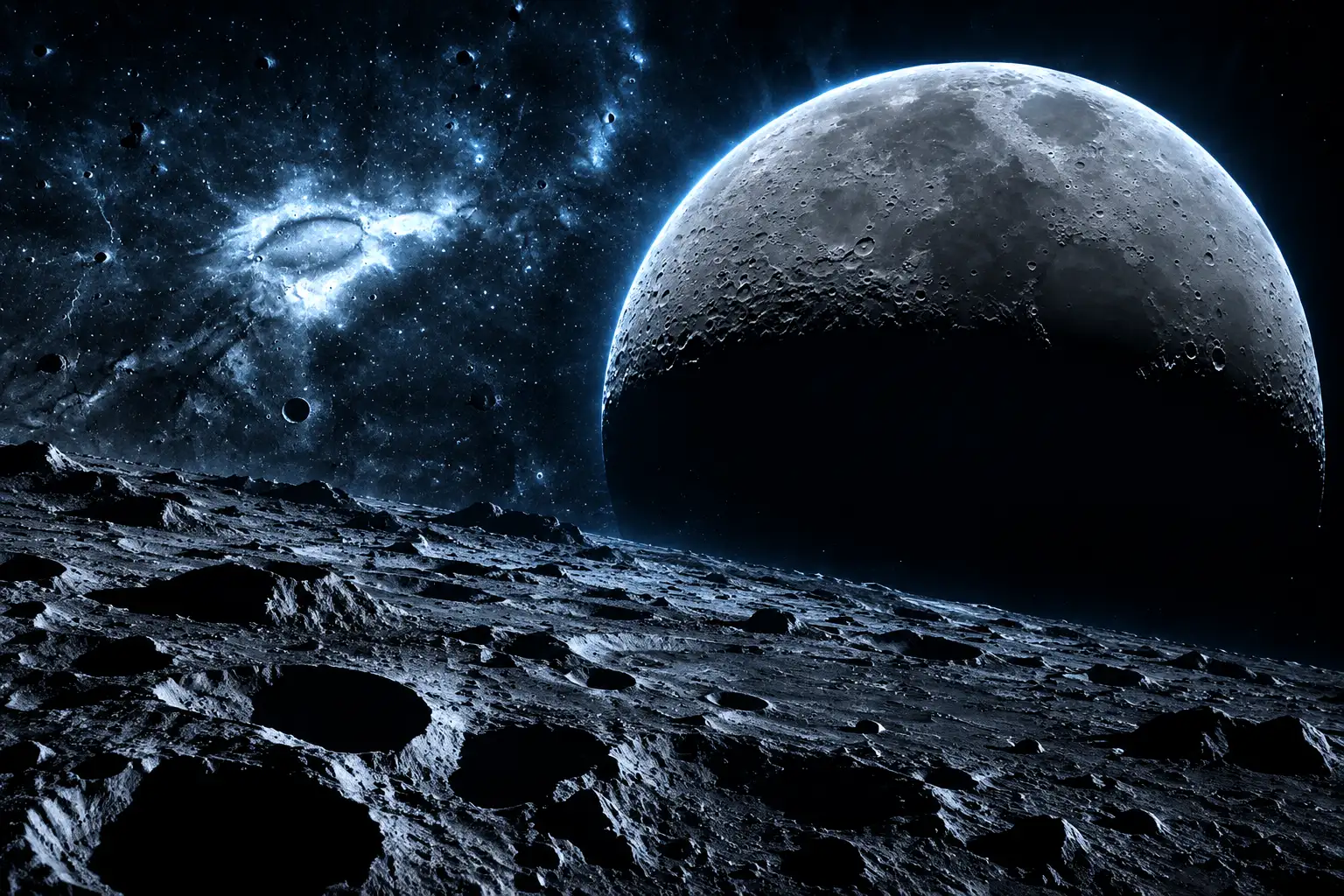
A rock body about 60 kilometres wide and 9 kilometres deep lies buried under the moon’s far side, and it cooled in a magnetic field stronger than 10 microtesla. The magma solidified about 4.2 billion years ago, several hundred million years after the moon formed, a team at ETH Zurich, the German Aerospace Center, and TU Berlin reports in Science Advances on September 23, 2026.
Gravity and magnetism overlap at Dewar, so the same maps also mark bright surface swirls that still turn solar wind aside, and they can be flown at other worlds without bringing a rock home.
A 60-Kilometre Intrusion Under Dewar
Dewar sits on the far side at about 3.5 degrees south, 167 degrees east, never visible from Earth. Xi Yang, a doctoral student in Earth and planetary sciences at ETH Zurich, called it a window into the interior because one of the strongest far-side magnetic anomalies sits on a clear gravity anomaly. Anna Mittelholz, a lecturer in the same department, said the overlap is what made a joint model possible.
Most crustal magnetic signals seen from orbit have no known source. Gravity, Mittelholz said, describes density and therefore the material under the surface, and where the two signals coincide the anomaly can be tied to a real structure. The team ran gravity from NASA’s GRAIL probes with magnetic models built from Lunar Prospector and Kaguya, using Max Moorkamp’s jif3D inversion code at TU Berlin, and recovered a single dense, strongly magnetised body.
THE DEWAR BODY IN NUMBERS
| Quantity | Value |
|---|---|
| Width | 60 kilometres (37 miles) |
| Depth | 9 kilometres (5.6 miles) |
| Age | about 4.2 billion years |
| Minimum magnetising field | stronger than 10 microtesla |
| Earth’s present surface field | about 50 microtesla |
Surface chemistry and an arched topography point to magma that rose and froze before it reached the surface, a buried volcanic complex, likely cryptomare, mare basalt that never broke through. An earlier conference abstract by the same authors argued that metallic iron, made as ilmenite reduced while the magma cooled, is what locked in the magnetisation. Impact ejecta stacked on top of the structure set the age at about 4.2 billion years.
Because the body can hold only so much iron-bearing mineral, the team could work backward to the weakest field able to magnetise it as it cooled. Yang said the lunar field then was very likely stronger than 10 microtesla, against about 50 microtesla at Earth’s surface now, or roughly one-fifth as strong. That figure is a floor, not a point reading.
Apollo Rocks Still Disagree With One Another
The argument over a lunar dynamo goes back to the 1970s, when Apollo crews brought home rocks that looked as if they had cooled in a global field. For a long time the working picture was a dynamo from about 4.25 billion to 3.5 billion years ago. Mittelholz said that is still what most researchers hold, but the last decade of Apollo re-analysis found no magnetic signal at all for parts of that span, and some groups now doubt an early dynamo existed.
One line of single-crystal work on Apollo samples has even tried to confine any core dynamo to the moon’s first roughly 140 million years. Other paleomagnetic studies of mare basalts still show a high-field stretch, then a sharp fade by about 3.2 billion years ago as the interior cooled. Two rocks that look alike can disagree, Mittelholz said, because a sample’s magnetic record is easy to scramble by later heating, shock, or even ordinary handling and storage in a lab.
Orbital data leave the rock in place. Lunar Prospector, launched in 1998, mapped crustal fields globally. Kaguya, launched in 2007, added vector magnetometry from about 100 kilometres up. GRAIL’s twin probes, launched in September 2011 and placed in lunar orbit in January 2012, built the average crust 34 to 43 kilometres thick gravity field that lets a 9-kilometre-deep dense lens stand out. Adrien Broquet, a researcher at the German Aerospace Center in Berlin, said Earth and the moon had very different geological histories, and a magnetic field is one of the few ways to reconstruct how the smaller, long-molten moon looked early on.
Dewar Sits Off the Impact Antipode
A second school says giant impacts, not a long-lived core engine, magnetised much of the crust. In a Science Advances paper on May 23, 2025, Isaac Narrett, then a graduate student in MIT’s Department of Earth, Atmospheric and Planetary Sciences, and colleagues modelled plasma from an Imbrium-scale impact wrapping the moon and amplifying a weak dynamo at the opposite point. Starting from a surface field of only 2 microtesla, their runs produced about 43 microtesla at the antipode. The spike lasted around 40 minutes. A pressure wave through the globe, they argued, could “jitter” rock electrons so they froze in that brief high field.
There are large parts of lunar magnetism that are still unexplained. But the majority of the strong magnetic fields that are measured by orbiting spacecraft can be explained by this process, especially on the far side of the moon.
Isaac Narrett, graduate student, MIT EAPS
Dewar is on the far side, which is exactly where that story predicts strong crustal fields. The ETH team still rules an impact out for this body. The region, they wrote, lies outside the zones treated as possible impact-magnetisation candidates, so a one-off blast is a poor fit. Yang said they can be almost certain the magnetising field came from a longer-lasting dynamo generated in the core. Narrett, commenting on the new paper, said it adds to evidence that the moon had a stronger field more than 4 billion years ago and lays groundwork for reading gravity and magnetic data at Mercury and Mars. The two results can both be partly right: some far-side patches may be impact-amplified, while Dewar looks like slow-cooled magma in a standing field.
The Small Core Problem Does Not Go Away
What the new work does not do is explain the engine. Electromagnetic sounding from Kaguya put the metallic core at only a few hundred kilometres across, far smaller than Earth’s. A core that small is a weak dynamo on paper, and earlier sample work had implied surface fields that, at times, rivalled Earth’s. The Dewar floor of stronger than 10 microtesla is lower than those high Apollo readings, yet it is still hard to produce with ordinary core convection in such a small volume.
WHERE EXPERTS DISAGREE
- Majority view: Mittelholz said most researchers still think a dynamo ran from about 4.25 billion to 3.5 billion years ago.
- Sample skeptics: Re-analyses of Apollo crystals that could have recorded a strong field instead show null magnetisation across much of that span, and some papers confine any dynamo to the moon’s first ~140 million years.
- Impact amplifiers: Narrett’s group keeps a weak dynamo and lets basin-forming plasma and shock do the rest, especially opposite Imbrium.
- Dewar team: A buried, slowly cooled magmatic body outside impact-candidate ground needs a standing core field at about 4.2 billion years, which moves the live question from whether a dynamo existed to how it ran.
Claire Nichols, associate professor of geology of planetary processes at the University of Oxford, who did not take part in the study, said it further supports an intense early dynamo, but that much more work is needed on how long the field lasted and how much it varied. The authors themselves could not estimate the dynamo’s lifetime. A core that small running a field that strong for any useful stretch of time is the objection that remains, and this paper does not make that engine easier to run. It only makes the field at 4.2 billion years harder to deny.
Quiet Ground Under a Bright Swirl
Above the buried body sits the Dewar swirl, a bright, winding albedo marking. Lunar swirls are always found with magnetic anomalies, though plenty of anomalies have no swirl. Yang said the leading idea is that the local field deflects solar wind and keeps the surface from weathering as fast as the darker ground around it. At Dewar, the joint model needs horizontal magnetisation plus iron-oxide enrichment at the surface for a swirl to form. A horizontal field is better at standing off incoming protons than a vertical one.
WHAT THE SWIRL RECORD IS ALREADY GOOD FOR
- A visible proxy: Mittelholz said magnetic field lines could offer protection from solar winds, and swirls flag those geometries on the surface.
- Not a full shield: Present crustal remnants are far weaker than Earth’s global field, so the protection is local and partial, not a substitute for a magnetosphere.
- A near-side testbed: Reiner Gamma, a swirl about 70 kilometres across in Oceanus Procellarum, is the classic case and the target of Lunar Vertex.
- A landing that has not happened yet: Johns Hopkins Applied Physics Laboratory leads the payload, booked on a commercial lander for a 2026 arrival, as the first surface study of a lunar magnetic anomaly.
David Blewett of APL is principal investigator. A lander magnetometer and a rover that can drive up to 2 kilometres are meant to map field geometry across light and dark soil during one lunar daylight stretch of about 13 Earth days. Models of Reiner Gamma have the local mini-magnetosphere blocking as much as 80 percent of incoming solar-wind plasma in places, and some work has floated “reduced radiation zones” under anomalies during solar storms. Yang called the Dewar swirl reading preliminary. It still turns a 4.2-billion-year-old intrusion into a practical map layer for anyone picking where to park hardware.
The Same Joint Model Can Fly at Mars
The method is the part that travels. Earlier satellite studies of lunar magnetism usually took the magnetic signal alone and guessed at the rock that made it. This team combined magnetism with gravity in one model, which, Mittelholz said, pins down an actual buried structure rather than a signal that many magnetised geometries could produce. Their paper, magmatic origin of the Dewar anomaly, is the first time that joint inversion has been used this way on the moon.
The method could also be applied to other celestial bodies to obtain information about a planetary dynamo based solely on data from orbit. Mars, for example, would be an interesting case, although data of sufficiently high quality is currently lacking.
Xi Yang, doctoral student, ETH Zurich
Mittelholz made the same calibration point in other words: if a body as small as the moon ran a dynamo at all, that sets a floor on the conditions needed, which matters for other small rocky and icy worlds. Mercury still has a field. Mars has crustal remnants and no global dynamo now. Both have gravity and magnetic datasets that are coarser than GRAIL plus Lunar Prospector. The Dewar result is one structure, dated by ejecta, not a full history. Nichols said it is further reason to keep collecting observations on Artemis and Chang’e flights. A sample from Dewar itself would test both the magmatic reading and the 10-microtesla floor. Until then, the far side has already given mission planners a swirl to watch and planetary scientists a trick that does not need a box of rocks.
Frequently Asked Questions
How did the team date the Dewar magma body?
They did not date the intrusion with a returned sample. Superposed basin ejecta on the surface set a formation time of about 4.2 billion years, and the body has to be younger than the South Pole-Aitken basin that dominates the far side. That stratigraphic clock is coarser than a lab age, which is why the paper treats 4.2 billion years as about, not exact.
Do all lunar magnetic anomalies have swirls?
No. Every known swirl sits on a magnetic anomaly, but many anomalies have no bright marking. The Dewar model finds that swirl formation also needs horizontal magnetisation and extra iron oxide at the surface, so a strong field alone is not enough to bleach the soil.
What did GRAIL actually measure?
GRAIL’s two spacecraft, named Ebb and Flow, flew in formation and timed radio signals between them to map how lunar gravity tugged their spacing. From that field, Mark Wieczorek and colleagues derived an average crust 34 to 43 kilometres thick, several kilometres thinner than older estimates, which is why a dense 9-kilometre-deep lens is a clear gravity target.
Why is Mars harder to read the same way?
Yang said the joint gravity-and-magnetism trick can, in principle, be run on any rocky world from orbit, but Mars still lacks gravity and magnetic maps at GRAIL and Lunar Prospector quality. Until those datasets thicken, a Dewar-style buried body there would stay a blur rather than a dated volcanic complex.

Edinburgh Opens a 2027 Tour Built for Time Trials

Korda Maps Auður From Meðalland to Irvine Bay

Apple Music Films Its New Logo in Mineral Oil

Oppo Prices the Pad Mini Above India’s iPad Mini

Austen Soaks Scotland Before Boelo Brings Weekend Gales

Volkswagen Sells the Osnabruck Plant to Clear a Board Fight

Apple’s Foldable iPhone Hinges on Samsung Display Supply

Tata Motors’ Iveco Tender Opens as Holders Still Decide

Saksham Gaur Finds He Is His Own Company’s Client

Onimusha Way of the Sword Preload Hits a Windows 11 Wall
-
 AUTO2 months ago
Volkswagen Sells the Osnabruck Plant to Clear a Board Fight
-
 NEWS2 months ago
Apple’s Foldable iPhone Hinges on Samsung Display Supply
-
 AUTO2 months ago
Tata Motors’ Iveco Tender Opens as Holders Still Decide
-
 BUSINESS2 months ago
Saksham Gaur Finds He Is His Own Company’s Client
-
 GAMING2 months ago
Onimusha Way of the Sword Preload Hits a Windows 11 Wall
-

 BUSINESS2 months ago
Hyderabad 22-Carat Gold Jumps After a False Bargain
-

 ENTERTAINMENT3 years ago
What is SD on Amazon Prime? – All You Need to Know
-

 NEWS2 months ago
iQOO 16 Locks 8,400 mAh While 100W Charging Holds