
NEWS
Wello’s Penguin Wave Machine Outlasted Storms, Not the Firm
Wello’s Penguin rode 18.7-metre Orkney waves for two years, then sank. The successor leaked in Spain and the Finnish firm was bankrupt by 2023.

Wello’s Penguin, a 1,600-tonne wave energy converter, generated power off Orkney for two years before it sank on 22 March 2019. The Finnish company had bet that a sealed hull which rolled with the sea, with no gearbox and no hydraulics, would survive water that had already wrecked hinged machines. Storm Caroline threw 18.7-metre waves at it. The hull lasted. The firm did not.
A second Penguin leaked off Spain in late 2021 and came out of the water in under six months. Wello filed for bankruptcy in late February 2023. The rotating-mass idea now sits with Holvi Oy, which filed a new patent in 2024. The berth at Billia Croo is booked for someone else.
A Hull Designed to Be Unstable
Heikki Paakkinen’s company, founded in Espoo in 2008, picked the Penguin from a stack of wave ideas that went back to 1976. Most boats are drawn to stay upright. This one was drawn to roll, heave and pitch so an internal spinning mass would keep turning and drive a generator on the same shaft.
The European Marine Energy Centre still describes the 1,600-tonne 500 kW Penguin as a hull about 30 metres long, nine metres high and with a seven-metre draft, of which only two metres showed above the water. Moving parts sat inside, out of the salt. The nickname came from the waddle, not from the silhouette.
THE HULL EMEC LOGGED
- Mass: More than 1,600 tonnes without ballast, with only a short cabin above the waterline.
- Site rating: 500 kW at Billia Croo; the U.S. Department of Energy’s Tethys file lists the project at 1 MW.
- Measured output: 2013 trials showed a steady 160 to 180 kW, with peaks of 700 kW in seas of three metres and up.
- Water: A deep berth of about 60 metres, inside a test field 50 to 70 metres deep.
That gap between a 500 kW operator figure, a 1 MW database line and a few hundred kilowatts on the meter is the first crack in the sales story. The machine did put current into the UK grid. It did not run as a megawatt plant in the sense a wind farm manager would use the word.
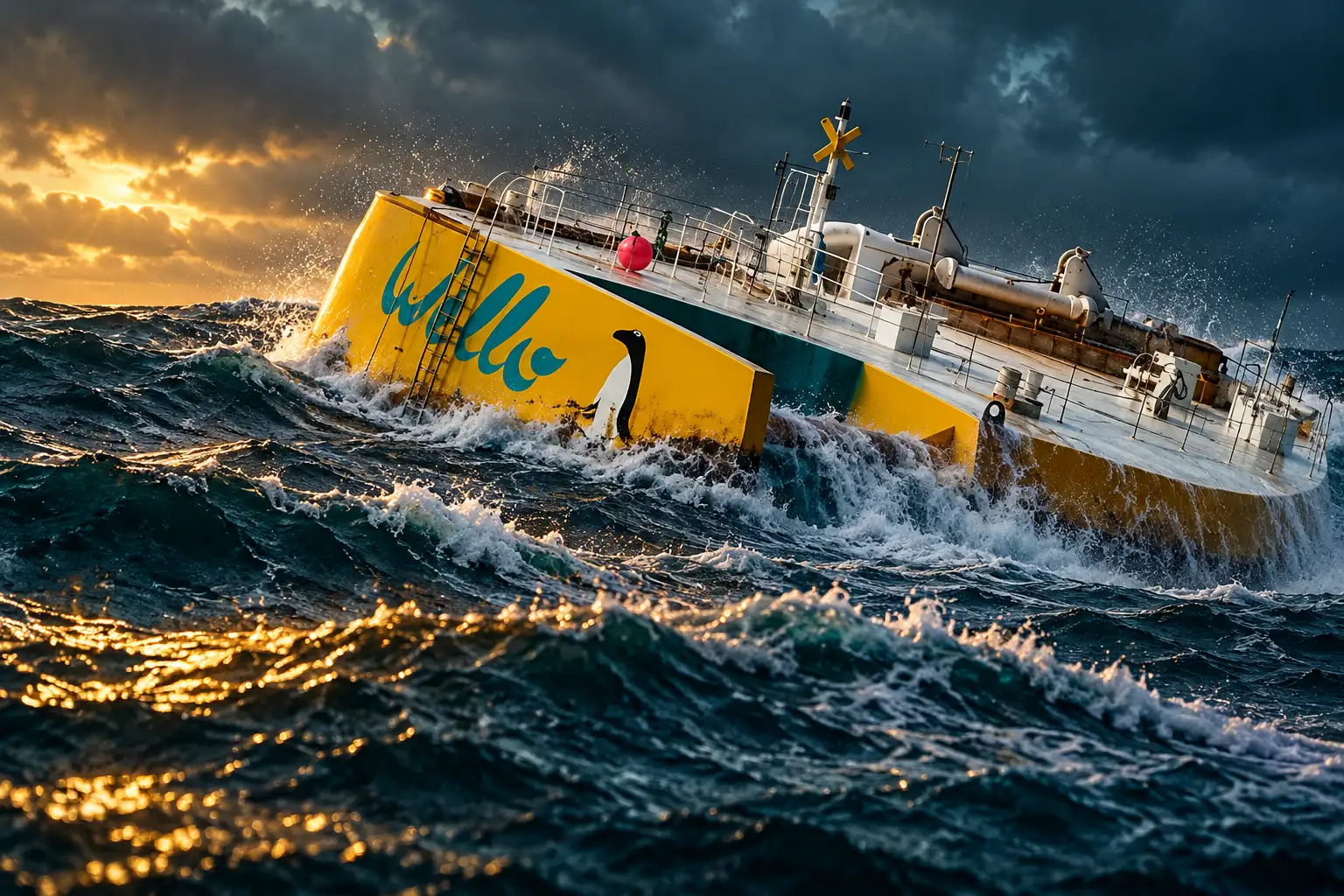
Storm Caroline Sent 18.7-Metre Waves
The device first reached Orkney in June 2011 and went into the water at Billia Croo in summer 2012. Tests ran into 2015. After a spell in Falmouth, when a planned move to Cornwall’s Wave Hub slipped, it came back for a fourth hook-up in March 2017, this time as the lead unit in Fortum’s EU array plan.
EMEC’s west-coast wave field sits in the path of North Atlantic storms. The centre’s own client note says the Penguin stayed on station for over two years and came through wave heights of up to 18.7 metres in Storm Caroline. A later EMEC notice on the sinking put the same survival at waves of over 18 metres and said the run had surpassed expectations on that score.
Moorings and the cable held. Green Marine, the Orkney contractor, had put the hull on Berth 5 in a winter window, which was part of the point: if you cannot hook up outside summer, you do not have a product. For a while the bet looked right. A sealed hull that gave with the sea, using kit closer to a wind-turbine drivetrain than to a hydraulic hinge, had lived where Pelamis Wave Power’s jointed tubes had already gone into administration in 2014.
What Happened When the Penguin Sank?
On Monday 18 March 2019, monitors flagged a problem. Inspection confirmed the hull was taking on water. EMEC’s notice on Friday 22 March 2019 said the Penguin was no longer visible, no longer lit, and still on its moorings at Berth 5. Mariners were told to stay outside the marked perimeter. Wello, EMEC and Green Marine were watching it, and the harbour notice was already up.
The centre called Billia Croo a place where new kit is meant to meet hard water, and said lessons would go into the next hull. That next hull was already being sold as the commercially ready step. Tethys, which logged the two-year mark just before the sinking, also carried Wello’s claim that the follow-on model would deliver a jump of 380% in power production. The file does not say whether that number is peak watts or energy over a year.
THE PENGUIN’S FOUR TOURS AND WHAT FOLLOWED
- June 2011: The 1,600-tonne hull arrives in Orkney for trials at Billia Croo.
- Summer 2012: First deployment at the grid-connected wave site; tests continue into 2015.
- March 2017: Fourth deployment, grid-linked, as the opening unit of the CEFOW plan.
- 22 March 2019: After taking on water from 18 March, the device is no longer visible at Berth 5.
- December 2018: Penguin WEC2 is launched at a Tallinn yard for a planned Orkney array slot.
- July 2019: WEC2 reaches Orkney, then leaves for Spain on the back of an investment deal.
- August 2021: The 44-metre, 600 kW second hull is installed at BiMEP off Armintza.
- 19 December 2021: The second hull is recovered after a leak, less than six months on site.
- Late February 2023: Wello files for bankruptcy in Finland; Holvi Oy takes the IP.
Tethys counts four deployments across nine years from a 2010 launch to the 2019 sinking. By the time the first hull went under, the prototype had done the job a test article is built for: it had lived through Atlantic storms, exported power, and handed over data on moorings, cable, control software and the spinning-mass take-off. That is a completed trial. It is not a farm.
Ocean Energy Europe, the trade body, was still calling the Orkney run proof of a resilient 1 MW machine two months after the sinking.
The @WelloWaveEnergy ‘Penguin’ 1MW #waveenergy device survived for two continuous years in the waters off #Orkney, an area with one of the highest wave #energy resources in Europe. It has proven to be a resilient machine, weathering
several big storms and 18-metre high waves. pic.twitter.com/RToegjfG2c— Ocean Energy Europe (@OceanEnergyEU) June 24, 2019
Spain, a Tow, and a Leak
WEC2 never took the EMEC berth the 2019 notices had promised. EMEC says the second Penguin arrived in Orkney in July 2019 and was towed to Spain after an investment deal. The 44-metre hull, rated at 600 kW, was installed at the Biscay Marine Energy Platform, 1.5 kilometres off Armintza, in a 70-metre berth with a six-leg mooring. Installation finished in August 2021. Generation into the Basque grid followed in September.
Wello said output matched tank tests and that storms had already sent waves up to 11 metres. In December 2021 the remote system saw a leak. The company first blamed a floating object. Marine inspectors later judged the breach had started during the tow from Scotland, because a moored hull would not have met debris at the speed needed to open that hole. Strong winds and nine-metre seas delayed the lift and let more water in. The hull has four separate watertight compartments, and it stayed afloat. Recovery on 19 December 2021 ended a campaign that had been sold as a two-year stay.
Penguin WEC2 has been launched in Estonia by @WelloWaveEnergy as part of @EU_H2020 #CEFOW project in preparation for towing and deploying alongside Penguin WEC1 at our grid connected wave test site, Billia Croo #cleanenergy #waveenergy
Read more: https://t.co/rHtfiJZH3k pic.twitter.com/2NgU3lkPRW
— EMEC (@EMEC_Ltd) December 7, 2018
EMEC had posted the Estonia launch in December 2018 as preparation to sit WEC2 beside the first hull at Billia Croo. That pairing never happened. Letters of intent for parks in India, China, Barbados and Bali had the same shape: paper in front of steel. The rotating-mass idea was a clean break from the hinged tubes that had already died in these waters. Getting a second full-scale hull built and towed was real work. Keeping it dry was the part that still failed.
How Much EU Money Backed the Bet?
Fortum, the Finnish utility that coordinated the array plan, said in May 2015 that Horizon 2020 had granted EUR 17 million in funding toward a total budget of EUR 24.5 million. The five-year mission was to run Wello’s Penguin on a grid-connected site, first named as Wave Hub in Cornwall, later moved to EMEC when the Cornwall timetable slipped.
The Horizon 2020 CEFOW project, grant 655594, set hard targets: raise converter performance by 50 percent, push availability to 70 percent, and put 3 MW in the water as three 1 MW units, with new moorings and electrical links for a multi-device spread. Wello was booked for most of the EU cash.
CEFOW SUMS ON CORDIS
| Organisation | Net EU contribution | Total cost |
|---|---|---|
| Wello Oy | €9,447,840.50 | €13,496,915 |
| Fortum Oyj (coordinator) | €250,125 | €693,750 |
| Fortum Power and Heat Oy | €194,250 | €277,500 |
Those three lines do not add up to the €17 million grant. Ten participants sat on the file, including marine contractors and universities, and some UK partners later dropped out when the site moved. The table is the Finnish core of the wager, not the whole consortium. Heli Antila, then Fortum’s chief technology officer, called the work “at the vanguard of wave power research” when the grant landed. The vanguard, as funded, was an array. What ran was one hull, then a second hull somewhere else, then none.
The Patent Trail Leads to Holvi Oy
Wello kept signing collaboration notes after Spain, from Barbados to Taiwan, and still ran out of cash. In late February 2023 it filed for bankruptcy with the Finnish regulators. Paakkinen, founder and chief executive, said the intellectual property had been sold and that most of the staff had gone with it.
Wello is not in business anymore. Another company, Holvi Oy, has acquired all IP from Wello and most of the team has also followed to Holvi. The company will continue providing the same technology and developing the product further.
Heikki Paakkinen, founder and chief executive of Wello
He also said Holvi, based in Espoo, was the house that first worked out the Penguin principle and filed that patent, and that it was still talking to some of Wello’s old customers about a commercial site. In January 2024 Holvi filed a Finnish application with Paakkinen as inventor. The international text, published on 17 July 2025 as WO2025149704A1, is a pending patent on wave conversion that still turns a rolling body and a long rotator shaft into rotation. The U.S. marine-energy device database marks the Wello Penguin inactive.
So the wager changed shape. It is no longer a 1,600-tonne hull on a Scottish berth. It is a pending filing and a small Finnish team that already lost two full-scale machines at sea.
Billia Croo’s Next Wave Farm Is Not a Penguin
Wave power is still the slow cousin of wind and solar. No converter family has yet run a multi-megawatt farm for a commercial term. Pelamis went into administration in 2014. Aquamarine’s Oyster left the same Orkney field. Wello’s first hull lasted two years and then sank; the second lasted less than six months. That is a better sea record than some of the hinged designs, and it is still a record of prototypes, not of plant.
The next booking at Billia Croo belongs to CorPower Ocean, which has a berth agreement for a 5 MW array of 14 converters, aimed at 2029. That is a different machine, a point absorber with phase control, and a different firm. Orkney still has the cables, the contractors and the test culture. It does not have a Penguin on the hook.
Paakkinen’s bet was specific: hide the electrics in a fat hull, let the hull stagger, and sell that stagger as power. For 24 months on Berth 5, the stagger worked. Then the first hull went under, the second hull leaked on a tow, €17 million of EU array money did not buy an array, and by February 2023 the company that named the bird was finished. Holvi still holds the shaft. The water off Orkney has not got any kinder.

Edinburgh Opens a 2027 Tour Built for Time Trials

Korda Maps Auður From Meðalland to Irvine Bay

Apple Music Films Its New Logo in Mineral Oil

Oppo Prices the Pad Mini Above India’s iPad Mini

Austen Soaks Scotland Before Boelo Brings Weekend Gales

Volkswagen Sells the Osnabruck Plant to Clear a Board Fight

Apple’s Foldable iPhone Hinges on Samsung Display Supply

Saksham Gaur Finds He Is His Own Company’s Client

Tata Motors’ Iveco Tender Opens as Holders Still Decide

Onimusha Way of the Sword Preload Hits a Windows 11 Wall
-
 AUTO2 months ago
Volkswagen Sells the Osnabruck Plant to Clear a Board Fight
-
 NEWS2 months ago
Apple’s Foldable iPhone Hinges on Samsung Display Supply
-
 AUTO2 months ago
Tata Motors’ Iveco Tender Opens as Holders Still Decide
-
 BUSINESS2 months ago
Saksham Gaur Finds He Is His Own Company’s Client
-
 GAMING2 months ago
Onimusha Way of the Sword Preload Hits a Windows 11 Wall
-

 ENTERTAINMENT3 years ago
What is SD on Amazon Prime? – All You Need to Know
-

 BUSINESS2 months ago
Hyderabad 22-Carat Gold Jumps After a False Bargain
-

 NEWS2 months ago
iQOO 16 Locks 8,400 mAh While 100W Charging Holds