
NEWS
StandardX Bets £10 Million on a London Isotope Refinery
StandardX raised £10 million to make cancer isotopes and fusion tritium from a London accelerator, while Europe still uses 1960s reactors.

StandardX has raised £10 million to build a London isotope refinery and ship first medical isotopes in early 2027. The UK company, founded in 2025 by nuclear engineers Dr Richard Pearson and Dr Ross Allen, wants one compact accelerator to serve cancer care and, later, fusion fuel.
Vsquared Ventures and East X Ventures led the seed round announced on 23 September 2026, with firstminute capital, UKI2S, Brevan Howard Macro Venture and Geometry joining. The money is meant to grow a team of 15, lock down a first industrial site in London, and move a digital design onto a factory floor.
Europe Still Runs Scans on 1960s Reactors
Most diagnostic and many therapeutic isotopes still come out of a small set of research reactors built in the 1950s and 1960s, plus a scatter of hospital cyclotrons that cannot cover the full catalogue. The Euratom Supply Agency says more than 10,000 hospitals use radioisotopes on about 35 million patients a year, including 9 million in Europe, and that Europe takes more than 20% of the global market for technetium-99m, the workhorse imaging isotope.
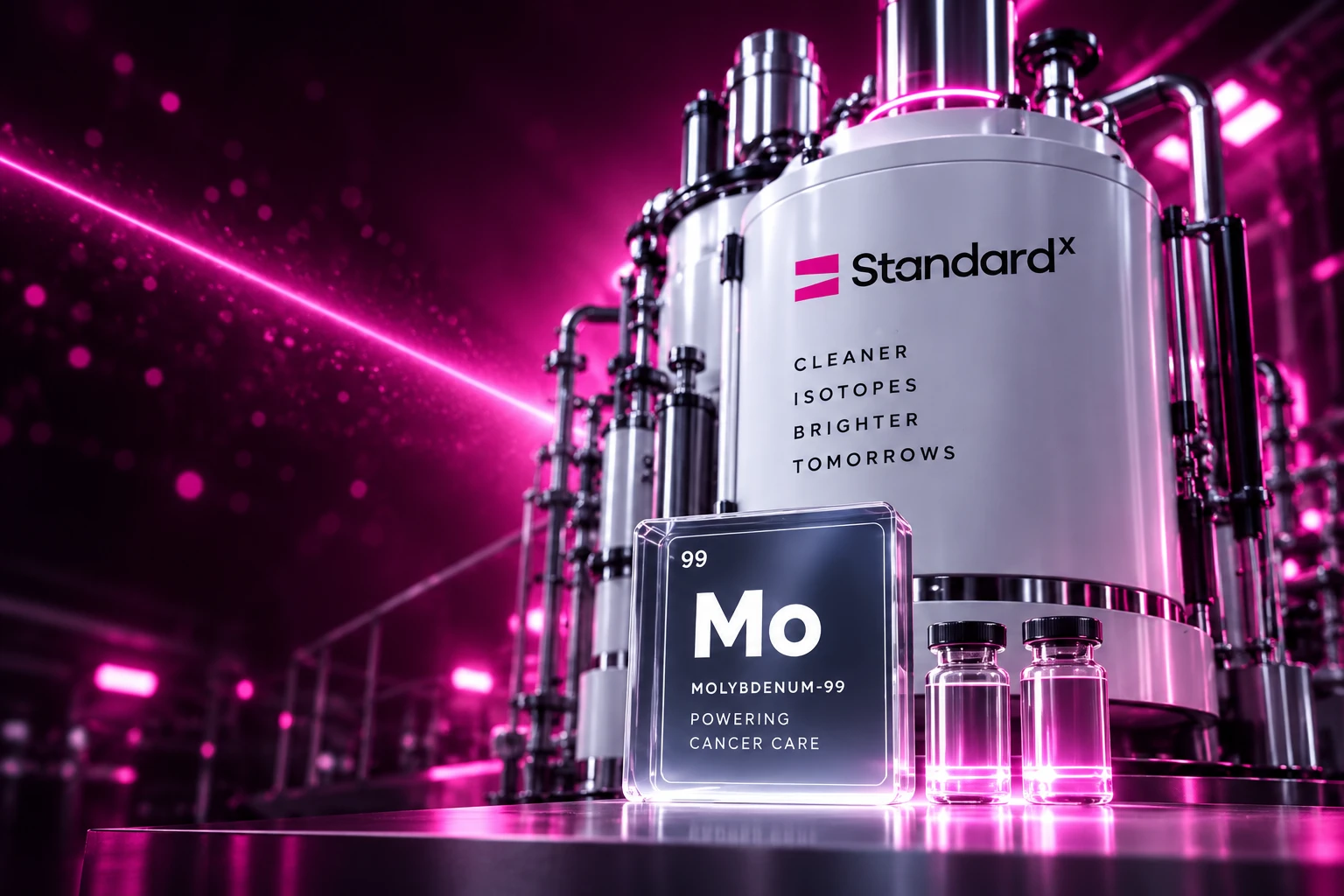
Technetium-99m is milked from molybdenum-99 made by irradiating uranium targets in those reactors, then processed, packed into generators, and flown to hospitals before it decays. When one reactor trips, the whole chain tightens. Euratom still treats the 2008-2010 molybdenum-99 supply crisis as the warning that cancelled and delayed scans for a lot of patients, and it says the same thin reactor set has become more fragile as the machines age.
The OECD Nuclear Energy Agency’s 2025 review of medical radioisotopes records how ageing research reactors still making molybdenum-99 sit at the centre of that risk. It names Belgium’s BR2 and the Netherlands’ High Flux Reactor among the mid-century plants, and it notes that the Dutch reactor stopped in October 2024 after a structural fault. High-assay low-enriched uranium for many of those cores is still imported into the EU from the United States or Russia.
WHERE THE CHAIN BREAKS
- Few irradiators: A handful of old research reactors still make the bulk of molybdenum-99 for Western hospitals.
- Short half-lives: Finished doses cannot sit in a warehouse, so a shutdown shows up in clinics within days.
- New drugs, old plants: Targeted alpha therapies need rarer nuclides that those reactors were never built to sell at commercial scale.
StandardX’s pitch is that a single accelerator on a standard industrial footprint can print a wider list of isotopes close to where they are used, instead of depending on that reactor queue. It has not yet done so.
A Fermilab Physicist Is Building the FFA Core
Allen, the chief technology officer, is a nuclear physicist and a third-time startup operator who specialises in accelerator-driven isotope production. Pearson, the chief executive, is a second-time founder with a PhD in fusion engineering and a stint at Kyoto Fusioneering on tritium supply and commercialisation. In the July note that took StandardX out of stealth, they wrote that they had already built a proprietary digital twin and were now building the machine itself.
The physics choice is an FFA, a fixed-field alternating-gradient accelerator. Magnets stay on, as in a cyclotron, while the beam is focused as in a synchrotron, which is how the design aims for a hard, steady current in a compact ring. StandardX has not published beam energy, current, or floor area for the London unit, so those numbers are still private.
The hire list is the other half of the claim. The company says it has assembled 15 scientists, engineers and operators from SpaceX, The London Clinic, Oxford, Cambridge, Fermilab and the UK Atomic Energy Authority, and it names a Fermilab physicist who pioneered FFA designs among them.
WHO IS ON THE FIRST MACHINE
- Dr Carol Johnston: Forty years at Fermilab designing, building and running accelerators, listed as the FFA physics lead.
- Jeff Peachman: Twelve years at SpaceX on Falcon 9 and Starlink, now leading engineering from concept through operations.
- Dr Grace Colverd: Cambridge machine-learning PhD running the digital twin that the founders say they have already deployed.
- Dr Sophie Morrison: Eighteen years in nuclear licensing and radiation safety, in charge of the regulatory path.
- Mark Bray-Parry: Fifteen years in nuclear medicine, including the UK’s first clinical targeted alpha therapy trial, running medical partnerships.
Ian Pebody is designing high-heat-flux targets for a high-current system. Fadi Al-Zir, a former UKAEA principal engineer, is leading electrical control and instrumentation. That is a serious crew for a seed-stage company, and it is still a crew without a named hall or a first beam.
First Isotopes Are Due in Early 2027
StandardX will start with isotopes for cancer diagnosis and therapy, including materials for targeted alpha therapies, and it says it will supply a medical research partner in early 2027. The first shipments are research supply, not a swap-out for the Dutch or Belgian reactors that still feed day-to-day hospital scans.
The company argues that two markets are already short. Hospitals need the isotopes they use now. Drug developers need others that are not sold at commercial scale, and StandardX says targeted alpha therapy trials have been paused or delayed in the UK, Europe and beyond because the nuclides are too scarce. It does not name the partner, the nuclides, or the trial sites.
In the launch statement Pearson tied that shortage to a rising cancer caseload. A World Health Organization report in July 2026 put new cases at 20.6 million in 2024 and said the annual count could reach nearly 35 million by 2050.
Isotopes underpin the next era of innovation across several key sectors, but all share the same constraints around supply. Shortages are most acute in cancer medicine, already impacting patients today, and stalling progress in the development of next-generation treatments. This problem will only get worse, with new cancer cases projected to increase 67% by 2050. So we’re building the platform the world needs to address this.
Dr Richard Pearson, CEO and co-founder, StandardX seed announcement
StandardX also pointed to May 2026 NHS figures: 69.6% of patients received treatment within 62 days of an urgent referral, against an 85% target last met in December 2015. Those waits have many causes, and the company did not show that isotope supply is the one that moved the 69.6% figure. It used the miss as the clinical backdrop for a domestic plant.
THE CLINICAL CLOCK STANDARDX CITES
- First product: Isotopes to a medical research partner in early 2027.
- NHS 62-day standard: 69.6% met in May 2026, against a target of 85%.
- WHO caseload: 20.6 million new cancers in 2024, nearly 35 million a year by 2050.
- Alpha therapy: Company says trials have been paused or delayed for lack of isotopes.
Allen’s own line on the raise was narrower than the cancer forecast. He said the money moves StandardX “from concept into engineering, physics into hardware, and conversations into delivery,” and that the immediate job is the London site and a first refinery system beside clinicians and researchers.
Why Fusion Investors Led a Cancer Round
East X Ventures is the venture arm of East X, a London commodities firm, and it has already launched Starmaker One with backing from the UK Atomic Energy Authority and the Department for Energy Security and Net Zero, a fund it calls Europe’s first dedicated fusion venture vehicle. Vsquared, the other lead, has previously backed deep-tech names including Neura Robotics. They did not lead this round only to wait on a tokamak.
The same accelerator is meant, once scaled, to make tritium, the hydrogen isotope that deuterium-tritium fusion plants burn. StandardX says only 25 kilograms of tritium exists worldwide, and that tens of kilograms are needed to run a single fusion plant for a year. It also says it has already signed manufacturing agreements with fusion developers. It has not named them, and it has not dated first tritium output.
TWO MARKETS, ONE UNBUILT MACHINE
| Market | What is scarce | StandardX timing |
|---|---|---|
| Hospital diagnosis and therapy | Output from a handful of old reactors and cyclotrons | First research isotopes in early 2027 |
| Targeted alpha therapies | Nuclides not sold at commercial scale | Same 2027 research supply |
| Fusion fuel | About 25 kilograms of tritium worldwide, per StandardX | Developer agreements signed; production later on the same platform |
Theodore Mollinger, general partner at East X, put the split in writing. Medicine can pay for the machine even if fusion slips. Fusion, if it arrives, turns tritium into the scarce industrial input.
What makes the opportunity particularly compelling is the asymmetry: StandardX can build a valuable isotope business without relying on fusion timelines, but if fusion scales, tritium could become one of the defining industrial bottlenecks of the sector.
Theodore Mollinger, general partner, East X Ventures, seed announcement
That is the larger trend sitting under a £10 million medical seed. Fusion groups are already spending on fuel-cycle kit, and ITER’s tritium plant is moving from design toward equipment due in 2028. A seed-stage London company is offering to manufacture the fuel those machines will have to find somewhere. Lise Rechsteiner, general partner at Vsquared, stayed on the radiopharma side, calling isotope supply the lagging piece as new cancer drugs move, and pointing to London’s trial base as the reason to put the first unit there.
UKAEA Money Arrived Through the UKI2S Fund
UKI2S, the UK Innovation and Science Seed Fund, is a government-backed vehicle managed by Future Planet Capital. In June 2026 the UK Atomic Energy Authority announced UKAEA’s £20 million into the UKI2S fund to back early fusion and deep-tech firms, and it said that purse also covers fusion-derived work in medical isotopes. Three months later UKI2S is on StandardX’s cap table.
Pearson’s own path makes that overlap less of a coincidence. Kyoto Fusioneering sells tritium and fuel-cycle hardware into the fusion build-out. He left that world to found a company whose first invoices are supposed to come from cancer researchers, with tritium listed as the later product of the same ring. Allen’s accelerator work is the other half of the same bet: if the FFA can switch targets, the medical line does not have to wait for a power plant.
Brevan Howard Macro Venture’s name is the odd one in a 15-person nuclear seed. Geometry and firstminute capital are more familiar early-stage cheques. None of the investors disclosed a valuation, and none of the fusion counterparties were identified, so the cap table says who is underwriting the next two years of payroll and hardware, not who will buy the first tritium.
Other plants are already trying to get isotopes off research reactors, including fusion-neutron and cyclotron projects in the United States. StandardX is not inventing that idea. Its specific claim is a portable FFA portfolio that starts in London cancer supply and is then supposed to stretch to tritium without a second architecture.
The First Industrial Site Is Still Unnamed
The seed is earmarked for four jobs: grow the team, secure the London industrial site, advance design and construction of the first accelerator refinery, and start pilot production for the medical partner in 2027, with industrial-scale output from 2029. Allen called the site the immediate priority. The company has not said where in London it will sit, what it will cost to licence, or how much of the £10 million is reserved for shielding, targets and waste handling.
FROM STEALTH TO A NAMED FLOOR
- 2025: Pearson and Allen found StandardX in the UK to build a multi-isotope accelerator platform.
- 20 July 2026: The founders publish their stealth-exit note, saying a digital twin is already running and the machine is being built.
- 23 September 2026: The company announces a £10 million seed led by Vsquared Ventures and East X Ventures.
- Early 2027: First isotopes are due to a medical research partner.
- 2029: Industrial-scale production is scheduled to begin.
Two years from a 15-person seed to a research delivery is a hard date for a licensed nuclear process. Four years to industrial output is still faster than a new high-flux reactor, which is the comparison the founders want, and it is still only a schedule. The 2027 date has not been pulled apart in public by hospital physicists or fusion fuel managers, which is a measure of how new the company is rather than a verdict on the ring.
WHAT WE KNOW
- The cheque: £10 million is in, with named leads and four other backers.
- The first job: Medical isotopes, including targeted alpha materials, to a research partner in early 2027.
- The later job: The same platform is intended to make tritium under agreements with unnamed fusion developers.
WHAT IS UNCONFIRMED
- The London site: No address, landlord, or licence timetable has been published.
- The buyers: The medical partner and the fusion counterparties have not been named.
- The product list: No nuclide, activity, or annual output figure has been released.
The seed buys a site search, a larger team, and a first machine. It does not yet put an isotope on a hospital dock. That date is early 2027 for a research partner and 2029 for industrial output, and both still depend on a London floor that has not been named.
Disclaimer: This article is news reporting and analysis of a private company’s seed round and public statements about isotope production. It is informational only and is not medical advice, investment advice, or a recommendation to use, buy, or rely on any radiopharmaceutical, fusion fuel, or unlisted security. Readers who need clinical guidance should speak to a qualified oncologist or nuclear-medicine specialist, and anyone considering an investment should consult a regulated financial adviser. Figures, timelines, and partnership claims reflect the company, Euratom, OECD-NEA, WHO, UKAEA, and NHS numbers cited here as of 23 September 2026 and may change as the London site, licences, and first deliveries move.

Edinburgh Opens a 2027 Tour Built for Time Trials

Korda Maps Auður From Meðalland to Irvine Bay

Apple Music Films Its New Logo in Mineral Oil

Oppo Prices the Pad Mini Above India’s iPad Mini

Austen Soaks Scotland Before Boelo Brings Weekend Gales

Volkswagen Sells the Osnabruck Plant to Clear a Board Fight

Apple’s Foldable iPhone Hinges on Samsung Display Supply

Saksham Gaur Finds He Is His Own Company’s Client

Tata Motors’ Iveco Tender Opens as Holders Still Decide

Onimusha Way of the Sword Preload Hits a Windows 11 Wall
-
 AUTO2 months ago
Volkswagen Sells the Osnabruck Plant to Clear a Board Fight
-
 NEWS2 months ago
Apple’s Foldable iPhone Hinges on Samsung Display Supply
-
 AUTO2 months ago
Tata Motors’ Iveco Tender Opens as Holders Still Decide
-
 BUSINESS2 months ago
Saksham Gaur Finds He Is His Own Company’s Client
-
 GAMING2 months ago
Onimusha Way of the Sword Preload Hits a Windows 11 Wall
-

 ENTERTAINMENT3 years ago
What is SD on Amazon Prime? – All You Need to Know
-

 BUSINESS2 months ago
Hyderabad 22-Carat Gold Jumps After a False Bargain
-

 NEWS2 months ago
iQOO 16 Locks 8,400 mAh While 100W Charging Holds