
NEWS
Pebble Time 2 Ships While Its App Store Owners Fight
Core Devices is selling the cancelled Pebble Time 2 for $225, but the watch faces that make it a Pebble still sit on a volunteer archive the company does not.

Core Devices now sells the Pebble Time 2 from stock for $225, after founder Eric Migicovsky said on August 25, 2026 that every pre-order had shipped. The 1.5-inch color e-paper watch is the machine Pebble cancelled in 2016, running software Google posted in public in January 2025.
The faces and apps that make it feel like a Pebble still rest on a volunteer archive Core Devices does not fully control, and that fight is already visible on the wrist.
We've finished shipping all pre-ordered @Pebble Time 2
*Those who pre-ordered a PT2 but didn't select a colour – go to https://t.co/PChm6dCQZ9 to get yours shipped now.
Didn't pre-order? PT2 is now in-stock on https://t.co/DNNrZThzFP – ships in 48 hours!
— Eric Migicovsky (@ericmigi) August 25, 2026
Core Devices Put the Cancelled Time 2 on Sale
The Time 2 is in stock and ships within 48 hours in four colors: black, red, grey, and blue. Migicovsky’s new firm lists it as stainless steel plus polycarbonate, 33g without a strap, with 22mm quick-release bands and 30m water resistance. A heart-rate sensor, microphone, speaker, and RGB backlight sit in a case that is 43.00 by 36.04 by 10.90 mm.
The original Time 2 never reached buyers. Pebble shut down in December 2016 and sold some of its intellectual property to Fitbit. The 2026 watch is that unshipped design with a touchscreen added, sold direct from rePebble.com, not through phone-store carriers.
The product page is blunt about who should skip it. People who want a polished sports computer, or a third-party Apple Watch, are told to look elsewhere. “This project is a labour of love rather than a startup trying to sell millions of watches,” the listing says. US orders also pick up a customs tariff of about $10 a watch. Warranty against manufacturing defects runs 30 days.
THE SHIPPING SNAPSHOT
- Built by July 14: Core said it had built over 23,000 Time 2 units after mass production started in late March 2026.
- In the field then: More than 19,000 watches were already on wrists, across 93 countries.
- Pre-orders cleared: Migicovsky posted on August 25, 2026 that every Time 2 pre-order had shipped.
- First sibling: The $149 Pebble 2 Duo, a black-and-white polycarbonate model, sold out after 5,000 units went out by November 2025.
The $199 Pebble Round 2 is a separate round watch whose new orders were listed as shipping in September 2026. It is not a substitute for the Time 2, and it is not the product on most review wrists.
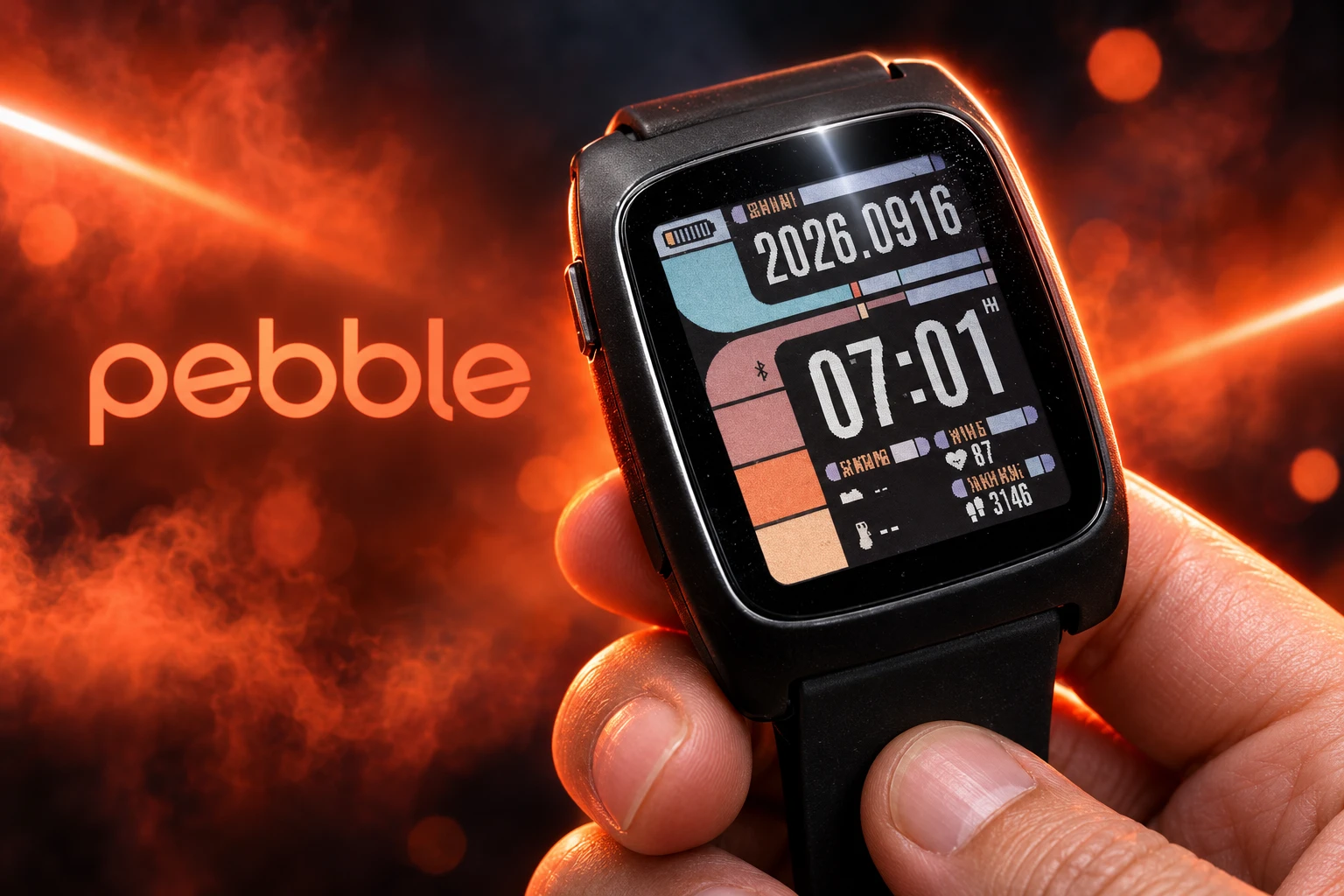
Google’s January Dump Made the Revival Possible
Migicovsky has said he asked Google to open-source the old firmware after Fitbit, and then Google, sat on code that no longer had a product. Google released the Pebble firmware on GitHub on January 27, 2025. Without that dump, he has said, rebuilding the OS from scratch was not realistic.
Core Devices then forked the work into its own public tree and kept shipping firmware. The latest tagged build on that tree, v4.38.1, went up on September 21, 2026. The mobile apps are public too. That is the entire commercial bet: a small hardware shop sitting on a gifted operating system, selling watches that still speak the old Pebble app format.
HOW PEBBLE GOT FROM KICKSTARTER TO A SECOND COMPANY
- 2012: Pebble launches on Kickstarter as an e-paper watch for iPhone and Android.
- December 2016: Pebble shuts down and sells some intellectual property to Fitbit, which keeps the app store running for about 1.5 years.
- July 2018: Fitbit closes the store. Rebble and others scrape about 13,000 apps and start hosting a copy, plus weather, timeline, and voice services.
- January 27, 2025: Google publishes the Pebble firmware.
- March 18, 2025: Migicovsky announces Core Devices and two new watches, later rebranded Pebble after the trademark came back.
- August 25, 2026: Core says Time 2 pre-orders are fully shipped and the watch is selling from stock.
In January 2026, Migicovsky described Core as five people, with no outside funding, selling direct. “We’ve structured this entire business around being a sustainable, profitable, and hopefully, long-running enterprise, but not a startup,” he said. By July, the software group was four people and customer support was three. He has also said he is “okay with a limited vision and a limited scope of what we’re trying to accomplish.”
The App Store Still Runs on Volunteer Rails
Rebble, a nonprofit that grew out of the old Pebble developer Discord in 2017, is the group that actually kept notifications, weather, and the catalog alive after Fitbit walked away. It scraped those 13,000 titles before the store died, spent what it calls hundreds of thousands of dollars hosting them, and took about 500 new uploads after 2018. Core’s own shop still depends on that pile.
On November 17, 2025, Rebble published a post arguing that Core was taking the catalog without locking in a future for the nonprofit. The group said Core wanted unrestricted rights to data Rebble had curated, and that a verbal promise was no longer enough.
What you now know as the Pebble App Store from Eric’s new company, Core Devices, is the result of nearly a decade of our work.
Team Rebble, rebble.io, November 17, 2025
That post is the record of nearly a decade of volunteer app-store work colliding with a company that has watches to ship. Rebble later softened the word “stealing” for one automated-access claim, but it did not drop the demand that any deal leave Rebble a future.
Migicovsky answered the next day. Core, he wrote, had agreed to pay Rebble $0.20 per user per month, then watched the deal collapse over who controls the archive. He says the faces were uploaded by individual developers to a company that no longer exists, and that one group should not wall them off. He wants to keep the Pebble app archive open, including on a neutral host such as Archive.org.
I believe the contents of the Pebble Appstore should be freely available and not controlled by one organization.
Eric Migicovsky, founder of Core Devices, November 18, 2025
He also said Core hired three people from Rebble, paid Codecoup $10,000 on Bluetooth bugs, and spent more than $30,000 of his own money in 2024 on the Cobble companion project before Google ever opened the firmware. Rebble says it paid for Bluetooth work Core then used, and that Core forked PebbleOS away from shared maintainership. Both sides accuse the other of building a garden.
That argument is not a side quest. Hands-on use of the Time 2 keeps running into watch faces whose settings panels no longer load, which is what a catalog looks like when original authors are gone and two stewards are fighting over the files. New work still lands. Core counted 2,120 apps and faces built for Time 2 and Round 2 by mid-July, on top of a legacy store Migicovsky had put at 15,000 titles in January. In September, a buyer even published a Squiggle face for the new screen. The store is not a museum. It is also not a clean, vendor-run shelf.
What $225 Buys on the Wrist
The Time 2 is still a button watch. One control sits on the left, three on the right, and long-presses can be remapped. The new touchscreen is real and limited: a left-to-right swipe dismisses a notification and acts as back, a double tap wakes the backlight, and up-down swipes move through menus. Every one of those gestures has a button twin. There is no long-press to swap faces, and no swipe that opens the timeline or settings. People who now expect a full gesture shell will not find one.
The backlight is the other daily friction. It is not aggressive enough in dim rooms until a tap wakes it, which is a choice that protects the battery and annoys anyone reading a notification in bed. The charger is a pogo dongle with USB-C and a thread loop, not a clip you would trust on a key ring, and losing it means the watch does not charge.
PEBBLE TIME 2 AT A GLANCE
| Item | Time 2 spec |
|---|---|
| Display | 1.5-inch 64-color e-paper, 200 x 228, 202 DPI, RGB backlight |
| Controls | 4 buttons plus limited touchscreen |
| Weight | 33g without strap |
| Health | Heart rate, steps, sleep; no GPS, no workout modes |
| Water | 30m |
| Price | $225 |
Old 144-by-168 faces still run, with a small border on the larger panel unless a developer updates them. Health charts in the phone app are basic, with a useful trick: dragging a finger across a graph shows the hour. Data can sync to Google Fit, then onward to Google Health, which is a clumsy chain Core has not shortened. There is no onboard GPS and no 4G, so a phone has to stay in range.
WHAT THE TOUCHSCREEN ACTUALLY DOES
- Swipe left to right: Dismisses a notification and works as a back button.
- Double tap: Wakes the RGB backlight.
- Swipe up or down: Scrolls menus, with button equivalents for the same moves.
- Missing: No long-press face switch, no swipe into timeline or settings.
Android is the better host. Core says Apple blocks third-party watches from doing things Apple Watch does as a matter of course, including replies to notifications. A Galaxy foldable pairs cleanly. iPhone owners get the time, the buzz, and a thinner slice of the software. Core is still reversing an old Bluetooth setup (PPoGATT) so it can use Apple’s AccessorySetupKit, which is a prerequisite for notification replies, and only in the EU at first. That work is not done.
Battery Life Settles Around Three Weeks
The listing still quotes a 30-day estimate. After months of use in the wild, Core’s own July 14, 2026 software note put Time 2 median life at around 21 days. Backlight, busy animated faces, and health tracking are the three drains it named. A Battery Saver backlight mode exists for people who want to stretch that. The black-and-white Duo, on the same code diet, went from a 17-day median the prior summer to more than 30 days.
That three-week median is the whole product idea. Flagship Apple and Pixel watches still live on a daily, or at best two-day, charge cycle because they drive bright OLED panels and a full sensor pack. The Time 2 stays readable in sun, stays on always, and asks for a pogo clip a few times a month. Reviewers who left it in the box without charging it were not performing a stunt. They were using it the way it was designed.
The same choice cuts the other way. There is no blood-pressure hardware coming down this pipe, and no runner’s GPS. Core points those buyers at Garmin. The Time 2 is a notification brick with a pulse meter, and it is honest about that in a way most $225 watches are not.
A Small Factory With 330 Free Replacements
By July 14, Core said it had built over 23,000 Pebble Time 2 watches and already replaced 330 of them, against more than 19,000 units in the field and 17.82 million hours of use. It has been sending free replacements, with free worldwide shipping, even when the 30-day warranty is over. That is generous, and it is also what a young line looks like when it is still finding assembly mistakes.
HARDWARE FAULTS CORE HAD LOGGED BY JULY 14, 2026
| Problem | What Core said |
|---|---|
| All replacements | 330 watches swapped |
| Very high drain | Most common fault; some units die in under about 3 days |
| Cracked front glass | 51 reports, each replaced |
| Button faults | 32 reports, including clips that let a button pop off |
| Touch panel | About 70 swaps, then treated as a software bug |
The glass sits proud of the case, bonded the way Pebble 2 and many modern watches are, which looks clean and leaves a sharp edge. Owners who waited a year, or ten, are twitchy about knocking it. Core’s public line is that nothing worn on a body is invincible, and that Time 2 should feel about as sturdy as an old Pebble. A raised edge still chips first. Dead touchscreens that still wake the backlight match the software bug Core is already tracking, along with step and sleep numbers that wander and an accelerometer that sometimes quits.
None of that makes the watch a lemon at the scale of 19,000 units. It does mean a 30-day written warranty is not the real policy. The real policy is a three-person support desk replacing whatever reasonably fails, for as long as the company can stand it. Migicovsky has already said that cracked-glass goodwill will eventually become a discount replacement, and that Core may sell whole front assemblies so owners can swap glass themselves.
The Index 01 Is the Next Wager
The other gadget in this shop is not a watch. Index 01 is a stainless ring with a button and a microphone, sold as a capture tool you mash with your thumb and speak into. Recordings go to the same Pebble phone app, on the phone, with no account required. The ring stores about 5 minutes locally if the phone is away, and clips top out around 2 minutes. Battery life is measured in years. It does not charge. When it dies, Core wants the ring back for recycling.
Pre-orders were $75, later $99. Sizes run 6 through 13. A size 10 is listed at 4.7g, 2.95mm thick and 6.6mm wide. On August 25, 2026, Migicovsky said 80% of Index pre-orders had shipped, with leftover size and color runs due in September. You do not need a Time 2 to use one, and you do not need a ring to use the watch.
That split is the company in miniature. The Time 2 is a 2016 watch that finally exists, priced at $225, lasting about 21 days, running an OS Google gave away, talking to a catalog volunteers rescued. Index 01 is the new idea: one job, a physical button, no subscription. Both products assume the phone app, the open firmware, and a staff that still answers mail when a button falls off.
PebbleOS 4.38.1 went out on September 21, 2026. The watches are in drawers and on wrists. The archive fight is not a firmware note, and it is not settled.
Frequently Asked Questions
How much does the Pebble Time 2 cost, and what does the warranty cover?
The watch is $225 from rePebble.com, plus about $10 in US customs for American orders, with a written 30-day warranty against manufacturing defects. Core has also been replacing cracked glass, dead-drain units, and popped buttons for free after that window, and has said cracked-glass goodwill will later become a discounted swap rather than a blank check.
Did Google really open-source PebbleOS?
Yes. Google published the old Pebble firmware on GitHub on January 27, 2025, after Migicovsky asked, and Core Devices now maintains a public fork that still receives tagged builds, including v4.38.1 on September 21, 2026. Rebble keeps a separate community firmware tree for classic hardware.
Does the Pebble Time 2 work with iPhone?
It pairs with iPhone and Android, but Apple’s rules block third-party watches from replying to notifications, and several other tricks Apple Watch does on iOS. Core is still reversing an old Bluetooth role so it can use AccessorySetupKit, which it says is required before EU iPhone users can reply, and that project is not finished.
Can old Pebble apps run on the Time 2?
Most of the old catalog launches, because the OS is the same family, but many abandoned faces have settings screens that no longer load. Original 144-by-168 apps also sit with a border on the 200-by-228 panel until a developer rebuilds them, which is why a live store still matters more than a frozen zip file.
What is the Pebble Index 01?
It is a $75-then-$99 stainless ring with a button and microphone that records short voice notes to the Pebble phone app, with about 5 minutes of on-ring storage and a battery Core rates in years of light use. It works without a Pebble watch, processes speech on the phone, and does not take a subscription.

Edinburgh Opens a 2027 Tour Built for Time Trials

Korda Maps Auður From Meðalland to Irvine Bay

Apple Music Films Its New Logo in Mineral Oil

Oppo Prices the Pad Mini Above India’s iPad Mini

Austen Soaks Scotland Before Boelo Brings Weekend Gales

Volkswagen Sells the Osnabruck Plant to Clear a Board Fight

Apple’s Foldable iPhone Hinges on Samsung Display Supply

Saksham Gaur Finds He Is His Own Company’s Client

Tata Motors’ Iveco Tender Opens as Holders Still Decide

Onimusha Way of the Sword Preload Hits a Windows 11 Wall
-
 AUTO2 months ago
Volkswagen Sells the Osnabruck Plant to Clear a Board Fight
-
 NEWS2 months ago
Apple’s Foldable iPhone Hinges on Samsung Display Supply
-
 AUTO2 months ago
Tata Motors’ Iveco Tender Opens as Holders Still Decide
-
 BUSINESS2 months ago
Saksham Gaur Finds He Is His Own Company’s Client
-
 GAMING2 months ago
Onimusha Way of the Sword Preload Hits a Windows 11 Wall
-

 ENTERTAINMENT3 years ago
What is SD on Amazon Prime? – All You Need to Know
-

 BUSINESS2 months ago
Hyderabad 22-Carat Gold Jumps After a False Bargain
-

 NEWS2 months ago
iQOO 16 Locks 8,400 mAh While 100W Charging Holds