
BUSINESS
NSE Lists on BSE After a Pure Shareholder Sale
NSE lists on BSE on September 24 after a ₹22,568.94 crore offer for sale, with grey-market quotes near 4.65% and sellers sitting on tiny cost bases.

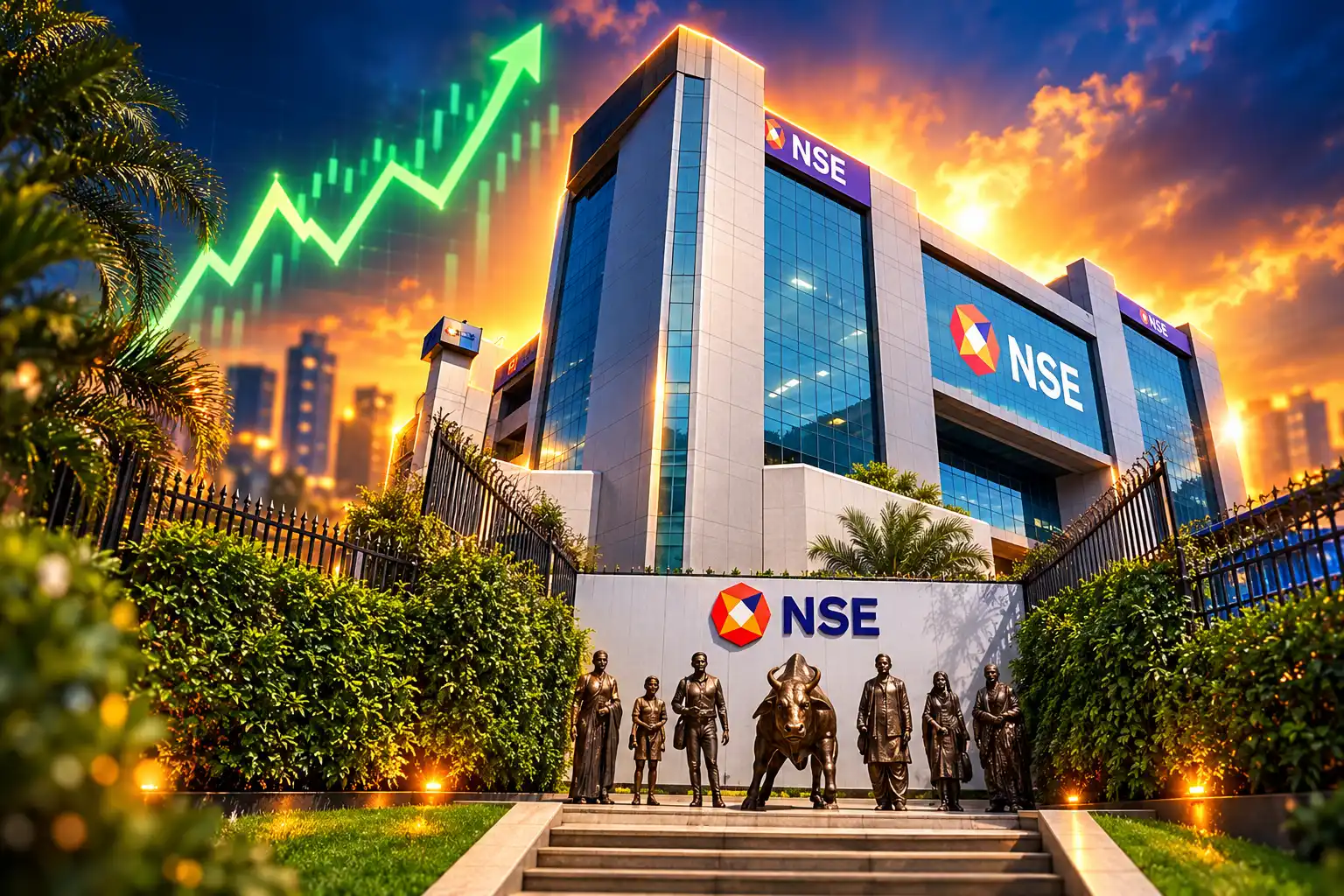
The National Stock Exchange lists on BSE on September 24 after a ₹22,568.94 crore share sale that sends every rupee to existing holders.
Grey-market quotes in InvestorGain’s grey-market premium series stood at ₹83 on September 23, about 4.65% over the ₹1,785 cap, after an early-September high of ₹310. The issue is a 100% offer for sale, the exchange raises nothing, and the stock cannot list on NSE.
Why NSE Shares List on BSE
NSE shares debut on BSE because Indian rules stop a recognised exchange from listing on its own platform. Managing director and chief executive Ashish Chauhan has said the firm will not ask SEBI for a waiver, so BSE is the designated exchange. BSE already lists on NSE, and this sale simply reverses that pairing.
THE SELF-LISTING BAN
- The rule: SECC rules that bar an exchange from self-listing let a recognised bourse list only on another recognised bourse, not on itself or an associated exchange.
- The conflict: An exchange that hosted its own stock would be asked to police the same name it runs as a business.
- The pairing: BSE granted in-principle listing approval on July 20, 2026, and is the Designated Stock Exchange for the offer.
Chauhan put the constraint in plain words when the filing was still ahead. “It’s a regulation of India, and we have to abide by that,” he said. Some global groups list on venues they own. India’s market-infrastructure code does not.
BSE walked this path the other way on February 3, 2017, when its shares listed at ₹1,069.20 against an issue price of ₹806, a 32.66% premium. That stock later became one of the louder wealth-creation stories in the listed capital-market group. NSE now arrives as the much larger franchise, on the smaller board, with a grey-market tape that no longer prices a similar pop.
Sellers Who Paid 80 Paise Collect the Cheque
The entire book is an offer for sale of up to 12,64,36,650 equity shares of ₹1 face value. NSE receives none of the proceeds. Twenty-three holders are selling a 5.11% slice of the 247.5 crore paid-up shares, and eight of them cut their planned sale before the red herring was locked. The SEBI abridged prospectus for the issue sets the gap between old cost and the ₹1,785 cap in rupees and paise.
TOP SELLING SHAREHOLDERS AND COST BASIS
| Selling shareholder | Shares on offer | Weighted average cost (₹) |
|---|---|---|
| State Bank of India | 1,59,69,410 | 0.80 |
| Canada Pension Plan Investment Board | 1,18,74,060 | 324.13 |
| Aranda Investments (Mauritius) Pte Ltd | 1,12,46,336 | 62.38 |
| MS Strategic (Mauritius) Limited | 1,10,00,000 | 66.54 |
| The New India Assurance Company Ltd | 1,05,00,000 | 0.32 |
| SBI Capital Markets Limited | 87,80,590 | 0.38 |
SBI is the largest seller in the book, offering stock it carried at 80 paise. New India Assurance is on the block at 32 paise. Bank of Baroda, Stock Holding Corporation of India and United India Insurance sit in the same cheap-cost group. CPPIB is the outlier among the top names, with a weighted average cost of ₹324.13, still well below the cap.
Life Insurance Corporation of India, the largest holder at 10.72%, is not selling. Premji Invest at 2.35% and Radhakishan Damani at 1.58% are staying in too. LIC still showed up in the ₹6,746 crore anchor book, which also named Goldman Sachs and Fidelity among 189 accounts. The public float after listing is the 5.11% that was sold, and the company has no identifiable promoter.
SBI Capital Markets is both a seller and a book-running lead manager, limited to marketing because merchant-banker rules block a fuller role. Morgan Stanley India and ICICI Securities are in a similar marketing-only box because of their links to selling shareholders. The sale is a liquidity event for banks, insurers and funds that have sat on NSE paper for years, not a cheque to build new racks or new products.
Grey Market Premium Fell From ₹310 to ₹83
Unofficial quotes for NSE stock ran hot in early September and then gave most of that premium back as the bid window opened. InvestorGain printed ₹43 on September 22, after allotment, then ₹83 by the evening of September 23. That last print implies an indicative price of ₹1,868 and about ₹664 on a retail lot of eight shares, if the tape is even close.
NSE IPO AT A GLANCE
- Issue size: ₹22,568.94 crore at the ₹1,785 cap, with a floor of ₹1,700, entirely an offer for sale.
- Grey-market print: ₹83 on September 23 evening, or 4.65% over the cap, after an early-September high of ₹310.
- Implied value: ₹4,41,788 crore at ₹1,785, on 247.5 crore shares of ₹1 face value.
- Retail cheque: ₹14,280 for one lot of eight shares at the cap, with a ₹170 discount for eligible employees.
The unofficial book is a thin tape, and it showed that this month. Quotes were talked down toward a flat open during the bid window, then marked back up once allotment was done. That swing is why a 4.65% premium should be read as a listing-day guess, not as a verdict on the franchise. Shivani Nyati, head of wealth at Swastika, had already framed the sale as one for a long hold, with only minor listing gains, and the brokerage had a subscribe rating on the book.
The 12.68 Times QIB Book
Demand sat with institutions. The issue was subscribed 5.71 times overall, with bids for 50.58 crore shares against 8.86 crore on offer, and it closed on September 21. Allotment was finalised on September 22. Refunds and demat credit were due on September 23.
HOW THE BOOK BROKE BY CATEGORY
- Qualified institutional buyers: 12.68 times their quota, the line that carried the issue.
- Non-institutional investors: 6.55 times, including the smaller and larger HNI slices.
- Retail individual bidders: 1.39 times, on 6.13 crore shares bid against 4.41 crore reserved.
- Eligible employees: 2.40 times a reserved slice, at a ₹170 discount to the issue price.
Retail did not chase this the way it chases a small-float listing lottery. A ₹14,280 lot is a large ticket for that crowd, and the growth print that has excited the listed exchange trade has belonged to BSE. Funds still wanted the paper. The 12.68 times QIB book, plus a ₹6,746 crore anchor list that included LIC, Goldman Sachs and Fidelity, is the demand that matters once the stock is free to trade.
Registrar to the offer is MUFG Intime India. Kotak Mahindra Capital, JM Financial, Morgan Stanley, Citigroup, HSBC, J.P. Morgan and a long tail of other banks ran the book. NSE’s posted offer documents and prospectus sit on the exchange’s investor-relations page, including the red herring, the abridged prospectus and BSE’s July 20 in-principle letter.
Where BSE Still Commands a Higher Multiple
NSE is priced at 42.9 times FY26 earnings at the ₹1,785 cap. The red herring pegs BSE at 54.28 times on the same basis. The smaller listed exchange therefore still trades at a richer multiple than the franchise that takes most of India’s cash and futures flow. That gap is the listing argument in one ratio, and it is also the reason some money will wait for a weaker print after September 24.
NSE AND BSE IN FY26
| Metric | NSE | BSE |
|---|---|---|
| Revenue from operations | ₹16,601 crore | ₹4,834 crore |
| Profit after tax | ₹10,302 crore | ₹2,487 crore |
| Cash-market share (turnover) | 92.99% | Balance of the market |
| Equity-futures share (turnover) | 99.79% | Negligible |
| FY26 P/E at NSE’s cap / RHP peer | 42.9x | 54.28x |
| Listed companies (FY26) | 2,978 | 5,955 |
NSE’s operating revenue fell 3.15% in FY26, the only decline in the reviewed period, and profit dropped from ₹12,188 crore. Transaction charges were 78.65% of FY26 operating revenue, and index options alone were 60.22%. SEBI’s single weekly expiry rule and later open-interest measures cut into that pool. Options premium share was 74.71% in FY26 and 68.48% in the quarter to June 2026. BSE’s share of index-options premium, near 3.7% in FY24, was about 28% by the end of FY26.
Scale still sits with NSE. As of June 30, 2026 it served 132.37 million unique registered investors, 1,328 trading members and 3,005 listed entities with a combined market value of ₹474.08 trillion. It has been India’s largest cash and equity-derivatives venue since FY01 and, by contracts traded, the world’s largest derivatives exchange for seven years running, with a 51.18% world share of equity-derivative contracts in FY26. BSE hosts more companies. NSE hosts the turnover. After September 24 those two facts will be priced on the same screen.
Q1 FY27 revenue was up 13.10% year on year and profit was up 6.71%, so the FY26 dip is not the last print. Earnings remain geared to derivatives volumes, which is where the rulebook has been busiest. Nyati also flagged that about 79% of revenue is tied to trading activity, which leaves the P&L open to volumes and to the next SEBI circular.
MSEI Opens NSE Shares Without a Listing Pact
Metropolitan Stock Exchange of India said on September 23 that NSE equity will be admitted on its capital-market segment under the permitted-to-trade category from September 24, in the EQ series, with a market lot of one share and ISIN INE721I01024. The circular is explicit that a name in that window does not sign a listing agreement and does not give the exchange the full disclosures of a listed company. BSE remains the listing venue and the place that handles compliance.
That is a third-exchange footnote, not a second listing. Chauhan has already said NSE will not seek SEBI’s nod to trade the stock on NSE itself. MSEI is using a window that already covers hundreds of other names. Extra screens can add a little liquidity. They do not change the conflict-of-interest rule that keeps NSE’s own order book away from NSE’s own shares.
For BSE, hosting the name is a prestige listing more than a fee windfall. Cash-market charges on even a busy NSE stock are small against an options book that already throws off most of BSE’s transaction income. The later questions are whether the shares enter BSE indices and whether single-stock derivatives follow. Those prints, if they come, will show up in BSE’s own quarterly share numbers, not in the listing-day tape.
Co-Location Costs That Hit FY26 Earnings
The IPO sat behind a decade of co-location and dark-fibre litigation. NSE paid ₹1,491.21 crore to settle those SEBI matters, including ₹714.74 crore in July 2026 on top of ₹776.47 crore already deposited. The Supreme Court disposed of the regulator’s pending appeals after taking the settlement on record, without admission or denial of guilt. FY26 still carries a ₹1,391.21 crore provision on those files, on top of ₹100 crore provided in FY23, which is one reason reported profit looks weaker than the cash engine.
PATH TO THE SEPTEMBER 24 LISTING
- June 17, 2026: NSE files the draft red herring for an offer for sale of up to 14.89 crore shares.
- July 20, 2026: BSE issues in-principle listing approval.
- July 30-31, 2026: SEBI accepts the ₹1,491.21 crore settlement terms and NSE pays the balance.
- September 3, 2026: The Supreme Court disposes of SEBI’s co-location and dark-fibre appeals.
- September 17-21, 2026: The issue is open, with anchors on September 16, and closes 5.71 times subscribed.
- September 22, 2026: Basis of allotment is finalised.
- September 23, 2026: MSEI admits the shares under permitted-to-trade; refunds and demat credit are due.
- September 24, 2026: Trading starts on BSE, with MSEI in the permitted-to-trade window.
Choice Equity Broking’s subscribe note treated the sale as a way to own Indian market plumbing at this scale, and it kept a subscribe rating even after the options-share loss.
What that price buys is market infrastructure with no real substitute.
Choice Equity Broking, IPO note
Choice also noted a 76.23% normalised operating EBITDA margin in FY26, no borrowings, and an in-house platform that handled 12.46 billion messages a day in the period to June 30, 2026. Index options remain the open flank, after SEBI capped each exchange at one weekly expiry and after the higher transaction tax from April 2026. The rest of the stack, cash, futures, currency, clearing, the Nifty franchise, is still the franchise funds were bidding for at 12.68 times.
September 24 puts that franchise on BSE’s board at ₹1,785 a share for anyone who got stock, with unofficial quotes only a few percent higher and with a third exchange opening a permitted-to-trade line the same morning. The holders who bought at 32 paise and 80 paise have already had their listing day. Public holders get the next one.
Disclaimer: This article is news reporting and analysis of the NSE share sale and the September 24 listing, and it is for information only. It is not investment advice, a recommendation to buy or sell NSE or BSE shares, or a forecast of listing gains, grey-market premia or post-listing prices. Readers should consult a SEBI-registered investment adviser, a qualified financial planner or their broker before acting on any IPO or secondary-market decision. Figures, subscription data, grey-market quotes and listing arrangements reflect the filings, tracker prints and circulars cited here as of September 23, 2026, and may change once trading begins.

Edinburgh Opens a 2027 Tour Built for Time Trials

Korda Maps Auður From Meðalland to Irvine Bay

Apple Music Films Its New Logo in Mineral Oil

Oppo Prices the Pad Mini Above India’s iPad Mini

Austen Soaks Scotland Before Boelo Brings Weekend Gales

Volkswagen Sells the Osnabruck Plant to Clear a Board Fight

Apple’s Foldable iPhone Hinges on Samsung Display Supply

Saksham Gaur Finds He Is His Own Company’s Client

Tata Motors’ Iveco Tender Opens as Holders Still Decide

Onimusha Way of the Sword Preload Hits a Windows 11 Wall
-
 AUTO2 months ago
Volkswagen Sells the Osnabruck Plant to Clear a Board Fight
-
 NEWS2 months ago
Apple’s Foldable iPhone Hinges on Samsung Display Supply
-
 AUTO2 months ago
Tata Motors’ Iveco Tender Opens as Holders Still Decide
-
 BUSINESS2 months ago
Saksham Gaur Finds He Is His Own Company’s Client
-
 GAMING2 months ago
Onimusha Way of the Sword Preload Hits a Windows 11 Wall
-

 ENTERTAINMENT3 years ago
What is SD on Amazon Prime? – All You Need to Know
-

 BUSINESS2 months ago
Hyderabad 22-Carat Gold Jumps After a False Bargain
-

 NEWS2 months ago
iQOO 16 Locks 8,400 mAh While 100W Charging Holds