
NEWS
The Orkney Tidal Array Is Cleared With Cash Still Due
Orbital Marine Power has an EU Go Decision for its Orkney tidal energy array, but 2028 deployment still hangs on an unclosed investment round.

The European Commission has given Orbital Marine Power a Go Decision for the EURO-TIDES tidal energy array in Orkney. The four-turbine farm is due in 2028, but only if the company finishes its current investment round.
The plant is meant to supply about 9,200 homes and to show that Orbital’s floating turbines can run as one connected farm.
The Go Decision Is a Review Stamp
Orbital, based in Orkney and Edinburgh, said on 12 October 2026 that the Commission had passed a formal review of engineering, permits and financing on EURO-TIDES. That is the language of a Horizon Europe checkpoint, not of a yard cutting steel. The company was picked in October 2023 to lead delivery of the array; the new paper is a green light to enter the construction phase of that existing programme.
Oliver Wragg, Orbital’s development director, called the ruling a vote of confidence in the machines and in tidal power’s next phase. He said the firm had proved the O2 and now had to prove the turbines working together.
The European Commission’s Go Decision for EURO-TIDES is a powerful vote of confidence in both Orbital’s technology and tidal energy’s readiness to move into its next phase of commercial development. Having successfully proven the O2, we are now taking the next major step, demonstrating that our turbines can operate together as a connected array at commercial scale.
Oliver Wragg, Development Director, Orbital Marine Power
Public money attached to that stamp is modest beside a multi-megawatt marine plant. RWTH Aachen, a project partner, records an EU contribution of €4,999,995.07 under grant agreement 101136085. That is research and innovation support, not a construction cheque for three new hulls.
THE RESOURCE THE PROJECT CITES
- In the water: The Commission fact sheet puts European tidal stream at 13 MW deployed.
- On paper: The same sheet cites 10 GW of potential in European waters and 100 GW globally.
- Cost target: Orbital’s floating kit is meant to move from €120/MWh to under €100/MWh.
- Uptime target: The farm is supposed to reach 95%+ availability.
Those figures are the project’s own case for why a small farm matters. They also show how little kit is actually spinning today.
Orbital Still Has to Close the Money
Every company notice of the Go Decision carries the same rider. Deployment is listed for 2028, subject to completion of the current investment round. Brussels reviewed financing arrangements. It did not, on the public record, put the last of the private capital in the account.
The last named close is a £7 million investment in December 2025, with PXN Ventures joining existing shareholders including Scottish Enterprise. Andrew Scott, Orbital’s chief executive, said the money backed a new chapter of growth and commercial tidal projects. Alastair Moore, investment director at PXN, talked about tidal joining the energy mix. Neither statement earmarked the cash for the three new EURO-TIDES machines.
Highlands and Islands Enterprise added non-dilutive funding in that same period to help prove local supply-chain work in Scotland. On 8 September 2026 the company named Ian Douglas as chair, with a brief to build the commercial and financial base for scale. Douglas, a former XLCC chief executive, said the job was to take proven kit into serial delivery. That hire is the clearest sign that the books for the farm are still being made.
Tidal current is forecastable to the minute, which is the product’s real selling point against wind and solar, but the 9,200-home figure is an annual equivalence. Output still falls away toward slack water. It is not a flat feed into Orkney’s kettles, and it is not a substitute for the equity the yard still has to raise.
Three New Machines Plus the O2 Already in the Water
The farm Orbital now describes is not the farm the EU fact sheet still describes. CORDIS, the Commission’s project record, still lists a 9.6 MW plant of four 2.4 MW Orbital devices of the same series, entering the water in 2027 and running for 15 years. Orbital’s October 2026 plan is three next-generation O2-X machines, each rated at 2.4 MW, tied to the existing O2, with first deployment in 2028. The firm has not published a new combined nameplate for that mix.
THE PLAN ON PAPER AND THE PLAN IN OCTOBER
| Item | CORDIS fact sheet | Orbital plan, October 2026 |
|---|---|---|
| Machines | Four 2.4 MW units of one series | Three O2-X units plus the existing O2 |
| Farm rating | 9.6 MW | Not restated as a single figure |
| First water | 2027 | 2028 |
| Cash condition | Horizon Europe grant 101136085 | Subject to the current investment round |
Each O2-X is listed as supplying about 2,400 homes. The four-machine farm is listed at about 9,200 homes, or about 85% of Orkney households, on Orbital’s own equivalence. Those household numbers are a developer yardstick, not a guaranteed local supply contract.
The O2-X is the machine Orbital wants to serialise. Lloyd’s Register issued an IECRE Feasibility Statement on it in early 2025, the first step on a certification path that would support series production. The Go Decision is how that design is supposed to leave the single-device stage.
CORDIS also sets the industrial tests the farm is meant to pass: 17,520 hours of running data, more than 50 GWh of output, a cheaper cost of capital from 10%-12% down to 5%-6%, and a jump in supply-chain capacity from one device a year to 80. That last number is the real scale claim. Four hulls in Orkney only matter if they teach a factory how to repeat.
Orkney Has Been the Test Bed Since 2011
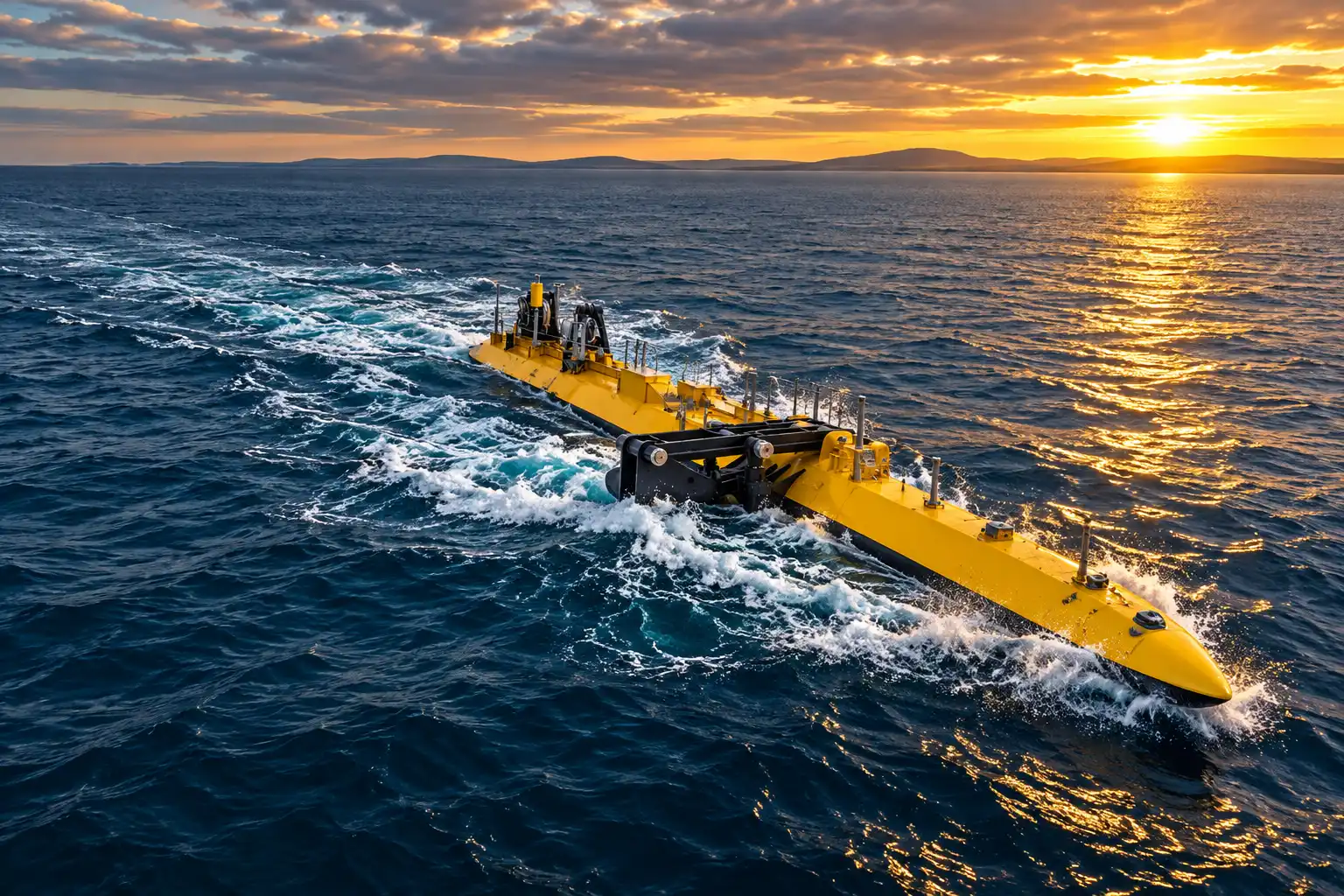
EURO-TIDES sits at EMEC, on water Orbital has used for three generations of floating kit. The O2 is a 2 MW machine with a 72 m hull, two 1 MW nacelles on 18 m legs, and 20 m rotors, and it has been on the Fall of Warness since July 2021. The hull was built at Texo in Dundee, with 75% of its supply chain in the UK.
ORBITAL AT THE FALL OF WARNESS
- 2002: The company is founded in Orkney to engineer floating tidal turbines.
- 2011 to 2013: The 250 kW SR250 is tested at the Fall of Warness and becomes the first floating tidal device to export to the UK grid.
- October 2016 to September 2018: The 2 MW SR2000 is deployed, exports over 3 GWh in 12 months, and is then removed to make way for the O2.
- July 2021: The O2 starts generating at EMEC and has run there as a single commercial unit.
- October 2023: The Commission selects the EURO-TIDES partnership to take the design from one machine to a connected farm.
- 12 October 2026: The Go Decision is issued, with 2028 water still tied to the open round.
The SR2000 already showed what a single floating unit can do on a small island grid, including spells when it met about a quarter of Orkney’s demand. EURO-TIDES is asking a different question. Can three new machines and the O2 be built, cabled and operated as one plant, with maintenance and insurance that a bank will live with?
Partners on that work include EMEC, the Center for Wind Power Drives at RWTH Aachen, Énergie de la Lune, ENGIE Laborelec, MaraSoft, Ocean Energy Europe and the University of Edinburgh. Ocean Energy Europe sits as the Brussels-facing partner. Rémi Gruet, its chief executive, is the voice treating the stamp as a sector event rather than a company event.
The Pentland Firth Array That Never Scaled
Scotland already has a working four-turbine tidal plant, and it is not this one. MeyGen, in the Inner Sound of the Pentland Firth, has four 1.5 MW seabed turbines and is still a 6 MW tidal flagship after a decade in the water. Consent runs far beyond that, and further Contracts for Difference have been stacked for later phases, but the machines that actually spin remain the original six megawatts.
That is the shadow on every “first farm” line around EURO-TIDES. Orbital is careful, and accurate, when it says this will be the first time its own turbines have run as a connected array. It is not the first multi-turbine tidal site in Scotland, and it is not in the Pentland Firth. The two places keep being folded together because both sit in fast Scottish water and both have spent years being described as the moment tidal becomes an industry.
MeyGen’s lesson is blunt. Four turbines can generate for years, set records, and still leave the next 50 MW on a slide deck. Orbital’s floating design is a different engineering bet, with towing, on-site rotor access and small workboats instead of heavy subsea lifts. The commercial bet is the same shape: a small array that is supposed to unlock a much larger one.
UK Contracts Now Cover 17 MW of Orbital Kit
The Go Decision is not Orbital’s only paid work. UK Contracts for Difference already sit behind a stack of O2-X machines at Eday, the same Orkney waters as EMEC. In December 2025 the firm counted 14.4 MW, six turbines, under those contracts. After Allocation Round 7 in February 2026 it reported its UK CfD portfolio increasing to 17 MW.
PAID WORK BEYOND THE EU FARM
- UK revenue contracts: 17 MW of Orbital CfD capacity, to join the 2 MW O2 already on the grid.
- Nova Scotia licences: Power purchase deals equal to six turbines, about 15 MW, in the Bay of Fundy.
- Stated orderbook: 32 MW, or 13 turbines, across the UK and Canada.
- French waters: EURO-TIDES also includes work to bring commercial projects forward in France, on top of the Orkney farm.
Scott said the AR7 result moved the firm and its suppliers into delivery mode. That is the other half of the 2028 problem. EURO-TIDES is a public demonstration farm with a small EU grant. The CfD stack is the paid market the demonstration is supposed to feed. If the investment round slips, both clocks slip together, because they share the same hull design and the same yards.
What Has to Happen Before Steel Hits the Water
Gruet put the sector test in one line after the ruling. Flagship farms have to become a pipeline, he said, and that needs a market framework as much as it needs another prototype.
The next challenge is clear: turning successful flagship projects like EURO-TIDES into a pipeline of commercial deployments across Europe. With the right market framework and continued policy support, Europe can remain the global leader in tidal energy, delivering economic growth, industrial leadership and clean, secure energy for Europeans.
Rémi Gruet, Chief Executive, Ocean Energy Europe
The Commission’s own sheet still talks about a European pipeline above 2 GW. Orbital talks about the same horizon. Between those sentences and the Fall of Warness sit three unbuilt O2-X machines, a cable plan for a connected farm, and an equity round that the company has not yet closed. The Go Decision lets that work start. It does not finish it.
If the round closes, Orkney gets a four-turbine floating plant aimed at 2028, with the O2 as the veteran in the line. If it does not, the EU fact sheet will keep describing a 9.6 MW farm of four identical 2.4 MW machines that was due in 2027, and the O2 will keep generating alone.

Edinburgh Opens a 2027 Tour Built for Time Trials

Korda Maps Auður From Meðalland to Irvine Bay

Apple Music Films Its New Logo in Mineral Oil

Oppo Prices the Pad Mini Above India’s iPad Mini

Austen Soaks Scotland Before Boelo Brings Weekend Gales

Volkswagen Sells the Osnabruck Plant to Clear a Board Fight

Apple’s Foldable iPhone Hinges on Samsung Display Supply

Tata Motors’ Iveco Tender Opens as Holders Still Decide

Saksham Gaur Finds He Is His Own Company’s Client

Onimusha Way of the Sword Preload Hits a Windows 11 Wall
-
 AUTO2 months ago
Volkswagen Sells the Osnabruck Plant to Clear a Board Fight
-
 NEWS2 months ago
Apple’s Foldable iPhone Hinges on Samsung Display Supply
-
 AUTO2 months ago
Tata Motors’ Iveco Tender Opens as Holders Still Decide
-
 BUSINESS2 months ago
Saksham Gaur Finds He Is His Own Company’s Client
-
 GAMING2 months ago
Onimusha Way of the Sword Preload Hits a Windows 11 Wall
-

 BUSINESS2 months ago
Hyderabad 22-Carat Gold Jumps After a False Bargain
-

 ENTERTAINMENT3 years ago
What is SD on Amazon Prime? – All You Need to Know
-

 NEWS2 months ago
iQOO 16 Locks 8,400 mAh While 100W Charging Holds