
BUSINESS
Scotland’s Tidal Flagship Is Still a 6 MW Array
MeyGen has generated 91 GWh from four turbines, yet the next 59 MW still needs subsidy and Ampeak is putting growth capital into batteries.

Ampeak Energy said on 25 September 2026 that MeyGen has generated 91 GWh from the same four 1.5 MW turbines first wired into the grid in 2016.
The Inner Sound lease was written for 398 MW. The array is still 6 MW, the owner is steering capital into batteries, and chairman Duncan Black told shareholders that future tidal phases remain challenging.
MeyGen started as a demonstrator and has become the world's leading tidal stream project, generating 91GWh and building 7.5 years of operational experience. Hear how those lessons are helping unlock the next generation of commercial tidal energy at https://t.co/WlqeJb2Qba
— Ampeak Energy (@AmpeakEnergy) September 25, 2026
Four Turbines and a 91 GWh Ledger
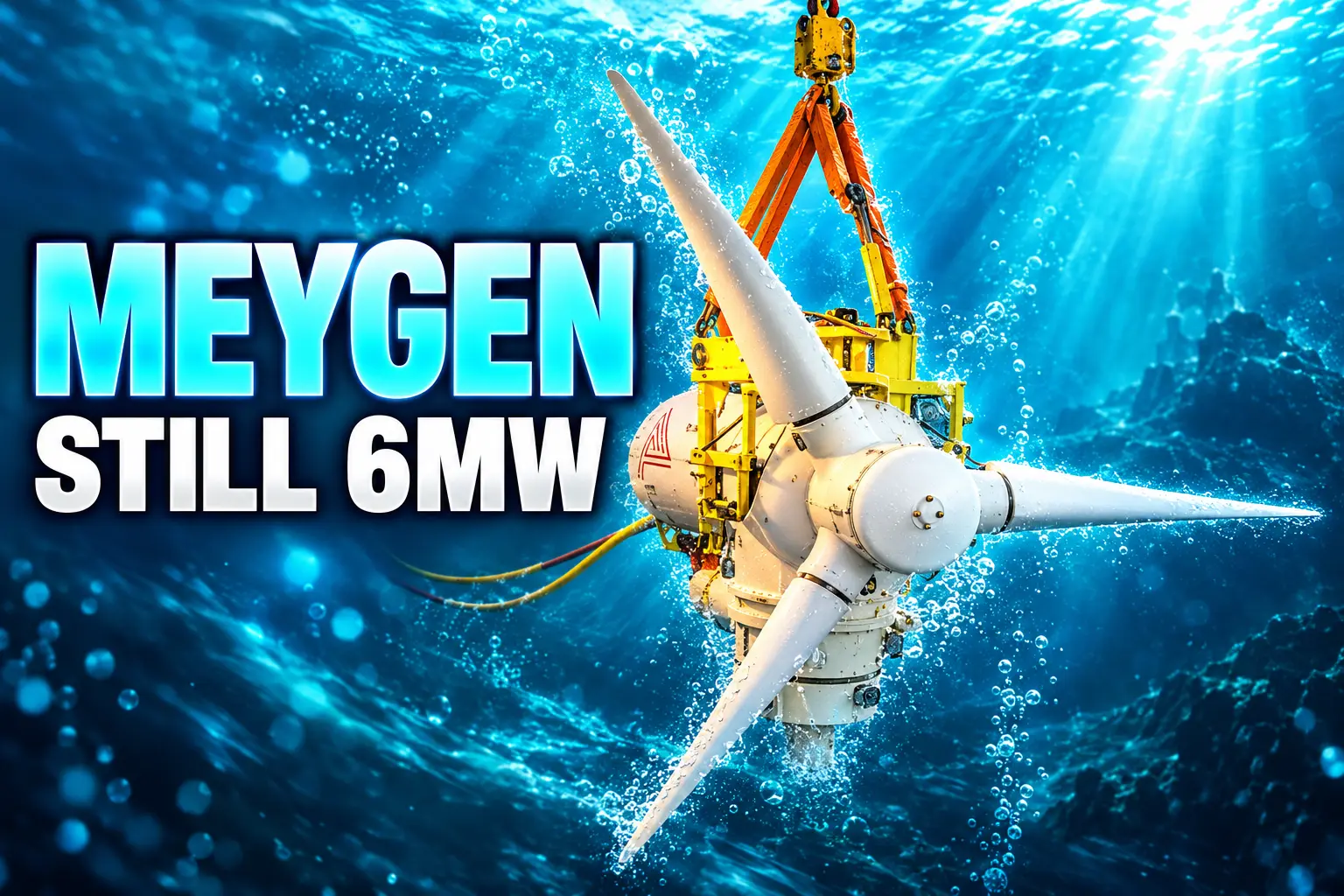
Ampeak, the AIM-listed owner formerly called Atlantis Resources, SIMEC Atlantis Energy and SAE Renewables, calls MeyGen the world’s largest tidal stream site. The hardware is four 1.5 MW seabed machines in the Pentland Firth, three from Andritz Hydro Hammerfest and one Atlantis AR1500, sitting in the Inner Sound off Caithness.
First power reached the grid in November 2016. The project entered its 25-year operations phase in April 2018. On 25 September 2026 the company put operating experience at 7.5 years and cumulative output at 91 GWh.
That is a real generation record, and it is still a demonstration. A second Ampeak post the same day said Ocean Energy Europe put global tidal stream output at 127 GWh by the end of 2025, with MeyGen supplying 83.6 GWh, about 66 percent of the world total. By March 2023 the same four machines had reached 51 GWh, so most of the lifetime yield is this one array, not a fleet.
THE MEYGEN OUTPUT SNAPSHOT
- Nameplate: 6 MW from four 1.5 MW turbines in the Inner Sound.
- Current yield: 91 GWh as of 25 September 2026, after 7.5 years of operation.
- World share: 83.6 GWh of 127 GWh of global tidal stream by the end of 2025.
- Early ledger: 51 GWh by March 2023, before later servicing rounds.
In December 2025 Ampeak and Proteus Marine Renewables serviced three of the four units. TTG 2 and TTG 4 went back in. TTG 1 went to Nigg. TTG 3 needed no work and had by then run seven years without a maintenance visit. Fraser Johnson, MeyGen’s director of operations and assets, still talks about scale.
Every step of the MeyGen journey is a step towards large-scale deployment and unlocking the full potential of tidal stream. For all involved, seeing firsthand the capabilities and opportunities makes it clear that tidal stream can and should play a major role in our energy future. It is predictable, scalable, and has the potential to be cost-competitive with other forms of predictable generation.
Fraser Johnson, MeyGen Director of Operations and Assets, 18 December 2025
Predictable is the sales word. Cost-competitive is the test the accounts have not yet passed.
Who Put Up the £51.3 Million
Phase 1A closed in 2014 on a syndicate, not on a merchant power price. Atlantis said a total of £51.3 million was secured from the UK government through DECC, Scottish Enterprise, Highlands and Islands Enterprise, the Crown Estate and Atlantis itself.
THE 2014 MONEY
- Senior debt: £17.5 million, of which £7.5 million came from Scottish Enterprise’s Renewable Energy Investment Fund and £10 million from the Crown Estate.
- Grants: £13.3 million in direct grants from DECC and Highlands and Islands Enterprise, including the Marine Energy Array Demonstrator fund.
- Equity: £20.5 million into Tidal Power Scotland Holdings, £10.8 million from Atlantis and £9.7 million from Scottish Enterprise.
- Control: After those subscriptions Atlantis held 86.5 percent of MeyGen and Scottish Enterprise 13.5 percent.
The Crown Estate was already the seabed landlord, having granted an Agreement for Lease on 21 October 2010 for 398 MW. It then lent into the first four turbines. Scottish Enterprise was both lender and shareholder. The private cheque was the smaller one.
A Black & Veatch lessons-learnt summary prepared for BEIS recorded £51.3 million capex and 34 percent capacity factor as the working forecast, with £1.4 million of annual operating cost and 450 GWh over 25 years. Turbines took 39 percent of capex. Onshore plant took 19 percent. Lease and insurance were listed as 32 percent of opex, with unplanned maintenance at 21 percent.
That is the stakeholder map. The public purse and the Crown’s balance sheet carried the demonstration. The grid got 6 MW.
Three Machines Earned £2 Million in Half a Year
Ampeak’s unaudited interim numbers for the six months to 30 June 2026 show what the array earns when one unit is on the dock. Electricity generation was 4.4 GWh, down from 7.9 GWh in the first half of 2025. Sales from the Phase 1 array were £2.0 million, down from £3.2 million. Operating and maintenance costs on the array rose to £1.1 million from £1.0 million.
THE HALF-YEAR ACCOUNTS
| Item | H1 2025 | H1 2026 |
|---|---|---|
| Electricity generated | 7.9 GWh | 4.4 GWh |
| Electricity sales | £3.2 million | £2.0 million |
| Array O&M cost | £1.0 million | £1.1 million |
| Turbines in service | 4 | 3 |
£2.0 million on 4.4 GWh is about £455 per MWh. That is the price the existing machines actually banked, wholesale power plus subsidy, in a half-year with three units running.
The tidal segment still posted EBITDA of £0.9 million, down from £2.3 million a year earlier. Then project-debt interest of £2.05 million turned the segment to a loss. The machines can cover day-to-day running. They do not cover the capital stack on their own.
The original station was accredited by Ofgem in February 2017 as a 5 ROC project. For 2025 to 2026 Ofgem set a buy-out price of £67.06 per ROC. That certificate stream, not the wholesale market, is why a 6 MW array can post a three-figure pounds-per-MWh top line.
Billpayers meet that obligation through their suppliers. They never see a line on the statement that says Pentland Firth.
A Ringfenced Price the Wind Auction Never Sees
New tidal capacity does not walk into the same auction as cheap wind. The Department for Energy Security and Net Zero set the administrative strike price for tidal stream in Allocation Round 6 at £261 per MWh in 2012 prices, against £73 for offshore wind, £64 for onshore wind and £61 for solar.
The sixth Contracts for Difference allocation round, published on 3 September 2024, awarded six tidal projects. Those contracts cleared at £172 per MWh in 2012 prices for 28 MW, with 9 MW tagged to MeyGen for delivery in 2028/29. Even at that discount to the cap, tidal is still several times the clearing price of the big wind pots.
Ampeak says it already has revenue support to take the site to 65 MW and planning to go to about 400 MW. 65 MW minus the 6 MW that exist is 59 MW of extra kit that has a contracted offtake and has not reached financial close. The company’s 2025 highlights said work continues to bring that 59 MW to close. In the June 2026 interim, Black was cooler.
A ringfence is the whole commercial model. Tidal does not have to beat offshore wind on price. It has to fill a pot that ministers keep open. That is a political customer, and it is why a site that has run for 7.5 years can still be waiting on the next turbine.
Slack Water Still Needs a Gas Plant
The design case was a 34 percent capacity factor after losses, 450 GWh over 25 years. The contractual case in the turbine supply agreements was 28 percent and 370 GWh. Nameplate output of 6 MW for 8,760 hours is 52,560 MWh a year, so 34 percent is about 18 GWh a year if the machines stay in the water.
Across 7.5 years at 91 GWh the array ran at about 23 percent of rated output. In the first half of 2025, with all four units in service, 7.9 GWh was about 30 percent of a half-year nameplate of 26,280 MWh, close to the design sheet. In the first half of 2026, with TTG 1 ashore, 4.4 GWh was about 17 percent.
Tides go slack four times a day. Output falls toward zero at those turns even when every nacelle is healthy, which is why a tidal station cannot retire the thermal plant that covers the same hours. The Pentland Firth is a strong site. It is not a baseload site in the way a gas turbine is a baseload site.
Holyrood’s own policy now states no support for onshore conventional oil and gas, confirmed in June 2025, after an October 2019 position against unconventional extraction. Offshore licensing stays with Westminster. Enrique Cornejo, energy policy director at Offshore Energies UK, has said Norwegian pipelines supply about 43 percent of UK gas, about the same share as domestic production. A 6 MW tidal array does not change that arithmetic. It adds a premium MWh on top of the firm power the system already buys.
Batteries Now Carry the Growth Plan
Read Ampeak’s 2026 interims in order and the corporate story is not a 398 MW tidal farm. It is battery storage. Construction of the AW1 project at Uskmouth is the thing the chairman calls transformational. After the period end, JB Energy bought 24.7 percent of AW1 Storage Holdings for £7.8 million. Planning is in hand for Mey BESS, a 1,200 MWh battery beside the Caithness site, and for a much larger Uskmouth expansion.
Tidal is still on the slide deck. Investor materials have been blunt that as a new technology it depends on government support. Black put the same point in plainer words for the first half of 2026.
Although development of future phases remains challenging, the Board continues to support efforts to advance the next stage of the MeyGen project where commercially viable opportunities arise.
Duncan Black, Chairman, Ampeak Energy, interim statement for the six months to 30 June 2026
Commercially viable, in this sector, means another ringfenced contract and another close that has not happened. The four turbines keep turning. TTG 3 has shown a seabed machine can run for seven years. The 91 GWh is earned electricity, not a brochure. The hidden party on the invoice is still the billpayer, and the company with the lease is building batteries while it waits.

TCS Opens Q2 as Mid-Cap IT Keeps the Growth

Bitcoin’s Jobs Rally Fails While December Hike Odds Hold

The Heat Turn a Bucks Rematch Into Vice City Night

The G7 Opens Diesel Tanks While Carriers Head East

Kia Bets Fortuner Money on a Made-in-India Sorento

Volkswagen Sells the Osnabruck Plant to Clear a Board Fight

Tata Motors’ Iveco Tender Opens as Holders Still Decide

Saksham Gaur Finds He Is His Own Company’s Client

Onimusha Way of the Sword Preload Hits a Windows 11 Wall

The Frame Pro’s $1,200 Labor Day Cut Needs a Soundbar
-
 AUTO4 weeks ago
Volkswagen Sells the Osnabruck Plant to Clear a Board Fight
-
 AUTO1 month ago
Tata Motors’ Iveco Tender Opens as Holders Still Decide
-
 BUSINESS1 month ago
Saksham Gaur Finds He Is His Own Company’s Client
-
 GAMING1 month ago
Onimusha Way of the Sword Preload Hits a Windows 11 Wall
-
 NEWS4 weeks ago
The Frame Pro’s $1,200 Labor Day Cut Needs a Soundbar
-

 NEWS1 month ago
Apple’s Foldable iPhone Hinges on Samsung Display Supply
-

 BUSINESS1 month ago
SEBI Reopens How F&O Settles After the Closing Auction
-

 BUSINESS1 month ago
The Rs 4.66 Lakh Crore IPO Queue Is Mostly Paper