
NEWS
Scotland Bets on Vaccines as the Bluetongue Zone Goes Nationwide
Scotland puts the whole country in a bluetongue zone from 3 October, dropping licences and betting vaccines can cover the extra spread risk.

Scotland will sit under a single bluetongue restricted zone from Saturday, 3 October, ending the movement licences that have boxed in south-west farms since 10 September. Jim Fairlie, the minister for agriculture, marine and the islands, called it a practical step at a hard point in the trading year.
The paperwork goes because the whole country will share one disease status with England and Wales. The wager underneath is that three vaccines, and colder nights that slow midges, can cover the extra risk of spread.
One Disease Status for the Whole Country
On 1 October the Scottish government said the south-west restricted zone will become a restricted zone covering the whole of Scotland from 3 October. Cattle, sheep and other ruminants will then move into, within and out of the old south-west box without the licences that have applied since the zone was declared on 10 September.
England and Wales are already country-wide restricted zones. From Saturday, Scotland matches them. Hauliers and auction markets get a simpler autumn. Keepers in Aberdeenshire and Angus get the same infected-area status as Dumfries.
THE NEW RULE FROM SATURDAY
- The start date: The whole-country zone begins on Saturday, 3 October 2026.
- Scottish premises: Bluetongue has been confirmed on 40 premises in Scotland.
- UK this season: The Animal and Plant Health Agency lists 2,408 confirmed premises this season.
- Last GB season: Great Britain recorded 348 premises in the 2025 to 2026 season, with none in Scotland.
This season’s UK total is almost seven times that 348. Northern Ireland has recorded 0 premises in the 2026 to 2027 season, after 5 last season, and it is staying outside this free-movement club.
Fairlie said bluetongue is “not going away any time soon” and that extending the zone “reflects the reality of the situation we now face.” Industry groups signed off, including NFU Scotland, the National Sheep Association, the Scottish Beef Association, the Institute of Auctioneers and Appraisers Scotland and Quality Meat Scotland. They saw no reason to wait.
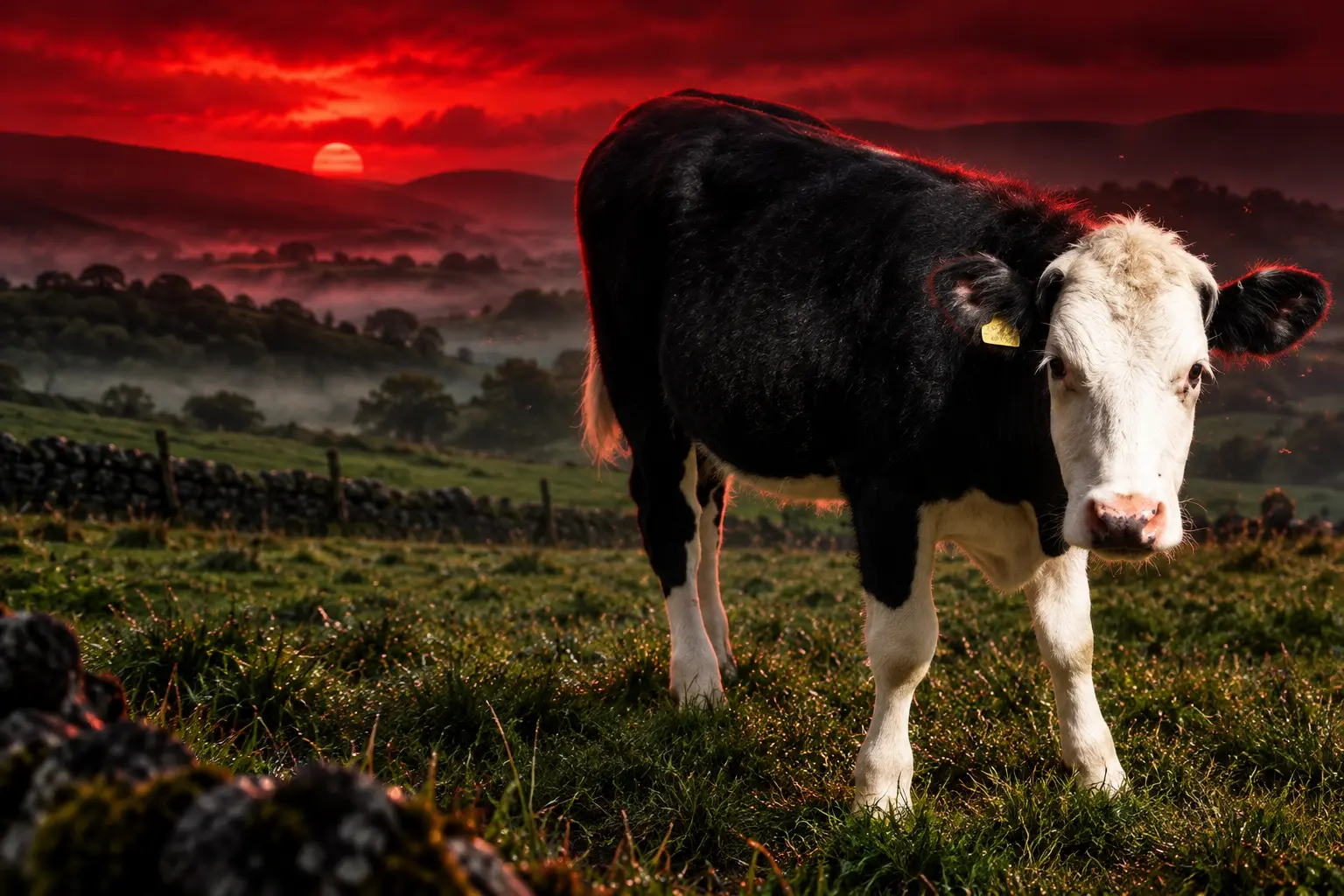
Four Farms Sat Outside the Old Zone
The first Scottish case of this season was confirmed on 8 August 2026. A temporary control zone went up around Dumfries and Galloway on 20 August. On 10 September that box became a restricted zone, after ministers said the virus was circulating in the south-west. Eight weeks after the first case, the internal border comes down.
The government’s own count is 40 confirmed affected holdings in Scotland. Four of those were found outside the old zone by tracing loads that had already left affected farms. Those four sit at south Aberdeenshire, Ellon, Brechin in Angus, and Carluke in South Lanarkshire. There is no claim of midge circulation in those counties. The animals moved, and the tests followed.
Confirmed animals on the Scottish list run to 20 sheep and 82 cattle. Testing does not cover every animal on a holding, so the true head count is higher. Dumfries and Newton Stewart remain the hottest towns, with 6 premises each.
WHERE THE 40 PREMISES SIT
| Area | Premises |
|---|---|
| Dumfries | 6 |
| Newton Stewart | 6 |
| Castle Douglas | 5 |
| Kirkcudbright | 4 |
| Lockerbie | 4 |
| Other Dumfries and Galloway | 11 |
| Outside the old south-west zone | 4 |
| Total | 40 |
On 8 September, when the south-west zone was locked in, Fairlie said ministers had done all they could “to stop bluetongue getting a foothold” and that the evidence now showed the disease circulating there. The four traced loads were the foothold that the licences did not catch.
HOW THE ZONE GREW
- 10 July 2026: First BTV-3 case of the 2026 to 2027 season is confirmed in England.
- 8 August 2026: First Scottish case of the season is confirmed in the south-west.
- 20 August 2026: A temporary control zone is declared around Dumfries and Galloway.
- 10 September 2026: That box becomes a restricted zone after officials confirm the virus is circulating.
- 1 October 2026: Ministers announce the zone will cover all of Scotland.
- 3 October 2026: The whole-country restricted zone takes effect and south-west movement licences fall away.
Cooler weather now cuts the chance of midge spread, the government said, and every affected farm is already under movement restrictions. That is the seasonal cover for taking the internal fence down. It is also an admission that the fence was already porous.
Priestley Called It a Trade-Off
Michael Priestley, policy manager at the National Sheep Association, backed simpler trading rules as midge activity falls with the temperature. He also named the cost in plain terms.
Farmers should be aware that there is a trade-off between the benefit of eased restrictions and a reduced bureaucratic burden that brings an increased risk of the virus spreading. This trade-off is being made because of the faith in the vaccine technology, which to date has offered excellent coverage to livestock in affected areas of the UK.
Michael Priestley, Policy Manager, National Sheep Association
Neil Shand, chief executive of the Scottish Beef Association, called the whole-country zone “the most logical way forward to prevent trade complications” and said the only way to protect cattle fully is to vaccinate. The south-west, where autumn store sales and breeding stock moves pile up, had the loudest claim on the diary. Keepers around Ellon and Brechin are being asked to accept infected-area status for animals that arrived on a lorry, not for midges in their own fields.
Finlay Carson, the MSP for Galloway and West Dumfries, welcomed the change as a relief before a busy trading season and said the next job is national vaccine uptake before next year’s midge season.
We welcome that the bluetongue restricted zone in place in the South West will be extended to the whole of Scotland.
This will ease pressure ahead of a busy trading season.
We must now ensure maximum national uptake of the vaccination ahead of next year’s midge season. https://t.co/m2FRHWbfxw
— Finlay Carson (@fincarson) October 1, 2026
That is the political bargain. The licences were the last tool that treated the rest of Scotland as clean. They also snarled the autumn ring. The ring won.
Do the BTV-3 Vaccines Stop Infection?
Fairlie still calls vaccination “the single most effective way for farmers to protect their animals from the worst effects of bluetongue.” He wants keepers to speak to their vet now and to lock in supplies before next year’s higher-risk season. A joint Scottish government and industry group is being set up to push that message.
The legal picture is narrower than the slogan. There are three BTV-3 vaccines authorised for use in the UK: Bluevac-3, BULTAVO 3 and Syvazul BTV 3. A vet must prescribe them. Keepers can inject their own animals. Use must be reported within 3 days, and records kept for at least 5 years. In Scotland, cattle, sheep and goats should be logged on ScotEID.
WHAT THE THREE JABS ARE LICENSED TO DO
| Vaccine | Sheep | Cattle |
|---|---|---|
| Bluevac-3 | Reduce viraemia, death and clinical signs | Reduce viraemia |
| BULTAVO 3 | Reduce viraemia and prevent clinical signs | Prevent viraemia and prevent clinical signs |
| Syvazul BTV 3 | Reduce viraemia, death, signs and lesions | Reduce viraemia |
Only BULTAVO 3 in cattle claims to prevent virus in the blood. The other licensed claims are about cutting virus levels, death and visible illness. Vaccinated sheep can still pick up BTV-3. So can cattle on Bluevac-3 or Syvazul. Faith in the technology, as Priestley put it, is mostly faith that fewer animals will die or abort, not that the virus stops moving.
Bluetongue does not affect people or food. It is spread mainly by Culicoides midges, and also by breeding and across the placenta. In sheep it can kill at a high rate. In cattle it hits fertility and milk. Signs include nasal discharge, redness and swelling of the lips, nose and muzzle, lameness, a drop in milk, and diarrhoea in cattle. Suspicion must be reported to APHA. Vaccination status does not lift that duty.
A Closed Door on Live Exports
Matching England and Wales on disease status fixes the autumn ring inside Great Britain. It does not reopen the routes that closed when GB stopped being bluetongue-free. Live ruminants still cannot go from Great Britain to the EU. They still cannot go to Northern Ireland. Freezing semen, ova and embryos still needs donor testing. Fresh germinal products can be used as normal.
WHAT STILL CANNOT MOVE
- To the EU: Live ruminant animals cannot currently be traded from Great Britain to the EU.
- To Northern Ireland: Live ruminant animals cannot currently be moved to Northern Ireland, and that bar stays after 3 October.
- Clinical cases: An animal showing signs of bluetongue on the day of movement must not be moved.
- Infected animals: Animals affected with bluetongue from 3 October stay on their premises for 60 days.
- Frozen germplasm: Donors still need a bluetongue test before semen, ova or embryos are frozen.
For a Scottish store-cattle producer selling into England, Saturday is a gain. For anyone who still wanted a clean-origin ticket into Belfast or an EU buyer, the ticket was already gone. The whole-country zone makes that loss official at home as well as at the border.
Keep Clinical Cases off the Road
Some farm-level rules survive the licence bonfire. Sick animals stay put. Other stock on those farms can trade inside the zone as normal, and from 3 October they will not need a licence to cross what used to be the south-west line. Infected farms remain under restrictions set locally by APHA on a risk basis.
The government was careful to say that extending the zone “does not change our long-term approach.” In practice the long-term approach is now the only approach. There is no remaining internal zone to tighten if a cluster appears in the north-east in April. The tools left are the jab, the 60-day hold, the ban on moving clinical cases, and the closed EU and Northern Ireland gates.
Keepers who vaccinate are asked to record cattle, sheep and goats on ScotEID. Officials said the reporting tool will be changed so sheep can be logged in batches. That is a supply-chain detail, and it is also a hint at the scale they want.
When Does the Real Risk Return?
Midge pressure falls as nights cool, which is why Priestley could back the trade-off in October. The higher-risk season Fairlie is already talking about is next year’s. Immunity, where the licences claim it, takes weeks to build. BULTAVO 3 lists onset at 3 weeks after the primary course, with a year’s duration in both sheep and cattle. Bluevac-3 and Syvazul list similar onset times; duration for those two is not yet established on the UK keeper pages.
A spring-calving herd or a hill flock that waits until the first warm week in May will be injecting into a rising midge curve. Fairlie’s ask is to have that conversation with the vet now, while doses can still be pulled through, not in the week the midges return.
Vaccination remains the single most effective way for farmers to protect their animals from the worst effects of bluetongue, and I would strongly encourage anyone with susceptible livestock to speak to their vet now to discuss the right vaccination approach and to secure supplies ahead of next year’s higher-risk season.
Jim Fairlie, Minister for Agriculture, Marine and the Islands, Scottish Government, 1 October 2026
From Saturday the lorries will roll without a south-west licence. The virus is already on 40 Scottish premises, and on 2,408 across the UK. The bet is that the jabs, and a cold autumn, hold until the midges wake up again.

Edinburgh Opens a 2027 Tour Built for Time Trials

Korda Maps Auður From Meðalland to Irvine Bay

Apple Music Films Its New Logo in Mineral Oil

Oppo Prices the Pad Mini Above India’s iPad Mini

Austen Soaks Scotland Before Boelo Brings Weekend Gales

Volkswagen Sells the Osnabruck Plant to Clear a Board Fight

Apple’s Foldable iPhone Hinges on Samsung Display Supply

Tata Motors’ Iveco Tender Opens as Holders Still Decide

Saksham Gaur Finds He Is His Own Company’s Client

Onimusha Way of the Sword Preload Hits a Windows 11 Wall
-
 AUTO2 months ago
Volkswagen Sells the Osnabruck Plant to Clear a Board Fight
-
 NEWS2 months ago
Apple’s Foldable iPhone Hinges on Samsung Display Supply
-
 AUTO2 months ago
Tata Motors’ Iveco Tender Opens as Holders Still Decide
-
 BUSINESS2 months ago
Saksham Gaur Finds He Is His Own Company’s Client
-
 GAMING2 months ago
Onimusha Way of the Sword Preload Hits a Windows 11 Wall
-

 ENTERTAINMENT3 years ago
What is SD on Amazon Prime? – All You Need to Know
-

 BUSINESS2 months ago
Hyderabad 22-Carat Gold Jumps After a False Bargain
-

 NEWS2 months ago
The Frame Pro’s $1,200 Labor Day Cut Needs a Soundbar