
AUTO
Hyundai Stacks Five SUVs on One Indian Price Ladder
Hyundai is lining up a CNG Bayon, a compact EV, a new Creta, a hybrid three-row and an off-roader, and three of those nameplates will hunt the same buyer.

Hyundai is lining up five SUVs for India, and three of them will hunt the same buyer the Creta already owns. A factory CNG Bayon is due in January 2027, a made-in-India compact EV in the first quarter of 2027, and a larger next Creta around mid-2027, with a hybrid three-row and an off-roader further back.
The expansion is real. So is the pile-up. Tarun Garg, managing director and CEO of Hyundai Motor India, has put Creta and Bayon together at 2,50,000 units in calendar 2027, which only works if the two cars split a growing midsize market instead of eating each other.
Bayon Is Priced to Catch Creta Shoppers Who Flinch
The Bayon reached showrooms on October 26, 2026 at an introductory ₹9.99 lakh ex-showroom, with a 1.5-litre naturally aspirated petrol engine rated at 115 hp and 144 Nm, a six-speed manual or iVT automatic, and no diesel. It is 4.2 metres long and sits under the Creta, which still lists from ₹10.79 lakh to ₹19.95 lakh including the N Line. That is an ₹80,000 gap at the floor, and it shrinks once a loaded Bayon is compared with a mid-spec Creta.
Hyundai has confirmed a factory CNG Bayon for January 2027, using the same 1.5-litre petrol engine with a lower output on gas. An underbody tank is expected, in the style of Maruti’s Victoris, so the Bayon’s 505-litre boot does not collapse. That would be Hyundai’s first CNG midsize SUV in India and its first real reply to the Victoris, Grand Vitara and Toyota Hyryder on gas.
THE FIVE-SUV STACK
| Nameplate | India window | Power | India status |
|---|---|---|---|
| Bayon CNG | January 2027 | 1.5 petrol-CNG | Confirmed |
| Compact EV (HE1i) | First quarter of 2027 | E-GMP (K), Svolt cells at start | Confirmed, built at Sriperumbudur |
| Next Creta (SX3) | Mid-2027 | 1.5 petrol, turbo, diesel; hybrid later | Testing in India |
| Ni1i three-row | Late 2027 at earliest | Strong hybrid expected | Not confirmed |
| Off-road SUV | Segment entry by 2030 | Open; US line is body-on-frame | Patent only |
The fence between Bayon and Creta is not size. It is diesel, the next Creta’s expected price step, and the CNG tank arriving on the cheaper car first.
HOW THE TWO CARS ARE MEANT TO SPLIT
- Diesel: The Creta keeps a 116 hp 1.5-litre diesel. The Bayon will not get one.
- Gas: CNG is scheduled for the Bayon in January 2027, not for the Creta.
- Price: Bayon opens at ₹9.99 lakh. The Creta’s floor is ₹10.79 lakh, and the next one is expected to cost more.
- Cabin brief: Bayon is the 4.2-metre, 505-litre boot car. The next Creta moves onto the larger K3 platform shared with the Kia Seltos.
That split is why a loaded Bayon already feels like a Creta alternative rather than a Venue with extra cladding. The Exter and Venue already carry much of Hyundai’s small-SUV volume, so Bayon is not filling an empty rung. It is a second door into the band the Creta has owned for years, built for shoppers who will not pay for the next Creta’s extra metal.
Chinese Cells Keep the Compact EV on the Calendar
The compact EV, coded HE1i, is Hyundai’s first dedicated electric SUV designed for India rather than a petrol model with a battery dropped in. It will be built at Sriperumbudur in Tamil Nadu on the E-GMP (K) platform that also underpins the overseas Inster, with standard-range and long-range packs, Level 2 driver aids and a next-generation infotainment system. José Muñoz, president and CEO of Hyundai Motor Company, called it a brand-new compact SUV, designed and localised in India.
Local cells were the original plan. Exide Energy Solutions was meant to supply them. In August 2026 Exide said production had slipped and that it would not have cells ready by March 2027, which is the end of FY27. Hyundai did not wait.
We are already ready with the new EV using Svolt cells. Otherwise, the programme could have been delayed, and we did not want to delay the vehicle.
Tarun Garg, MD and CEO, Hyundai Motor India, to Autocar Professional
Svolt is the stopgap. Pack assembly, bodywork and interiors can still be done in Tamil Nadu while the cells arrive from abroad, and Hyundai still intends to switch to Exide later. No changeover date is public. Hyundai has also not published the HE1i’s battery size, chemistry or certified range. The overseas Inster uses 42 kWh and 49 kWh packs and claims up to 355 km on the WLTP cycle; those figures describe the Inster, not the Indian car.
The rivals already have prices. The Tata Nexon EV starts at ₹12.49 lakh, the Kia Syros EV at ₹13.49 lakh and the Mahindra XUV 3XO EV at ₹13.89 lakh. HE1i has to land in that band and still fund a dedicated platform. EVs were 1 percent of Hyundai’s Indian sales in FY26. The company has said it wants that share above 7 percent, which is why the compact SUV cannot slip a year for Exide’s factory.
Manali Test Mules Show a New Creta Cabin
The third-generation Creta, coded SX3, has been running camouflaged mules in the hills around Manali, and cabin footage from those tests matches a dashboard first seen on Korean prototypes in February 2026. A large central screen sits beside a slim digital cluster set deep in the fascia, with a new steering wheel that carries Hyundai’s Morse-code H, touch buttons and two scroll wheels. Boss-mode controls for the front passenger seat are visible, as is a rotary knob under the screen.
The layout points to Pleos Connect, Hyundai’s new software stack, and it breaks from the single joined display used on the new Venue and the latest Kia Seltos. Flush door handles, a boxy grille with a central radar, split headlights and a three-piece tail-lamp are already on the mules. The car rides on the K3 platform, which should make it longer and wider than today’s Creta and move it clearly above the Bayon.
Engines are expected to carry over: a 115 hp 1.5-litre naturally aspirated petrol, a 160 hp 1.5 turbo-petrol and the 116 hp 1.5 diesel, with the same manual and automatic choices. A strong hybrid based on the 1.5 petrol is being readied with the Seltos and is likely to arrive after launch rather than on day one. Mid-2027 is the working India window. A dearer Creta is the whole point of having Bayon underneath it.
What the Ni1i Is Meant to Replace
Hyundai still sells the Alcazar as its three-row SUV. It no longer sells the Tucson in India; that nameplate was taken off the local site in November 2025 after weak volume. The gap between a stretched Creta and a full-size import is the slot product planners keep describing for a model coded Ni1i.
Early briefings put Ni1i above the Alcazar, on a longer C-segment architecture, with a strong hybrid as the headline powertrain and a late-2027 arrival at the earliest. Rivals named in those briefings are the Mahindra XUV 7XO, Tata Safari and Toyota Innova Hycross. Hyundai has not confirmed the code, the timing or the price. A Palisade has been floated for 2028 as a larger, costlier three-row, which would leave Ni1i as the family hybrid rather than the flagship.
If the hybrid Creta and Ni1i share a 1.5-litre strong-hybrid pack, Hyundai will be selling two hybrids a class apart inside a year. That is efficient for the factory. It is also another overlap for the salesperson.
A New York Show Truck With an Indian Patent
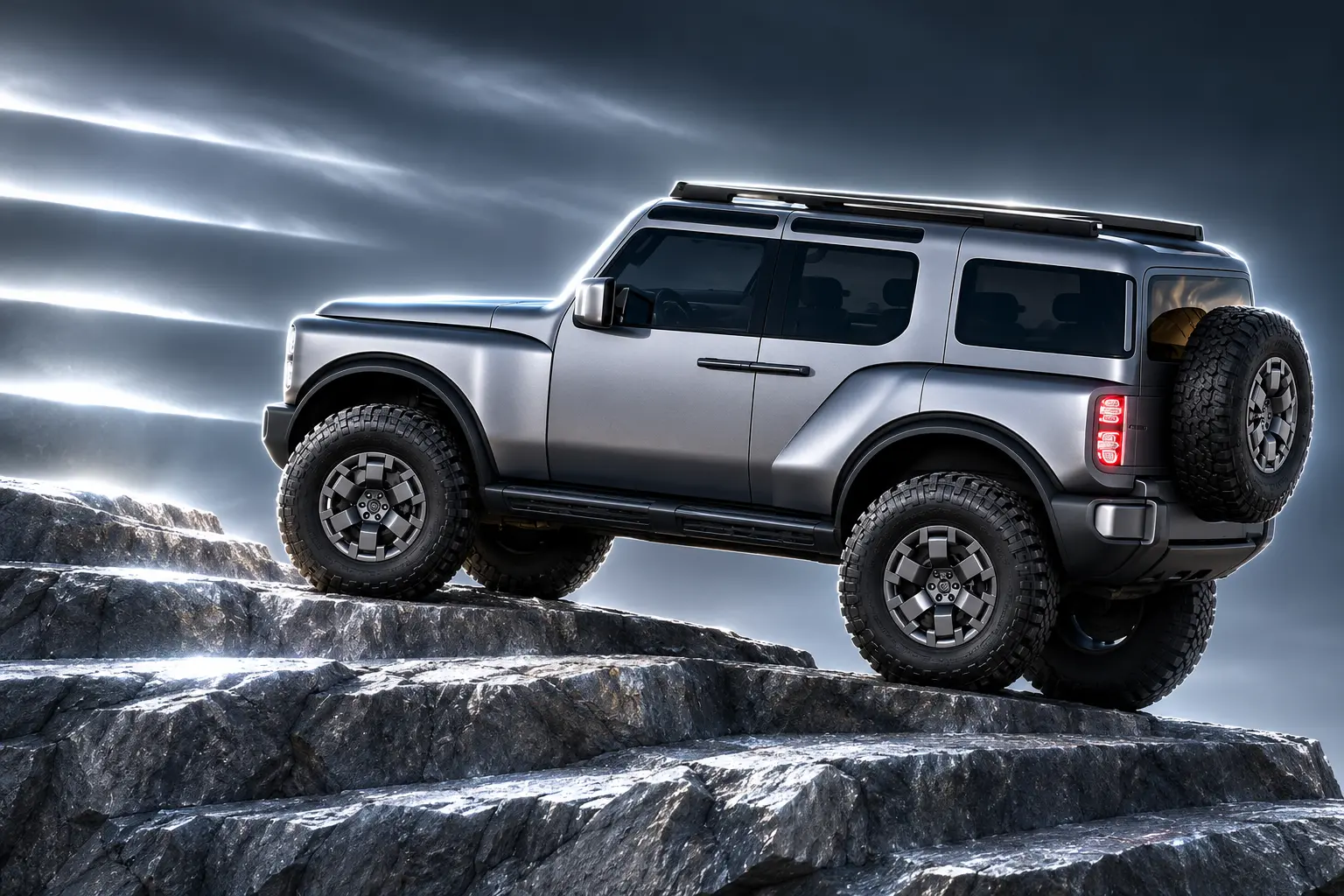
The Boulder Concept rolled out as a surprise at the New York International Auto Show on April 1, 2026. Hyundai presented it as a design study for the brand’s first fully boxed body-on-frame architecture, with the first production use locked as a midsize pickup for the United States by 2030. The show car wore 37-inch mud-terrain tyres, coach-style doors, safari windows, a tailgate-mounted spare and a double-hinged tailgate. SangYup Lee, head of Hyundai and Genesis Global Design, called it a four-wheeled love letter to off-road life. Muñoz tied it to American towing and hauling, not to Chennai.
— Hyundai Motor Group (@HMGnewsroom) April 2, 2026
A design registration numbered 502534-001, filed in May 2026 with India’s Controller General of Patents, Designs and Trade Marks, shows a boxy SUV close to that concept, with smaller square lamps, a tighter nose and a roof carrier. The filing does not name a powertrain and does not schedule a launch. Hyundai Motor North America has said the Indian filing is not related to any North American concept or production vehicle.
WHAT WE KNOW
- US truck: The ladder-frame platform is confirmed for a midsize pickup in America by 2030, designed, developed and built there with Hyundai US steel.
- India patent: Registration 502534-001 covers exterior design only and does not confirm a showroom model.
- Segment promise: Hyundai’s India Investor Day in 2025 included an off-road SUV among new segments to enter by FY2030.
WHAT IS UNCONFIRMED
- Boulder in India: No launch date, price, engine or four-wheel-drive spec has been issued for a production Boulder here.
- Architecture: A separate India brief has described a muscular monocoque SUV with off-road ability by 2030, which would not be the US ladder frame.
The patent is being read as a Thar and Jimny play. The documents support a design being protected, not a body-on-frame Hyundai in a 2027 price list. Until a local spec sheet appears, the off-roader is the longest-dated item on a five-SUV list that otherwise lands inside 12 months.
The ₹45,000 Crore Plan Behind the Five SUVs
On October 15, 2025, Hyundai Motor India used its first Investor Day to publish the budget that makes this stack possible: ₹45,000 crore through FY2030, with 60 percent on product and research and 40 percent on capacity. Muñoz said India would become Hyundai’s second-largest region, with exports up to 30 percent of output. Garg set a domestic share target above 15 percent and a utility-vehicle mix above 80 percent, from 68.5 percent in FY2025.
THE FY2030 MIX HYUNDAI PUT ON THE SLIDE
- The money: ₹45,000 crore through FY2030, 60 percent product and research, 40 percent plants and upgrades.
- The count: 26 launches and seven new nameplates, plus six full model changes, six derivatives and seven facelifts.
- The powertrains: 13 petrol or diesel models, five EVs, eight hybrids and six CNG models, with more than 50 percent of sales from CNG, EV and hybrid combined.
- The plants: 1.1 million units of capacity, with the compact EV booked for Sriperumbudur.
THE DATES THAT ARE BOOKED
- October 15, 2025: Investor Day sets the 26-model, ₹45,000 crore India plan and an off-road SUV entry by FY2030.
- April 1, 2026: Boulder Concept debuts in New York as a US ladder-frame pickup preview.
- May 2026: Design 502534-001 is filed in India.
- August 2026: Exide says cells will miss March 2027; Hyundai keeps HE1i on Svolt.
- October 26, 2026: Bayon petrol launches at ₹9.99 lakh.
- January 2027: Bayon CNG is scheduled to go on sale.
- First quarter of 2027: HE1i compact EV is due from Sriperumbudur.
- Mid-2027: Next Creta is expected on the K3 platform.
January’s CNG Bayon is the first of those SUVs a buyer can actually order. The compact EV and the bigger Creta follow on the same calendar. Ni1i and the off-roader are still slides. The risk in the near term is not that Hyundai lacks SUVs. It is that Bayon, HE1i and Creta will be asking for the same deposit in the same showroom, while the Boulder on the poster is still a New York concept with an Indian patent number.

Gold Prices Fall to a 14-Month Low Despite Strikes

SpiceJet Clears a Rs 5,500 Crore Raise After Mumbai Stalled

Honda Activa’s Record Month Came With a Share Loss

Sony Turns the GTA 6 Launch Into a Firmware Gate

Xiaomi 18 Leak Skips the Rear Screen for Battery

Volkswagen Sells the Osnabruck Plant to Clear a Board Fight

Apple’s Foldable iPhone Hinges on Samsung Display Supply

Saksham Gaur Finds He Is His Own Company’s Client

Tata Motors’ Iveco Tender Opens as Holders Still Decide

What Is SD on Amazon Prime?
-
 AUTO2 months ago
Volkswagen Sells the Osnabruck Plant to Clear a Board Fight
-
 NEWS3 months ago
Apple’s Foldable iPhone Hinges on Samsung Display Supply
-
 BUSINESS3 months ago
Saksham Gaur Finds He Is His Own Company’s Client
-
 AUTO3 months ago
Tata Motors’ Iveco Tender Opens as Holders Still Decide
-
 TECHNOLOGY3 years ago
What Is SD on Amazon Prime?
-

 BUSINESS3 months ago
Hyderabad 22-Carat Gold Jumps After a False Bargain
-

 GAMING3 months ago
Onimusha Way of the Sword Preload Hits a Windows 11 Wall
-
 BUSINESS3 months ago
UltraTech Ultravolt Launch Splits Friday Stocks to Watch