
BUSINESS
Peterhead Wins 910 MW Consent as the Cluster Stalls
Scottish ministers consented SSE and Equinor’s 910 MW Peterhead carbon capture plant, but construction stays locked until Acorn can take the CO2.

Scottish ministers granted consent on 27 October 2026 for a 910 MW Peterhead carbon capture power station at Boddam in Aberdeenshire. SSE Thermal and Equinor designed the new gas unit to catch at least 90% of its flue gas, up to 1.5 million tonnes of carbon dioxide a year.
The legal yes does not let them pour concrete. Except for site enabling works, construction cannot start until ministers approve a carbon capture and storage plan that shows how the gas reaches St Fergus, and the Acorn network that would take it is still without a lead developer.
Ministers Consented a Plant They Cannot Yet Build
The signed decision grants Section 36 consent under the Electricity Act 1989 and deems planning permission under the Town and Country Planning (Scotland) Act 1997. SSE Thermal Generation (Scotland) Limited applied in March 2022. The consented Energy Consents Unit record, ECU00003433, lists the outcome as Consented on 27 October 2026, after more than four years of extra environmental work and consultation.
Authorised works include one combined cycle gas turbine, a post-combustion capture plant, gas and power connections, an extra substation, water kit, and carbon dioxide compression and export gear. Section 36 covers building and running the station. The 1997 Act direction is the deemed planning permission. They are not a construction loan, a storage licence, or a final investment decision.
Ministers gave a seven-year window to start, against the usual three years in Scottish planning, because carbon capture kit still has to catch up. The generating consent then runs for 25 years from final commissioning, a separate clock. Condition 5 is the lock. With the exception of site enabling works, development cannot commence until Scottish ministers approve a Carbon Capture and Storage Technology Plan. That plan must show space for kit able to capture and compress all carbon dioxide that would otherwise leave the stack, and it must set out in detail how the captured gas will reach the St Fergus gas terminal.
The station must then be built and run to that approved plan unless ministers agree otherwise. Carbon Capture Readiness rules from 2013 were treated as a feasibility test, not as proof the pipes will work. Finlay McCutcheon, managing director of SSE Thermal, called the decision an important milestone and said further progress at Peterhead remains contingent on delivery of the Scottish carbon capture cluster. He said the firm would take time to consider the decision in detail.
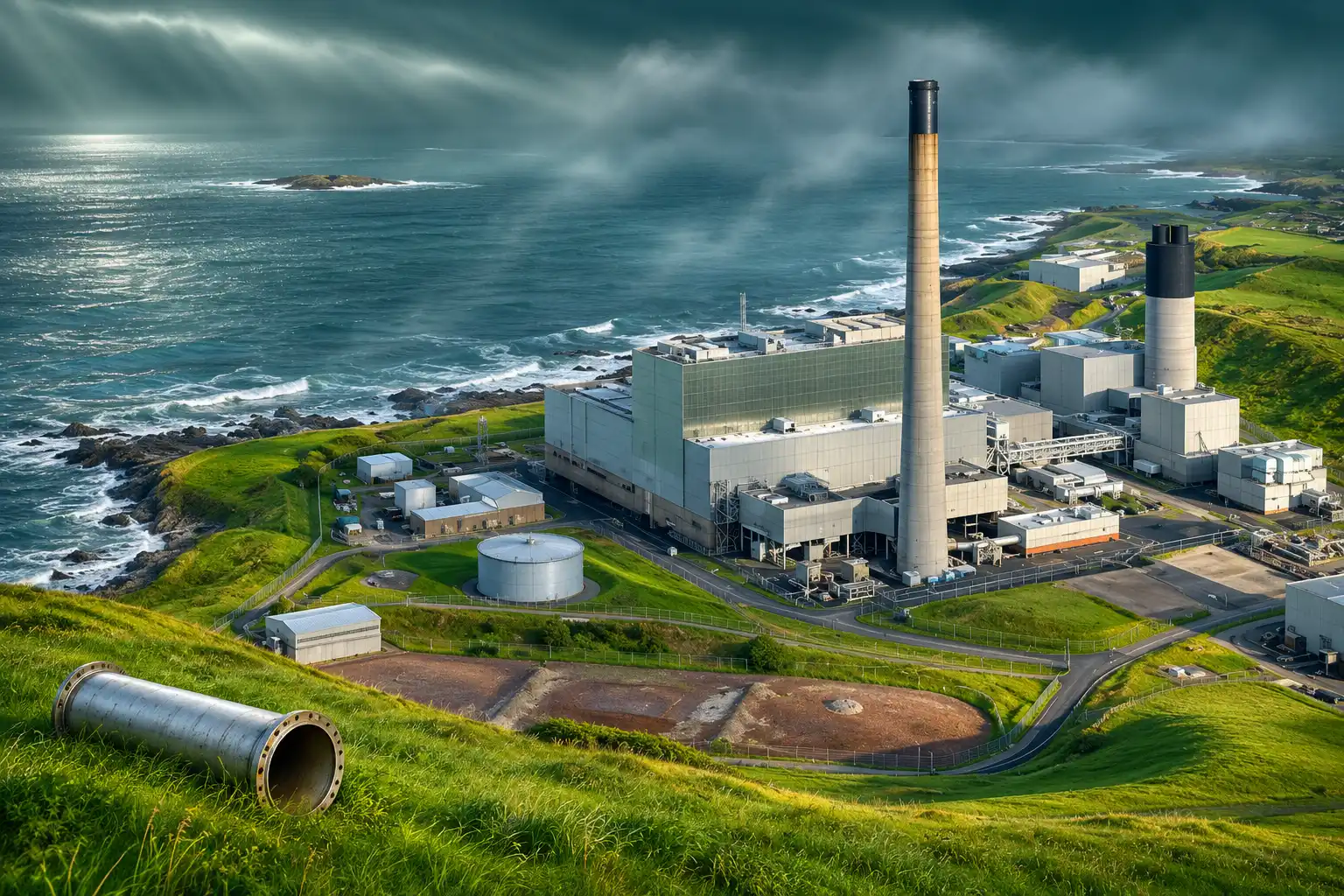
910 Megawatts In, About 750 Out
Nameplate capacity is 910 MW. SSE’s March 2026 FAQ says net electrical output is expected to be around 750 MW because the capture process itself burns a large slice of the power. The design minimum capture rate is 90%, and SSE says it is aiming higher. About 1.5 million tonnes of carbon dioxide a year is the stored volume in that design case, against a conventional gas station with no capture.
NEW PLANT VERSUS THE 1982 STATION
| Measure | New Peterhead capture unit | Existing Peterhead station |
|---|---|---|
| Capacity | 910 MW installed, about 750 MW net | 1,180 MW |
| Role | Gas turbine plus capture from day one | Scotland’s last fossil power station, in use since 1982 |
| Carbon kit | At least 90% capture, up to 1.5 million tonnes a year | No capture |
| Running life now stated | 25 years from final commissioning | Once due to close by 2030, now at least the mid-2030s |
SSE Thermal’s Peterhead carbon capture plans put the new unit on land beside the old station, with compression and export kit pointed at St Fergus and then at rock about 100 km offshore. The Scottish Environment Protection Agency discussed an estimated 76% cut in generation carbon intensity against the existing station under the assessed baseline. That is an appraisal figure, not a reading from a working new plant.
Where the Carbon Would Go From Boddam
Captured carbon dioxide is meant to leave Peterhead for the St Fergus gas terminal, then move through the Scottish Cluster into the Acorn store in North Sea rock about 100 km offshore. Ministers treated that route as feasible on paper. There is still no working capture transport and storage network in Scotland, and the plan that Condition 5 demands has not been approved.
Acorn is supposed to reuse old North Sea gas pipes as a backbone for industrial and power emissions. In June 2025 the UK government said it was meeting in full a request for around £200 million of development funding for Acorn, subject to a business case, and described National Gas’s SCO₂T Connect line as a 175-mile reuse plus 35 miles of new pipe to move carbon from Grangemouth toward North Sea storage. Industry figures given to government put Acorn at about 15,000 jobs at peak construction and said the project would safeguard around 18,000 North Sea jobs. Combined with the Viking project in the Humber, the two schemes were said to be able to remove up to 18 million tonnes of carbon dioxide a year once running.
Aberdeenshire Council’s planners had already warned, in a July 2025 consultation reply, that the St Fergus CCS project did not have planning permission and was not even in for planning, so the mitigation for Peterhead carried “significant uncertainty.” They asked ministers to consider a Grampian-style condition that would block operation until CCS was in place. Condition 5 goes earlier than that, and stops main construction, but enabling works can still begin.
Storegga’s Exit and a Budget Recast as Loans
The cluster lost mass before the consent letter was signed. Storegga, then lead developer with a 30% stake, launched a sale of that interest on 4 December 2025 after a strategic review, saying a new long-term owner would be better placed as Acorn entered a more capital-heavy phase. Shell and Harbour Energy each still hold 30%, and North Sea Midstream Partners holds 10%. Friends of the Earth Scotland said on 27 October 2026 that no replacement stakeholder had been announced. Industrial Info Resources was still flagging a new lead developer as a watch item on 17 November 2026.
CLUSTER SETBACKS BEFORE AND AFTER CONSENT
- April 2025: Petroineos ends oil refining at Grangemouth, removing a large industrial emitter Acorn had counted on.
- 12 June 2025: UK government pledges around £200 million of Acorn development funding, subject to business case, with Ed Miliband saying ministers were putting their money where their mouth is.
- 4 December 2025: Storegga starts a sale of its 30% Acorn stake and says a new owner should take the project into its capital-intensive phase.
- February 2026: ExxonMobil shuts the Fife Ethylene Plant at Mossmorran after failing to find a buyer, cutting another prospective emitter.
- 27 October 2026: Scottish ministers consent the 910 MW Peterhead capture station, with Condition 5 blocking main works until a CCS plan to St Fergus is approved.
- 28 October 2026: The UK Budget saves £200 million of carbon capture capital grants, keeps grant support for more mature clusters, and says loan or equity tools are being examined for Acorn.
The Budget landed one day after the Peterhead yes. Treasury papers described a £200 million saving on carbon capture grants inside the Department for Energy Security and Net Zero, with money steered toward defence and toward clusters at Teesside, Merseyside and North Wales, while grant funding for the Viking cluster in the Humber was kept. Acorn was named only as a future candidate for loan or equity investment that would need a return for taxpayers, subject to a business case. DESNZ said existing grant cover would run to the end of the year and that later support would come through those financial transactions. An Acorn spokesperson said the Budget did not change the current development programme.
The SNP later argued that £5.1 billion of forecast oil and gas tax receipts over the next year should be put into Acorn, with Peterhead as the starting point. That is a political claim, not a Treasury line. The practical split is already visible: English and Welsh clusters keep grant language, and Scotland’s cluster is being asked to borrow or dilute.
The Old Station Now Runs Into the Mid-2030s
The existing Peterhead station has run since 1982 and, after a 2000 repowering, burns gas as Scotland’s only remaining fossil power plant. SSE’s FAQ says it was until recently expected to close by 2030. Slow delivery of low-carbon flexibility, including CCS, now means the power system may need it until at least the mid-2030s, and there may be a limited period when both plants run at once.
SSE says running the new capture unit would cut how often the old station is dispatched and would cut its net emissions. The updated environmental file, submitted after the 2024 Finch judgment on upstream greenhouse gases, had to look at those overlap years and at emissions from producing and moving the gas. Friends of the Earth Scotland says SSE had to accept in 2025 that the project’s climate pollution was more than three times the figure in the first planning file, because extraction and transport sit outside the stack capture system. The group also cites Carbon Tracker work putting the full climate load at five times the original admission. Those are different counts of the same upstream gap, and neither is captured by the 90% stack rate.
Ministers still gave security of supply decisive weight. The decision letter says the project would support the resilience of the electricity network and that a scheme of this scale delivers a very significant national benefit in energy and security of supply, weighing heavily in favour of consent. They accepted leftover local landscape and visual harm, including for nearby residents and coastal-path users, and concluded that protected sites such as Buchan Ness to Collieston, the Ythan Estuary and Loch of Strathbeg would not lose integrity. Aberdeenshire Council raised no objection, subject to conditions. SEPA withdrew earlier holding objections.
Objectors Lost the Planning Fight
The decision records objections from Friends of the Earth Scotland and from members of the public, including a petition carrying more than 12,900 signatures. Objectors attacked reliance on gas, the odds of capture working, upstream emissions, the chance both stations would run together, and the dependence on Acorn. The application was consented on the same day Holyrood debated climate change and climate justice.
Giving the green light for new fossil fuelled power at Peterhead is a catastrophic failure from the Scottish Government to protect people from both climate breakdown and the increasing burden of rocketing household bills.
Caroline Rance, Head of Campaigns, Friends of the Earth Scotland
Rance also called carbon capture “cynical greenwash” and said successive governments and fossil firms have promised it for more than 20 years without storing a drop. The group’s 27 October statement framed the consent as a catastrophic failure to protect people, and said the plant would lock households onto volatile gas prices. A Scottish government spokesperson said the full grounds sat in the decision letter and that it would not be appropriate to comment further, while noting that impacts on communities, nature and cultural heritage, including cumulative effects, were important in the process.
National Planning Framework 4’s designation of the Scottish Cluster as a national development helped the developers’ case. So did the claim that a capture-ready thermal plant can back a wind-heavy grid. The louder problem is still the missing pipe. Approving a capture plant before the store, the owner and the cash are in place leaves Scotland with a consented gas station whose carbon plan can be delayed, varied, or never built while the seven-year start clock runs.
SSE Will Not Spend Until Acorn Moves
BiGGAR Economics, in an analysis SSE published on 16 May 2022, put lifetime spend at £2.2 billion over the first 25 years of operation, plus development and construction. During build it put £60 million into the Aberdeen City and Shire economy and 980 years of local employment, £190 million and 3,070 employment-years across Scotland, and £470 million and 7,850 employment-years across the UK.
JOBS SSE AND BIGGAR PUT ON THE TABLE
- Construction: SSE’s March 2026 FAQ says in the region of an additional 1,000 jobs during the build, against 980 local employment-years in the 2022 BiGGAR note.
- Operation, supported: About 240 long-term skilled jobs supported each year, matching BiGGAR’s Aberdeen operational figure, with 290 a year across Scotland and 560 across the UK.
- Operation, direct: Friends of the Earth Scotland, reading the planning file, puts direct posts at the new plant at 50, against 80 full-time staff and up to 30 contractors at the old station.
- Annual local value: BiGGAR estimated about £25 million a year added to the wider Aberdeen economy once the station is running, £35 million a year for Scotland and £50 million a year for the UK.
Those construction numbers only arrive if steel goes in the ground. McCutcheon has already tied that spend to Acorn. Industrial Info Resources put the same point in plainer terms on 17 November 2026: consent is a milestone, not a funding decision, and the items to watch remain a new Acorn developer, any replacement for the withdrawn grant form, the old station’s mid-2030s run-on, and SSE’s own review of the consent.
STILL REQUIRED BEFORE MAIN WORKS
- CCS technology plan: Ministers must approve the Condition 5 plan that shows capture, compression and the route to St Fergus.
- Acorn transport and store: A working owner, pipes and offshore store have to exist in commercial form, not only in a national development map.
- UK finance: Remaining Acorn support is described as loans or equity with a taxpayer return, subject to a business case, not as the June 2025 grant.
- Final investment: SSE and Equinor still have to choose to spend, after reading the consent conditions, including design, noise, species, traffic, water, an independent environmental clerk of works, and a financial guarantee for later demolition.
SSE said it will take time to consider the decision and keep working with its partners. Main construction still needs a carbon plan ministers have not approved, and a cluster that has not been rebuilt.

Gold Prices Fall to a 14-Month Low Despite Strikes

SpiceJet Clears a Rs 5,500 Crore Raise After Mumbai Stalled

Honda Activa’s Record Month Came With a Share Loss

Sony Turns the GTA 6 Launch Into a Firmware Gate

Xiaomi 18 Leak Skips the Rear Screen for Battery

Volkswagen Sells the Osnabruck Plant to Clear a Board Fight

Apple’s Foldable iPhone Hinges on Samsung Display Supply

Saksham Gaur Finds He Is His Own Company’s Client

Tata Motors’ Iveco Tender Opens as Holders Still Decide

What Is SD on Amazon Prime?
-
 AUTO2 months ago
Volkswagen Sells the Osnabruck Plant to Clear a Board Fight
-
 NEWS3 months ago
Apple’s Foldable iPhone Hinges on Samsung Display Supply
-
 BUSINESS3 months ago
Saksham Gaur Finds He Is His Own Company’s Client
-
 AUTO3 months ago
Tata Motors’ Iveco Tender Opens as Holders Still Decide
-
 TECHNOLOGY3 years ago
What Is SD on Amazon Prime?
-

 BUSINESS3 months ago
Hyderabad 22-Carat Gold Jumps After a False Bargain
-

 GAMING3 months ago
Onimusha Way of the Sword Preload Hits a Windows 11 Wall
-

 BUSINESS3 months ago
UltraTech Ultravolt Launch Splits Friday Stocks to Watch