
BUSINESS
SpiceJet Clears a Rs 5,500 Crore Raise After Mumbai Stalled
SpiceJet approved a Rs 5,500 crore raise the day after Mumbai flights halted, two years after a Rs 61.60 QIP the stock has already undone.

SpiceJet’s board approved a plan to raise up to Rs 5,500 crore on November 18, a day after the airline flew nothing out of Mumbai after 7 p.m. Shares closed at Rs 9.97, up 4.95%, on a 5% upper circuit, while the BSE Sensex fell 0.61%.
The vote is still a permission slip. Cash arrives only if shareholders, regulators and buyers of the paper all say yes, and the last time this script ran the issue price was Rs 61.60.
The Board Approved Rs 5,500 Crore, Not Cash in the Bank
Directors met from 10:00 a.m. to 2:30 p.m. and cleared a raise in one or more tranches, through equity, non-convertible debt with warrants, other convertible paper, a qualified institutions placement, a rights issue, a preferential allotment, a private placement, or any other route the law allows. They also voted to lift authorised share capital from Rs 2,000 crore to Rs 7,500 crore, which means the cap on equity shares of Rs 10 face value would move from 200 crore shares to 750 crore shares, subject to shareholder and regulatory nods.
Management told the board it is already in talks with new investors and was told to hurry those discussions. Chairman and Managing Director Ajay Singh cast the vote as a rebuild of the airline and the brand.
We believe this fundraise will provide an important opportunity to rebuild the airline, strengthen its operations and restore the brand. We are conscious of the challenges ahead, but we have a clear plan and are focused on putting the necessary building blocks in place. Our priority is to execute that plan with discipline and restore SpiceJet’s position as a strong and competitive airline.
Ajay Singh, Chairman and Managing Director, SpiceJet
The company had already sent exchanges a notice of the November 18 board meeting on November 13, and it closed the trading window around that calendar. None of that puts Rs 5,500 crore on the balance sheet.
THE CAPITAL CAP THE BOARD WANTS
| Item | Now | Proposed |
|---|---|---|
| Authorised share capital | Rs 2,000 crore | Rs 7,500 crore |
| Equity shares authorised | 200 crore | 750 crore |
| Face value | Rs 10 | Rs 10 |
A 3.75-times jump in authorised capital is the room a deep equity issue needs. At Rs 9.97, filling even part of that room would swamp the present share count.
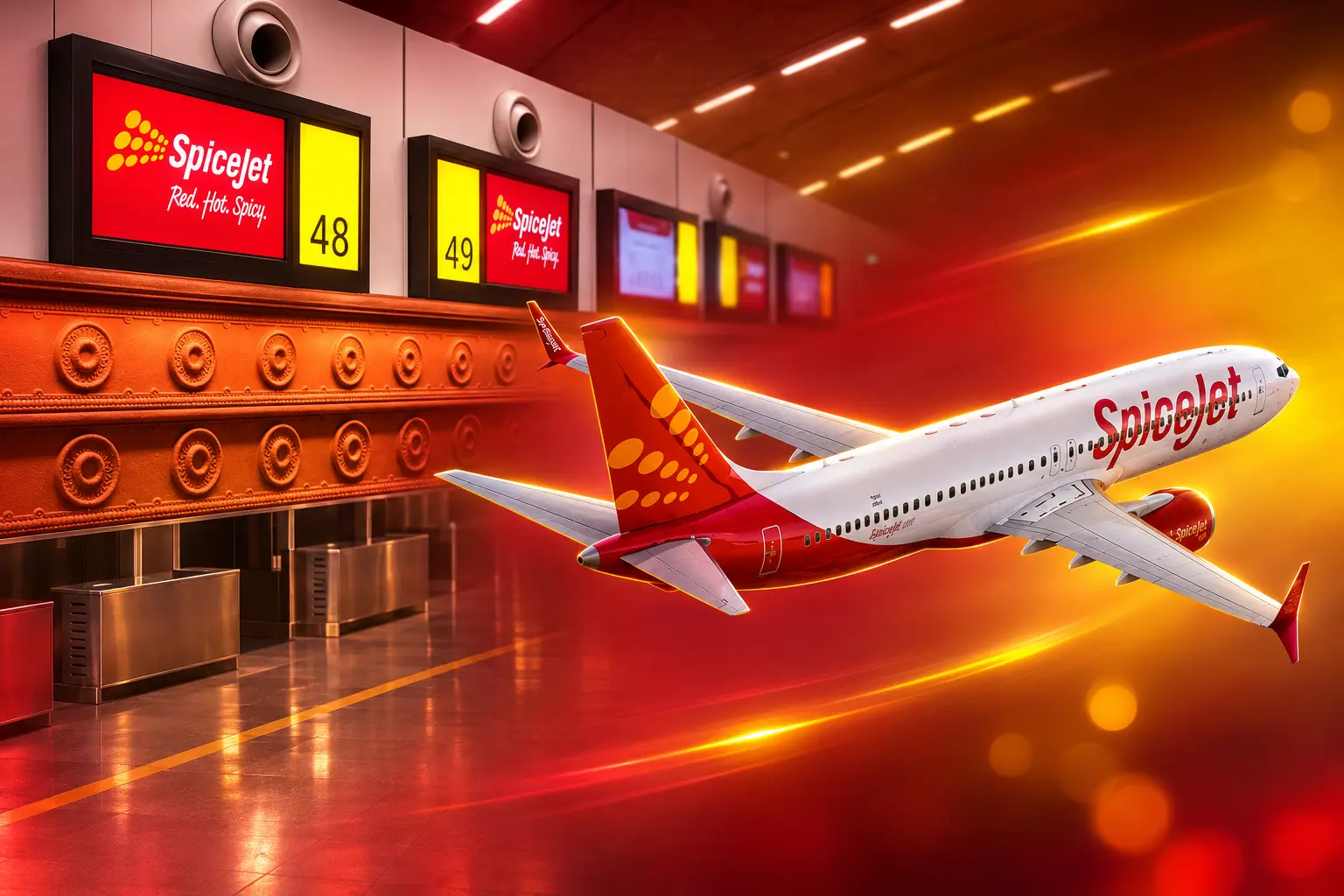
Mumbai Had No SpiceJet Departures After 7 p.m.
On November 17, no SpiceJet flight left Chhatrapati Shivaji Maharaj International Airport after 7 p.m. Airport officials counted 12 cancelled Mumbai departures that day, including SG-676 to Bengaluru and SG-5113 to Dubai. A service listed at 11:30 p.m. had not begun boarding late that night. Passengers who had arrived around 7 p.m. said a flight finally moved near 4 a.m. on November 18, after about nine hours on the floor of Terminal 1.
It was the second straight day of a broken Mumbai bank. Travellers clustered at the counters and shouted at staff who, they said, had no revised times and no boarding passes. Across all airlines, Flightradar24 logged 422 delays and 39 cancellations at Mumbai on November 17, so SpiceJet was not the only carrier in trouble, but it was the one that stopped departing altogether after early evening.
The same week, people chasing refunds for cancelled sectors found the phone line dead. SpiceJet posted that its helpline was working again and listed two Gurugram numbers. Callers in the replies said the numbers still did not connect, and that refunds from festive-season cancellations had not landed.
#Update: We are pleased to inform you that our helpline numbers are now working fine, and we are available 24×7 to assist you. Please feel free to contact us at +91 (0)124 4983410 or +91 (0)1247101600 for any assistance. https://t.co/wU5ESs0FVE
— SpiceJet (@flyspicejet) November 12, 2026
That is the operating picture the board voted beside: a Mumbai bank that can go dark after 7 p.m., and a customer desk passengers already do not trust.
Thirteen Aircraft Are Left to Hold the Network
Aircraft-tracking site Planespotters.net put the fleet at about 13 aircraft in early November, some of them on six-month wet leases. In 2019 the airline was flying around 74 planes. The gap is the whole commercial problem. You cannot hold slots, crew rosters or a connecting bank with a dozen jets, and you cannot promise a winter schedule if half of them are someone else’s metal on a short hire.
SpiceJet’s own Q1 FY26 deck still carried a plan to unground about 10 aircraft by April 2026, plus lease deals for 10 Boeing 737s on DAMP terms due in from October 2025. April 2026 has already passed. The 13-plane count in November is what those induction slides produced in public view.
A thin fleet shows up as missed banks, not as a slide. When one aircraft goes technical in Mumbai, the next three waves slip, and the last departure of the night never pushes. That is how a 7 p.m. freeze happens on a carrier that once filled the domestic map.
SpiceJet Now Trails Star Air in Domestic Share
Directorate General of Civil Aviation figures for September 2026 put SpiceJet at 0.6% of India’s domestic passengers, with 73,000 people on board. Regional carrier Star Air held 0.7% and 79,000 passengers, the first month Star Air has come out ahead. In 2019 SpiceJet still had close to 15% of the home market.
The slide through 2026 was a straight line down. Share was 3.9% in January and February, 3.8% in March, 3.4% in April, 2.5% in May, 1.9% in June, 1.6% in July, 1.2% in August, then 0.6% in September. August traffic was 140,000 passengers, so September cut that almost in half. Scheduled domestic airlines as a group carried 11.82 million people in September, down 6.49% from a year earlier, which means SpiceJet shrank much faster than the market.
SEPTEMBER 2026 DOMESTIC MARKET
| Airline | Share | Passengers | On-time (10 airports) |
|---|---|---|---|
| IndiGo | 65.4% | 7.73 million | 91.1% |
| Air India Group | 26.8% | 3.165 million | 81.7% |
| Akasa Air | 5.6% | 664,000 | 90.8% |
| Star Air | 0.7% | 79,000 | Not published |
| SpiceJet | 0.6% | 73,000 | 16.6% |
| Fly91 | 0.5% | 62,000 | Not published |
DGCA’s on-time sample covers Bengaluru, Delhi, Hyderabad, Mumbai, Chennai, Kolkata, Ahmedabad, Kochi, Guwahati and Lucknow. SpiceJet’s 16.6% on-time rate sat under Alliance Air’s 75% and far under IndiGo and Akasa Air. Its cancellation rate was 20.29% against 1.15% for scheduled domestic airlines as a whole. Some 39.36% of its flights ran more than two hours late. Complaints came in at 14.3 per 10,000 passengers, against 1.0 at IndiGo. Load factor, at 78.8%, was not the hole. Getting the aircraft out was.
The Last Rebuild Was Priced at Rs 61.60
On September 20, 2024, the fund-raising committee recorded the allotment of 48.70 crore shares at Rs 61.60, a 4.92% discount to the floor, for Rs 2,999,99,99,937.60. Paid-up equity rose from 79,46,72,717 shares to 1,28,16,85,703 shares. Goldman Sachs (Singapore), Morgan Stanley Asia, Discovery Global Opportunity, Societe Generale, Authum Investment and Infrastructure, Tata funds and Bandhan funds were among the buyers on the allotment list.
From Rs 61.60 to Rs 9.97 is an 84% decline. The six sessions into November 18 still produced a 30% bounce and a string of 5% upper circuits, which is what a Z-group penny name does when a raise is rumoured. The 52-week range is Rs 7.40 to Rs 37.70. On a year-on-year basis the stock is down 72.86%.
A CARE monitoring filing on the exchange shows how the 2024 QIP proceeds were used. By March 31, 2025, Rs 2,699.54 crore of the Rs 3,000 crore had already gone out, for statutory dues, creditor settlements, ungrounding, new aircraft, staff dues, airport charges, general corporate purposes and issue costs. On February 25, 2025, the board shifted Rs 300 crore out of the new-fleet bucket, Rs 150 crore into general corporate purposes and Rs 150 crore into creditor settlements. A later resolution on November 12, 2025, moved another Rs 25 crore from ungrounding and new-fleet lines into general corporate purposes.
The 2024 book was sold as ungrounding and induction. A large share of it was then steered toward keeping the lights on. Two years later the board is back asking for Rs 5,500 crore for the same rebuild language.
BSE Set a December Deadline Before the Vote
SpiceJet last filed quarterly numbers on February 12, 2026, for October to December 2025: a consolidated loss of Rs 261.7 crore on Rs 1,408.3 crore of operating revenue. Results for the March and June 2026 quarters were still out. BSE, in a notice covering eight companies, said trading in SpiceJet would be suspended from December 10 unless the filings satisfied the exchange by December 7. Promoter holdings, and other securities in those demat accounts, would be frozen for the length of any suspension.
A company spokesperson said the audit had taken longer and that the numbers would be in by the deadline. SpiceJet also said the Registrar of Companies had given it until December 31 to hold the annual meeting for the year ended March 2026. The stock already trades in BSE’s Z group, which means every trade must settle with delivery. There is no intraday square-off, no short sale, no buy-today-sell-tomorrow.
FROM THE LAST QIP TO THIS VOTE
- September 20, 2024: Allots 48,70,12,986 shares at Rs 61.60 in the QIP.
- February 12, 2026: Files its last quarterly results, a Rs 261.7 crore loss.
- September 2026: Domestic share falls to 0.6%, below Star Air.
- November 9, 2026: BSE warns of a December 10 trading halt.
- November 13, 2026: Company says it will file by December 7 and flags the capital-raise board meeting.
- November 17, 2026: No SpiceJet departures from Mumbai after 7 p.m.
- November 18, 2026: Board approves the Rs 5,500 crore plan and the capital-cap increase.
A Z-group name that has not published three quarters, and that faces a freeze on promoter demat if it misses December 7, is a hard place from which to place Rs 5,500 crore of equity. Buyers will want those accounts first. The raise and the filing deadline are now on the same winter calendar.
Who Would Be Diluted if the Shares Are Issued
SpiceJet has not published a shareholding pattern for the last two quarters. The March 2026 filing is the latest on BSE. Promoters, including Ajay Singh, Ajay Singh HUF, Kalpana Singh and Spice Healthcare Pvt. Ltd., held 24.19%. Singh’s personal stake was 12%. Mutual funds held 1% and foreign portfolio investors 2%. Authum Investment and Infrastructure held 1.96%.
SPICEJET SHAREHOLDING, MARCH 2026
- Promoter group: 24.19%, with Ajay Singh at 12% in his own name.
- Small retail: 4.3 lakh holders with up to Rs 2 lakh in capital, 18.99% of the company.
- Larger retail: more than 4,000 holders above that ticket, 28.6%.
- Institutions: mutual funds 1%, FPIs 2%, Authum 1.96%.
If the full authorised headroom is ever issued near Rs 10, those blocks shrink hard. A rights issue would ask the same 4.3 lakh small holders to send more money into a Z-group stock. A QIP or preferential deal would hand cheap paper to whoever still wants the name after watching Rs 61.60 turn into Rs 9.97. New investors the board was briefed on have not been named.
THE STOCK ON NOVEMBER 18
- Last price: Rs 9.97, up 4.95% from Rs 9.50, on a 5% upper circuit.
- Day range: Rs 9.70 to Rs 9.97, after opening at Rs 9.97.
- 52-week range: Rs 7.40 to Rs 37.70.
- Versus the 2024 QIP: about 84% below the Rs 61.60 issue price.
Singh’s 12% and the wider 24.19% promoter line are also the holdings BSE said it would freeze if the December 10 suspension lands. The capital vote, the missing results and the promoter demat now sit on one clock.
Rs 5,500 crore would, if it is ever placed, buy time to pay lessors, unground metal and restaff a Mumbai bank that failed after 7 p.m. It would not, by itself, put 73,000 monthly passengers back to a 15% airline. The last issue at Rs 61.60 already tried that sentence. The share price, the 13-plane fleet and Star Air’s 0.7% are what that sentence returned.
Disclaimer: This article is news reporting and analysis of SpiceJet’s board approvals, traffic data and share-price moves, and it is for information only. It is not investment advice, a solicitation to buy or sell SpiceJet securities, or a recommendation on any QIP, rights issue or preferential allotment. Readers should consult a SEBI-registered investment adviser or other qualified financial professional before acting on any capital-markets decision. Figures, shareholding lines, fleet counts and listing statuses reflect the company filings, DGCA tables and market data cited here and can change as later results, allotments or exchange orders are published.

Gold Prices Fall to a 14-Month Low Despite Strikes

SpiceJet Clears a Rs 5,500 Crore Raise After Mumbai Stalled

Honda Activa’s Record Month Came With a Share Loss

Sony Turns the GTA 6 Launch Into a Firmware Gate

Xiaomi 18 Leak Skips the Rear Screen for Battery

Volkswagen Sells the Osnabruck Plant to Clear a Board Fight

Apple’s Foldable iPhone Hinges on Samsung Display Supply

Saksham Gaur Finds He Is His Own Company’s Client

Tata Motors’ Iveco Tender Opens as Holders Still Decide

What Is SD on Amazon Prime?
-
 AUTO2 months ago
Volkswagen Sells the Osnabruck Plant to Clear a Board Fight
-
 NEWS3 months ago
Apple’s Foldable iPhone Hinges on Samsung Display Supply
-
 BUSINESS3 months ago
Saksham Gaur Finds He Is His Own Company’s Client
-
 AUTO3 months ago
Tata Motors’ Iveco Tender Opens as Holders Still Decide
-
 TECHNOLOGY3 years ago
What Is SD on Amazon Prime?
-

 BUSINESS3 months ago
Hyderabad 22-Carat Gold Jumps After a False Bargain
-

 GAMING3 months ago
Onimusha Way of the Sword Preload Hits a Windows 11 Wall
-
 BUSINESS3 months ago
UltraTech Ultravolt Launch Splits Friday Stocks to Watch