
NEWS
Voyager 1’s Light-Day Turns Every Hello Into a Two-Day Wait
Voyager 1 reaches one light-day on Nov. 18, a 24-hour radio wait for a 49-year-old probe that already went silent in October.

Voyager 1 will reach one light-day from Earth at 5:16:07 a.m. EST on Wednesday, Nov. 18, a gap of 16,094,799,096 miles. Radio commands will then take 24 hours to arrive, and the reply will take another 24 hours to come home.
NASA is marking the moment with a global flash of Morse code after sunset on Tuesday, Nov. 17. The spacecraft itself will not notice. The flight team in Pasadena already lives inside that delay, and in October it went two nights without a signal.
Commands Will Take a Full Day to Arrive
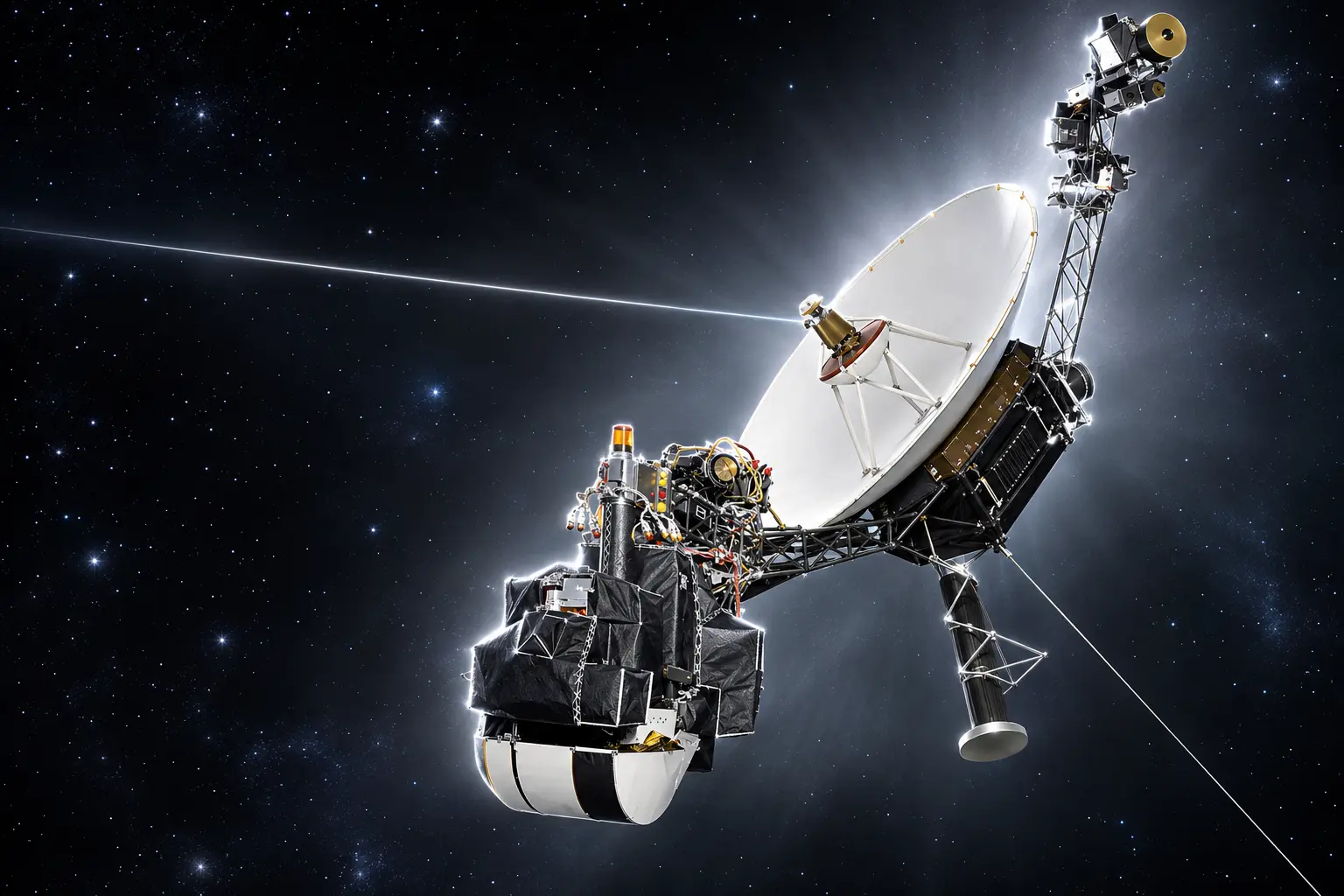
A light-day is a unit of distance, the path light covers in 24 hours, which NASA puts at 16,094,799,096 miles in 24 hours (25,902,068,356 kilometers). Voyager 1, launched Sept. 5, 1977, will have taken 49 years, two months, and 11 days to crawl that far at 38,000 mph (61,155 kph).
Light crosses the Moon in 1.3 seconds and the Sun-Earth gap in eight minutes and 20 seconds. Voyager 2 needed 12 years to reach Neptune, a planet that sits about four light-hours and 10 light-minutes out. The new mark is a round number on a clock the Deep Space Network has been watching grow for years.
NASA says the spacecraft will not detect any change in its surroundings, and nothing will change on board. For the people sending commands, a hello and a reply will fill two calendar days.
If you want to say ‘hello’ to Voyager, you send your message and then you go home and you wait two days before you finally get a response.
Suzanne Dodd, Voyager project manager, NASA JPL
Dodd has worked with the probes since 1984. The skeleton crew at the Jet Propulsion Laboratory still sends commands about once a week, and retirees sometimes help when hardware misbehaves. After Nov. 18, even a clean pass is a two-day loop.
THE LIGHT-DAY CLOCK
- The mark: 5:16:07 a.m. EST on Nov. 18, 2026, at 16,094,799,096 miles.
- One-way wait: 24 hours for a command, 24 hours for the reply.
- Speed: 38,000 mph (61,155 kph) through interstellar space.
- Age: 49 years, two months, and 11 days since the Sept. 5, 1977 launch.
That clock already shaped the last instrument shutdown. On April 17, the sequence to turn off the Low-energy Charged Particles experiment took about 23 hours to reach the spacecraft, then another three hours and 15 minutes to finish. The light-day does not invent the lag. It names it.
The 48-Hour Silence Nobody Commanded
In early September, engineers finished a power-saving swap they nicknamed the Big Bang, turning off three devices and bringing three lower-power substitutes online at the same time so heat still spread through the bus. About six weeks earlier they had run the same swap on Voyager 2. Then the radio went quiet.
NASA’s Deep Space Network, the large dishes in California, Spain, and Australia, lost contact on Oct. 18 and 19 during two scheduled passes 24 hours apart, with the probe already about 16 billion miles out. The signal came back on Oct. 20, before anyone had sent a troubleshooting command.
Telemetry showed one thruster group had gone offline and the backups had turned on by themselves. That swap is written into fault protection: if the computers see trouble with the active thrusters, the craft puts itself in a stable state and pauses normal work so Earth can sort it out. Earth, in this case, found out after the fact.
This is the first time we’ve seen the spacecraft do something like this, but we are also at a point in the mission where we have to expect the unexpected.
Kareem Badaruddin, Voyager mission manager, NASA JPL
Badaruddin said the team was relieved to be back in contact and still wanted to know what happened. As of NASA’s Oct. 29 update, they did not. A missed pass at this range is not a one-shift problem. It is two nights of silence, then a day of waiting to learn whether a fix even arrived.
THE 2026 POWER AND RADIO CALENDAR
- Feb. 27, 2026: Power falls during a planned roll, raising the risk of an automatic undervoltage shutdown.
- April 17, 2026: Controllers turn off the Low-energy Charged Particles experiment to keep the rest of the craft alive.
- Early September 2026: The Big Bang swap finishes on Voyager 1, after the same change on Voyager 2.
- Oct. 18 and 19, 2026: Two Deep Space Network passes hear nothing.
- Oct. 20, 2026: The signal returns on its own; backup thrusters are already on.
- Nov. 17, 2026: NASA asks the public to flash V-G-R after sunset.
- Nov. 18, 2026: Voyager 1 reaches one light-day at 5:16:07 a.m. EST.
The October pause is the preview. Once the one-way light time is a full day, every surprise of that kind occupies two calendar days before Pasadena even knows whether the spacecraft heard the next command.
Two Instruments Left as 4 Watts Vanish Each Year
Each Voyager draws power from radioisotope thermoelectric generators, which turn heat from decaying plutonium into electricity. Both probes lose about 4 watts a year. The original science suite was 10 instruments. Voyager 1 now flies with two still on: the magnetometer and the plasma wave subsystem.
Voyager 2, which launched Aug. 20, 1977, and entered interstellar space in 2018, still has three, because its cosmic ray subsystem remains on. NASA’s status table, updated April 17, 2026, is the scorecard the light-day will not improve.
SCIENCE INSTRUMENTS STILL RUNNING
| Instrument | Voyager 1 | Voyager 2 |
|---|---|---|
| Magnetometer (MAG) | On | On |
| Plasma Wave Subsystem (PWS) | On | On |
| Cosmic Ray Subsystem (CRS) | Off to save power (Feb. 25, 2025) | On |
| Low-Energy Charged Particles (LECP) | Off to save power (April 17, 2026) | Off to save power (March 24, 2025) |
| Plasma Science (PLS) | Off, degraded (Feb. 1, 2007) | Off to save power (Sept. 26, 2024) |
The cameras that made the 1990 Pale Blue Dot image have been off since Feb. 14, 1990. The April shutdown left a 0.5-watt motor spinning on the dead LECP sensor, a small bet that extra watts might someday bring the instrument back. Badaruddin called turning science off nobody’s preference and the best option left.
Without the September swap, NASA said another Voyager 1 instrument would have had to go dark as early as summer 2027. The six devices in that swap keep the craft warm enough to run in deep cold, and they had to change together so the heat map did not collapse. Hydrazine lines that freeze would mean lost pointing, an antenna off Earth, and a mission that ends in silence rather than a press event.
Voyager 2 gets a little more power and is closer, which is why it was the test case. It is on pace for its own light-day in November 2035. Until then, the farther twin is the one that answers a day late.
What the Plasma Wave Detector Still Hears
The two instruments left on Voyager 1 are not heartbeats. The magnetometer tracks the strength and direction of the field in the space between stars. The plasma wave subsystem listens to electron waves in the thin gas the craft is flying through. Science data still comes home at 160 bits per second, a trickle the Deep Space Network has to catch on purpose.
Those plasma measurements are how Voyager 1 confirmed it had left the heliosphere, the Sun’s bubble of particles and magnetic fields, in August 2012. Inside that bubble the tones sat near 300 Hz. Outside they jumped to a higher pitch, between 2 and 3 kHz, denser gas than the solar wind.
A Cornell-led team later found a fainter, steadier signal in the same instrument. Their paper on persistent plasma waves in interstellar space showed a weak narrowband emission from 2017 onward, a density sample across about 10 astronomical units, without waiting for a shock from the Sun to ring the plasma like a bell. That is the science a two-day radio loop is still buying.
Dodd has compared the craft to weather satellites for a region no other machine has reached. Magnetic field, pressure, dust, and galactic cosmic rays still come back in pieces. The October fault protection pause is a reminder that the weather report can stop without warning, and that the next command to restart it will be a day in flight before anyone knows if it worked.
NASA Asks Earth to Flash V-G-R After Sunset
The public program sits on the other side of that delay. After sunset on Tuesday, Nov. 17, NASA wants phones, flashlights, bike lights, glow sticks, and even buildings to blink the mission call sign, V-G-R, in Morse, a gold wave around the night side of Earth. A browser tool flashes the code for anyone who does not want to count dots in the cold.
THE V-G-R PATTERN NASA IS ASKING FOR
- V: Three short flashes and one long flash (dot dot dot dash).
- G: Two long flashes and one short flash (dash dash dot).
- R: Short, long, short (dot dash dot).
Those photons will not catch a probe 16 billion miles out. The radio greeting that does leave Earth on Tuesday will still be in flight when Voyager 1 crosses the mark before dawn on Wednesday. NASA still wants the pictures, tagged to the agency, because the party is for the people who can still see the sky.
No other traveler has ever journeyed so far from home.
Voyager 1 is about to become the first human-made object to reach a distance of one light-day from Earth, or about 16 billion miles. ½ pic.twitter.com/uETo8DHUF1
— NASA Solar System (@NASASolarSystem) November 10, 2026
On Thursday, Nov. 19, at 12 p.m. EST, JPL will hold a moderated discussion on Nov. 19 in the von Kármán Auditorium, the same room that hosted the grand tour briefings. Dodd, Badaruddin, project scientist Linda Spilker, deputy project scientist Jamie Rankin of Princeton, JPL chief scientist Jonathan Lunine, and NASA science chief Nicky Fox are on the bill, with a look at a NASA+ Voyager film planned for 2027, the mission’s 50th year.
Gliese 445 Is 40,000 Years Down the Road
A full light-year is 5.88 trillion miles (9.46 trillion kilometers). At Voyager 1’s pace, that is still about 18,000 years of flight. The nearest star system, Proxima Centauri, sits 4.24 light-years away. Astrophysicist Neil deGrasse Tyson put the scale in one line on Nov. 14: “Before you get too excited by this, the Sun’s nearest stars are Light Years away.”
Forty-nine years to cover what light covers in a day is the same fact as the two-day hello. The empty gap is why a missed network pass now costs two nights, and why the Morse party is a gesture aimed at Earth, not at the spacecraft.
Voyager 1 is headed toward an obscure star more than 17 light-years away, AC +79 3888, also called Gliese 445, in Ursa Minor. NASA expects it to pass within about 1.7 light-years of that star in 40,000 years. Long before then the plutonium will have faded, the last instrument will have been switched off, and the 30-centimeter gold-plated record, with greetings in 55 languages and the voice of Carl Sagan’s son Nick at age 6, will be the only payload still doing the job it was given in 1977.
Dodd has called that disk a time capsule of life on Earth from 1977, and said she hopes something finds it in maybe 1,000 years. Sagan, introducing the Pale Blue Dot in 1990, said that on that pixel “everyone you know and everyone you ever heard of and every human being who ever lived, lived out their lives.” The craft that took the picture is now a day of radio time beyond the pixel.
The Morse flashes on Tuesday will die in a second. The radio reply from Voyager 1, if one is on the way that night, will still be in transit at 5:16 a.m. on Wednesday, when the odometer rolls over to one light-day.

Gold Prices Fall to a 14-Month Low Despite Strikes

SpiceJet Clears a Rs 5,500 Crore Raise After Mumbai Stalled

Honda Activa’s Record Month Came With a Share Loss

Sony Turns the GTA 6 Launch Into a Firmware Gate

Xiaomi 18 Leak Skips the Rear Screen for Battery

Volkswagen Sells the Osnabruck Plant to Clear a Board Fight

Apple’s Foldable iPhone Hinges on Samsung Display Supply

Saksham Gaur Finds He Is His Own Company’s Client

Tata Motors’ Iveco Tender Opens as Holders Still Decide

What Is SD on Amazon Prime?
-
 AUTO2 months ago
Volkswagen Sells the Osnabruck Plant to Clear a Board Fight
-
 NEWS3 months ago
Apple’s Foldable iPhone Hinges on Samsung Display Supply
-
 BUSINESS3 months ago
Saksham Gaur Finds He Is His Own Company’s Client
-
 AUTO3 months ago
Tata Motors’ Iveco Tender Opens as Holders Still Decide
-
 TECHNOLOGY3 years ago
What Is SD on Amazon Prime?
-

 BUSINESS3 months ago
Hyderabad 22-Carat Gold Jumps After a False Bargain
-

 GAMING3 months ago
Onimusha Way of the Sword Preload Hits a Windows 11 Wall
-
 BUSINESS3 months ago
UltraTech Ultravolt Launch Splits Friday Stocks to Watch