
HISTORY
Rome Left Antoninus Pius One Gilded Boot in Scotland
A gilded bronze boot from a Borders bog is now read as Antoninus Pius on horseback, taken apart so cleanly the knee still has no axe marks.

National Museums Scotland now reads a gilded bronze lower right leg from a Borders bog as the last piece of an equestrian statue of Emperor Antoninus Pius. The limb, known as the Milsington leg, came out of wet ground near Hawick in 1820 and has been treated for more than two centuries as loot carried north from York.
Curators say the statue stood in southern Scotland in the AD 140s to mark Pius’s push beyond Hadrian’s Wall, then came apart so cleanly that the knee still shows no axe marks. The reconstruction goes on show in Edinburgh from 14 November 2026.
The Boot That Came From a Borders Bog
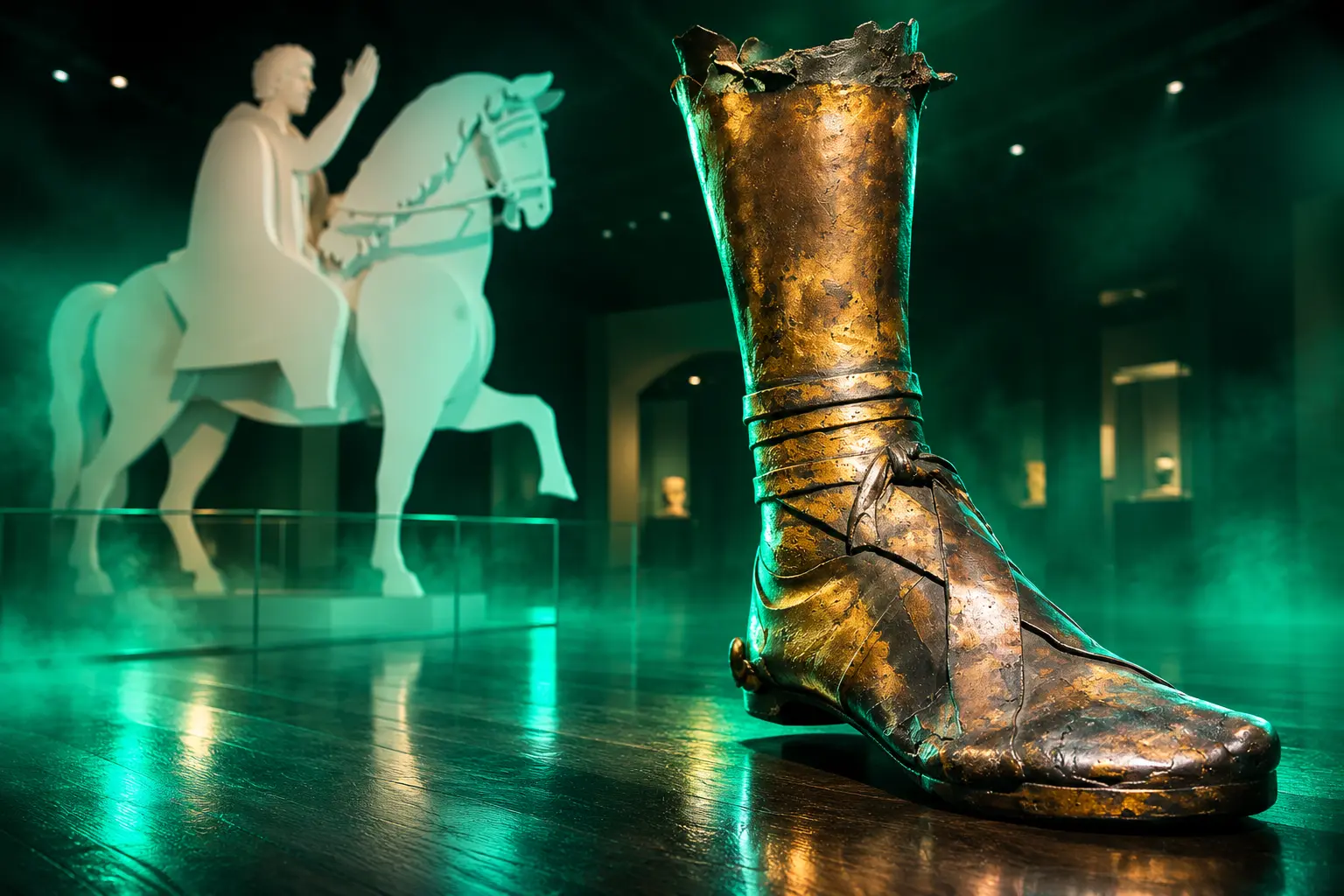
The surviving piece is larger than life: a hollow-cast calf, a heavy-soled military boot, and straps that once laced around the ankle. A fitting on the heel took a spur, which is how curators can say the figure sat on a horse rather than stood on a plinth. Gold still clings to the bronze, though not around the knee, where a tunic or cloak once hid the join.
Sir Walter Scott heard about the find within days. Writing to Lord Montagu on 22 February 1820, he spelled the farm as Melsington and already wanted the rest of the body.
I have a report that there is found on the farm of Melsington, in a bog, the limb of a bronze figure, full size, with a spur on the heel. Clarkson has sent me a curious account of it; and that a Roman statue (for such it seems) of that size should be found in so wild a place, has something very irritating to the curiosity.
Sir Walter Scott, letter to Lord Montagu, 22 February 1820
He asked for the bronze to be sent provisionally to Abbotsford, and for leave, if it proved curious, to search for the rest of the statue. Montagu gave him “full authority to howk for this Castle of Otranto figure that has as yet only shown one leg.” There is no record that Scott ever dug. The limb went instead to Dalkeith House, a Buccleuch seat near Edinburgh, and sat in the charter room for 100 years.
In 1920 it was found again and sent to the National Museum of Antiquities, the collection that became National Museums Scotland. A bronze base recovered with it went the same way. The rider’s name was never on the leg.
Scholars Refused to Seat an Emperor in Scotland
For the next century the working story was simple enough to repeat. Someone had hacked an imperial statue in the south, probably at York, the Roman town of Eboracum, and Scottish raiders had carried the trophy over Hadrian’s Wall. James Curle, writing in 1932, could not picture any other route. “We cannot visualise the conditions which would have led to its erection anywhere north of the Great Wall,” he said. He also described the leg as hacked off below the knee.
That reading fitted a wider habit of stopping Roman Britain at Hadrian’s Wall. A gilded horse and rider in the Borders would have meant a public monument on a frontier that later writers treated as thin, brief, and barely urban. Curators at National Museums Scotland say a wider study of statue fragments from other Roman frontiers has broken that habit. Bronze imperial figures, including equestrian ones, did stand in frontier forts. A Scottish setting for this piece is no longer a stretch.
TWO READINGS OF THE MILSINGTON LEG
| Question | Older reading | National Museums Scotland, 2026 |
|---|---|---|
| Where it stood | Loot from further south, often York | A monument in southern Scotland |
| How the leg came off | Hacked by raiders after a fight | Taken apart with no cut marks |
| Who it showed | An unnamed emperor or commander | Antoninus Pius on horseback |
| When it was made | Broadly AD 100 to 180 | The AD 140s |
| Why it was buried | A trophy dumped in a bog | A valued sculpture packed up on withdrawal |
The new name is still an argument from context, not a portrait. The fragment has no face and no inscription. Trimontium’s older record left the rider as an emperor or a senior officer and dated the bronze AD 100 to 180. Pius enters the picture because he is the emperor who treated a Scottish victory as a title worth taking.
The Knee Still Looks the Way It Was Cast
The physical case against a raid sits at the top of the shin. Staff who examined the bronze ahead of the new display say the rim is not a wound. It is the edge the founder made.
WHAT THE BRONZE STILL SHOWS
- The rim: There are no cut marks, and the metal remains exactly as it was cast.
- The gilding gap: Gold stops around the knee, where a tunic or cloak would have covered the join.
- The lumps: Cast blobs at the top filled the folds of that garment and locked the leg to it.
- The spur seat: A fixing on the heel is the trace of a rider, not a standing figure.
- The boot: A thick sole and ankle straps match Roman military footwear on a monumental scale.
National Museums Scotland sets that clean edge against three other fates bronze emperors usually met. Statues wrecked after a battle, statues smashed when an emperor’s memory was condemned, and statues chopped for scrap all tend to leave small, irregular shards. This leg is a whole lower limb, still the size of a living calf, still wearing its boot. Fraser Hunter, principal curator of prehistoric and Roman archaeology at the museum, put the same point in plainer words: when you look, you see it has not been hacked off. It is a complete leg.
A tidy teardown is a different kind of ending. It is the sound of an army that still expected to own the metal, and perhaps to use it again, rather than of a crowd taking revenge on a face in gold.
Scotland Was His Only Imperator Victory
Antoninus Pius ruled from AD 138 to 161, succeeding Hadrian, who had closed the north with a stone wall. Pius had little military reputation of his own. National Museums Scotland says the conquest of southern Scotland was the only foreign adventure he marked with the title Imperator, a battle honour meaning commander. That is the thread that ties a nameless gilded rider to this emperor rather than to his predecessor or his successor.
This really turns on its head our understanding of Rome’s second attempt at conquering Scotland. This was a big deal for the Emperor, something which was worth celebrating.
Fraser Hunter, Principal Curator of Prehistoric and Roman Archaeology, National Museums Scotland
The campaign sat inside a short northern push. Hadrian had visited Britain in AD 122 and ordered the wall that still bears his name. On his death, the governor Quintus Lollius Urbicus led an advance north in AD 139/42. A new turf barrier went up from around AD 142 across the Forth-Clyde isthmus, the line now called the Antonine Wall. Official chronology for the wall says construction may have taken up to twelve years, and that the finished frontier was occupied for about twenty years.
The decision to give it up came in or around AD 158. The pulling back itself may have run more than six years, to AD 164 or later, after which Hadrian’s Wall was restored as the main northern line. National Museums Scotland dates the careful stripping of the Milsington statue to the AD 160s or 180s, a wider window than the wall’s own abandonment and a separate estimate for when the bronze came down. Either way the occupation that the horse was meant to advertise did not outlast a generation.
Hunter has said monuments of this kind are uncommon on a frontier, and that this one would have been a big, impressive marker. Gold on bronze, larger than a living man, set on a horse in country that had only just been taken: that is a claim about who owned the ground, aimed as much at the people living there as at officers riding past.
What the Reconstruction Puts on the Horse
The museum’s answer, for now, is a full-scale silhouette of horse and rider with the real gilded leg mounted on it. Visitors see one authentic limb and a shadow of the rest. The comparison curators use is the equestrian statue of Marcus Aurelius in Rome, Pius’s successor, a gilded bronze statue 4.24 metres tall that still stands, in the original, inside the Capitoline Museums. National Museums Scotland is not claiming the Borders monument matched that height. It is claiming the same idea: an emperor in the saddle, gilded, over life size, meant to be seen from a distance.
That silhouette is the centrepiece of Roman Scotland: Life on the Edge of Empire, which runs from 14 November 2026 to 18 April 2027 at the National Museum of Scotland on Chambers Street in Edinburgh. Hunter calls it the first exhibition to look in detail at Roman attempts to conquer Scotland, why they failed, and what they did to the people already there. A book of the same title, by Hunter and Rebecca H. Jones, is out from Archaeopress.
The rest of the room is not a statue gallery. Two newly conserved altars from the Mithraeum at Inveresk, east of Edinburgh, are billed as a centrepiece in their own right. That fort held the world’s most northerly temple to Mithras, and a town grew around the base. Other loans include the earliest known copy of Tacitus’s life of Agricola, from the Biblioteca Nazionale Centrale in Rome, and a ceramic cult vessel from Mainz. A tin-coated enamel brooch from Pathhead, possibly a diplomatic gift, and a digital face built from a decapitated burial at Inveresk sit in the same argument: the frontier was crowded, supplied from far away, and unfinished.
Distance Stones Went Into the Ground the Same Way
The Milsington leg is no longer being treated as a one-off panic. National Museums Scotland places the unbolting beside a pattern already known from the Antonine withdrawal: distance stones from the wall were buried with care, and the Inveresk Mithras altars went into the ground the same way. Those altars are in the new exhibition. The point is not that every bronze in Scotland was saved. It is that when the army left, some of the most loaded objects were taken apart or buried rather than left to be smashed.
That is a colder image than a raid. An emperor’s horse is expensive to cast, expensive to gild, and awkward to move. Someone still thought it was worth unmaking properly. The same units that had advertised conquest with gold were, a generation later, packing the advertisement so it would not be reused against them, or so the metal could travel south. The knee with no axe marks is the paperwork of that decision.
Older writing on the piece assumed violence because violence was the story people already told about Rome in Scotland: a thin occupation, a hostile north, trophies dragged over the wall. The bronze itself never supported that plot. It supports a slower one, in which a prestige frontier is built, celebrated, then methodically shut.
Where Is the Rest of the Statue?
Hunter’s last line in the museum statement is the one the silhouette cannot answer. It offers a glimpse of the grand monuments that once stood in southern Scotland, he said, and then: where is the rest of the statue?
WHAT WE KNOW
- The surviving piece: A larger-than-life gilded bronze lower right leg and boot, with a spur fitting, found at Milsington near Hawick in 1820.
- The modern path: A century in the Dalkeith charter room, then the national collection from 1920, including a loan to the Trimontium museum in 2017.
- The current reading: An equestrian statue of Antoninus Pius, set up in southern Scotland in the AD 140s and taken apart on withdrawal.
WHAT IS UNCONFIRMED
- The site: No inscription pins the horse to a named fort. Hunter has said undiscovered Roman sites may lie near where the limb was deposited.
- Ruberslaw: Novelist Douglas Jackson said on 12 November 2026 that Hunter told him there is evidence of a grand building on Ruberslaw, a hill already known for Roman dressed stone, which might have held the statue. That remains a lead, not a find.
- The other pieces: They may still be in wet ground, or they may have been melted. Scott wanted to dig in 1820. Nobody has yet turned up the horse.
The gold boot in Edinburgh is both the proof that Pius paid for a triumph in Scotland and the receipt for how quickly that triumph was packed. On Chambers Street the rider is a silhouette. The only weight on the plinth is still the leg that came out of the bog.

Gold Prices Fall to a 14-Month Low Despite Strikes

SpiceJet Clears a Rs 5,500 Crore Raise After Mumbai Stalled

Honda Activa’s Record Month Came With a Share Loss

Sony Turns the GTA 6 Launch Into a Firmware Gate

Xiaomi 18 Leak Skips the Rear Screen for Battery

Volkswagen Sells the Osnabruck Plant to Clear a Board Fight

Apple’s Foldable iPhone Hinges on Samsung Display Supply

Saksham Gaur Finds He Is His Own Company’s Client

Tata Motors’ Iveco Tender Opens as Holders Still Decide

What Is SD on Amazon Prime?
-
 AUTO2 months ago
Volkswagen Sells the Osnabruck Plant to Clear a Board Fight
-
 NEWS3 months ago
Apple’s Foldable iPhone Hinges on Samsung Display Supply
-
 BUSINESS3 months ago
Saksham Gaur Finds He Is His Own Company’s Client
-
 AUTO3 months ago
Tata Motors’ Iveco Tender Opens as Holders Still Decide
-
 TECHNOLOGY3 years ago
What Is SD on Amazon Prime?
-

 BUSINESS3 months ago
Hyderabad 22-Carat Gold Jumps After a False Bargain
-

 GAMING3 months ago
Onimusha Way of the Sword Preload Hits a Windows 11 Wall
-

 BUSINESS3 months ago
UltraTech Ultravolt Launch Splits Friday Stocks to Watch