
NEWS
Gemini Tasks Goes Free as Local Shops Take the Calls
Google opened Gemini Tasks free in six countries. Local shops take the calls, and card networks tokenize the payments.

Google on November 17 opened Gemini Tasks for free in six countries, letting the app call shops, pay with tokenized cards and sign into sites. Advanced actions start in the U.S. The shops that pick up, the sites that take the login and the card networks that issue the tokens are the ones who have to answer.
Josh Woodward, vice president of Labs, the Gemini app and AI Studio, wrote the launch as a household diary. The operational load sits on the other end of the line.
Gemini Tasks Goes Free on Hydrogen
The update is rolling out free of charge for hundreds of millions of people across the six countries of the U.S., Japan, Korea, Canada, Australia and India, using Gemini 4 Hydrogen for agentic workflows. Google introduced that model on November 12 as a faster worker for everyday agent jobs, and the Tasks post names it as the engine for the free toggle.
Open Gemini, flip the home-screen control from Chat to Task, and give it an errand. In the U.S., you can also forward mail to gemini@google.com or text the agent after you verify a phone number under Settings, then Channels, then Text with Gemini. Texting needs a U.S. number on an eligible carrier.
Google first shipped this agent on May 19 as Gemini Spark, a 24/7 helper for testers and then U.S. Google AI Ultra subscribers. Spark kept working in Google’s cloud after a phone locked or a laptop closed. On November 17 the company dropped the paid gate on the Task toggle in those six markets. The United Kingdom is not on the list, and neither is any country in the European Economic Area.
WHERE GEMINI TASKS RUNS NOW
| Feature | Where Google says it runs | Limit on the page |
|---|---|---|
| Chat to Task toggle | U.S., Japan, Korea, Canada, Australia, India | Runs on Gemini 4 Hydrogen |
| Calls to businesses | U.S. | Off in Indiana, Louisiana, Minnesota, Montana, Nebraska |
| Text with Gemini | U.S. | U.S. number and eligible carrier |
| Mail to gemini@google.com | Starting in the U.S. | None stated |
| Google Pay checkout | Starting in the U.S. | Mastercard and Visa tokens; American Express coming soon; spending cap |
Calling, texting, mail drop and payments are the “advanced features” Google said would start in the U.S. The free toggle in Japan, Korea, Canada, Australia and India does not automatically include that phone and wallet layer.
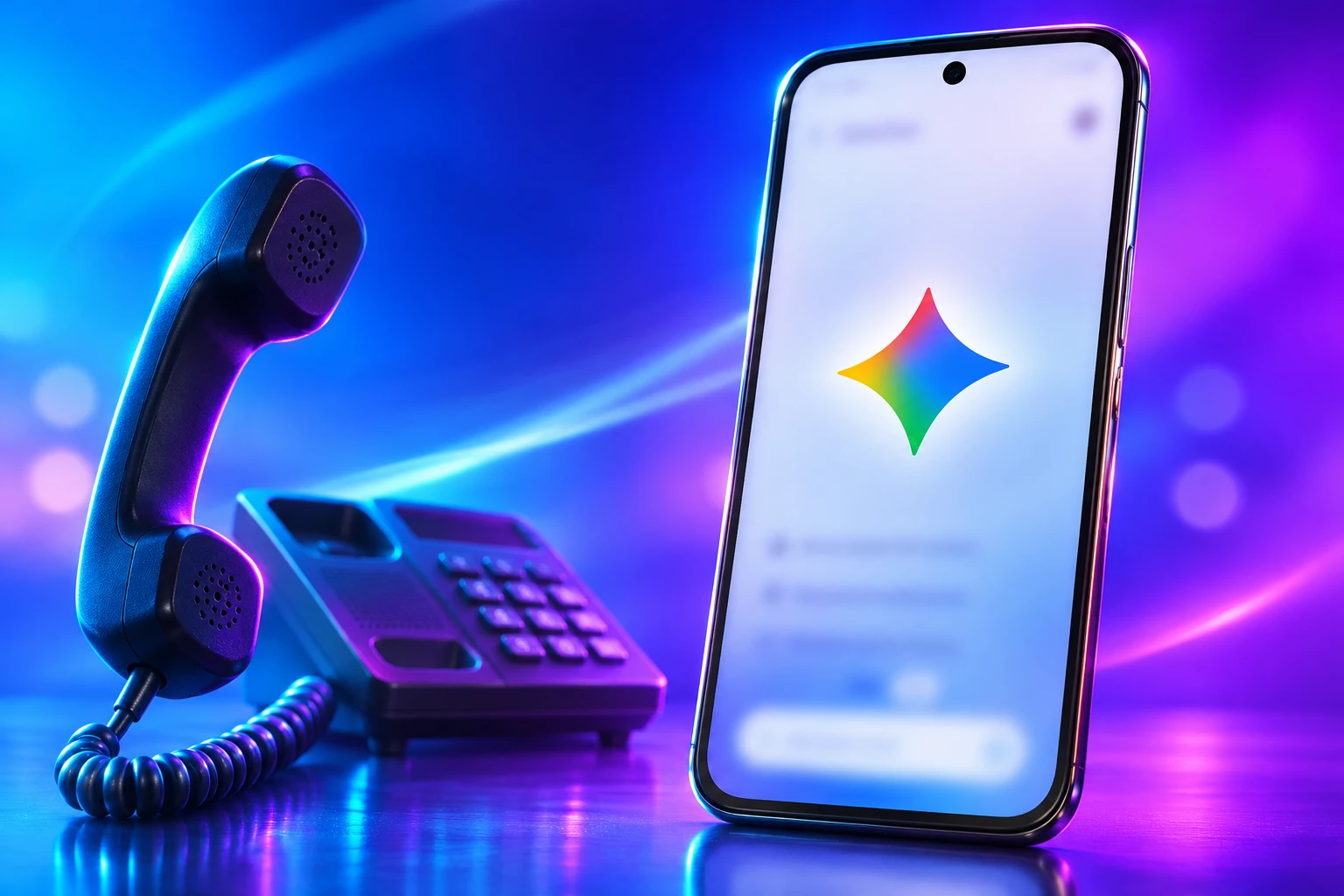
Two Honda Shops Get the Same Call
Woodward’s test case is the one local service desks will recognize. After the check-engine light came on, he told Gemini the family’s minivan was overdue for a service booking and asked it to call the two nearest dealerships for an early Friday slot over the next month. Gemini already knew they drive a 2019 Honda Odyssey and where they live, through Personal Intelligence. It found the shops on Google Maps and rang both at once.
Because Gemini already knows we drive a 2019 Honda Odyssey and where we live through Personal Intelligence, it found the nearest shops on Google Maps and called both at once.
Josh Woodward, Vice President of Labs, Gemini app, and AI Studio, Google Keyword blog
He says he did not sit on hold. Gemini booked the shop that takes appointments rather than walk-ins, found a free Friday morning on his Google Calendar and added the visit in less than five minutes. On the dealership’s end, he wrote, Gemini disclosed right away that it is an AI, will not hand over payment or private account details unless he says so, and leaves shops a way to refuse the calls.
Sundar Pichai, Google’s chief executive, posted the same day that Tasks can call local businesses to compare price quotes and check inventory, with full transcripts and approval before dialing, then check out through Google Pay and sign in through Google Password Manager. He also said Google is partnering with major websites and security providers so the agent works for site owners, not only for the person who flipped the toggle.
Knowing things → doing things → finding ways to save you time and money
We’re expanding Tasks in Gemini free of charge to hundreds of millions of people in six countries. Powered by Gemini 4 Hydrogen, Tasks lets you hand off everyday life admin directly:
– Forward emails to… pic.twitter.com/wEUDsamRbV
— Sundar Pichai (@sundarpichai) November 17, 2026
That is the product as Google wants it seen: one user, two simultaneous outbound calls, a calendar write, and a disclosure line for whoever picked up. The unread part is the service writer who just took two AI calls about the same Odyssey before lunch.
Woodward’s other household jobs show how far the agent reaches into other people’s systems. He gave it permission to open a utility portal, then asked it to read old statements in Gmail after a surprise $389 electric bill; it blamed a heat pump that came on around 4 p.m. during peak pricing. He texted an Instacart add for lasagna, strawberries, cucumbers and vanilla ice cream, then sent a photo of an empty Cheerios box; Gemini added the cereal and handed him to Instacart to finish. He forwarded a batch of school mail to gemini@google.com and, he wrote, had every date on the calendar with his wife invited in less than a minute, plus a clash with basketball practice. Gemini now connects with more than 60 popular apps, and developers can apply to join the Connected Apps Platform.
His own write-up of how Gemini Tasks handles calls and payments is the closest look at the agent as a daily clerk. It is also a map of who else gets pulled in: dealerships, a utility, Instacart pickers, a school office, and whoever owns the last checkout button.
The Same Five States Still Block the Phone
A footnote on the Tasks post is easy to miss and hard for a shop to ignore. Calling through Gemini is not currently available in Indiana, Louisiana, Minnesota, Montana and Nebraska. Google’s Business Profile help page lists the five states for automated customer-request calls that book visits, check restaurant waits, or confirm price and stock. The Tasks launch did not invent that hole. It inherited it.
Google has been putting a machine on small-business phone lines since 2018, when it showed Duplex ringing restaurants and salons in a voice that used “um” and a West Coast lilt. The first public demo did not say the caller was a machine and did not warn that the call was being recorded. After that fight, Google added a line that it was an automated booking service and that it would record the call. Gemini’s version, per Woodward, identifies itself as an AI up front. The help page still says those customer-request calls are monitored and recorded for quality assurance.
GOOGLE’S PATH FROM DUPLEX TO TASKS
- May 2018: Google shows Duplex calling restaurants and salons in a human-like voice, without a clear machine disclosure in the debut clips.
- June 2018: The company adds an automated-booking line and a recording notice after the disclosure fight.
- May 19, 2026: Gemini Spark launches as a 24/7 cloud agent for testers, then U.S. Google AI Ultra subscribers, and keeps working after a device locks.
- November 12, 2026: Google ships Gemini 4 Hydrogen as the faster model for agent work in the Gemini app, Search and AI Studio.
- November 17, 2026: Tasks goes free in six countries; U.S. calling still skips Indiana, Louisiana, Minnesota, Montana and Nebraska.
Those five states are the live legal scar. All-party recording rules made Duplex awkward in a similar belt of the map, and Google is still not ringing shops there through this product. For a dealer group that straddles a state line, one location can take Gemini calls and the next cannot. Google says it limits repeat calls for the same facts and avoids late-night and early-morning rings, and that it will call only when a customer wants a booking, a wait time, a price or stock check, hours, or in-demand inventory.
Tokenized Cards Carry the Checkout
The other new counterparty is the card network. Woodward asked Gemini for USB-C charger options ahead of a trip to Oklahoma. It compared listings through Google’s Shopping Graph, asked about wattage and color, helped him check out with Google Pay, and applied a code that saved an extra $10. Gemini now uses the Agent Payments Protocol for buys like that.
Google posted AP2 on September 16, 2025, with Stavan Parikh, VP of Payments, and Rao Surapaneni, VP of the Business Applications Platform at Google Cloud, as the named authors, and with more than 60 firms in the working group, among them Adyen, American Express, Mastercard, PayPal, Visa’s wider industry and Worldpay. The Agent Payments Protocol mandates and credentials exist because a human is no longer the one clicking Buy on a trusted page. AP2’s job, in Google’s own three-word list, is authorization, authenticity and accountability: proof the user gave the agent the right to that purchase, proof the cart matches what the user meant, and a trail if the charge is wrong.
In the human-present flow, an Intent Mandate captures the ask and a Cart Mandate locks the items and price after the user approves. In the human-not-present flow, the user signs a detailed Intent Mandate first, with price limits and timing, and the agent can mint a Cart Mandate when those rules are met. Google also published open Agent Payments Protocol code samples so other agents and merchants can speak the same checkout language. Woodward says Gemini is designed to stay inside a hard spending cap the user sets up front, and that card points, cash back and purchase protections still apply. Receipts and tracking go to Google Wallet, which Google opened on iOS in the U.S. on November 17. American Express is listed as coming soon. Universal Commerce Protocol support inside Gemini is “up next,” with no date.
WHAT THE PAYMENT RAIL ACTUALLY DOES
- Card tokens: Mastercard and Visa tokens on supported cards, with American Express still on the way.
- Spending cap: The user can set a hard limit before Gemini shops, and Google says the agent is designed to stay inside it.
- Buy pause: Gemini is designed to ask for confirmation or pre-approval before it clicks Buy.
- Audit trail: AP2 signs Intent and Cart mandates so a merchant can see what the user authorized, not only what an agent requested.
A charger with a $10 code is a small proof. The same rail can, in Google’s AP2 examples, watch for a jacket in a given color or fire two bookings once a trip budget clears. Merchants who never built for an agent now face a checkout that arrives with a cryptographic mandate instead of a person on the page.
Password Manager Opens the Utility Portal
Calling a dealer is noisy. Signing into a utility account is quiet, and it may matter more. Woodward says he gave Gemini permission to use the new Google Password Manager link, then asked it to read past bills in email. The agent worked for a few minutes and tied the $389 spike to that 4 p.m. heat-pump cycle. He and his wife, he wrote, would not have caught it in the PDFs themselves.
That is Gemini using stored credentials on a third-party site, with the user’s say-so, then reading mail that already lives in Gmail. Woodward’s pitch is blunt: if your mail, calendar, passwords, photos, files and payment cards already live at Google, you do not have to send them somewhere else. The hidden party is the utility, the insurer or the school portal that never agreed to an AI session in its login box. Google does not say in the Tasks post whether the model sees a password in the clear, or what happens when the portal wants a second factor.
Each task, Google says, runs on Google Cloud’s Agent Compute Engine in a hardware-isolated virtual machine dedicated to that account and never shared. The VM is sandboxed and tested by Google’s security red teams. Prompt-injection filters scan search results and webpages, and Safe Browsing limits which links Gemini can open. Users can change task settings, disconnect apps or delete chat history. Google also points people at its AI Vulnerability Reward Program if they find a hole in an agent that can spend money and open doors.
For routine chores already trusted, such as adding cereal to a grocery cart, the user can set “Always allow” so the agent does not keep asking. That setting is a gift to the person holding the phone. It is a standing permission slip for every merchant on the other side of those 60-plus app connections.
How a Shop Stops Gemini From Calling
Woodward’s opt-out link does not go to a Gemini page. It goes to Google’s Business Profile help article on automated calls and texts, a document written for hours checks, wait times and stock questions as much as for Tasks. Google says it will never ask for payment, card numbers or passwords on those calls, and that a caller who wants money to keep a listing is not Google.
A shop that wants the ringing to stop can opt out of Google automated business calls in two official ways. It can tell the caller to stop, with lines Google itself suggests, such as “Please stop calling my business.” It can also open Business Profile settings, then Advanced settings, and switch off “Bookings and inquiries from customers,” plus the toggles that let Google keep the profile current or post on the shop’s behalf. Text and WhatsApp threads take STOP to leave and DELETE to wipe the thread. After an opt-out, Google still says the shop may get occasional manual calls to confirm listing facts.
HOW A BUSINESS STOPS THE CALLS
- On the phone: Tell the automated caller to stop, using a line such as “Please stop calling my business.”
- In Business Profile: Under Advanced settings, turn off bookings and inquiries from customers, profile updates and posts on your behalf.
- On text: Reply STOP to leave the thread, or DELETE to wipe the messages.
- After opt-out: Google may still place occasional manual calls to confirm business information.
The help page never names Gemini. A manager who searches for “Gemini calling my front desk” lands on a generic Google-calls article and three separate toggles. Opting out of customer-request calls is not the same as opting out of hours checks, and it is not the same as killing posts Google writes to the listing. Shops that already feed in-store catalog data through Merchant Center get a quieter deal: Google says it will use that feed for stock questions and will not call to ask about inventory.
Some Sites Still Hand the Last Click Back
Woodward is clearer about failure than most launch posts. Google has not eliminated all mistakes, he wrote, and a task may fail or miss the mark; the requested fix is a thumbs down. Personal assistants on the web are still new, and sites are still adapting. On some sites, Gemini can get most of the way through and then hand the screen back so the user clicks the final button. For decades, he notes, bots were blocked by default because most were hostile. A shopping clerk that signs in and pays needs a different rule, and Google wants open, verifiable standards to be that rule.
That last-click handoff is the tell. The user was sold a secretary. The website still wants a person. Until merchants and security vendors take the partnership Pichai described, Gemini can compare chargers, fill an Instacart list and talk a dealer onto a Friday slot, then stall on the page that actually charges the card. Google’s next shopping step is wiring the Universal Commerce Protocol into Gemini. There is no date on that work, and American Express is still “coming soon.”
The Chat to Task switch is simple. The people it deputizes Gemini to bother, bill and log in as are the dealership on hold, the utility portal, the card network that minted the token, and the site that may yet put the Buy button back in a human hand. Woodward still wants a thumbs down when the agent misses. The toggle is free. The misses are not gone.

Gold Prices Fall to a 14-Month Low Despite Strikes

SpiceJet Clears a Rs 5,500 Crore Raise After Mumbai Stalled

Honda Activa’s Record Month Came With a Share Loss

Sony Turns the GTA 6 Launch Into a Firmware Gate

Xiaomi 18 Leak Skips the Rear Screen for Battery

Volkswagen Sells the Osnabruck Plant to Clear a Board Fight

Apple’s Foldable iPhone Hinges on Samsung Display Supply

Saksham Gaur Finds He Is His Own Company’s Client

Tata Motors’ Iveco Tender Opens as Holders Still Decide

What Is SD on Amazon Prime?
-
 AUTO2 months ago
Volkswagen Sells the Osnabruck Plant to Clear a Board Fight
-
 NEWS3 months ago
Apple’s Foldable iPhone Hinges on Samsung Display Supply
-
 BUSINESS3 months ago
Saksham Gaur Finds He Is His Own Company’s Client
-
 AUTO3 months ago
Tata Motors’ Iveco Tender Opens as Holders Still Decide
-
 TECHNOLOGY3 years ago
What Is SD on Amazon Prime?
-

 BUSINESS3 months ago
Hyderabad 22-Carat Gold Jumps After a False Bargain
-

 GAMING3 months ago
Onimusha Way of the Sword Preload Hits a Windows 11 Wall
-
 BUSINESS3 months ago
UltraTech Ultravolt Launch Splits Friday Stocks to Watch