
AUTO
Tata Hits Record Car Revenue and Barely Breaks Even
Tata Motors Passenger Vehicles booked record India revenue in Q2 FY27, yet a thin mix and a Jaguar Land Rover reset left the group with a ₹5,500 crore loss.

Tata Motors Passenger Vehicles booked record India revenue of ₹20,423 crore in the July-September quarter and still finished the car business at break-even. Consolidated sales rose 34% to ₹96,920 crore, but a £530 million Jaguar Land Rover reset left the group with a ₹5,500 crore loss.
Electric and CNG models made up 51% of the cars it sent out. That mix filled the plants. It also left little room once steel, other commodities and currency swings hit the cost line.
Record Sales Left Tata PV Near Break-Even
The India passenger business, reported as Tata Passenger Vehicles inside the group, posted its highest quarterly revenue and a 50.9% jump on the year. Volumes grew 40%, faster than the industry, and Vahan data kept Tata in second place with a 14.3% share. Profit before tax and exceptional items in that domestic unit was at break-even, against ₹200 crore a year earlier. EBIT margin was -0.3%, down 50 basis points.
The consolidated Q2 FY27 results put group EBITDA at ₹6,000 crore, a 6.2% margin, and EBIT at 1.1%. Both look healthier than last year because Jaguar Land Rover was recovering from a cyber incident in the same quarter of FY26. Sequentially, group EBIT slipped from 2.4% in April-June as mix at JLR and commodity costs in India went the wrong way. The 13 November board filing shows exceptional items of ₹6,700 crore, of which ₹3,800 crore was for employee separation and ₹2,900 crore for asset impairment, turning a ₹403 crore pre-exceptional profit into a ₹6,300 crore pre-tax loss.
TMPV shares closed at ₹287.40 on 13 November, down 3.3%. Motilal Oswal kept a Sell with a ₹240 target. Nuvama kept a Buy with a ₹360 target. The company’s own channel led with the ₹96,900 crore revenue line the same afternoon, a caption that matches a busy factory and not the loss sitting under it.
Tata Motors Passenger Vehicles Ltd Q2 FY27 Financial Results at ₹96.9K Cr (Consolidated).
Click here to Know More: https://t.co/ktleE4gKcu#TataMotors #TataMotorsPassengerVehicles pic.twitter.com/CdJ0uYJIbm
— TATA.CARS (@TATA_CARS) November 13, 2026
Q2 FY27 PROFIT AND LOSS
| Line | Group | Tata PV India | JLR |
|---|---|---|---|
| Revenue | ₹96,920 crore | ₹20,423 crore | £5.9 billion |
| Year on year | +34.0% | +50.9% | +20.3% |
| EBITDA margin | 6.2% | 4.0% | 6.6% |
| EBIT margin | 1.1% | -0.3% | 1.1% |
| PBT before exceptional items | ₹403 crore | Break-even | £6 million |
India is about 21% of group revenue. The rest sits largely in Gaydon. Free cash flow for the group was a ₹6,300 crore outflow, and net debt closed at ₹50,800 crore on 30 September 2026. The India car unit still generated ₹825 crore of free cash in the quarter and held ₹7,900 crore of net cash. JLR carried ₹53,000 crore of net debt on the same map, with TML Holdings adding ₹6,000 crore.
Why India Margins Fell While Volumes Jumped
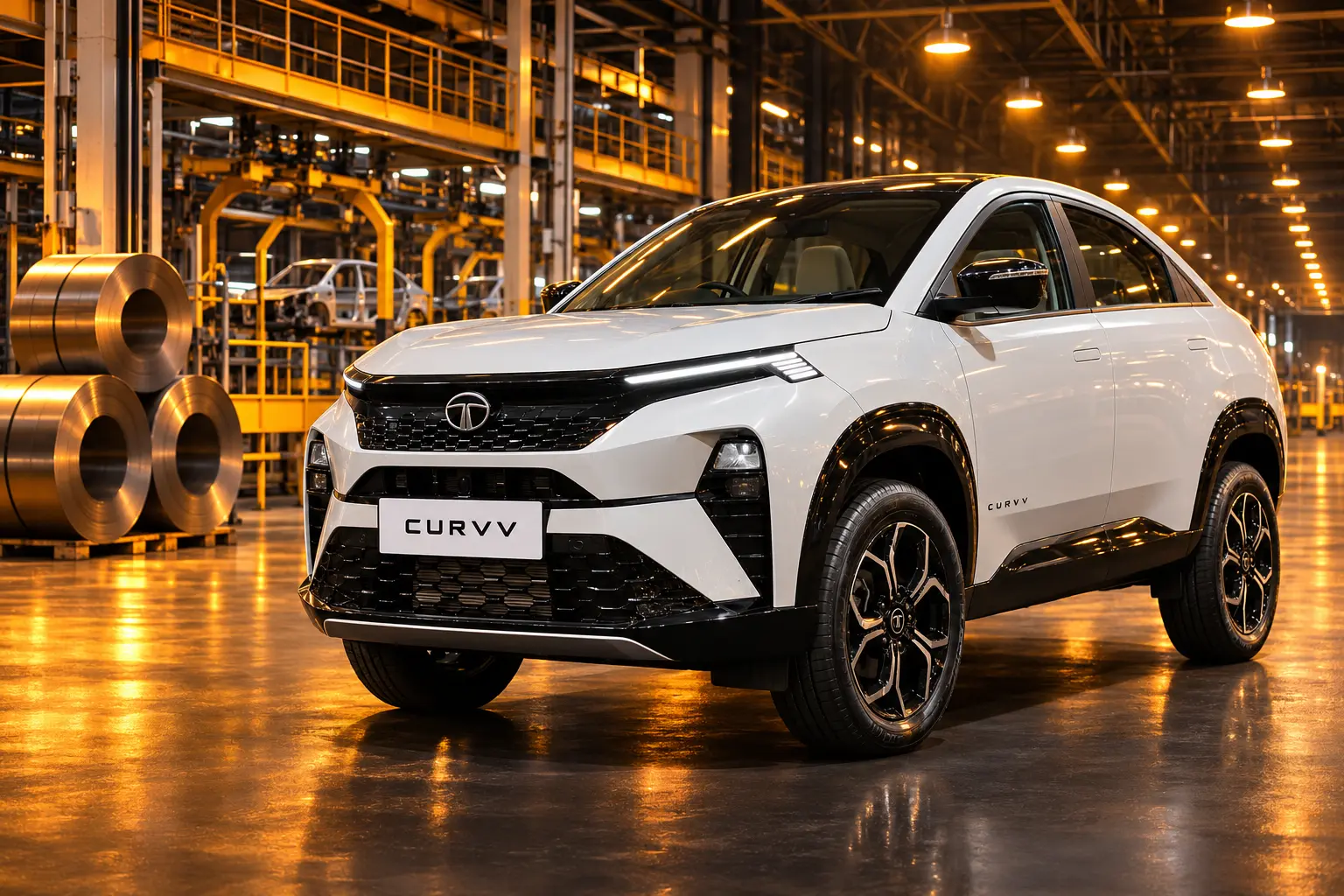
Shailesh Chandra, managing director and chief executive of Tata Motors Passenger Vehicles, told exchanges the company dispatched 201,723 passenger vehicles in Q2, up from 144,397. Domestic sales were 196,674. Exports were 5,049, up 20%. Electric models were 47,150, up 90%, and made up 23% of the book against about 8% for the industry. CNG took another 28%. Together those two powertrains crossed 50% of sales.
THE MIX THAT FILLED THE PLANTS
- Electric share: 23% of Tata PV sales, with a 43% Vahan share of electric cars, up 380 basis points on the previous quarter.
- CNG share: 28% of volumes, the highest quarterly CNG total the company has logged.
- Combined alt-fuel: 51% of the quarter, which lifts registrations and pulls average realisation and margin the other way when commodities rise.
- Industry backdrop: Chandra put Vahan growth at around 24% and tied the demand to the GST 2.0 cut that has been in force since 22 September 2025.
Domestic EBITDA margin was 4.0%, down 180 basis points on the year. The company said steep commodity costs and foreign-exchange moves compressed the line even as volumes ran ahead of the market. Chandra said the firm answered with calibrated pricing and cost actions. Dhiman Gupta, chief financial officer, said adverse mix and persistent commodity pressure weighed on margins in both businesses.
INDIA PV SNAPSHOT
- Quarterly revenue: ₹20,423 crore, the highest India quarter on the books.
- EBIT: Negative 0.3%, 50 basis points weaker than a year earlier.
- Cash: ₹11,000 crore on hand, ₹3,100 crore of gross debt, ₹1,945 crore of free cash in the first half.
- Hero product: Punch was India’s highest-selling SUV in the quarter, per Chandra’s sales note.
Amit Kamat, chief commercial officer, said earlier in the autumn that SUVs had grown 67% since the GST cut and that Nexon and Punch together were up 60%. That is the volume engine. It is also a cheaper mix than the old petrol-SUV stack, which is why a 50.9% revenue jump can still land at break-even.
A British Reset Shows Up in Mumbai’s Loss
Jaguar Land Rover, a wholly owned subsidiary of Tata Motors Passenger Vehicles, reported second-quarter operating profit after last year’s cyber hit. Revenue was £5.9 billion, up 20.3%. Profit before tax and exceptional items was £6 million, against a £485 million loss a year earlier. Adjusted EBIT margin was 1.1%, down from 2.8% in the first quarter. Exceptional items of £530 million covered restructuring, separation costs and write-downs of assets and intangibles under development. Loss after tax was £451 million. Free cash outflow was £540 million.
JLR delivered positive operational profits in the second quarter and first half of the financial year, despite ongoing global challenges. We launched three new products: Range Rover Electric, Range Rover Sport Electric and the show stopping Jaguar Type 01 at a world premiere in New York.
P.B. Balaji, Chief Executive Officer, JLR, 13 November 2026 results statement
Wholesale volumes were 82,400, up 24.5% from 66,165, with wholesale volumes by region showing 21,000 in the UK and 27,100 in North America. China was 6,100, 46% below 11,370 a year earlier. Range Rover, Range Rover Sport and Defender were 77.6% of wholesales. The company cut full-year adjusted EBIT guidance to 2% to 3% and now expects a free cash outflow of about £1.25 billion. It still plans £1.7 billion of Enterprise Missions savings over two years and wants break-even volumes near 300,000. The product spend remains £15 billion to £18 billion, with £11.5 billion already out since 2024. The Range Rover Electric, Range Rover Sport Electric and Jaguar Type 01 are being built at Solihull, with customer deliveries from early 2027. A Range Rover GT and an electric Defender are due from Halewood on the EMA architecture.
Cash at JLR was £1.8 billion. Total liquidity was £6.0 billion, including an undrawn £1.7 billion revolving credit facility, an undrawn £1.5 billion UK Export Finance loan and a new £1.0 billion syndicated term loan signed on 29 September 2026. Year-on-year profit looks recovered. The charge, the China hole and the guidance cut are what hit Mumbai’s consolidated loss.
The October Month That Cleared 75,426 Cars
The company carried the run-rate into the festive month. Total sales in October 2026 were 75,426 units, up 23% from 61,295, the first time the passenger business has crossed 75,000 in a month. Domestic dispatches were 73,894, up 21%. Exports were 1,532, against 161 a year earlier. Combined EV sales were 16,244, up 75%. Chandra told analysts market share in October rose to 14.8%.
Product work in the quarter included the Aeris compact sedan, the Curvv Series X, the Sierra Legend Series and a Sierra Dark edition. Tata also put the Osprey, the Nexon in export spec, on sale in South Africa and extended Battery-as-a-Service across the full electric car range. The consumer brand is now TATA.CARS, with the line “Nothing’s Too Far.” Chandra said on the 13 November call that the company had delivered its highest quarterly volumes of over 2 lakh units and had held the number two slot at 14.3%.
Q2 FY27 was another quarter of strong execution for Tata Motors PV, with record quarterly sales of 200k+ units and industry beating growth of 40% YoY reflecting robust customer demand across our portfolio. We maintained our leadership in electric mobility, recording industry-beating growth of 90% YoY in EV sales.
Shailesh Chandra, MD and CEO, Tata Motors Passenger Vehicles, 13 November 2026 results statement
Stellantis Gets Tata Architecture for Export Markets
On 12 October 2026, Tata Motors Passenger Vehicles, Tata Passenger Electric Mobility and Stellantis India signed a definitive agreement that gives Stellantis access to Tata’s vehicle architecture and product technology. Stellantis will use its India engineering teams to adapt those platforms for more than 50 export markets. The cars will be built at Fiat India Automobiles Private Limited, the 50:50 Pune joint venture. The deal turns a February 2026 memorandum of understanding on manufacturing, engineering and supply chain into a specific architecture partnership.
Chandra called it a next step in a relationship that is more than two decades old. For a company whose India EBIT is negative, licensing the underpinnings that already sell in volume at home is one of the few ways to spread engineering cost without waiting for JLR’s 2027 electric cycle. It does not change the July-September P&L. It does show where the India side thinks its leverage sits: cheap, proven architecture, not luxury margins.
Passenger Cars and Trucks Now Trade Apart
This is the first full year in which the car-and-JLR company reports without the truck book. The composite scheme that split Tata Motors became effective on 1 October 2025. The listed passenger entity took the name Tata Motors Passenger Vehicles Limited on 13 October 2025 and kept Jaguar Land Rover and the electric-car subsidiary. The commercial-vehicle company listed on 12 November 2025. Shareholders received one CV share for each Tata Motors share on a 14 October 2025 record date.
THE SPLIT THAT FRAMES THIS PRINT
- 1 July 2025: Appointed date under the scheme sanctioned by the National Company Law Tribunal, Mumbai Bench.
- 1 October 2025: Scheme effective; trucks move out, cars and JLR stay.
- 13 October 2025: The passenger company takes the Tata Motors Passenger Vehicles name.
- 12 November 2025: The commercial-vehicle company lists as a separate stock.
Gupta said both businesses remain focused on launches, cost cuts and cash. Chandra said the domestic priority is to keep beating industry growth, raise electric penetration, add capacity and rebuild profit. JLR’s near-term test is whether the Solihull electric trio and the Halewood pair can fund a business that just spent £530 million to shrink its break-even. India can print record revenue at 4.0% EBITDA and still send cash to the parent. The group still closed September with ₹50,800 crore of net debt, because the luxury house that provides most of the sales is the one being rebuilt.
Frequently Asked Questions
What Is Tata Motors Passenger Vehicles After the Demerger?
It is the listed company that holds the India passenger-car business, Tata Passenger Electric Mobility and Jaguar Land Rover after the scheme that took effect on 1 October 2025. The National Company Law Tribunal, Mumbai Bench, sanctioned the split in orders dated 25 August 2025 and 10 September 2025, with an appointed date of 1 July 2025. The truck-and-bus business listed separately on 12 November 2025, and eligible holders received one commercial-vehicle share for every Tata Motors share they held on 14 October 2025.
How Did First-Half FY27 Profit Compare With India Sales?
India passenger revenue for April to September 2026 was ₹38,352 crore, up 57.1%, while profit before tax and exceptional items in that unit was ₹37 crore and EBIT margin was -0.4%. Group first-half revenue was ₹192,719 crore, up 20.4%, with pre-exceptional profit before tax of ₹2,009 crore, so almost all of the half-year profit sat outside the India car P&L.
Did JLR Sell as Many Cars as It Shipped?
No. Wholesales in the quarter were 82,400 and retails were 79,000, including the China joint venture in the retail count. Jaguar wholesales were 800, against 1,519 a year earlier, as production of the previous Jaguar range wound down ahead of the Type 01. Retail volumes were also lower than the 85,371 recorded in the same quarter of FY26.
What GST Rates Sit Under Tata’s Q2 Mix?
GST 2.0, in force from 22 September 2025, charges 18% on small petrol, diesel and CNG cars that meet the length and engine caps, 40% on larger cars and SUVs, and 5% on electric cars, with the old compensation cess removed. That is why a 23% electric mix still has a tax edge, and why Chandra still points to GST 2.0 as the demand backdrop a year after the cut.
Disclaimer: This article is news reporting and analysis of Tata Motors Passenger Vehicles’ published results and related company statements. It is for information only and is not investment advice, a research recommendation, or an offer to buy or sell TMPV, JLR-related securities, or any other financial instrument. Readers who may act on company earnings, margin guidance or share-price targets should consult a SEBI-registered investment adviser or other qualified financial professional who can consider their own objectives and risk. Figures, ratings and statuses here reflect the company filings, exchange releases and statements cited, and those items can change in later quarters, guidance updates or market trading.

Gold Prices Fall to a 14-Month Low Despite Strikes

SpiceJet Clears a Rs 5,500 Crore Raise After Mumbai Stalled

Honda Activa’s Record Month Came With a Share Loss

Sony Turns the GTA 6 Launch Into a Firmware Gate

Xiaomi 18 Leak Skips the Rear Screen for Battery

Volkswagen Sells the Osnabruck Plant to Clear a Board Fight

Apple’s Foldable iPhone Hinges on Samsung Display Supply

Saksham Gaur Finds He Is His Own Company’s Client

Tata Motors’ Iveco Tender Opens as Holders Still Decide

What Is SD on Amazon Prime?
-
 AUTO2 months ago
Volkswagen Sells the Osnabruck Plant to Clear a Board Fight
-
 NEWS3 months ago
Apple’s Foldable iPhone Hinges on Samsung Display Supply
-
 BUSINESS3 months ago
Saksham Gaur Finds He Is His Own Company’s Client
-
 AUTO3 months ago
Tata Motors’ Iveco Tender Opens as Holders Still Decide
-
 TECHNOLOGY3 years ago
What Is SD on Amazon Prime?
-

 BUSINESS3 months ago
Hyderabad 22-Carat Gold Jumps After a False Bargain
-

 GAMING3 months ago
Onimusha Way of the Sword Preload Hits a Windows 11 Wall
-
 BUSINESS3 months ago
UltraTech Ultravolt Launch Splits Friday Stocks to Watch