
NEWS
Shure MV360 Puts a $349 Ambisonic Master on USB-C
Shure’s MV360 writes a four-channel AmbiX master at $349, but full 360 still needs MOTIV or a DAW, while Sony already owns the cheaper YouTube path.

Shure opened the MV360 Spatial Audio Microphone kit at $349 on November 17, 2026. The USB-C array can write a two-channel file and a four-channel Ambisonic master in one take.
From Niles, Illinois, the company is selling that master to phones and laptops now, then restaging it later in MOTIV Mix for binaural, 5.1, or up to 7.1.4. Ordinary apps still see a stereo pair. YouTube still wants first-order AmbiX.
Shure Puts an Ambisonic Master on USB-C
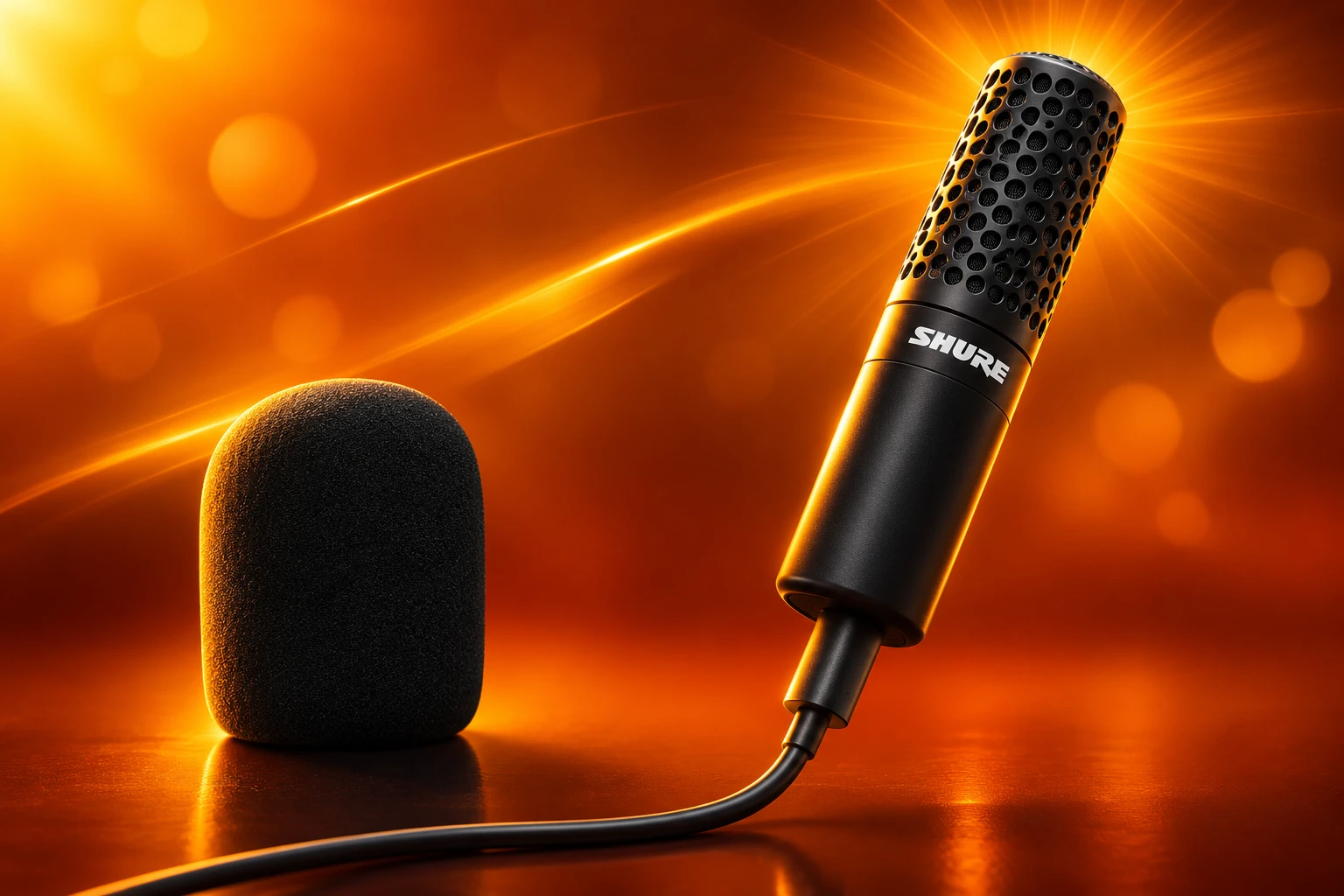
The compact USB-C spatial microphone kit is an all-metal stick, 11.2 cm by 3.4 cm, with a 3.5 mm jack for headphones. Japanese dealers list the body at 141.8 grams without the windscreen. Power and audio share one cable into a phone, tablet, or computer. There is no XLR snake and no interface.
Eduardo Valdes, Shure’s associate vice president of global marketing and product management, framed the pitch around presence rather than polar patterns.
Until now, capturing that sense of presence has required expensive equipment, technical expertise and time that many creators simply don’t have. The MV360 changes that.
Eduardo Valdes, Associate Vice President of Global Marketing and Product Management, Shure
Shure’s own launch clip went out the same morning the kit went on sale.
Say hello to MV360 🎧✨
Capture mono, stereo, binaural and full 360° spatial audio from one simple mic. Explore now: https://t.co/2cZhUCvHNT pic.twitter.com/PLeguvm1KJ
— Shure (@shure) November 17, 2026
In Japan the same unit is due on shelves on November 26, 2026, and Shure’s InterBEE booth already had it running straight into a phone. UK list prices are £339 and €389. The American kit in the box is the microphone, a mini tripod, a cold-shoe clip, a 5/8-inch clip, a phone clamp, two USB-C cables, a carry case, and a foam windscreen.
Two Files Come Off a MOTIV Recording
The useful split is not mono versus “spatial.” It is which file you keep. In MOTIV Audio on a phone, or MOTIV Mix on a desktop, the array can write a ready two-channel take and a separate four-channel Ambisonic B-format (AmbiX) file at the same time. The stereo side is for the cut you post tonight. The four-channel side is the master you can steer later.
That master is first-order Ambisonics in practice: four channels in AmbiX order, which YouTube already documents as W, Y, Z, X. Shure’s Virtual Mic Editor then lets you drop in up to four virtual microphones on a heatmap, aim them after the fact, and render the same session as mono, stereo, binaural, 5.1, 7.1, 7.1.2, or 7.1.4. Atmos beds, VR, games, and 360 video are the jobs Shure names in the immersive audio capture for creators launch note.
MV360 CAPTURE NUMBERS
- Bit depth: Up to 32-bit float, with 24-bit also listed, at 48 kHz or 96 kHz.
- Self-noise: Shure lists 25 dB SPL-A, and says the figure changes with the mode.
- Gain: 0 to 36 dB in MOTIV, plus a -10 dB pad, a 5-band EQ, and a high-pass at 75 Hz or 150 Hz.
- Windows catch: 32-bit float on a PC is tied to Shure’s ASIO driver.
Float recording is there so a sudden shout or a door slam is less likely to clip the file. You still have to point the array at the scene you care about. A reply to Shure’s launch post put it in workshop language: mark the mic’s position and rotation, then hold the talent’s distance, or the mono, stereo, and binaural versions of the same take stop meaning anything next to each other. Virtual mics in post cannot invent a axis you never logged.
Third-Party Apps Still See a Stereo Pair
Plug the MV360 into CapCut, a camera app, or any other tool that only speaks stereo USB, and you get a two-channel file. Shure is explicit on the product page: mono, stereo, binaural, and Auto Tracking will record into those apps. Full Ambisonic 360 is for MOTIV or a DAW. That is the second-order product. The $349 stick is how the four-channel master gets onto a phone. The software is where that master stays editable.
The four ready modes are the on-ramp, and each one still lands as a two-channel file.
THE FOUR READY MODES
- Mono: Cardioid, hypercardioid, or bi-directional, for a single talker or a tight source.
- Stereo: Width and separation you can set, aimed at music and rooms.
- Immersive binaural: A headphone-ready pair with more spatial cues than a normal stereo take.
- Auto Tracking: A virtual microphone that steers toward the loudest source, for interviews and people who move.
You can skip MOTIV entirely and use the MV360 as a standard USB microphone. You give up the four-channel archive when you do. For a weekly vlog that will never be remixed into 7.1.4, that may be the whole purchase. For anyone who might later need to re-aim a boom that was never on set, the AmbiX file is the reason to open MOTIV on the take.
What YouTube Still Wants for Spatial Sound
A 360 video with fancy headphones in the thumbnail is not enough. YouTube’s own help page still specifies first-order Ambisonics for 360 video in AmbiX, with ACN order and SN3D normalization, as a single audio track. Extra stereo-plus-spatial tracks in one file are rejected.
YOUTUBE SPATIAL UPLOAD RULES
- Core layout: Four channels as W, Y, Z, X at 48 kHz.
- Optional sixth: The same four plus a head-locked left and right that do not turn when the viewer turns.
- Metadata: The file needs the spatial metadata pass before upload.
- Playback: Head tracking on youtube.com and in headset apps has been the reliable path; phone apps and embeds have been the weak ones.
That is why a two-channel binaural bounce still matters. Most viewers will hear the MV360 on a phone speaker or a cheap pair of buds. The four-channel master is insurance for the cut that later goes to a headset, a 7.1.4 bed, or a game engine. Shure is selling the insurance at USB-mic money, then charging the time in MOTIV Mix and a DAW plugin.
Sony Already Owns the Phone-Native Path
Sony got to the same USB-C idea first, and pointed it at YouTube’s other spatial pipe. On October 8, 2026, Sony announced the ECM-AX10, an Eclipsa Audio certified phone microphone with four omnidirectional capsules in a sphere. Europe’s list price is about €199. The body is about 24 grams. Compatible phones start at iOS 18 and Android 14.
Ambisonics in Sony’s Spatial Audio Video Tool is built to export Eclipsa Audio, the IAMF-based format Google has been rolling out on YouTube for regular (not 360) video. Binaural on the ECM-AX10 is the fallback for platforms that will not take Eclipsa. Stereo is the everyday social file. The whole loop, record, trim, export, is meant to finish on the phone.
Shure’s loop is wider and slower. You can finish a binaural file on the phone in MOTIV Audio, but the 7.1.4 and Atmos jobs live on the desktop in MOTIV Mix and the Virtual Mic Editor. Sony is cheaper and lighter and already certified for the format YouTube is pushing on standard uploads. Shure is heavier, costs more, and keeps a DAW-shaped archive. Those are different products that will be compared in the same cart anyway.
SPATIAL MICS AT CREATOR PRICES
| Microphone | List price | How it connects | What you actually keep |
|---|---|---|---|
| Sony ECM-AX10 | About €199 | USB-C to a phone | AmbiX toward Eclipsa, plus binaural and stereo |
| Zoom H3-VR | $249.99 at B&H | Onboard recorder, micro-USB | First-order Ambisonics in a handheld deck |
| Shure MV360 | $349 | USB-C to phone or computer | Two-channel modes anywhere; four-channel AmbiX in MOTIV or a DAW |
| Rode NT-SF1 | $1,049 at B&H | Four XLRs into a recorder | A-format capsules, software conversion later |
| Blackmagic Ambisonic | $1,909 | USB-C | Seventh-order encode from 108 MEMS capsules |
The Rode NT-SF1 and the Sennheiser AMBEO VR, listed at $1,599, still assume a four-channel analog chain and phantom power. That is the market Shure is quietly pricing against. A creator who only needed first-order files no longer has to buy four XLR preamps to get them.
THE SPATIAL USB-C CALENDAR
- October 8, 2026: Sony announces the ECM-AX10 for about €199, certified for Eclipsa Audio.
- November 11, 2026: Blackmagic Design announces a seventh-order sphere for December.
- November 17, 2026: Shure starts selling the MV360 kit at $349 and previews the MV360+.
- November 26, 2026: Japanese shops get the MV360.
- December 2026: Blackmagic’s microphone is listed to ship.
- Early 2027: The MV360+ is due at $449 with a recorder and a battery.
Three USB spatial mics in two months is the tell. First-order capture is no longer a boutique order. The fight is over which software owns the file after the take.
Blackmagic’s $1,909 Mic Targets Seventh-Order Capture
A week before Shure’s launch, Blackmagic put a seventh-order Ambisonic Microphone at $1,909 on its shop page, or $2,405 as a kit with a mount, windshield, and locking USB-C cable. The sphere holds 108 MEMS capsules and a built-in encoder that outputs 64 channels of 32-bit audio on one cable. That is a different order of spatial resolution, and more than five times the MV360 kit.
Hugh Hou, an Emmy-winning immersive filmmaker who had already hung the Shure array on an URSA Cine Immersive, wrote that the MV360 “doesn’t use MEMS” and “sticks to what Shure does best: condenser capsules with high max SPL and very low self-noise.” He also described the live output as six channels at once, a two-channel binaural pair ready for social posts and a four-channel B-format bed for later. That matches Shure’s MOTIV FAQ. The argument he put to other shooters was first-order at about this price versus seventh-order near $2,000. Condenser arrays still win on noise and loud sources in that crowd. MEMS spheres win on channel count and a single-cable 7th-order encode. Neither side is confused about which job they bought.
The Battery Kit Is Due in Early 2027
The MV360 is tethered. If the phone dies, the take dies with it. Shure’s answer is the MV360+, listed at $449 for early 2027, £439 and €499 in the UK materials, a $100 step up from the USB kit. It keeps the same array and adds onboard 32-bit float recording to a microSD card, an internal rechargeable battery, and wireless control from a phone out to about 100 feet. The radio starts and stops the deck and changes settings. The sound does not leave the card over the air. A 3.5 mm cable in the box is there for cameras. Shure also describes it as a plant mic you can leave near a source and run from a distance.
WHAT WE KNOW
- Onboard deck: 32-bit float to microSD, with USB-C still on the body.
- Control range: About 100 feet from a phone, while audio stays local.
- Kit extras: Tripod, 5/8-inch clip, cold shoe, case, USB-C cable, windscreen, 3.5 mm cable.
WHAT IS UNCONFIRMED
- Battery life: Shure has not published a runtime.
- Card in the box: The microSD slot is specified; a card in the kit is not.
- Japan price: Spring 2027 is the local window; a yen figure has not been set.
Until that deck ships, the $349 USB kit is the whole offer: a four-channel AmbiX master you can cut as stereo tonight and reopen as 7.1.4 when a platform, a headset, or a client finally asks for it.
Frequently Asked Questions
Does the Shure MV360 Work Without the MOTIV App?
Yes. Shure says it enumerates as a standard USB microphone on Windows, macOS, Android, and iOS, so any app that accepts stereo USB audio can record the two-channel Capture Modes. MOTIV Audio, MOTIV Mix, or a DAW is required only if you want the four-channel AmbiX file, virtual-mic steering, or the 5.1 through 7.1.4 renders.
Can You Record Binaural and Ambisonics on the Same Take?
In MOTIV Audio or MOTIV Mix you can. The app writes the two-channel Capture Mode, including binaural, beside a separate four-channel Ambisonic recording. Third-party apps do not get that dual-file path; they receive only the two-channel mode you selected.
What Sample Rate Does YouTube Want for Spatial 360 Uploads?
YouTube’s spatial help page specifies 48 kHz for first-order Ambisonics, with the four AmbiX channels in W, Y, Z, X order. If you add head-locked stereo, the upload becomes a six-channel track at the same 48 kHz. The MV360 can record at 96 kHz, so a downsample is part of that particular publish path.
What Comes in the MV360 Kit and What Is Sold Separate?
The $349 kit includes the microphone, foam windscreen, carry case, mini tripod, 5/8-inch clip, cold-shoe clip, phone clamp, and two USB-C cables. Shure also lists those mounts and the case as spare parts under AMV360 SKUs if one piece is lost. The ASIO driver for Windows is a free download, not a box item.

Gold Prices Fall to a 14-Month Low Despite Strikes

SpiceJet Clears a Rs 5,500 Crore Raise After Mumbai Stalled

Honda Activa’s Record Month Came With a Share Loss

Sony Turns the GTA 6 Launch Into a Firmware Gate

Xiaomi 18 Leak Skips the Rear Screen for Battery

Volkswagen Sells the Osnabruck Plant to Clear a Board Fight

Apple’s Foldable iPhone Hinges on Samsung Display Supply

Saksham Gaur Finds He Is His Own Company’s Client

Tata Motors’ Iveco Tender Opens as Holders Still Decide

What Is SD on Amazon Prime?
-
 AUTO2 months ago
Volkswagen Sells the Osnabruck Plant to Clear a Board Fight
-
 NEWS3 months ago
Apple’s Foldable iPhone Hinges on Samsung Display Supply
-
 BUSINESS3 months ago
Saksham Gaur Finds He Is His Own Company’s Client
-
 AUTO3 months ago
Tata Motors’ Iveco Tender Opens as Holders Still Decide
-
 TECHNOLOGY3 years ago
What Is SD on Amazon Prime?
-

 BUSINESS3 months ago
Hyderabad 22-Carat Gold Jumps After a False Bargain
-

 GAMING3 months ago
Onimusha Way of the Sword Preload Hits a Windows 11 Wall
-

 BUSINESS3 months ago
UltraTech Ultravolt Launch Splits Friday Stocks to Watch