
NEWS
Teba’s 20th Douglas Days Restaged a 1330 Scottish Death
Teba’s 20th Douglas Days closed on 23 August 2026, restaging Sir James Douglas’s 1330 death and a Melrose twinning built on Robert the Bruce’s heart.

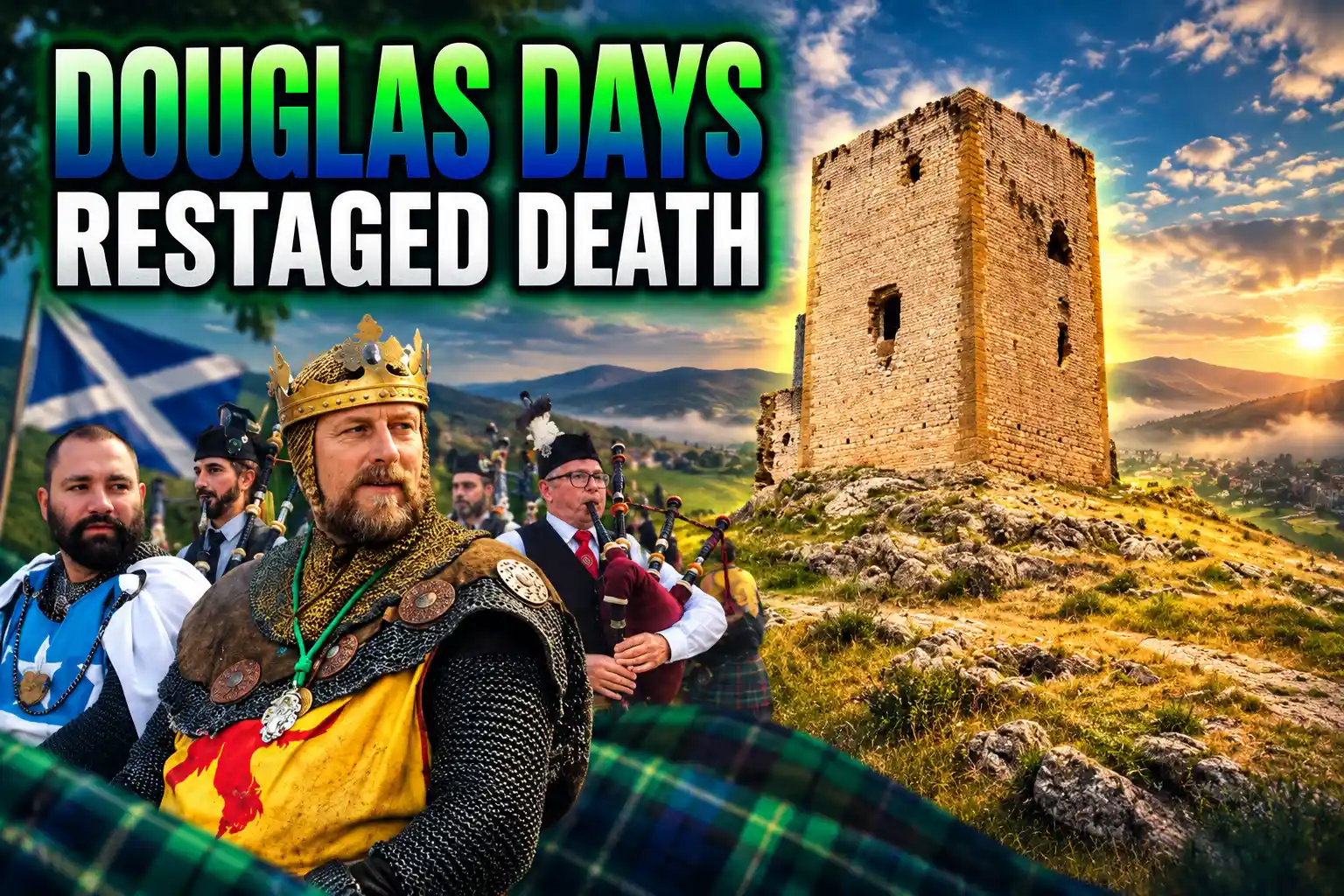
Teba closed its 20th Douglas Days on 23 August 2026, four nights of pipes in a hill town of 3,708. The weekend restaged the death of Sir James Douglas, who was carrying Robert the Bruce’s embalmed heart when he fell below Castillo de la Estrella in August 1330.
The official site billed music as the bridge between Andalusia and Scotland. On the ground it was still a small pueblo putting on tartan for a knight who never reached Jerusalem, 696 years after the fight.
Twenty Augusts After a 2005 Start
The XX Jornadas Escocesas ran from 20 to 23 August 2026 under a poster from Wiro Studio. Culture deputy Manuel López Mestanza and mayor Cristóbal Corral presented the dates in Málaga, with the local groups Hisn Atiba and Alzar el Vuelo named as the volunteers who keep the streets in costume.
The first Douglas Days were held in August 2005. Schoolchildren at Colegio Nuestra Señora del Rosario had written to the Earl of Selkirk in 1992 to ask about Douglas, and twinning talks with Melrose began a year later and then stalled. The heritage group Hisn Atiba formed in 2003. Two years later the pipes arrived in August and stayed on the calendar.
Málaga’s provincial council put the event on Málaga’s unique tourist festival list on 6 March 2007. By the ninth edition in 2013, organisers were already talking of more than 3,000 visitors for a three-day run. The 19th edition in August 2025 ran from 21 to 24 August, still selling the same death in a different summer.
A municipal bagpipe school, built with piper Leslie Thompson, is now part of the pitch. On Thursday 20 August the school played in Plaza de la Constitución, an Andalusian take on Scotland the Brave sat beside Douglas’ March to Teba, and Philip Graeme Lawson Barlow received a banner with Teba’s arms.
The Knight Who Never Reached Jerusalem
Robert I of Scotland died in 1329. He asked Douglas, his lieutenant from Bannockburn in 1314, to take the king’s heart on crusade. The Walloon chronicler Jean le Bel says Bruce wanted it laid at the Church of the Holy Sepulchre. The poet John Barbour says only that it should be carried against “God’s foes.”
Douglas left Berwick in spring 1330 with a safe conduct from Edward III and a letter to Alfonso XI of Castile. He waited twelve days at Sluys, then sailed for Seville. Alfonso was already moving on Teba, a Nasrid fortress twenty-five miles east of Olvera and a lock on the road toward Málaga. The Scots joined as pilgrims, not as paid captains. Barbour has Alfonso offering horses and armour, and Douglas turning them down.
The Junta de Andalucía’s tourism account of the heart of Braveheart in Teba dates Douglas’s death to 25 August 1330 and gives the line the town still prints on posters.
Go on, brave heart, wherever you go you must win, and Douglas will follow you or die.
Words attributed to Sir James Douglas, Junta de Andalucía tourism account
A young Scottish squire, quoted on the same page, saw Castillo de la Estrella “standing right on top of a high, steep hill, strongly fortified and overlooking a flat landscape and the river.” The castle is still the backdrop. The visitor centre in town tells the same journey, and an open-air trail of mosaics by Carmen Ruiz, opened as El corazón de Escocia, walks it through the streets.
Alfonso’s Chronicle Calls Him a Foreign Count
The version that fills Scottish feeds each 25 August is Barbour’s: Douglas overruns his own men, turns back too late, rides to save Sir William St Clair, and dies with the Logans. Later retellings add the casket torn from his neck and thrown at the Nasrid line. Clan Logan Society International was still posting that ending on 2 October 2026, naming two Logans among the dead.
Castile’s own record is colder. The Gran Cronica de Alfonso XI mentions a clash at the watering place on the Río Guadalteba and the death of “a foreign count… through his own error.” Uthman ibn Abi al-Ula brought a Granadan relief force up from Málaga, tried a night split across the river and onto the camp, and broke when Alfonso kept his main body standing and sent Pedro Fernández de Castro, then Rodrigo Álvarez de las Asturias, into the pursuit. The garrison of Teba surrendered. Uthman died some weeks later. The battle did not settle the frontier; the Guadalteba and Turón valleys stayed disputed for another century and a half.
WHERE THE SOURCES SPLIT
- Barbour’s chase: Douglas and a handful of knights die in a running fight after a rout, with St Clair and the Logan brothers named among the fallen.
- The Castilian note: a foreign count is killed at the river “through his own error,” with no thrown heart and no last speech.
- The heart in Melrose: Historic Environment Scotland will not assign the lead casket to Bruce for certain, because three heart burials are recorded at the abbey and the find sat in the chapter house, not by the high altar.
None of that argument reaches the plaza in August. The festival needs a last charge, a silver box, and a line you can shout over drums.
Melrose Signed the Twin Papers in June
Douglas’s bones went home to St Bride’s Kirk in Douglas, South Lanarkshire, after the flesh was boiled off in the field. The casket went to Melrose Abbey, while the rest of Bruce’s body already lay at Dunfermline. A granite monument to both men has stood in Teba’s Plaza de España since 1987.
Archaeologists first lifted a lead container from the chapter house in 1921, then lost the exact spot. It was the casket found at Melrose Abbey again in 1996, inside a later canister, with a 1921 plaque still in the tin. Conservator Richard Welander and Mandy Clydesdale of AOC Archaeology used an endoscope rather than prising the damaged medieval box. They saw a small, prune-like heart. Lord Elgin offered DNA. The preservation method, a dip in hot tar, would have cooked it. The casket went back into a time capsule and into the ground at a private burial, then under a marker stone unveiled on 22 June 1998.
FROM THE CASKET TO THE TWINNING
- 1329: Robert I dies and charges Douglas with the heart.
- August 1330: Douglas is killed in the Teba campaign; the casket and his bones start home.
- 1921: A lead heart container is dug from Melrose’s chapter house and buried again unmarked.
- 1996-22 June 1998: The same casket is found, examined, and reburied under a public stone.
- August 2005: Teba holds the first Douglas Days.
- 21 June 2025: Mayor Cristóbal Corral and Melrose community chair Mike Sherlock sign the twinning at Melrose Abbey.
Corral said the paper sealed a friendship already made by history. Melrose pilgrims Amir Hosny, Ben Magowan, Harry Fletcher and Jamie Fletcher came the other way for the 2025 festival and said Teba had done more of the remembering than the Borders town had.
Four Nights of Markets, Pipes and a Castle Walk
The 20th-edition programme in Teba kept the shape of earlier years: a Thursday of speeches and pipes, a Friday market, a Saturday homage at the Douglas monument, and a Sunday of open doors. The medieval stalls sat on calles San Francisco, Grande and Herradores. A large Red Dragon joined the Friday street parade. The street play Lágrimas por Itaba again walked the 1330 story up toward the castle. Neighbours dressed mudéjar courtyards for the Conquista de las Alquerías Tebeñas. Mardanis played Plaza de España on Saturday. Celeste Torres and Corrado Guiducci launched the book Il Cavaliere Nero on the opening night.
THE 2026 NIGHTS
| Day | Date | Centrepiece |
|---|---|---|
| Thursday | 20 August | Poster reveal, Il Cavaliere Nero, pipes in Plaza de la Constitución, banner for Philip Graeme Lawson Barlow |
| Friday | 21 August | Medieval market opens, Red Dragon parade, Lágrimas por Itaba toward the castle |
| Saturday | 22 August | Cortege to the Douglas monument, alquerías walk, Mardanis in Plaza de España |
| Sunday | 23 August | Heritage open day, closing at 13:00 in Plaza de España, market again at 19:00 |
Teba’s own tourism account posted on the last morning with the saltire still in the copy, pointing visitors at the museums and the 13:00 close.
🏴 | ¡Llegamos al último día de las XX Jornadas Escocesas!
La mañana del domingo estará dedicada a descubrir nuestro patrimonio con una jornada de puertas abiertas en algunos de los espacios históricos y culturales de Teba. pic.twitter.com/PTULTspRYu
— #ConoceTeba (@ConoceTeba) August 23, 2026
Sunday’s open list was the Municipal History Museum, the Ethnological House-Museum, the Church of Santa Cruz Real from 11:00 to 15:00, and the Hermitage of Nuestro Padre Jesús from 11:00 to 14:00. After the speeches, the stalls and the children’s corner opened again at 19:00. The festival does not empty the town at lunch.
Why Teba Still Dresses as Scotland
Spain’s 2025 municipal register puts Teba at 3,708 people. That is a white hill town in the Guadalteba, about an hour from Málaga, sitting under a ruined castle while the Costa del Sol takes the beach money. A four-night Scottish week is one of the few times the plaza is full of outsiders in August.
THE WEIGHT THE STORY STILL CARRIES
- The headcount: 3,708 residents on the 2025 register, against a mid-century town that was more than twice that size.
- The editions: twenty numbered festivals since the first August in 2005, with a provincial tourism badge since 6 March 2007.
- The distance in time: 696 years from the 1330 campaign to the 2026 close.
The people who actually keep the kilts walking are local. Hisn Atiba and Alzar el Vuelo dress the streets. The municipal pipe school now trains children who will play Douglas’ March whether or not a Borders band gets on a plane. Gibraltar’s Saint Andrew’s Society and groups such as The Strathleven Artizans have made the trip in past years. The 2026 theme put music first because music is cheaper to repeat than a full international guest list.
WHO HOLDS THE WEEK UP
- The town hall: Corral’s council and the Diputación book the dates, the poster, and the unique-festival badge.
- The heritage groups: Hisn Atiba, named for the old fortress, and Alzar el Vuelo run volunteers and the mudéjar street sets.
- The pipe school: Leslie Thompson’s municipal class puts Teba’s own players on the Thursday stage.
- Melrose: the 2025 abbey signing gives the weekend a living twin, even when only a handful of pilgrims come south.
Scottish anniversary posts still prefer the thrown casket and a crusade. Teba’s own notices talk about craft stalls, children’s corners, and a Sunday in the church. Both versions need the same dead knight. The castle is still on the hill. The heart, or a heart, is still under a stone in Melrose. On 23 August the town closed the twentieth of these weekends at 13:00 in Plaza de España and opened the market again at dusk.
Frequently Asked Questions
Why does a Spanish town hold a Scottish festival?
Jean le Bel, writing in the fourteenth century, counted Douglas’s company at Sluys as one knight banneret, six ordinary knights and twenty esquires, a band of 27 if the banneret is Douglas himself, and that small group is the whole Scottish stake in the 1330 siege. Teba marks their deaths each August because the Castilian victory at Castillo de la Estrella is also the place those men ran out of road.
Where is Robert the Bruce’s heart buried?
The marker stone set over the reburial at Melrose Abbey on 22 June 1998 carries a line from Barbour’s poem The Bruce, “A noble hart may have nane ease gif freedom failye,” while the king’s body remains at Dunfermline Abbey; no DNA test was done, and Historic Environment Scotland treated the find as human remains under Scots law rather than as a proven royal relic.
When did Teba and Melrose become twin towns?
The signing at Melrose Abbey on 21 June 2025 was the formal act, but the first paperwork push was in 1993 after the Rosario school letters of 1992, and that attempt did not stick, which is why the towns spent three decades sharing a monument and a festival before they shared a twinning document.
What is Castillo de la Estrella?
It is the hill fortress above Teba that Nasrid forces held in 1330 under the older name Hisn Atiba, and after the surrender Alfonso XI placed the Order of Santiago in it to hold the new Castilian line; the ruin is still the last stop on the Lágrimas por Itaba walk.
When did Douglas Days start?
The first edition was in August 2005, the ninth in 2013 already expected more than 3,000 visitors, and the Diputación’s unique-festival vote on 6 March 2007 is the paperwork that turned a local homage into a dated slot on the provincial calendar.

TCS Opens Q2 as Mid-Cap IT Keeps the Growth

Bitcoin’s Jobs Rally Fails While December Hike Odds Hold

The Heat Turn a Bucks Rematch Into Vice City Night

The G7 Opens Diesel Tanks While Carriers Head East

Kia Bets Fortuner Money on a Made-in-India Sorento

Volkswagen Sells the Osnabruck Plant to Clear a Board Fight

Tata Motors’ Iveco Tender Opens as Holders Still Decide

Saksham Gaur Finds He Is His Own Company’s Client

Onimusha Way of the Sword Preload Hits a Windows 11 Wall

The Frame Pro’s $1,200 Labor Day Cut Needs a Soundbar
-
 AUTO4 weeks ago
Volkswagen Sells the Osnabruck Plant to Clear a Board Fight
-
 AUTO1 month ago
Tata Motors’ Iveco Tender Opens as Holders Still Decide
-
 BUSINESS1 month ago
Saksham Gaur Finds He Is His Own Company’s Client
-
 GAMING1 month ago
Onimusha Way of the Sword Preload Hits a Windows 11 Wall
-
 NEWS4 weeks ago
The Frame Pro’s $1,200 Labor Day Cut Needs a Soundbar
-

 BUSINESS1 month ago
SEBI Reopens How F&O Settles After the Closing Auction
-

 BUSINESS1 month ago
The Rs 4.66 Lakh Crore IPO Queue Is Mostly Paper
-

 NEWS1 month ago
Apple’s Foldable iPhone Hinges on Samsung Display Supply