
NEWS
Illinois Weighs a Public Stadium to Keep the Bears
Gov. JB Pritzker is aiming the November veto session at a publicly owned Bears stadium, matching a tax-free model Indiana already signed into law.

Gov. JB Pritzker said the November veto session is the window to keep the Chicago Bears in Illinois. He sat down on Oct. 1 in Chicago with NFL Commissioner Roger Goodell and Bears minority owner Pat Ryan, while team president Kevin Warren, chairman George McCaskey, and Mayor Brandon Johnson stayed out of the room.
One idea now under review would put a new stadium in public hands so the club pays no property taxes, a model Indiana already wrote into law this year, and there is still no deal.
Goodell Sat Down, and Warren Did Not
Pritzker called it a helpful meeting and said the right people were at the table. Beside Goodell and Ryan were House Speaker Emanuel “Chris” Welch, Sen. Bill Cunningham, and Rep. Kam Buckner, the two Chicago Democrats who have carried the stadium bills. It was the first known face-to-face between the governor and the commissioner after nine months of calls and texts about tax certainty on land the Bears already own in Arlington Heights.
Ryan is a Bears board member and the retired Aon chief who funded Northwestern’s $875 million Ryan Field. Pritzker treated his presence as the point of the session, not a substitute who wandered in.
Remember: He’s an owner of the Bears, so I think it’s a big positive to have him at the table. And the Bears want to have all the options that they can have on the table. And having him in the room was very important.
JB Pritzker, governor of Illinois, Oct. 1 interview
Warren spent the summer telling anyone who asked that Hammond, Indiana, was the club’s “sole focus.” McCaskey chairs the franchise. Pritzker said both men knew the meeting was happening and that “the fact that they had their people there” meant talks were still live. The seating chart still did the talking. Springfield put the owner who can work a Chicago room in the chair, and left the executive who spent June and August pointing at Indiana off the list.
WHO SAT DOWN ON OCT. 1
- In the room: Pritzker, Goodell, Ryan, Welch, Cunningham, and Buckner met in Chicago on keeping the club in-state and on protecting taxpayers, according to the governor’s office.
- Not in the room: Warren, McCaskey, and Johnson were absent, even though Johnson still says the Bears belong in the city and the team still plays at Soldier Field.
- The league line: The NFL said timely action is essential as the Bears hunt for a long-term stadium, a nudge aimed at the veto session that starts after Election Day.
Further meetings were expected later in October. People in the talks described no breakthrough, only a chance to find common ground before Springfield comes back.
The NFL appreciated the opportunity to meet with Governor Pritzker and legislative leaders today. Timely action is essential as the Bears work to find a long-term stadium solution for the club and their fans.
NFL statement, Oct. 1, 2026
A Public Authority Would Zero the Property Tax
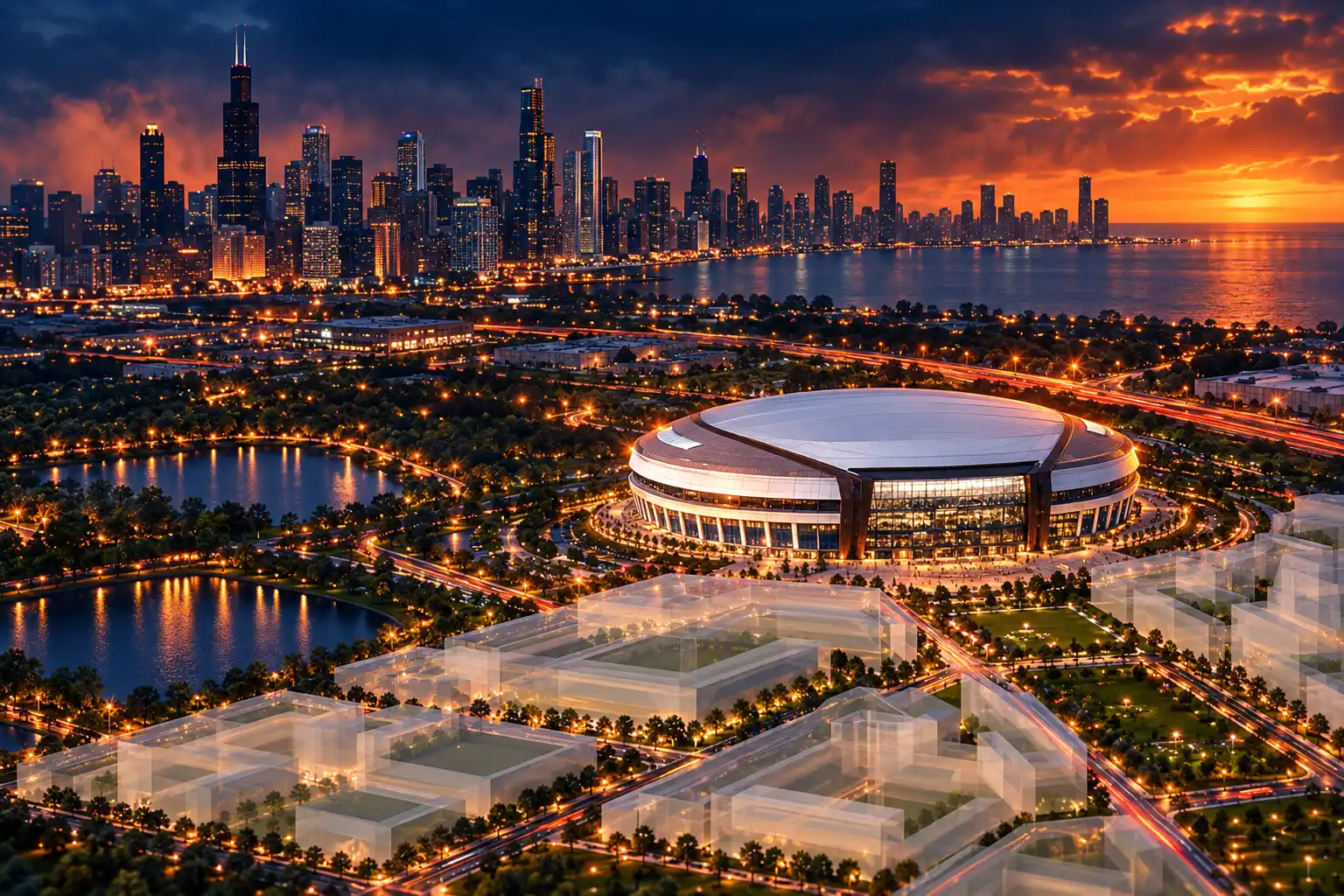
On Oct. 2, people familiar with the drafting said lawmakers are looking at a plan that would have a stadium authority own the building. That is the same lever the Senate already passed on June 1 and the House refused to call. Pritzker said he is hopeful the legislature will take up a bill in the veto session “that would advance the cause of keeping the Bears in the state of Illinois.” He also said there is no deal yet.
The Municipal Stadium Authority Act amendment would let a home-rule city of 70,000 or more in a county of more than 3,000,000 people, which in practice means Cook County, create an authority during a five-year window. The authority could finance, buy, or build a pro sports stadium. Any facility it owned, or that was leased to it for games, would be exempt from the property tax. Cunningham, who sponsored the rewrite, did not hide the mechanics.
The municipality would own the stadium as a public property. It would pay no property taxes.
Bill Cunningham, Illinois senator, on the June bill
He said the Bears would still put up the cash to build, then lease the place under a public-use agreement, and the locality would hold title. If they used the 326-acre Arlington Heights site, the team would turn that land over to the authority. The host city could also seek a sales-tax and revenue-bond district around the stadium, with bond debt repaid from state sales-tax increment. Traffic studies would be required at the new site and at Soldier Field.
That structure is the opposite of what the Bears said they wanted for years, which was to own the building and pay a known tax bill. It is also the structure that solves the bill they would not pay. Welch would not call the Senate rewrite on June 1 because, he said, “to pass a bill about the Bears, just being about the Bears, the votes weren’t there,” and members had not had time to read it. A House megaprojects bill that froze assessments and allowed a payment in lieu of taxes had already passed that chamber and stalled in the Senate. Two houses, two theories, no law.
Pritzker, on that same June day, said he was not willing to “give up billions of dollars of taxpayer money” for “a billionaire-owned team.” The idea now being walked back through the same offices would take the stadium off the tax roll entirely. Welch’s public line after the Goodell meeting was that the focus “remains on responsible steps that protect taxpayers while keeping the Bears in Illinois.” Those two sentences can live in the same press release. They do not describe the same ledger.
Indiana Already Signed That Model Into Law
Indiana did not wait for a second chamber. Gov. Mike Braun signed a stadium-authority law in February, enrolled as Public Law 44 on Feb. 26, 2026. The act creates a Northwest Indiana Stadium Authority as a state instrumentality to acquire, build, own, lease, and finance facilities, plus a stadium board that can issue bonds. Hammond can impose an admissions tax. The bill amends Lake County and Porter County food-and-beverage taxes and Lake County innkeeper taxes, and it lets Hammond draw a professional sports development area to capture increment.
Accounts of that package have put Bears capital at $2 billion and public support around $1 billion, with the club keeping stadium revenue and holding an option to buy once the bonds are paid. The Bears board voted on June 4 to advance a Hammond project, and the club announced it the next morning, after Illinois adjourned with nothing. Construction talk has pointed at parcels around Wolf Lake. Nothing is signed with the team. Braun’s pitch since winter has been speed: Indiana put a finished authority on the table while Illinois was still arguing over whose bill was whose.
Warren called the Indiana offer excellent on property tax and infrastructure certainty, the two items he has named as prerequisites. Pritzker has said Indiana still has to pass the local taxes that would actually pay for the thing, and that he does not buy the idea that Hammond is “a whole heck of a lot closer.” The legal fact is simpler than the talking points. Indiana already has an owner for the building. Illinois is trying, in November, to create one.
The Racetrack Land the Bears Already Own
The Illinois path still runs through a hole in the ground the franchise already paid for. Churchill Downs Incorporated closed the sale of 326 acres at the old Arlington Park to the Bears on Feb. 15, 2023, for $197.2 million, under a purchase agreement signed Sept. 29, 2021. The village’s file on the site, including a short-term tax settlement that set a $125 million assessment on the unimproved land through 2027, sits in the village’s Arlington Park redevelopment file. That settlement prices the vacant tract at about $3.6 million a year, down from the higher bill the club had been paying after the grandstand came down.
Arlington Heights Mayor Jim Tinaglia has kept lobbying Springfield even after the Hammond vote, saying he still hopes for a bill the governor can sign “before it’s too late.” Goodell told Illinois lawmakers in August the team was still looking at the Arlington site. Karen Murphy, the Bears’ executive vice president for stadium development, texted Deputy Gov. Andy Manar on June 26, two weeks after the Hammond vote, that the club was still working on “changes we would need with the existing proposed legislation.” The “sole focus” line and the text file have been living in the same summer.
HOW THE BEARS GOT TO A TWO-STATE FIGHT
- Sept. 29, 2021: The club signs a purchase agreement with Churchill Downs for the Arlington Park land.
- Feb. 15, 2023: The sale closes at $197.2 million for 326 acres.
- December 2024: Arlington Heights sets the vacant-site tax at about $3.6 million a year through 2027.
- Feb. 26, 2026: Indiana signs Public Law 44 and stands up a northwest Indiana stadium authority.
- June 1, 2026: The Illinois Senate passes the municipal authority rewrite; the House adjourns without a vote.
- June 4, 2026: The Bears board votes to advance a Hammond project, announced June 5.
- Oct. 1, 2026: Pritzker, Goodell, and Ryan meet in Chicago; Pritzker aims the file at the veto session.
Soldier Field, where the Bears have played since 1971, holds 61,500, the smallest crowd in the league, and the lease with the Chicago Park District runs through 2033 at about $6.5 million a year. A new building on the racetrack land would sit in the suburbs the club already bought. A Hammond building would sit across a state line the club does not yet own. The land file is the part of this fight that is not a rumor.
Who Pays If the Stadium Leaves the Tax Rolls
Cook County Treasurer Maria Pappas’s office ran the Arlington Heights numbers during the spring megaprojects fight, using a conservative $675 million market value from sports economist Geoffrey Propheter rather than a $2 billion construction sticker. At the village’s current rate, that value would produce about $53.2 million a year in property tax. Under the House megaprojects freeze, the office said the bill would be less than $4 million a year. If the team then layered on an assumed $10 million payment in lieu of taxes, the break would be more than $39 million a year, more than $1.5 billion over 40 years, money that would otherwise have gone to schools and local governments.
Public ownership goes further. It does not freeze the assessment. It removes the stadium from the roll. The spring Senate bill was written that way on purpose after Senate Democrats rejected a PILOT package. Republican Sen. Seth Lewis asked whether an authority appointed by local officials could pile on taxes the town did not want. Cunningham said the bill does not bar a home-rule city from using powers it already has. Darren Bailey, the Republican nominee for governor, later stood outside Soldier Field and offered an “I-Formation” plan with up to $800 million in infrastructure revenue bonds and a fixed PILOT that rises with inflation, plus a 40-year stay in Illinois. Unless he wins on Nov. 3, that plan is a press conference.
TWO WAYS TO TAKE THE STADIUM OFF THE FULL TAX BILL
| Item | Illinois public-authority idea | Indiana SB 27 (law) |
|---|---|---|
| Status | Senate passed June 1, 2026; House did not vote | Signed Feb. 26, 2026, Public Law 44 |
| Owner of the building | Municipal stadium authority | Northwest Indiana Stadium Authority |
| Property tax on the stadium | Exempt | Authority-owned, tax-exempt structure |
| Team cash | Bears finance construction, then lease | Bears pledged $2 billion |
| Public package | Sales-tax increment bonds around the site | About $1 billion described with the bill |
| Where it would sit | Cook County city of 70,000-plus, including Arlington Heights | Hammond |
The hidden party in both columns is the same. Schools, towns, and counties do not collect a full freight tax on a privately owned, privately profitable NFL palace. Indiana socializes that choice through Lake and Porter County excise taxes and a state authority. Illinois would socialize it through a local authority and a state sales-tax increment, then call the result keeping the Bears. The club gets a building. The public gets a tenant.
Chicago’s Mayor Never Got a Chair
Johnson, whose administration was not part of the Oct. 1 meeting, repeated that the Bears belong in the city and that he has not closed his door. People around the talks say the club has ruled out a new stadium inside Chicago because no site works. Rate Field in Bridgeport has been floated if the White Sox leave, and that is still a hypothetical stacked on another hypothetical. The live map is Hammond or Arlington Heights, if Springfield writes something the McCaskeys will sign.
Forty-three lawmakers represent Chicago. Supporters of an Arlington Heights bill now have to ask how many of those members will vote to move a Chicago namesake to the suburbs in order to stop it from moving to Indiana. State Rep. La Shawn Ford has already supplied the slogan he thinks will travel.
“You don’t vote to send the Bears away,” Ford said. “You vote to keep the Bears in Illinois, and I don’t think that anyone that represents Chicago will vote to send the Bears to Indiana. But they will be voting to make sure that we keep the Bears in Illinois.”
That framing treats Indiana as the only loss that counts. It does not price a tax-exempt building in Arlington Heights, and it does not give Johnson a lakefront stadium he can point to. Soldier Field stays a Park District problem either way. The mayor can keep his door open. The meeting happened without him.
Six Session Days After the November Election
Lawmakers return on Nov. 17 to 19 and again on Dec. 1 to 3, six session days, two weeks after the Nov. 3 election. Pritzker said that is when it should happen, and that acting sooner rather than later “would be very important,” and that “the veto session is exactly the right time.” The calendar is the strategy. A vote after Election Day is a vote after the ads stop.
He wants an agreement in hand before rank-and-file members walk back into the Capitol. Drafting a tax-exempt authority, a bond district, and a lease the NFL will accept is not a weekend job, which is why a commissioner, a governor, and a billionaire owner were in the same room six weeks out. It is also why a June collapse is still the governing fact. The House would not vote then. Nothing in the Oct. 1 readout says those votes have been counted now.
WHAT WE KNOW
- The meeting: Pritzker, Goodell, Ryan, and legislative leaders met Oct. 1 in Chicago and pointed at the veto session.
- The Illinois idea: A public stadium authority, like the Senate’s June bill, would own the building and pay no property tax.
- The Indiana law: Public Law 44 is already on the books, and the Bears board has voted to advance Hammond.
- The land: The franchise still owns 326 acres in Arlington Heights that it bought for $197.2 million.
WHAT IS UNCONFIRMED
- A bill: No veto-session text has been filed, and Pritzker and legislative leaders say there is no deal.
- A site: Arlington Heights is back in play only if the tax language appears; Hammond is live only if the club signs.
- Chicago: No one in the Oct. 1 meeting put a city site on the table, and Johnson was not there to argue for one.
Until Springfield files something, the Bears still own the racetrack land, Indiana still has a stadium authority ready to lease a tax-exempt building, and the November calendar still has six days on it. That is the whole file Goodell flew in to hear.

The BMW iX4 Undercuts Mercedes and Trails Its Twin

Scotland’s Ten Big Supermarkets Already Hold the Weekly Shop

Scotland EMS Faces a State Probe After a Wagram Death

Meritz Signs Ripple to Race Korea’s 2027 Token Rules

Pocognoli’s First Camp Leaves Scotland Third and Exposed

Volkswagen Sells the Osnabruck Plant to Clear a Board Fight

Saksham Gaur Finds He Is His Own Company’s Client

Tata Motors’ Iveco Tender Opens as Holders Still Decide

Onimusha Way of the Sword Preload Hits a Windows 11 Wall

Apple’s Foldable iPhone Hinges on Samsung Display Supply
-
 AUTO2 months ago
Volkswagen Sells the Osnabruck Plant to Clear a Board Fight
-
 AUTO2 months ago
Tata Motors’ Iveco Tender Opens as Holders Still Decide
-
 BUSINESS2 months ago
Saksham Gaur Finds He Is His Own Company’s Client
-
 GAMING2 months ago
Onimusha Way of the Sword Preload Hits a Windows 11 Wall
-
 NEWS2 months ago
Apple’s Foldable iPhone Hinges on Samsung Display Supply
-

 ENTERTAINMENT3 years ago
What is SD on Amazon Prime? – All You Need to Know
-

 NEWS2 months ago
iQOO 16 Locks 8,400 mAh While 100W Charging Holds
-

 AUTO2 months ago
Simple Wave Chases Range as Ather Konarc Cuts Price