
NEWS
CUREE Found Nearly 25 Times More Fish at One Pillar
CUREE found fish nearly 25 times denser at one pillar coral, showing average reef scores miss the endangered structure that holds the life.

A Woods Hole robot found fish packed nearly 25 times denser around one pillar coral than on the rest of a U.S. Virgin Islands reef. The finding comes from CUREE, the Curious Underwater Robot for Ecosystem Exploration, in a Science Robotics paper dated May 13, 2026.
The vehicle did not stumble onto a busy patch by luck. Over three expeditions between 2022 and 2024 it kept locking onto the same Dendrogyra pillar on Joel’s Shoal, then used cameras to count what the noise had already flagged.
One Pillar Coral Held Nearly 25 Times the Fish
Joel’s Shoal is a healthy Caribbean reef in the U.S. Virgin Islands, named for Joel Llopiz, the Woods Hole Oceanographic Institution biologist who found it. Llopiz died on January 19, 2026, at 48, after a career that ran from a 2010 postdoc to tenure in 2023.
Visual surveys around the large Dendrogyra pillar showed fish densities nearly 25 times higher than on the rest of the reef. Acoustic maps put a wider halo of biological noise around the same feature, which is how the robot kept coming back.
THE JOEL’S SHOAL NUMBERS
- Fish density: Nearly 25 times higher beside the pillar than on the rest of the reef.
- Sound tracking: Controlled tests followed sources from up to 80 meters.
- Hotspot homing: The robot closed on natural reef hotspots over 30 meters.
- Map grain: The paper’s aim is mobile reef fauna at less than 1 meter.
That gap is the point of the work. Reef life is not spread like paint. It clumps around structure, and a whole-site average can make a crowded pillar look like ordinary bottom.
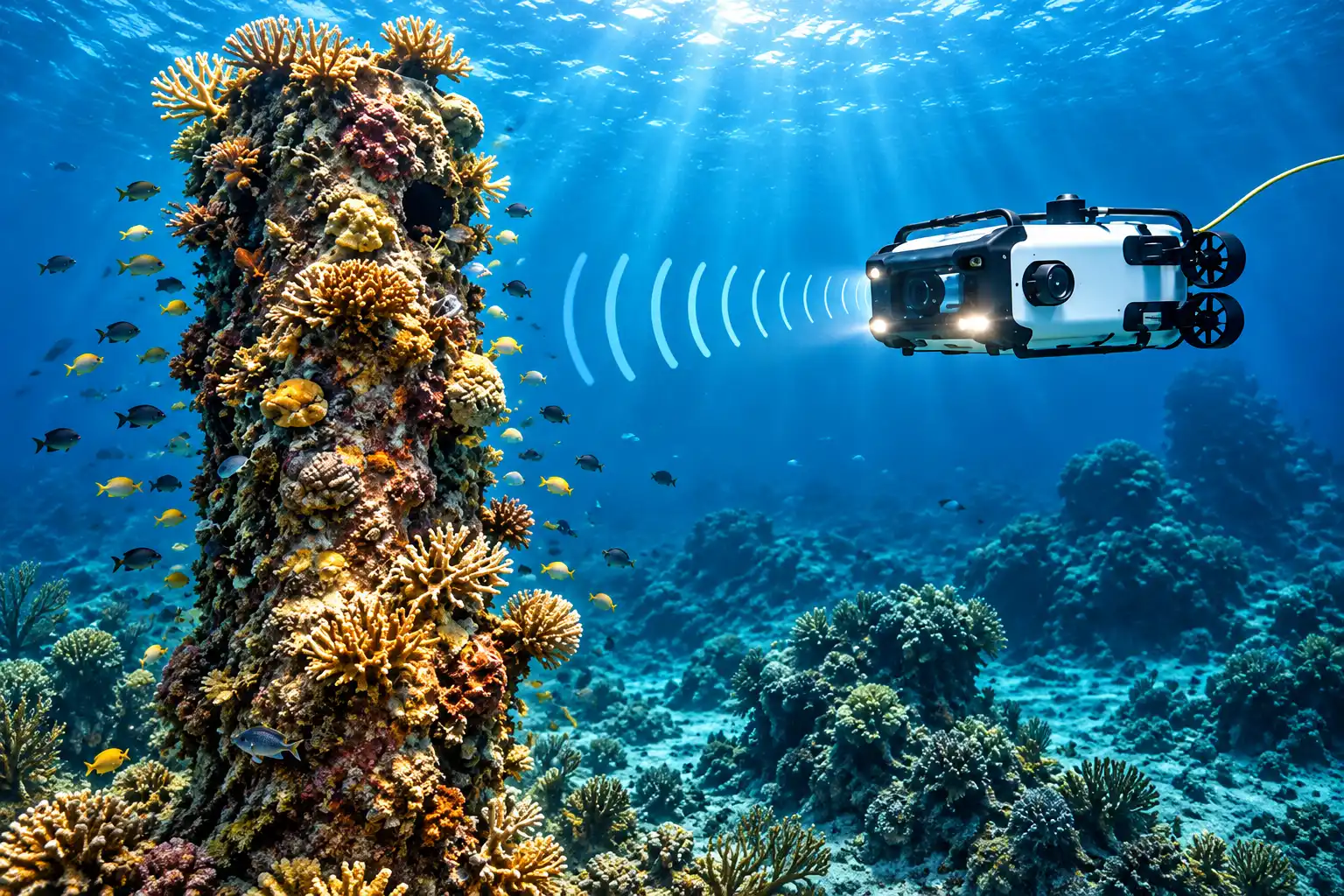
The Robot Hears the Reef Before It Sees It
Seth McCammon, a WHOI roboticist and lead author, put the problem in plain terms. Biologists have long known reefs are patchy. They have not had a reliable way to find those patches, map them at centimeter scale, and measure how busy they are.
We know that biodiversity on reefs isn’t distributed uniformly. But until now we haven’t really been able to reliably quantify that by finding these patchy hotspots, mapping them at the centimeter scale, and measuring just how active they really are.
Seth McCammon, WHOI roboticist, Woods Hole Oceanographic Institution release
CUREE carries cameras and hydrophones, which are underwater microphones, plus onboard computers that score sight and sound while the vehicle moves. Sound reaches tens of meters, even when animals sit in holes or blend into the coral. Cameras give species-level detail, but only up close. The robot uses the long-range cue to pick a target, then rolls in for the photograph.
It also has to go quiet to hear well. Earlier CUREE deployments already used drifting pauses so thruster noise would not drown the crackle of snapping shrimp, and that same constraint still sits inside the listening behavior.
FOUR BEHAVIORS ON ONE REEF
- Visual fish surveys: Close-range camera counts of the animals around a feature.
- Acoustic mapping: Hydrophone records that sketch biological noise over a wider patch.
- Sound-guided homing: Steering toward shrimp snaps or fish calls with no prior map of the reef.
- Sentinel tracking: Following a predator such as a barracuda to see which ground it keeps using.
On Joel’s Shoal those four behaviors independently marked the same pillar. In a separate demo the robot tailed a barracuda, a top predator, and treated the places it kept returning to as another kind of hotspot. Co-authors on the May 13 paper include Yogesh Girdhar, who leads WHOI’s WARP Lab and built CUREE, and T. Aran Mooney, a WHOI marine biologist whose lab has spent years recording Virgin Islands reefs.
The journal’s own clip shows the vehicle working that sight-and-sound loop on a Caribbean reef.
An #autonomous underwater vehicle equipped with a new framework can follow sights and sounds to detect and map #biodiversity hotspots in coral reefs. @WHOI
Learn more in Science #Robotics: https://t.co/mNiv2IQkAf pic.twitter.com/ThfGr9IXRJ— Science Robotics (@SciRobotics) May 14, 2026
Pillar Coral Is Already on the Endangered List
The coral at the center of the map is not a generic boulder. Dendrogyra cylindrus, pillar coral, grows as tall, cigar-like columns and is the only species in its genus. Those vertical shafts add shelter and feeding ground that low, flat coral does not, which is why fish pile up around them.
NOAA Fisheries changed pillar coral from threatened to endangered under the Endangered Species Act. The final rule published on December 17, 2024, and took effect on February 18, 2025, after the agency concluded the species is in danger of extinction throughout all or a significant portion of its range. The IUCN had already listed it as Critically Endangered on the Red List in an assessment dated 2021 and published in 2022.
PILLAR CORAL’S LEGAL SLIDE
- 2014: Listed as threatened under the U.S. Endangered Species Act.
- 2014-2020: Florida Reef Tract loses 93% of colonies and 86% of genotypes; the IUCN treats that northern edge as functionally extinct.
- 2021: IUCN assesses the species as Critically Endangered.
- December 17, 2024: NOAA publishes the final endangered rule.
- February 18, 2025: The endangered listing takes effect.
Stony coral tissue loss disease, SCTLD, is the main recent killer. It tore through Florida first and then across the Caribbean, including the U.S. Virgin Islands. NOAA’s species page still lists climate warming, acidification, habitat damage, pollution, and fishing beside disease. Lifespan can run to hundreds of years, which makes a standing pillar both a rare animal and a piece of architecture other species use.
CUREE’s hotspot sits on a living Dendrogyra column on a reef WHOI still calls healthy. That is the uncomfortable pairing. The structure that packed the fish is the same species U.S. law now treats as endangered.
Why Divers Still Miss These Crowded Pockets
Standard reef work still runs on divers with slates and cameras, plus a few fixed sensors. Those surveys are good at species IDs in a small box. They are costly, short, and risky, and they tend to follow set lines. A transect that misses one pillar by a few meters can miss the crowd.
Girdhar, the project principal investigator, has been blunt about what the robot is for. It is not a stand-in for a trained eye in the water.
That does not mean CUREE is a replacement for human observation of a reef. Instead, it’s meant to augment those capabilities and do things a human simply can’t.
Yogesh Girdhar, WARP Lab lead and CUREE principal investigator, Woods Hole Oceanographic Institution release
What a human cannot do is stay down for hours, hold a precise position on a messy reef, and chase a sound that started 80 meters away. The map hotspots at less than 1 meter problem in the paper is exactly that grain: mobile animals, not just coral cover, at a scale divers sample too sparsely to trust.
DIVER SURVEYS VERSUS CUREE
| Method | How far it sees or hears | Time on the reef | What it actually catches |
|---|---|---|---|
| Trained divers | Close range, line of sight | Limited by air, depth, and safety | Species IDs in a small, planned box |
| Cameras alone | Short visual range | Hours if the rig is mounted | Animals in frame; hidden life is missed |
| CUREE, sound then sight | Sound to 80 meters, cameras up close | Hours, on its own | The noisy patch first, then the species in it |
McCammon’s centimeter-scale maps are the product of that last row. Once the hotspot is marked, a diver can still go in and name every fish. The robot’s job is to stop the survey from treating the empty sand and the packed pillar as the same reef.
The Same Reef Noise Pulls Coral Larvae In
CUREE is listening to a cue other WHOI work already showed that young coral use. In March 2024, Mooney’s group reported that mustard hill coral larvae, Porites astreoides, settled at rates up to 7 times higher when a degraded reef played a tape of a healthy one.
The average lift was 1.7 times. Cups sat at 1, 5, 10, and 30 meters from the speakers, with the strongest settlement at 5 meters, and even the 30-meter cups beat silent control reefs. Nadège Aoki, then a WHOI doctoral candidate and first author, said the result means you can induce settlement by playing sounds. Mooney called the distance fade a check that the speakers, not some other reef trait, caused the change.
Those playback tests ran in June and July 2022 on the south coast of St. John, using three nights of a 2013 recording from Tektite Reef. CUREE’s Joel’s Shoal expeditions overlap that same Virgin Islands field season. The robot and the larvae study are not one experiment, but they share a claim: a noisy patch is a living patch, and both fish and coral larvae orient to it.
WHOI’s CUREE release states that coral reefs occupy less than 0.01% of the ocean and support roughly one quarter of all marine species. If the animals that make up that share cluster at pillars, then a restoration crew that plants coral on the quiet flat is working the wrong square meters. A manager who scores a whole shoal as one health number is doing the same thing with a spreadsheet.
WHOI Wants Fleets on Reefs Still Unmapped
Girdhar’s group built CUREE inside the WHOI Reef Solutions Initiative, and the May paper ends on a fleet, not a single vehicle. The pitch is simple. Most reefs are still poorly mapped. A set of small robots that hunt noise, then photograph the source, could tell a park or a fishery which corners still hold fish before a bleaching year or a disease wave wipes the structure.
Field tests of the hull go back at least to November 2021 in the U.S. Virgin Islands. The hotspot result is later, from the 2022-2024 Joel’s Shoal trips. Girdhar’s line on the release is that reefs are under hard pressure, and that conservationists need faster ways to see where life persists so they can put effort there.
The robot will not replace the biologist who still has to say which snapper is which. It also will not grow a new pillar coral. What it did on Joel’s Shoal is narrower and harder to shrug off. It found the crowded shaft, measured the pile-up at nearly 25 times the background, and did it by following sound from 80 meters out. That is a map of where the fish already are, on a species the United States has now listed as endangered.
Frequently Asked Questions
What Does the Name CUREE Stand For?
CUREE stands for Curious Underwater Robot for Ecosystem Exploration. Girdhar’s WARP Lab designed it for shallow reefs as part of WHOI’s Reef Solutions Initiative, and a single operator can put it in the water from a small boat. The May 13, 2026 authors are Seth McCammon, Levi Cai, Daniel Yang, John Walsh, John D Cast, T. Aran Mooney, and Yogesh Girdhar, in Science Robotics volume 11, issue 114.
Can CUREE Follow a Single Animal, Not Just a Noisy Patch?
Yes. The 2026 barracuda run is the headline case, but a 2023 CUREE paper already showed the same hull following a barracuda in midwater and a stingray on the bottom for several minutes each. The later hotspot study treats that tracking as a fourth behavior, using the animal as a scout for ground that matters.
How Far Can CUREE Hear Compared With a Camera?
In controlled tests it tracked sound sources from up to 80 meters and closed on natural hotspots over 30 meters. Cameras still only work at short range, which is why the code is built to hear first. Passive sound also picks up animals that are hidden or camouflaged, which a straight swim-by photo survey will skip.
Where Is Pillar Coral Protected in U.S. Waters?
It is listed as endangered throughout its range under the Endangered Species Act, effective February 18, 2025. Critical habitat is designated in Florida, Puerto Rico, and the U.S. Virgin Islands, including all islands of St. Thomas, St. John, and St. Croix in waters 1 to 25 meters deep. NOAA also notes CITES Appendix II and SPAW Annex III listings across the wider Caribbean.
Which Coral Larvae Responded to Healthy Reef Sounds?
Mustard hill coral, Porites astreoides, in the June and July 2022 St. John tests. Settlement averaged 1.7 times higher with the healthy-reef tape, peaked at 5 meters from the speaker, and stayed above silent reefs out to 30 meters. A later WHOI trial found golfball coral larvae also settled more around healthy-reef sound, which is why the lab treats the cue as more than a one-species quirk.

The BMW iX4 Undercuts Mercedes and Trails Its Twin

Scotland’s Ten Big Supermarkets Already Hold the Weekly Shop

Scotland EMS Faces a State Probe After a Wagram Death

Meritz Signs Ripple to Race Korea’s 2027 Token Rules

Pocognoli’s First Camp Leaves Scotland Third and Exposed

Volkswagen Sells the Osnabruck Plant to Clear a Board Fight

Tata Motors’ Iveco Tender Opens as Holders Still Decide

Saksham Gaur Finds He Is His Own Company’s Client

Onimusha Way of the Sword Preload Hits a Windows 11 Wall

Apple’s Foldable iPhone Hinges on Samsung Display Supply
-
 AUTO1 month ago
Volkswagen Sells the Osnabruck Plant to Clear a Board Fight
-
 AUTO2 months ago
Tata Motors’ Iveco Tender Opens as Holders Still Decide
-
 BUSINESS2 months ago
Saksham Gaur Finds He Is His Own Company’s Client
-
 GAMING2 months ago
Onimusha Way of the Sword Preload Hits a Windows 11 Wall
-
 NEWS2 months ago
Apple’s Foldable iPhone Hinges on Samsung Display Supply
-

 ENTERTAINMENT3 years ago
What is SD on Amazon Prime? – All You Need to Know
-

 AUTO2 months ago
Simple Wave Chases Range as Ather Konarc Cuts Price
-

 NEWS2 months ago
iQOO 16 Locks 8,400 mAh While 100W Charging Holds