
NEWS
Congo Declares an Ebola Peak WHO Refuses to Call
Kinshasa says the DRC Ebola outbreak has peaked, yet WHO calls it too early and the only licensed shot targets Zaire virus.

Congolese health officials said on 15 September that the Bundibugyo Ebola outbreak has peaked, with new cases down from about 120 a day to about 80. Samuel Roger Kamba, the health minister, said the outbreak was under control and that 10 of 62 affected health zones had gone more than 22 days without a new case.
The same day, at a Geneva briefing, WHO’s Olivier le Polain said it was too early to say a peak had passed. Government figures put confirmed cases at 7,258 and deaths at 3,510 across seven provinces, a case fatality rate of 48.4%.
Kinshasa Calls a Peak That Geneva Will Not
Kamba has been making the case in stages. On 12 September he pointed to “encouraging signs” since “the peak reached in mid-August” and said spread had been slowing. He put the high-water mark at about 120 new cases a day and the later run rate at about 80. Six zones, he said, had gone more than 42 days without a case, and four more had gone more than 21 days, so those 10 could come off the active list.
“We are fighting a very dangerous virus that is killing many of our people. Today, we can say that the outbreak is under control,” Kamba said. He added that the figures “must not lead us to lower our guard.”
Julien Harneis, the United Nations special Ebola coordinator, would not follow him there. He told the Geneva briefing that teams were seeing progress in parts of Ituri, still the centre of the outbreak, and that some places were now in hand. He also said cases were still rising fast in North Kivu, especially in Butembo.
It remains a deadly and a massive epidemic. There are some areas of progress, but nonetheless, in other areas, we continue to see growth in cases.
Julien Harneis, UN special Ebola coordinator, Geneva briefing
Le Polain, who heads epidemiology and analytics for response in WHO’s Health Emergencies Programme, said an outbreak can look better and then climb again. “It’s too early to confidently say we have passed a peak,” he said. “It will take many, many months to get this outbreak under control fully, and it will require significant support.”
WHERE EXPERTS DISAGREE
- The peak: Kamba dates it to mid-August on the drop from about 120 daily cases to about 80; le Polain says that dip is not enough to call a peak.
- Control: Kamba says the outbreak is under control; Harneis says it is still one epidemic in some places and several in others, with North Kivu still growing.
- The public test: Iracan Gratien de Saint-Nicolas, the MP for Bunia, says a control claim has to rest on published indicators, not a single daily-case number.
Iracan warned against “triumphalism” and asked for the numbers behind the announcement. Jean Kaseya, director general of the Africa Centres for Disease Control and Prevention, had set a stricter bar when he visited Bunia in August: epidemiologists, he said, call a peak when new cases all come from the known contact list. He also said 60 to 70% of deaths were still happening in the community, outside treatment centres, which is the pattern of an outbreak that is still finding people late.
How Fast the Bundibugyo Wave Outran 2018
The Democratic Republic of the Congo declared the outbreak on 15 May 2026 in Ituri, its 17th Ebola outbreak since the disease was identified in 1976. WHO declared a Public Health Emergency of International Concern two days later, on 17 May. The virus is Bundibugyo, a species that had produced only two recognised human outbreaks before this one.
U.S. CDC situation pages now call this the second-largest Ebola outbreak on record, and the fastest of the modern comparisons. Confirmed cases passed 1,000 within 40 days of the response starting. The 2018 outbreak in eastern Congo took about 235 days to cross that line, and that wave had a licensed Zaire vaccine to throw at it.
HOW THIS OUTBREAK COMPARES
| Outbreak | Confirmed or total cases | Deaths | Case fatality |
|---|---|---|---|
| DRC Bundibugyo, 2026 (as of 15 Sept) | 7,258 | 3,510 | 48.4% |
| DRC Zaire, 2018 to 2020 | 3,470 | 2,287 | 66% |
| West Africa Zaire, 2014 to 2016 | 28,652 | 11,325 | 39.5% |
| Uganda Bundibugyo, 2007 | 149 | 37 | 24.8% |
The 2018 to 2020 North Kivu and Ituri epidemic, Congo’s previous high-water mark, ended with 3,470 cases and 2,287 deaths, a case fatality rate WHO put at 66%. Responders vaccinated more than 303,000 people with rVSV-ZEBOV, the shot now sold as Ervebo, and still needed 23 months to close the file. This Bundibugyo wave has already passed that case count in four months, without a licensed match for the virus.
Congo’s 2018 Epidemic Took Almost Two Years
That earlier outbreak stayed inside 29 health zones in three provinces. It still took a war-zone response, more than 250,000 registered contacts, and a 42-day quiet period after the last patient tested negative twice before Kinshasa and WHO would call it over on 25 June 2020. The West Africa epidemic of 2014 to 2016 remains the only larger Ebola event, at 28,652 cases and 11,325 deaths, a 39.5% fatality rate on those CDC figures, and it ran for more than two years after its peak week.
Bundibugyo Had Never Looked Like This
Until 2026, Bundibugyo was the smaller cousin. The 2007 Uganda outbreak that gave the virus its name ran to 149 cases and 37 deaths, a 24.8% fatality rate. WHO puts the 2012 Isiro outbreak in Congo at a historical fatality rate of 50%. A September Disease Outbreak News note calls the present wave the largest Ebola outbreak ever recorded in Congo, of any species, and the largest Bundibugyo event on record.
Fatality on the current count sits at 48.4%, in the band of those earlier Bundibugyo outbreaks and well above West Africa’s Zaire wave. The species is not “milder” in this setting. It is simply the one for which the stockpile was not built.
What a Controlled Ebola Outbreak Is Supposed to Show
WHO’s rule for declaring an Ebola outbreak over is not a falling daily curve. An outbreak can be called over only after 42 days, twice the maximum incubation period, with no new confirmed or probable case after the last infectious contact. Uganda met that test. Congo has not.
Uganda recorded 21 confirmed and probable cases and 3 deaths, with the last confirmed case on 21 June. The last patient left care on 16 July. Africa CDC and WHO welcomed the end of Uganda’s Bundibugyo outbreak on 27 August, 42 days after that discharge. South Kivu, inside Congo, has reported no confirmed case since 29 May, which already clears the same window locally. The national file does not.
Iracan, the Bunia MP, listed the checks he said had been left out of the government announcement. They are the boring ones outbreak teams actually use.
THE CONTROL CHECKS STILL MISSING FROM THE BRIEFING
- A lasting drop: New cases falling, and staying down, for 7 to 21 days, not a single comparison with the mid-August high.
- Fewer deaths: A published fall in deaths, not only in new confirmations.
- Fewer active zones: A clear shrink in the map of transmission, beyond the 10 zones Kamba wants to strike off.
- Known contacts: Most new cases coming from people already on the contact list, which is the peak test Kaseya described in Bunia.
- Tracing and burial: A high share of contacts found and followed, and a high share of dead buried by trained teams.
Some of those numbers do exist, and they do not all point one way. European CDC, using Congolese data through 12 September, said 88% of identified contacts were under follow-up and that 923 patients were in isolation. It also said 62 of 167 health zones were affected across seven provinces. Kamba’s 10 quiet zones, if they hold, would still leave 52 on the list. A 42-day clock on six of them is a real gain. It is not an end date.
The Only Licensed Shot Was Built for Zaire
There is still no licensed vaccine or specific drug for Bundibugyo virus disease. The shot Congo has been able to move at scale is Ervebo, Merck’s rVSV-ZEBOV vaccine, written for Zaire ebolavirus, the species behind the 2014 to 2016 West Africa disaster and the 2018 to 2020 Congo war-zone outbreak.
In May, a WHO expert panel judged the evidence too weak to use that mismatched shot as a public campaign, warning that a vaccinated person who still fell ill could break trust in Ebola vaccination. By late July the same advisory group had reversed far enough to recommend that Ervebo go straight into a Phase 3 trial of Ervebo against Bundibugyo, on the back of lab and animal data and a large human safety file from Zaire campaigns.
The International Coordinating Group on Vaccine Provision then released 70,000 Ervebo doses from the Gavi-funded global stockpile after Kinshasa asked for them. Of that allocation, 20,000 doses are meant for the Phase 3 trial and 50,000 for frontline and health workers, WHO and Africa CDC said. First shipments reached Kinshasa in late August, and Kamba launched vaccination of health workers in Tshopo later that month. Gavi is separately putting US$40 million from its First Response Fund into Bundibugyo-specific candidates.
Sania Nishtar, Gavi’s chief executive, said the Congo outbreak is already the country’s largest “and could well become the largest outbreak ever,” which is why the alliance wants Ervebo tested in the field while species-specific shots are still in early trials. Early lab and animal work suggests some cross-protection; WHO has been clear that this remains unproven in people. Ring vaccination, the tactic that helped close Zaire outbreaks, is being run here as a bet and a study, not as a registered Bundibugyo tool.
Antibody cocktails and antivirals, including Mapp’s MBP134 and remdesivir, have been put into adaptive trials in the region. None is an approved Bundibugyo treatment. Supportive care, isolation, contact tracing, and safe burial are still the response, as they were before Ervebo existed.
Butembo Keeps Rising After Sud-Ubangi’s First Death
The map is what makes a national “peak” so hard to defend. Ituri is still the centre. North Kivu is the problem that will not sit still. As of 12 September the province had 1,269 confirmed cases, 555 of them in the previous 21 days. Thomas Paerisch, a public health specialist with Médecins Sans Frontières recently sent to Congo, called North Kivu “alarming” because of insecurity, dense towns, and constant movement.
THE 12 SEPTEMBER SNAPSHOT
- Isolation beds: 923 patients in isolation, on the European CDC cut of Congolese data through 12 September.
- Contact follow-up: 88% of identified contacts were being followed in affected provinces on that cut.
- North Kivu pace: 555 of the province’s 1,269 confirmed cases fell in 21 days, which is a climb, not a peak.
- Active map: 62 health zones across seven provinces, with South Kivu quiet since 29 May and Sud-Ubangi newly lit.
Sud-Ubangi, in the north-west, became the seventh province when a 23-year-old man died after testing positive. He had left South Kivu on 10 July, travelled, and re-entered Congo before reaching Bulu health zone, which borders the Central African Republic and Congo-Brazzaville. One imported death does not make a western epidemic. It does mean the chain is long enough to jump a country-width after a claimed national peak.
Harneis’s line about “many different locations” is the plainer description. A fall in the national daily count can be real in Bunia and false in Butembo at the same time. CDC still lists conflict, attacks on health workers, weak labs, population movement, and mistrust as the reasons this outbreak outran the last one. Those conditions did not lift because Kinshasa held a briefing.
Burial Crews and a Mother Who Wants Ordinary Days
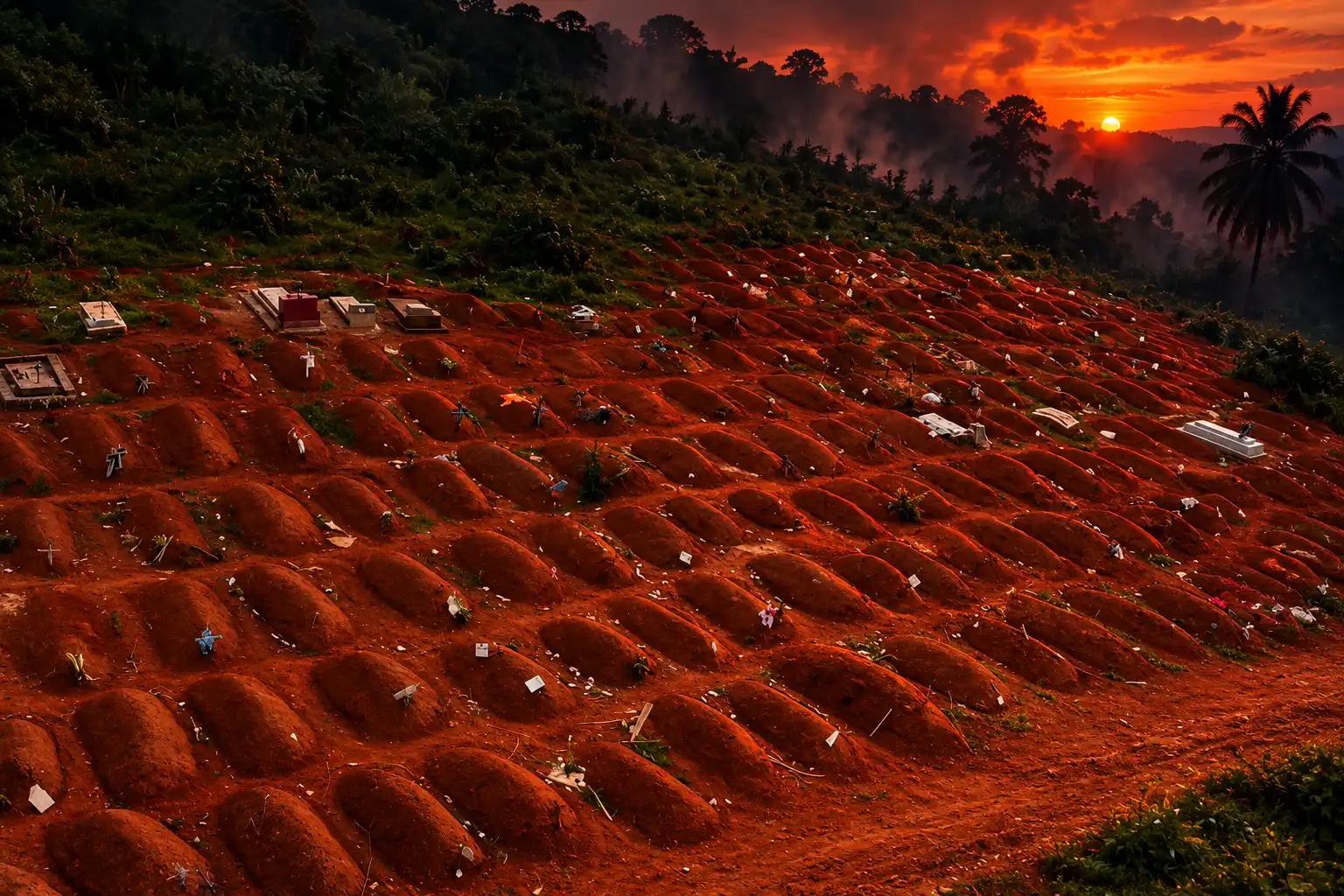
Safe-burial teams in eastern Congo say they are still being assaulted by some residents while they collect bodies, take samples, and disinfect homes. That is not a side detail. If families hide the dead, the contact list that Kaseya called the true peak test never gets written. Community deaths at 60 to 70% of the total are how an outbreak keeps a second life outside the treatment centre.
Schools have gone back as well. In Bunia, Angele Magani, the mother of a schoolboy, said she did not know which child came from which household or who in that household was ill. UNICEF has been putting prevention drills into classrooms and posted a video of a nine-year-old, Obed, and his principal walking through the new rules.
It’s back-to-school season and Obed, 9, is eager to learn!
With the ongoing Ebola outbreak in DR Congo, preventive measures have been put in place in schools with UNICEF’s support to protect students and staff.
Watch as Obed and his school principal, Déborah Ageno, tell us… pic.twitter.com/aPvK0GIK4r
— UNICEF (@UNICEF) September 15, 2026
In Rwampara, Ituri, Léa Munyere, 36, a mother of four, had already lost two close friends. She was glad to hear health officials say the disease was in hand, and she was not treating that as a finish line.
We hope the disease will soon be declared over. It has robbed us of the people we cherish so much since it was first reported. We just want to get back to our normal lives.
Léa Munyere, Rwampara, Ituri
Kamba is not claiming the outbreak is finished. He is claiming the curve has bent and that six zones have earned the 42-day quiet that Uganda already used to close its file. WHO will not grant the peak. About 80 confirmed cases are still being logged on a typical day, Butembo is still climbing, and the licensed vials in the freezer were packed for a different virus.
Disclaimer: This article is news reporting and analysis of an ongoing outbreak, based on official case counts, public briefings, and published guidance. It is informational only and is not medical advice, a diagnosis, or a guide to treatment, vaccination, or travel. Anyone who may have been exposed to Ebola, or who has fever or other symptoms after time in an affected area, should contact a qualified physician or local public health authority and follow their instructions. Case totals, death counts, zone lists, and vaccine-trial status are those published by the cited health authorities as of 15 September 2026 and can change as investigations continue.

The BMW iX4 Undercuts Mercedes and Trails Its Twin

Scotland’s Ten Big Supermarkets Already Hold the Weekly Shop

Scotland EMS Faces a State Probe After a Wagram Death

Meritz Signs Ripple to Race Korea’s 2027 Token Rules

Pocognoli’s First Camp Leaves Scotland Third and Exposed

Volkswagen Sells the Osnabruck Plant to Clear a Board Fight

Tata Motors’ Iveco Tender Opens as Holders Still Decide

Saksham Gaur Finds He Is His Own Company’s Client

Onimusha Way of the Sword Preload Hits a Windows 11 Wall

Apple’s Foldable iPhone Hinges on Samsung Display Supply
-
 AUTO2 months ago
Volkswagen Sells the Osnabruck Plant to Clear a Board Fight
-
 AUTO2 months ago
Tata Motors’ Iveco Tender Opens as Holders Still Decide
-
 BUSINESS2 months ago
Saksham Gaur Finds He Is His Own Company’s Client
-
 GAMING2 months ago
Onimusha Way of the Sword Preload Hits a Windows 11 Wall
-
 NEWS2 months ago
Apple’s Foldable iPhone Hinges on Samsung Display Supply
-

 ENTERTAINMENT3 years ago
What is SD on Amazon Prime? – All You Need to Know
-

 AUTO2 months ago
Simple Wave Chases Range as Ather Konarc Cuts Price
-

 NEWS2 months ago
iQOO 16 Locks 8,400 mAh While 100W Charging Holds