
NEWS
Senate Bill Would Cap Athlete Pay and Spare Coaches
Cruz wants a fast Senate vote on a college sports bill that would lock in an athlete pay cap, leave coaches uncapped, and still needs 60 votes.

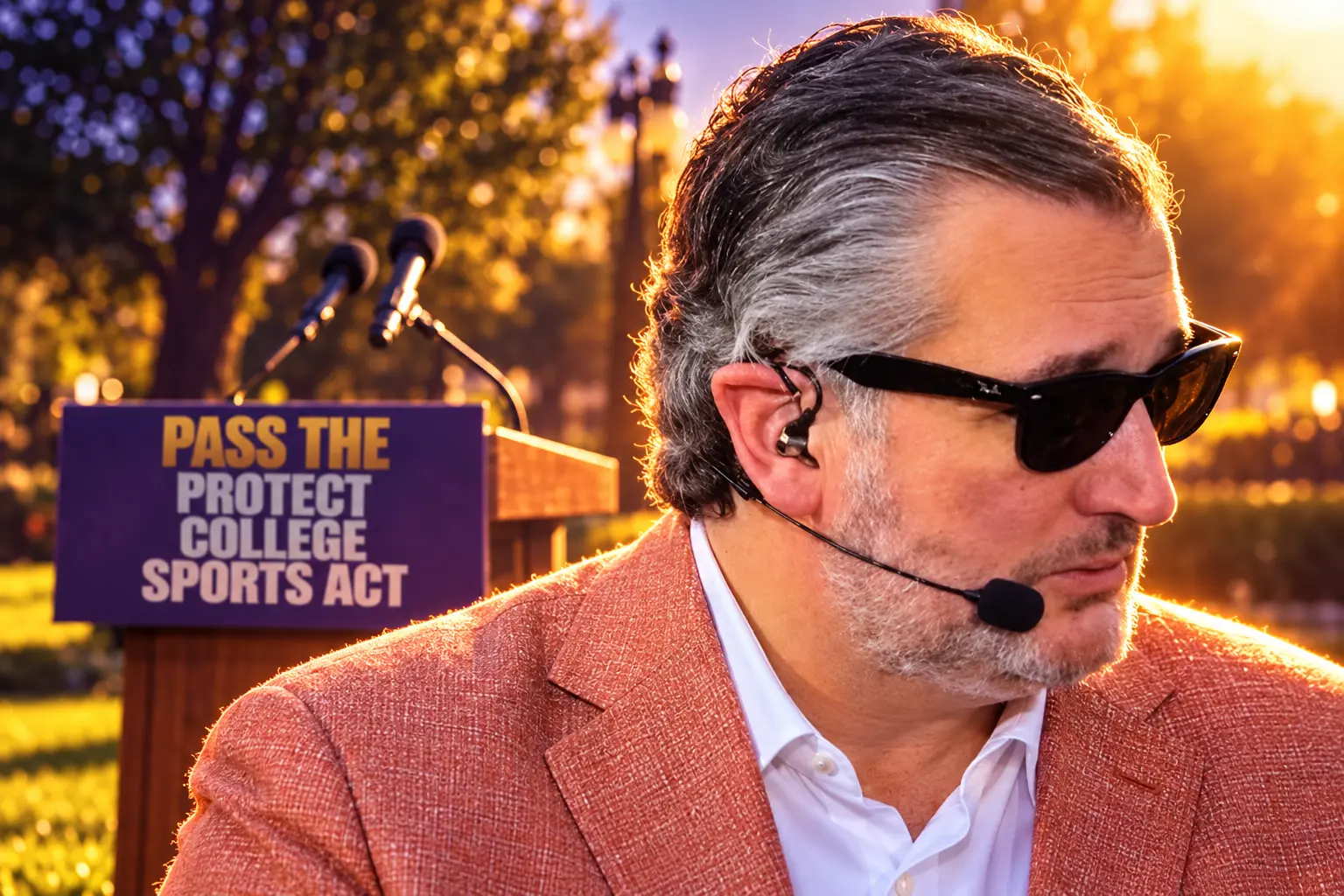
Sen. Ted Cruz said Sept. 14 he expects a Senate vote within days on a bill that would put a federal cap on college athlete pay. The Texas Republican, standing with Democratic Sen. Maria Cantwell of Washington, told a Washington press conference he wants the Protect College Sports Act of 2026 through the chamber this week or next, then into a House that has already killed a harder version of the same bargain.
Major conferences, Senate leaders, and President Donald Trump have lined up behind it. The bill still has to clear 60 votes in a 53-47 Senate, and it does not cap what coaches can earn.
Cruz Took 10 Minutes on College GameDay
Cruz spent nearly 10 minutes on ESPN’s College GameDay on Sept. 12 making the pitch from Austin, with University of Texas fans booing behind him. Two days later he was back in Washington with Cantwell, current athletes, and coaches, saying he had “a very high level of confidence that the House will pass this bill” if the Senate sends over a big bipartisan roll call.
Cantwell called the package a first-time federal statute on NIL rights and on revenue sharing. She also said schools are running to state legislatures for bailouts “because of the runaway arms race in sports spending.” Arkansas men’s basketball coach John Calipari told the same room the bill “clears up about 75-80% of our issues.” Gonzaga’s Mark Few called it “far, far away the best thing we got out there right now.”
The press conference is the sponsors’ own record of that Monday push.
https://www.youtube.com/watch?v=Zy0GqGhmzwA
Nick Saban, Deion Sanders, and Texas Tech booster Cody Campbell have been in national ads as football season opened. Saban’s spot says the bill “ends the NIL chaos” and safeguards women’s sports and Olympic programs. Saving College Sports, the 501(c)(4) group behind some of those ads, has been running them into the Senate’s return.
ESPN then booked NAACP CEO Derrick Johnson for SportsCenter on Sept. 15. Cruz got the Saturday window that sets the week’s sports conversation. Johnson got a Tuesday night counter-slot after the NAACP asked for GameDay time of its own.
A $20.5 Million Cap Would Not Touch Coach Pay
The House v. NCAA settlement, given final approval on June 6, 2025, already lets Division I schools share athletic revenue with players. The first-year ceiling was $20.5 million per school for 2025-26, set at 22 percent of average Power 5 athletic revenue, with 4 percent annual bumps. Direct school pay started July 1, 2025. Back damages in that deal are $2.78 billion.
The Senate bill would keep that cap after the settlement expires and give the NCAA and conferences a legal shield to enforce it. A separate “athlete retention fund,” added to bring the Big Ten and SEC on board, would let a school spend another $22.5 million a year, or up to $27.5 million if it puts more into women’s and Olympic NIL, to keep players who have already spent a full season on campus.
Coach salaries are not in that box. Public payroll records at Georgia show how the other side of the ledger still works.
PAY UNDER THE BILL, AND OUTSIDE IT
| Who | What the bill limits | Money already on the books |
|---|---|---|
| Athletes, school revenue share | House-style cap, plus the retention fund | $20.5 million cap in 2025-26; extra retention pool up to $22.5 million ($27.5 million with added women’s and Olympic NIL) |
| Football head coaches | No salary cap | Top contracts sit above $13 million a year; Georgia’s Kirby Smart is listed at $13.003 million |
| Georgia athletic department | Coach pay from athletic revenue and athletic donations stays open | $66,999,629 total athletic pay on July 1, 2026, up from $63,046,220 |
Georgia’s year-over-year athletic payroll rise was 6.3 percent. Nineteen people there now make at least $500,000, including men’s basketball coach Mike White at $4.010 million and two football coordinators at $2.2 million each. Athletic director Josh Brooks is at $1.6 million.
Section 114 of the bill is easy to misread as a coach cap. It is not. Schools with more than $80 million in athletic revenue could not pay coaching staff more than $500,000 from money that is not college sports revenue or a gift to the athletic department. Athletic-department cash and booster gifts could still fund the $13 million contracts.
Sen. Chris Murphy, a Connecticut Democrat, put that contrast on a reporters’ call the same Monday.
This bill protects the billions of dollars that coaches and sports industry executives are making over the suppression of compensation for some of the most highly valued athletes in the world. What we’re being asked to do is to basically allow colleges and conferences and the NCAA to illegally collude.
Sen. Chris Murphy, D-Conn., reporters’ call, Sept. 14, 2026
Murphy also said the bill “doesn’t stop billionaires from spending money on athletic facilities” or from “directly subsidizing the salaries of coaches.” The only slice it limits, he said, is “the relatively small slice of money in the system that goes to athletes.”
What the Protect College Sports Act Would Change
Cruz and Cantwell unveiled the bill on May 27 and formally introduced it on June 2 as S. 4668, with Sens. Eric Schmitt of Missouri and Chris Coons of Delaware. Sens. Peter Welch, Shelley Moore Capito, Pete Ricketts, John Hickenlooper, and John Hoeven later signed on. The Commerce Committee sent it to the floor 19-9 on June 18.
The sponsors’ own targeted antitrust protection for schools sits beside a long list of athlete-facing rules. Those rules are real. They are also the wrapping around the cap.
RULES THE BILL WOULD WRITE INTO FEDERAL LAW
- NIL rights: Athletes could earn NIL money and hire agents without losing a scholarship, with deals over $600 in 12 months disclosed within five days.
- Agent fees: Endorsement commissions would be capped at 5 percent, with a public registry and a private right of action against abusive agents.
- Transfers: One penalty-free transfer, then extra moves only for cases such as a coach leaving, a dropped sport, graduate school, or certain misconduct.
- Eligibility: A five-year clock, with Cruz describing a “hard cap at age 24,” and a bar on athletes who already earned pro pay beyond prize money.
- Medical coverage: Division I schools would cover sports-injury costs during play and for five years after the last game, plus a $60 million trust (rising by $5 million a year, up to $100 million) for smaller schools and long-term cases.
- Scholarships: Aid could not be cut for performance, injury, illness, or roster cuts.
- Voice: At least one-third of certain association boards and rulemaking panels would have to be current or recent athletes, with a no-cost ombuds office.
- Coaches: Football coaches and key staff could not take over another FBS job during the same season, a rule written after Lane Kiffin’s 2025 in-season move from Ole Miss to LSU.
- Employment: Section 122 says the Act does not decide whether athletes are employees.
State NIL, transfer, and eligibility laws that clash with the federal rules would be overridden. Civil rights, tort, criminal, privacy, contract, and campus-safety laws would stay. CatholicVote is already pressing for a carve-out so state laws on women’s categories cannot be swept up in that override, a fight the sponsors have tried to close by saying the bill does not rewrite Title IX.
Two Antitrust Shields the NCAA Has Sought Since Alston
The load-bearing ask is legal immunity. Section 118 would protect schools, conferences, and athletic associations when they enforce the bill’s rules on pay, eligibility, transfers, agents, recruiting, and mid-season coaching moves. They could also designate the College Sports Commission, the House-settlement enforcement body, to police the revenue-share cap.
That is the shield the NCAA has wanted since the Supreme Court’s Alston ruling opened the pay cases that produced House. Athletes could still sue for violations of the statute’s affirmative duties. They could not attack the cap itself as an antitrust conspiracy.
Title II adds a second shield. If 75 percent of current FBS schools agree, they could pool and sell media rights the way the NFL, NBA, MLB, and NHL have done since the Sports Broadcasting Act of 1961. NCAA men’s basketball tournament rights would stay out of that pool. Participating schools would have to offer a free local broadcast of football and basketball in each home market, send at least 15 percent of remaining pooled revenue out in equal shares, and keep women’s and Olympic roster and scholarship levels at 2024-25 marks.
Large-revenue conferences would be barred from merging if they sit above $700 million a year, and a separate cap would stop such a league at 19 schools when it swallows a smaller independent. Cruz has sold that clause as a brake on a Big Ten-SEC “super league.” The two leagues denied they were building one, then endorsed the bill on Aug. 1 after the retention fund was added.
The Athletes Who Fill the Stadiums Are Mostly Black
Murphy has spent the month telling colleagues this is a civil-rights vote. He said the “unprecedented restraint on compensation” falls hardest on young Black athletes, and that it is hard to defend a crackdown on money “only when it pertains to largely Black athletes who are being vastly underpaid in football and basketball.”
Johnson made the same case in an Aug. 4 letter to Majority Leader John Thune and Democratic Leader Chuck Schumer. Schools in the ACC, SEC, and Big 12, he wrote, have generated approximately $16 billion in athletic revenue over the past decade, excluding NIL. Black men make up about 66 percent of their football rosters, a share that does not match Black enrollment on those campuses.
This bill has nothing to do with protecting college sports. Any college sports legislation must protect the whole ecosystem, including student-athletes, universities, conferences and historically Black colleges and universities by guaranteeing athletes have a real voice, fair economic rights, long-term health and educational security.
Derrick Johnson, CEO, NAACP, reporters’ call with Sen. Chris Murphy, Sept. 14, 2026
The Congressional Black Caucus has been there since June. Chair Yvette Clarke’s letter asked Cruz and Cantwell to pause consideration of the college sports bill while college-sports leaders stayed quiet on Southern map-drawing after the Supreme Court’s Louisiana v. Callais decision. In August the caucus said it would not be “complicit” in a bill that sets the economic future of Black athletes “without their meaningful participation.”
The AFL-CIO and its sports council opposed the package in August. Michele Roberts, the former WNBA union chief, and DeMaurice Smith, who ran the NFL Players Association from 2009 to 2023, have been feeding the caucus and Murphy. “What I find astounding is that all of this is being done without athletes,” Roberts said. “Beyond it being horrific legislation, it’s even being done without the participation of the labor that’s bringing in all the wealth.”
Olympic Sports Get a Roster Floor, HBCUs Get a Grant
Every ad leans on women’s sports and Olympic sports. The text does freeze Division I and FBS sponsorship minimums and requires large and mid-sized schools to keep grant-in-aid and roster spots for non-revenue sports, including Olympic and women’s sports, at 2024-25 levels. Championship medical care, lodging, meals, and travel would have to meet comparable standards for similarly situated men’s and women’s programs. Para-athletes could still walk on without blowing House roster limits.
Those floors are why Saban and Cantwell can say the bill saves sports that do not print TV money. They do not change the fact that football and men’s basketball generate the rights fees that fill the $20.5 million pool, or that most of that pool will still go to those two sports.
Title III of the same bill would create a federal grant program for broadband and media gear at HBCUs and a 24-member congressional commission with reserved HBCU seats. That is the sponsors’ answer to Johnson’s HBCU point. It has not moved the CBC, which says meetings are not the same thing as a real voice over the cap.
Cantwell has used a closer-to-home budget example. Washington State’s governing board diverted $20 million to athletics to cover a shortfall, which she called a warning that the spending spiral is already hitting taxpayers and academic budgets. The bill’s media-pool clause is meant to spread rights money beyond the two richest leagues. The price of that spread is the legal shield for the pay cap.
The House Bill That Tried to Ban Athlete Employment
This is the second major college-sports bill of the 119th Congress. The SCORE Act, the House vehicle, would have barred athletes from being classified as employees and given the NCAA a wider immunity. House leaders pulled it more than once. The CBC’s opposition, and the loss of Democratic co-sponsors, left it without a floor.
HOW THE FIGHT GOT TO THIS WEEK
- June 6, 2025: Judge Claudia Wilken grants final approval to the House v. NCAA settlement, including $2.78 billion in back damages and a $20.5 million year-one revenue-share cap.
- July 1, 2025: Direct school-to-athlete pay begins for schools that opt in.
- May 27, 2026: Cruz and Cantwell unveil the Protect College Sports Act after SCORE stalls in the House.
- June 18, 2026: Senate Commerce advances S. 4668 on a 19-9 vote.
- August 1, 2026: The Big Ten and SEC endorse the bill after the retention fund is added.
- August 5, 2026: Thune files cloture. The Senate adjourns on August 8 without a vote.
- September 12-14, 2026: Cruz appears on College GameDay, then holds the Washington presser with Cantwell and coaches.
House Energy and Commerce Chair Brett Guthrie and Education and Workforce Chair Tim Walberg said after the Senate text dropped that Congress cannot deliver “real stability” while leaving the employee question open. Cantwell has said that question can wait. The neutrality clause is the concession that kept some Democrats on the bill and kept SCORE’s core demand out of it.
Walberg is already on a second track. On Sept. 14, he and Sen. Jon Husted of Ohio introduced a separate bill that would limit international athletes to 20 percent of each varsity roster. “American colleges and universities should first and foremost provide opportunities for American students,” Walberg said. That fight is not the Cruz-Cantwell vote, but it shows how many ways Congress is trying to police who gets a roster spot now that the roster has a price.
Cloture Still Needs 60 Votes After August’s Miss
Republicans hold 53 seats. If every Republican votes yes, seven Democrats still have to join them. Schmitt said in July that supporters “probably have 60 votes.” Aides said the same thing in September, and they said it in July before the bill missed the recess. Murphy and Sen. Cory Booker have spent the extra weeks briefing the left that this is a wage-and-race vote, not a chaos-cleanup vote.
The Senate came back on Sept. 14 with the CLARITY crypto bill also queued for cloture. If that fight eats the floor, college sports slips again. If CLARITY fails fast, Cruz’s bill can come up in the Sept. 15-23 window Thune already reserved once. Even a Senate pass would still need the House, which Cruz is trying to bounce with a lopsided roll call before November’s midterms scramble both chambers.
Calipari called the bill “a bite out of the apple.” Few said it is imperfect and still the best thing on the table. Murphy’s reply is that the bite is taken from the players, and that the apple left on the table is coach pay, facilities, and a legal shield the NCAA could not win in court. Johnson’s SportsCenter booking on Sept. 15 is the other side’s attempt to say that out loud on the same network that gave Cruz his Saturday.

The BMW iX4 Undercuts Mercedes and Trails Its Twin

Scotland’s Ten Big Supermarkets Already Hold the Weekly Shop

Scotland EMS Faces a State Probe After a Wagram Death

Meritz Signs Ripple to Race Korea’s 2027 Token Rules

Pocognoli’s First Camp Leaves Scotland Third and Exposed

Volkswagen Sells the Osnabruck Plant to Clear a Board Fight

Tata Motors’ Iveco Tender Opens as Holders Still Decide

Saksham Gaur Finds He Is His Own Company’s Client

Onimusha Way of the Sword Preload Hits a Windows 11 Wall

Apple’s Foldable iPhone Hinges on Samsung Display Supply
-
 AUTO1 month ago
Volkswagen Sells the Osnabruck Plant to Clear a Board Fight
-
 AUTO2 months ago
Tata Motors’ Iveco Tender Opens as Holders Still Decide
-
 BUSINESS2 months ago
Saksham Gaur Finds He Is His Own Company’s Client
-
 GAMING2 months ago
Onimusha Way of the Sword Preload Hits a Windows 11 Wall
-
 NEWS2 months ago
Apple’s Foldable iPhone Hinges on Samsung Display Supply
-

 AUTO2 months ago
Simple Wave Chases Range as Ather Konarc Cuts Price
-

 NEWS2 months ago
iQOO 16 Locks 8,400 mAh While 100W Charging Holds
-

 NEWS1 month ago
The Frame Pro’s $1,200 Labor Day Cut Needs a Soundbar