
NEWS
Xiaomi’s Privacy Screen Already Costs Side-On Image Quality
Xiaomi’s 18 Pro ships SuperPixel 2.0 privacy as standard in China, but a September 25 clip already shows a weaker off-axis picture with the feature off.

Xiaomi’s 18 Pro went on sale in China on September 23 with a hardware privacy screen that the company said would not dim the picture at normal viewing distances. Two days later, a comparison video of that same panel sat next to last year’s 17 Ultra and looked weaker from the side, with privacy mode still off.
The phone is the first Xiaomi flagship to put directional pixels on every unit in the 18 Pro line. The software around those pixels is more ambitious than Samsung’s first try. The glass is already picking up the same kind of argument.
SuperPixel 2.0 Splits Every Pixel Into Two Jobs
Xiaomi’s product pages describe hardware-level privacy on SuperPixel 2.0 as a physical trick, not a blur filter. The 6.4-inch AMOLED uses a full RGB layout and 8.18 million subpixels at 2,436 by 1,120, with a 120Hz refresh and 400 PPI. Peak brightness is listed at 4,000 nits. Color is quoted as BT.2020. Minimum brightness is 1 nit, with DC dimming across the range.
Half of those subpixels are built as privacy pixels with a tight optical structure. The other half stay wide-angle. In daily use both sets light up, which is how Xiaomi argues the screen can still look like a normal flagship OLED. Turn privacy on and the wide-angle set goes dark. Only the narrow-beam pixels stay on, so light that would have spilled to the side is cut. Xiaomi says a viewer past 60 degrees sees side brightness fall to about 1 percent of the head-on level.
The emitter behind that claim is an M11 OLED stack. Xiaomi says it co-developed a new green material with Professor Duan Lian’s chemistry group at Tsinghua University and that green efficiency is up 20%. Bezels are listed at 0.99mm. The cover glass is Xiaomi Dragon Crystal Glass 3.0. A German TÜV Rheinland mark on the page is framed as a privacy-ease certification for the panel, separate from older software privacy tests on MIUI.
That is the pitch that launched with the phone: a privacy mode you can tap, without a film, and without the grain and dimming people already associated with Samsung’s first hardware version.
Two Days In, the Off-Axis Penalty Is on Video
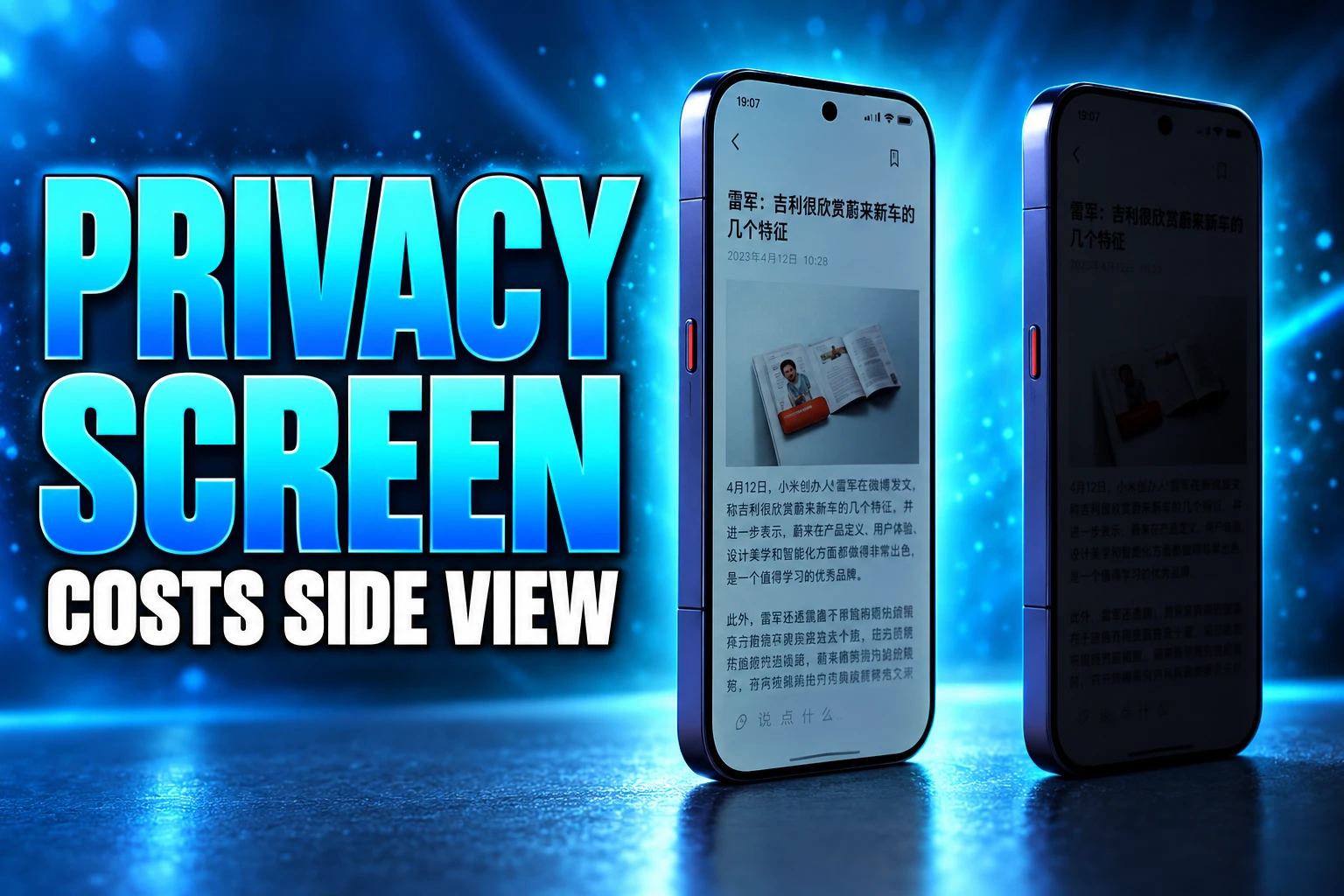
Display analyst Ice Universe posted a side-by-side viewing-angle clip on September 25. The 18 Pro sits on the left, the Xiaomi 17 Ultra on the right. Privacy mode is off on the new phone.
Even with Privacy Mode turned OFF, the Xiaomi 18 Pro already shows noticeably worse brightness, visibility, and image quality from different viewing angles compared with the Xiaomi 17 Ultra.
Ice Universe, display analyst, on X
He called the privacy display a possible mistake for the year and an undeniable downgrade. A follow-up comparison circulating the same day put the 18 Pro next to a Galaxy S26 Ultra, again with privacy off on both, and described the Xiaomi’s side view as much worse. Those clips are not lab reports. They are the first widely shared look at the panel away from Xiaomi’s own lighting.
The objection is familiar. Samsung’s Ultra already taught buyers that directional pixels can tax the default picture, not only the privacy preset. Xiaomi’s answer was a full RGB stripe and a brighter M11 stack. The September 25 video is the first public sign that the extra subpixels did not erase the off-axis cost. Anyone who never taps the privacy tile still lives with that glass.
How Xiaomi Turns Privacy On Without a Film
The hardware toggle is only half of what Xiaomi shipped. HyperOS 4 wraps the panel in rules that Samsung’s first Ultra privacy mode never matched, and those rules are the part of the product that actually feels new. A side AI key can be remapped so a long press turns on full-screen privacy. Super Xiao AI can take a spoken rule, including location fences, though expert mode spends credits and can require a paid top-up.
PRIVACY TRIGGERS ON THE 18 PRO
- Quick tile: A control-center switch turns the whole panel into privacy mode in one tap.
- AI key: Long-press on the new side button can be set as a global privacy shortcut.
- App follow: A chosen app carries privacy onto its notifications, floating windows, and split-screen pane.
- Page rules: Banking, payments, system passwords, and social pages can force privacy on those screens only.
- Places: Xiao AI can tie a rule to work, home, an airport, or another geofence you name.
- Looker alert: With a privacy app on screen, the front camera watches for someone gazing at the display and pings Xiaomi Super Island or a vibration.
That last item is the sting in the feature. The phone hides the picture from a person at your shoulder by pointing a camera at the room. Xiaomi’s own copy frames it as a leak warning, not a silent auto-lock, which is a milder design than some launch write-ups implied. It is still a privacy tool that needs a view of faces. The 6.4-inch SuperPixel 2.0 panel specs also list a 50-megapixel front camera, the same sensor that now has a second job as a lookout.
Hands-on clips from the launch day spent more time on those software paths than on nit charts. Per-app privacy, lock-screen notification filters, and split-screen follow-through are the pieces people called thoughtful. The panel is the piece they said still needs work. That split is likely to stick until independent measurements land.
Samsung’s March Statement Still Fits
Samsung put a privacy display on the Galaxy S26 Ultra in March 2026, using wide-angle and narrow-angle pixels that shut off in sequence. Reviewers then spent weeks on grain, fuzzy text, and a dimmer picture even when the feature was idle. Some buyers cancelled pre-orders. Samsung said close-up photos can pick up a moiré grid and that any brightness change at an angle or at maximum brightness should be negligible in the hand. It also confirmed a blunter point: with Maximum privacy protection on, contrast falls and the screen looks dimmer.
Xiaomi’s launch copy was written against that month. Full RGB instead of a diamond pentile layout. M11 brightness instead of a darker Ultra. No film. No claimed hit at a normal distance. The 18 Pro is smaller than the Ultra, at 151.8mm by 72mm and 203g in the fiberglass colors, 208g in glass, so it is also easier to hold in a crowd where a side view matters.
THE PRIVACY-PANEL CALENDAR
- March 2026: Samsung ships a privacy display on the Galaxy S26 Ultra and later says some brightness variation at an angle is expected.
- September 7, 2026: Huawei puts an optional Lingdun privacy panel on the Mate XT 2 trifold in China.
- September 23, 2026: Xiaomi launches the 18 Pro and 18 Pro Max in Beijing with SuperPixel 2.0 as standard.
- September 25, 2026: Ice Universe posts the 18 Pro versus 17 Ultra clip with privacy mode off.
Six months after the Ultra, the argument has not moved far. Directional pixels still seem to cost you a wide, even picture when you are not sitting dead-center. Xiaomi bet that a different subpixel map would hide that cost. The first comparison out of China says it did not.
A 1,000 Yuan Extra on Huawei’s Trifold
Calling the 18 Pro the second privacy-screen phone skips Huawei. The Mate XT 2 launched on September 7 with a dual-pixel Lingdun privacy layer on the cover screen, 16 days before Xiaomi’s event. Huawei sold it as an extra on the 1TB model, about 1,000 yuan above the same storage without the panel. A double-tap or a control key narrows the view. Demos swung a camera through a 60-degree arc until the image went dark from the side.
That is a different commercial choice. Huawei parked the feature on a trifold that already costs as much as a small laptop and charged again for the glass. Xiaomi put it on every 18 Pro and every 18 Pro Max, including the 5,999 yuan 12GB plus 256GB model. If directional OLEDs become a flagship checkbox, Xiaomi’s version is the one that treats privacy pixels as default equipment, not a 1TB surcharge.
It is also the one now being compared with last year’s Xiaomi, not with a 20,000 yuan foldable. Volume is the test that will decide whether SuperPixel 2.0 looks like a standard or a one-year experiment.
Privacy Films Have Not Left the Accessory Aisle
Hardware privacy is still rare. Apple’s iPhone 18 Pro, launched in early September, has no equivalent panel. Most Androids still rely on a stick-on filter. Shops still sell aftermarket privacy screen protectors that darken the view from the side with a louver film. ZAGG lists Glass Elite Privacy from $54.99 and Glass XTR Privacy at $59.99, aimed at people who want the blackout without buying a new phone.
Those films always cost brightness and sharpness, which is the compromise Xiaomi says SuperPixel 2.0 avoids on-axis. They also sit on top of an ultrasonic fingerprint reader. Xiaomi’s own spec sheet warns that third-party films can spoil that sensor and tells buyers to use the factory sheet. The box already includes a pre-applied protector. If the built-in pixels do the peep-blocking, the extra privacy glass becomes a fingerprint problem as much as a privacy solution.
HARDWARE PRIVACY VERSUS A STICK-ON FILTER
| Approach | Where it lives | How you switch it | What you give up |
|---|---|---|---|
| SuperPixel 2.0 | Standard on Xiaomi 18 Pro and Pro Max | Tile, AI key, app, place, or looker alert | Off-axis picture, per the Sept 25 clip, even with the mode off |
| Samsung privacy display | Galaxy S26 Ultra | System privacy controls, including a maximum setting | Samsung says contrast drops when maximum protection is on |
| Huawei Lingdun | Optional on Mate XT 2 1TB | Double-tap or control key | About 1,000 yuan extra, limited to one storage tier |
| Privacy film | Accessory, any phone | Always on once stuck | Brightness and clarity at all times, plus fingerprint risk on ultrasonic panels |
The film business does not vanish because two Chinese flagships and one Korean Ultra can black out a side view. It does start to look like a fallback for phones that never got the pixels, which is still most of the market, Apple included.
China Has Stock; Everyone Else Waits
Xiaomi opened Chinese sales the night of the Beijing event. The 18 Pro starts at 5,999 yuan (about $900) for 12GB of RAM and 256GB of storage, then 6,999, 7,999, and 8,999 yuan as RAM and storage climb to 16GB and 1TB. A red transparent special edition is 9,999 yuan. The 6.9-inch 18 Pro Max starts at 6,999 yuan and reaches 10,999 yuan for its transparent 16GB plus 1TB kit.
CHINA PRICES, SEPTEMBER 23
| Model | Memory | Price (yuan) |
|---|---|---|
| Xiaomi 18 Pro | 12GB + 256GB | 5,999 |
| Xiaomi 18 Pro | 12GB + 512GB | 6,999 |
| Xiaomi 18 Pro | 16GB + 512GB | 7,999 |
| Xiaomi 18 Pro | 16GB + 1TB | 8,999 |
| Xiaomi 18 Pro transparent | 16GB + 1TB | 9,999 |
| Xiaomi 18 Pro Max | 12GB + 256GB | 6,999 |
| Xiaomi 18 Pro Max | 16GB + 1TB transparent | 10,999 |
Both phones use Qualcomm’s Snapdragon 8 Elite Gen 6 on TSMC’s 2nm process, with a 5GHz peak on the 18 Pro. The Pro carries a 7,000mAh cell (6,860mAh minimum), 100W wired charging, 50W wireless, and 27W reverse wired. The Pro Max uses an 8,500mAh pack and a higher-tier Elite Extreme chip. Leica’s triple camera pairs a 200-megapixel Light Fusion 960 main sensor with a 200-megapixel 3.2x periscope and a 50-megapixel ultrawide. The rear companion screen is a 2.7-inch AMOLED at 912 by 596 on the Pro, 976 by 596 on the Pro Max, both up to 120Hz and 4,000 nits, set flush with the camera block.
Xiaomi says international 18 Pro models follow later in the year. Import listings were already circulating by September 25. Those global units will inherit the same SuperPixel 2.0 argument unless Xiaomi changes the glass, because the privacy pixels are in the panel, not in a software flag you can patch out.

The BMW iX4 Undercuts Mercedes and Trails Its Twin

Scotland’s Ten Big Supermarkets Already Hold the Weekly Shop

Scotland EMS Faces a State Probe After a Wagram Death

Meritz Signs Ripple to Race Korea’s 2027 Token Rules

Pocognoli’s First Camp Leaves Scotland Third and Exposed

Volkswagen Sells the Osnabruck Plant to Clear a Board Fight

Tata Motors’ Iveco Tender Opens as Holders Still Decide

Saksham Gaur Finds He Is His Own Company’s Client

Onimusha Way of the Sword Preload Hits a Windows 11 Wall

Simple Wave Chases Range as Ather Konarc Cuts Price
-
 AUTO1 month ago
Volkswagen Sells the Osnabruck Plant to Clear a Board Fight
-
 AUTO2 months ago
Tata Motors’ Iveco Tender Opens as Holders Still Decide
-
 BUSINESS2 months ago
Saksham Gaur Finds He Is His Own Company’s Client
-
 GAMING2 months ago
Onimusha Way of the Sword Preload Hits a Windows 11 Wall
-
 AUTO1 month ago
Simple Wave Chases Range as Ather Konarc Cuts Price
-

 BUSINESS2 months ago
UltraTech Ultravolt Launch Splits Friday Stocks to Watch
-

 BUSINESS2 months ago
Hyderabad 22-Carat Gold Jumps After a False Bargain
-
 NEWS2 months ago
Apple’s Foldable iPhone Hinges on Samsung Display Supply