
BUSINESS
Scottish Islands Still Lack Targets After Ofcom Postal Cuts
Ofcom’s 2025 universal postal service cuts left Orkney, Shetland and the Western Isles without local quality targets, and those gaps remain in 2026.

Consumer Scotland warned on 10 July 2025 that Ofcom had cut the universal postal service without island quality targets or a clear price shield. By October 2026 those gaps are still open, last year’s delivery got worse, and Scotland’s finance minister has asked London to get the parties in a room.
The regulator let Royal Mail drop Saturday second-class rounds and move the rest to alternate weekdays. It also lowered the headline delivery targets from 1 April 2026. First-class numbers have since ticked up. The island exemption Consumer Scotland flagged has not moved.
Consumer Scotland Called the Island Gap a Missed Chance
Grace Remmington, Head of Post at Consumer Scotland, set the terms on the day Ofcom published the decision. The statutory body said people in Scotland had already lived with poor reliability and sharp stamp rises, and that the package asked them to take fewer second-class days, slower second-class timings for some items, and lower quality targets for both classes.
This was an opportunity to shape services to consumer needs. However, today’s decision means consumers are being asked to accept a reduction in service, including fewer delivery days for second class mail, slower deliveries for some second class post and lower quality of service targets for both first and second class post.
Grace Remmington, Head of Post, Consumer Scotland
The line that has aged least is the one about the isles. Remmington said Orkney, Shetland and the Western Isles had no postcode-level quality targets, and that Ofcom’s failure to put any in place was “a significant missed opportunity.” That Consumer Scotland’s 10 July 2025 statement also said people were being asked to accept a thinner service “without sufficient clarity or protection on the price they will be charged.”
Ofcom’s own case was survival. Letter volumes had more than halved from 14.3 billion in 2011/12 to 6.6 billion in 2023/24, letter revenue had fallen from £6.9 billion to £3.7 billion since 2008, and Royal Mail had lost £348 million in 2023/24 after a £419 million loss the year before. Natalie Black, Ofcom’s Group Director for Networks and Communications, said the changes were “in the best interests of consumers and businesses, as urgent reform of the postal service is necessary to give it the best chance of survival.”
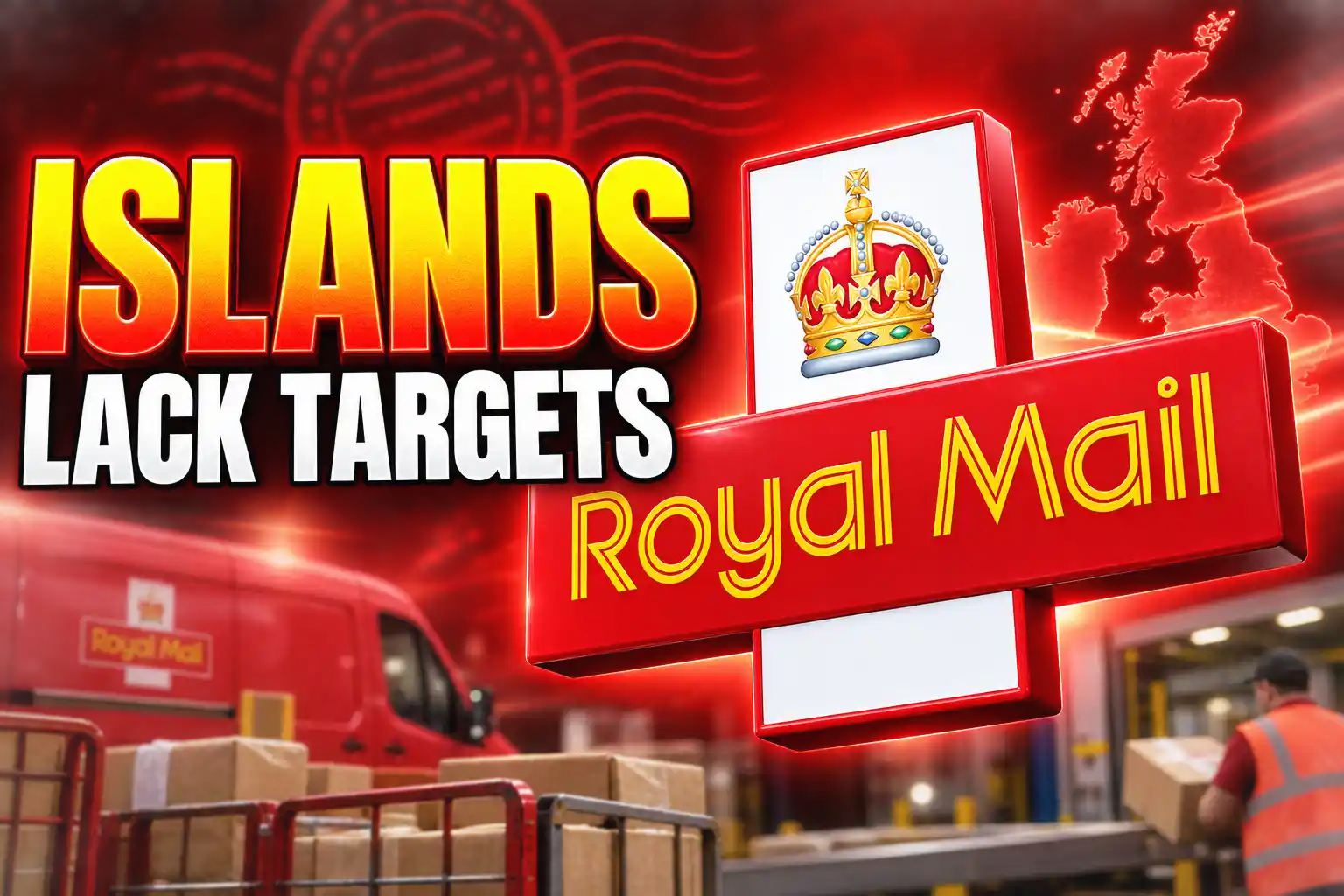
Second-Class Days Were Cut, Then Sat Idle
Ofcom’s July 2025 postal reforms kept first-class letters on a next-working-day aim, Monday to Saturday. Second class could move to alternate weekdays, Monday to Friday, still with a three-working-day aim. New backstop rules said 99% of first-class mail had to arrive within three working days and 99% of second-class mail within five. Ofcom put the annual saving, if the model landed, at between £250 million and £425 million, and told Royal Mail to meet consumer bodies and industry groups while it rolled the change out.
The rules took effect on 28 July 2025. The vans did not. Ofcom later told Parliament it had been frustrated by the lack of progress, because Royal Mail and the Communication Workers Union had not agreed how to put the new pattern in place. Dave Ward, the union’s general secretary, had already said on 10 July 2025 that the CWU accepted the need to change the obligation, then pointed at recruitment and retention as the reason mail was piling up in delivery offices.
THE CUT THAT WAITED ALMOST A YEAR
- 10 July 2025: Ofcom publishes the new universal service rules and opens a pricing review.
- 28 July 2025: The second-class frequency change becomes lawful.
- October 2025: Ofcom fines Royal Mail £21 million for missing 2024/25 targets.
- 1 April 2026: Headline targets fall to 90% first class next day and 95% second class in three days.
- May 2026: Royal Mail starts the new delivery model in offices, after a union deal.
- 1 June 2026: Ofcom opens a case on 2025/26 quality of service.
- 2 October 2026: The Scottish Government publishes Hannah Mary Goodlad’s letter on island post.
That idle year matters because 2025/26 was still scored against the old, harder targets. Royal Mail was allowed a cheaper second-class duty and did not get it into the street until the following spring, so the savings Ofcom had priced in did not arrive in time to change that year’s result.
Delivery Fell Further in 2025/26
On 29 May 2026 Royal Mail said it had delivered 75.7% of first-class mail the next working day in 2025/26, against a 93% target, and 90.2% of second-class mail within three working days, against 98.5%. Both figures were weaker than 2024/25, when Ofcom recorded 77% and 92.5%. On 1 June 2026 the regulator opened an investigation into 2025/26 delivery and said it would consider another fine.
NATIONAL RESULTS AGAINST THE TARGET IN FORCE
| Period | First class result | First class target | Second class result | Second class target |
|---|---|---|---|---|
| 2024/25 (full year) | 77% | 93% | 92.5% | 98.5% |
| 2025/26 (full year) | 75.7% | 93% | 90.2% | 98.5% |
| Q1 2026-27 (30 March to 28 June) | 85.0% | 90% | 91.4% | 95% |
The 2025/26 miss came after two earlier penalties, £5.6 million in November 2023 and £10.5 million in December 2024. Ofcom says it has fined the company more than £37 million for delivery failures. Ian Strawhorne, Ofcom’s Enforcement Director, said customers had missed important letters because of “Royal Mail’s consistent failure to improve its service over the years.”
The thinner second-class timetable is now visible in ordinary post. Cards and PIN mailings land in the same drop when the second-class day finally comes, and streets report tracked parcels moving while standard letters sit. That is the shape of a network that still makes money on parcels and is scored, fined and reformed on letters.
Orkney, Shetland and the Western Isles Still Have No Local Target
The national row is about percentages. The island row is about a blank. Every other Scottish postcode area has a first-class local target, 87% within one day, on top of the UK-wide figure. Orkney, Shetland and the Western Isles are exempt because of remoteness and logistics. Their performance still feeds the national average, but the three areas are a small share of UK volume, so a bad island year barely moves the UK score and cannot, on its own, trigger a local enforcement case.
Royal Mail data cited by Consumer Scotland in June 2025 showed that in 2024/25 only 29% of first-class post arrived on time in Shetland, with 31% in Orkney and 31% in the Western Isles. Kirkwall on Orkney was faster, at 54%. About 60,000 people live in those three exempt areas. Remmington said it was not reasonable to hold the islands to the UK target, given ferry timetables, but that “there is an important issue of consumer fairness and equality where Ofcom provides a target for consumers in the rest of the UK, but does not provide any target at all.”
A year after the USO decision, Consumer Scotland went back. Its 14 July 2026 study of Na h-Eileanan an Iar, Orkney and Shetland found a fragmented, unreliable and often expensive service. Residents still valued local posties and the one-price-goes-anywhere letter. They also described late hospital letters, legal papers that could not be planned around, and retailers who either added island fees or refused to send at all. Surcharges of £10 to £50 were common. Earlier Consumer Scotland work found 72% of consumers in the Highlands and Islands had been charged extra fees when ordering parcels online.
Scotland has 94 inhabited islands and 103,000 island residents. Those island economies contributed about £3 billion to Scotland’s Gross Value Added in 2023. Harris Tweed, Fair Isle knitwear, Stornoway black pudding and island spirits all leave on the same fragile pipe. Douglas White, Consumer Scotland’s Director of Policy and Advocacy, said island consumers “are frequently paying significantly more for some deliveries or are excluded altogether, which is simply not fair.”
WHAT CONSUMER SCOTLAND IS STILL ASKING OFCOM TO DO
- A local first-class floor: Put a tailored postcode-area quality target on the three exempt island groups, even if it is not the mainland 87%.
- Second-class postcode analysis: Check remote Scottish postcodes that already have first-class targets, to see if they need extra second-class protection.
- Fairer parcel fees: Make island surcharges transparent and consider a cap so a delivery charge cannot outrun the item.
- Local disruption flags: Use complaints and quality data to catch a stuck island or Highland office early, rather than waiting for a year-end UK average.
- Post office access: Protect remaining branches and test mobile, community-run and locker options without stripping the counter network.
Ofcom’s 2025 package did not do the first of those things. The 2026 report asks the regulator to “revisit its decision” on a minimum island quality standard. That is the same request, filed twice.
Stamp Prices Rose Before the Affordability Review
Remmington’s other 2025 complaint was price. Ofcom said it would keep a cap on the second-class stamp and launch a review of pricing and affordability, with a public consultation planned for the following year. First class stayed uncapped. Royal Mail then set new letter stamp prices from 7 April 2026: a first-class stamp at £1.80, up 10p, and a second-class stamp at 91p, up 4p. Ofcom had already recorded the second-class letter stamp rising from 66p in April 2021 to 87p in April 2025, close to the cap.
The review slipped. A November 2025 call for input closed in December. On 13 March 2026 Ofcom said it would not publish proposals that month, citing uncertainty over the second-class frequency change and Royal Mail work on a targeted discount scheme. It now expects to consult later in 2026 and decide by March 2027, when the current second-class cap expires. Consumers took the thinner specification in 2025 and the higher stamp in April 2026 with the old cap still in place and no new social tariff agreed.
Royal Mail says a second-class stamp remains 65p below a European average of £1.56, and a first-class stamp 13p below £1.93. That comparison does not answer Remmington’s point, which was not whether UK stamps undercut France. It was whether people had any protection on the price of a reduced service. They still do not, beyond a cap that runs out in March 2027.
The New Delivery Model Is Only Part-Rolled
The operational story finally moved in 2026. Royal Mail’s improvement plan, backed by £500 million over five years, started putting second-class and other non-first-class letters onto every other weekday from May, across about 1,200 delivery offices at around 50 offices a week, with a aim of finishing before the Christmas peak. A July 2026 company update put the live count at 252 offices. First class stays six days. Parcels are unchanged. Last financial year the firm delivered 5.7 billion letters and 1.4 billion parcels to around 32 million addresses, with about 130,000 staff.
On 21 August 2026 it published quality of service results for the first quarter of 2026-27, covering 30 March to 28 June. First class next-day delivery reached 85.0%, up 9.0 percentage points on 76.0% a year earlier, and ahead of the plan band of 77% to 79%. Second class within three days reached 91.4%, up 2.1 points on 89.3%, inside a 90.5% to 91.5% band. Reliability, the new backstop measure, was 98.1% of first class within three days and 98.4% of second class within five.
WHERE THE Q1 FIGURES SIT
- First class speed: 85.0% next day, still 5 points under the new 90% target.
- Second class speed: 91.4% in three days, still under the new 95% target.
- Reliability: 98.1% and 98.4%, close to the 99% backstops but not there yet.
- Company claim: 93% of all letters on time in that window, and more than 99% within a week.
Jamie Stephenson, Royal Mail’s Chief Operating Officer, called the figures encouraging and said first class was “well ahead of where we expected to be.” They are better than the 75.7% full-year result. They are also being scored against a lower bar than 2025/26, and they are a quarter, not a year. The 2025/26 investigation is still open.
Hannah Mary Goodlad Asks Westminster to Convene the Parties
On 2 October 2026 the Scottish Government published a letter to UK government ministers from Hannah Mary Goodlad, Minister for Public Finance. The letter is dated 25 August 2026 and goes to Jonathan Reynolds, Secretary of State for Business, Innovation, Science and Trade, with Douglas Alexander, Secretary of State for Scotland, copied. Goodlad’s brief includes liaison with the UK government, Ofcom and industry on post, which remains reserved.
I hope you will therefore agree with me that urgent action is therefore required and doing nothing is not an option.
Hannah Mary Goodlad MSP, Minister for Public Finance, letter dated 25 August 2026
She asked Reynolds to convene Royal Mail, Post Office Ltd, Ofcom, parcel firms, and consumer and community groups, and said she would attend. She pointed to Consumer Scotland’s island report, to the 72% extra-fee finding in the Highlands and Islands, and to communities that are refused deliveries. Blair McDougall, while minister for small business, had already said island postal services had not met customer expectations “for quite some time.” The 2026 National Islands Plan commits the Scottish Government to work with London on equitable postal and delivery services. Goodlad noted that only the UK government can mandate the change.
That is the reckoning on the warning issued when the cuts were announced. Ofcom cut the specification, Royal Mail missed the old targets by more in the year that followed, the new model is part-rolled, first class has improved on a lower target, and Orkney, Shetland and the Western Isles still have no local quality floor. Goodlad has asked for a meeting. Reynolds has not yet, in the published letter, given her one.

TCS Opens Q2 as Mid-Cap IT Keeps the Growth

Bitcoin’s Jobs Rally Fails While December Hike Odds Hold

The Heat Turn a Bucks Rematch Into Vice City Night

The G7 Opens Diesel Tanks While Carriers Head East

Kia Bets Fortuner Money on a Made-in-India Sorento

Volkswagen Sells the Osnabruck Plant to Clear a Board Fight

Tata Motors’ Iveco Tender Opens as Holders Still Decide

Saksham Gaur Finds He Is His Own Company’s Client

Onimusha Way of the Sword Preload Hits a Windows 11 Wall

The Frame Pro’s $1,200 Labor Day Cut Needs a Soundbar
-
 AUTO4 weeks ago
Volkswagen Sells the Osnabruck Plant to Clear a Board Fight
-
 AUTO1 month ago
Tata Motors’ Iveco Tender Opens as Holders Still Decide
-
 BUSINESS1 month ago
Saksham Gaur Finds He Is His Own Company’s Client
-
 GAMING1 month ago
Onimusha Way of the Sword Preload Hits a Windows 11 Wall
-
 NEWS4 weeks ago
The Frame Pro’s $1,200 Labor Day Cut Needs a Soundbar
-

 NEWS1 month ago
Apple’s Foldable iPhone Hinges on Samsung Display Supply
-
 BUSINESS1 month ago
SEBI Reopens How F&O Settles After the Closing Auction
-

 BUSINESS1 month ago
The Rs 4.66 Lakh Crore IPO Queue Is Mostly Paper