
NEWS
O-ID Bets $1.2 Million on Japan-Made Factory Humanoids
O-ID’s $1.2 million pre-seed funds a Japan-built modular humanoid whose joints swap on site, aimed at factories that lose millions when a line stops.

O-ID raised $1.2 million on September 24, 2026 to build modular humanoid robots in Tokyo for factory work. Chicago’s TAWANI Ventures led the pre-seed round, with Hustle Fund, Techstars, and angels who include the founders of Humanoid Guide, early backers of the humanoid firm 1X.
The check is smaller than one idle hour at a large auto plant. The bet is a Japan-built machine whose joints, arms, and computers come off on the floor.
The Round Would Not Cover One Hour of Downtime
Siemens’ True Cost of Downtime 2024 study put a lost hour at a large auto plant at $2.3 million an hour in automotive, more than $600 a second, and twice the 2019 figure. O-ID’s entire raise would not buy that hour. That gap is the point of the product, not a rounding error in the cap table.
William Pritzker, a partner at TAWANI Ventures, a Chicago fund backed entirely by Pritzker Family capital, called modular humanoids a way to lift factory output as workforces shrink. The fund’s typical first check is $200,000 to $500,000. A $1.2 million pre-seed fits that box. It does not fit the humanoid race as it is being financed in California and Texas.
Figure AI’s 2025 round ran above $1 billion. Apptronik, the Austin builder of the Apollo industrial humanoid, disclosed a $520 million round in February 2026. O-ID is not trying to outspend those shops. It is trying to make a robot that a Japanese plant can keep running when a joint dies, without shipping the whole machine back to its maker.
THE NUMBERS AROUND THE CHECK
- The raise: $1.2 million pre-seed, announced September 24, 2026, led by TAWANI Ventures.
- Idle auto hour: $2.3 million at a large plant, per Siemens’ 2024 downtime study.
- Japan’s 2040 gap: 11 million workers, per the Recruit Works Institute.
- Physical AI purse: ¥10.5 trillion ($65.1 billion) in public and private spend through fiscal 2040.
Yuki Shirato, managing director at Techstars, said he picked co-founders Stian Jakobsen and Simon Gormuzov because the robots would be modular, built for mass production and repairs, and made in Japan. O-ID went through Techstars Tokyo in 2025. The new money, the company said, takes its first machine, AP-1, from a prototype toward production and grows the Tokyo engineering team.
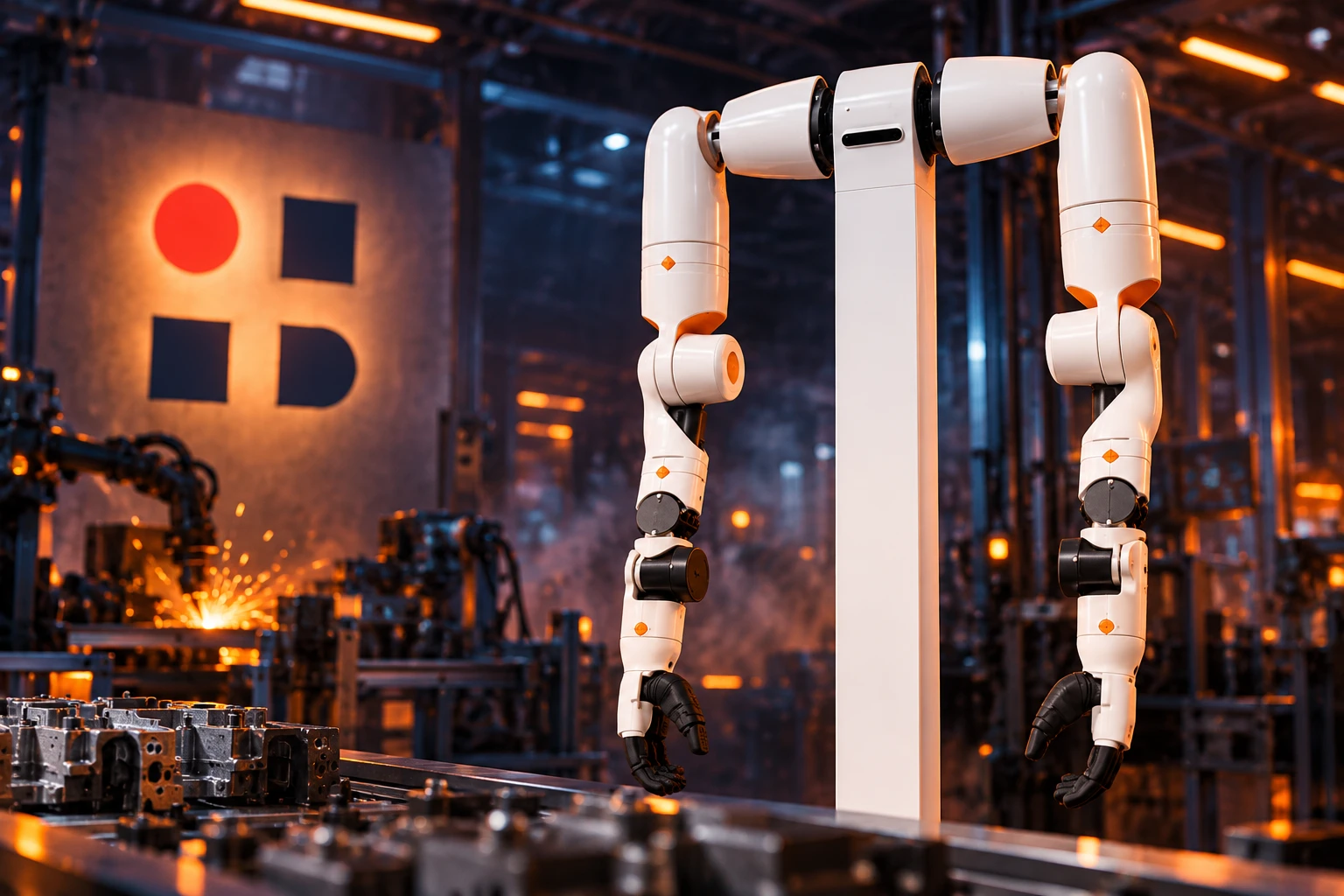
Japan Still Makes the World’s Robot Bodies
Jakobsen, a Norwegian who worked in cyber defence, and Gormuzov, a Dutch mechanical robotics engineer, met at Waseda University and founded O-ID in Tokyo in 2025. The parent, O-ID Inc., is registered in Delaware. Research, build, and deployment sit with the Japan company. Jakobsen said they stayed because the labour shortage is visible on the ground, and because the same plants that could buy the robots can also make the parts.
Japan is still the world’s main builder of industrial robots. The International Federation of Robotics puts Japan at 38 percent of global robot production. In 2024 Japan installed 44,500 industrial robots and ran an operational stock of 450,500. China installed 295,000 that year, 54 percent of a world total of 542,000, and its stock has passed 2 million. The old picture of Japan as the robot nation still holds on the factory that makes the arms. It no longer holds on the factory that buys them, and it has not held on humanoids, where US and Chinese firms have set the pace.
Tokyo is trying to close that gap with money. The Cabinet’s AI Basic Plan (Phase II) assumes ¥10.5 trillion in public and private physical AI investment through fiscal 2040. METI wants about 10 million AI-equipped robots in 18 sectors by 2040, including manufacturing, logistics, care, disaster response, and defence. Industry minister Ryosei Akazawa has tied that target to data Japan already holds on shop floors, including at the Fukushima Daiichi decommissioning site. Prime Minister Sanae Takaichi has called a Japanese physical AI foundation model the banner of a comeback. NVIDIA’s Jensen Huang told a METI event on July 16, 2026 that the next industrial turn starts in Japan.
O-ID is a six-person-scale shop against that national plan, and it is hiring a manufacturing and supply chain manager in Tokyo. The company has said it wants 85 percent of each robot, by weight, to come from dozens of Japanese small and midsize firms, with factory sales aimed at 2027. Many parts already come from Japan. The work now is to make that chain domestic, while bringing some US and European components into local production.
Nine Swappable Pieces and a Holonomic Base
O-ID’s public site lists swappable modules shipped from Tokyo and calls the figures indicative, with a full data sheet on request. The advertised platform is a human-scale upper body on wheels, not a walking biped. Read “humanoid” here as arms, hands, and a torso built to the height of a person, sitting on a holonomic base that can slide in any direction on a smooth floor.
O-ID INDICATIVE PLATFORM SPECS
| Spec | Figure |
|---|---|
| Height | 172 cm |
| Weight | 70 kg |
| Payload | 16 kg |
| Axes | 30 degrees of freedom |
| Modules | 9 |
| Uptime claim | 24/7 |
| Base | Holonomic, wheeled |
The named modules on the site are a head, a torso core, a shoulder, an elbow, a forearm, a dexterous gripper, and the holonomic base. Jakobsen’s maintenance pitch is blunt. If a car tyre blows, you change the tyre. In robotics, he said, a failed part can still mean sending the whole machine away. O-ID wants a factory technician to pull a shoulder, an elbow, or a compute unit on site. The company has said a module comes off in about five minutes.
That five-minute figure is a design target, not a timed trial released to the public. The clip that travelled with the funding news is an animation of parts separating, not a filmed repair on a running cell. Other makers already sell reconfigurable platforms. O-ID’s claim is that the swap is meant for a shift supervisor, not a specialist bay, and that sensors on each module will watch current draw and heat so a replacement can ship before the joint dies.
The first physical article is more modest than the spec sheet. AP-1 is a fully assembled, stationary dual-arm robot used for integration tests and for the manipulation work of the first customer jobs. A later version, with mobility and more strength, is due to be shown at CES 2027. Factory pilots are targeted for early 2027. Lead software engineer Johannes Schoenke and lead project engineer Yuuta van Hamond sit on a small Tokyo hardware team that still has to prove the hot-swap under load, with power and data coming off and back on without taking the cell down.
What the Sumitomo Letter Covers
O-ID has signed a letter of intent with Sumitomo Electric Industries to explore putting the supplier’s technology into wire harnesses for humanoid robots. That is a real adjacency for a machine designed to be unplugged and replugged. It is not a robot order, a production supply contract, or a factory deployment. Treat it as a conversation about cables, which is where modularity either works or becomes a tangle of connectors that no line worker will touch.
The company has also filed a provisional US patent on its modular connector. Jakobsen said the hard work sits on O-ID’s side: the mechanical joints, power, data, and software all have to be designed around a swap from the start, while the arm still holds 16 kg with the stiffness a line needs. A worn finger joint or a tired shoulder actuator should mean a module, not a crate. If hundreds of thousands of robots are ever in the field, he said, flying specialists to every replacement will not scale.
O-ID is not publishing build cost or customer price. Jakobsen said the larger difference over the life of the machine is replacing and refurbishing modules instead of retiring the body when a hand or a computer improves. If the robot covers a shift a plant cannot staff, he argued, its value is not the sticker. Until a named plant runs that shift, that remains a claim.
Why Factories Still Want a Human-Shaped Arm
Japan’s labour math is the demand side O-ID is selling into. The Recruit Works Institute’s Future Forecast 2040 puts the shortfall at 3.415 million workers in 2030 and 11 million workers by 2040. That is an economy-wide gap, not a count of jobs a wheeled dual-arm can do. It is still the number Japanese manufacturers use when they talk about lines that will not have a person at the pack-out station.
When enough factory roles go unfilled at once, entire supply chains are at risk. O-ID’s robots are built to work alongside the people still on the floor, closing those gaps before they become a crisis for a single factory and for the industries Japan depends on.
Stian Jakobsen, co-founder and CEO, O-ID
The case for a human-shaped upper body, in Jakobsen’s telling, is the furniture of the plant. Table height, tool reach, and the way a person leans into a machine were all set around a body. Conventional automation can run those jobs well, he said, but fitting it in often means moving stations and rewriting the line. The robot is meant to stand in those spaces, use the gear already there, and work next to the people who remain. The point is not to look human. It is to fill a role that is getting harder to hire, without asking the plant to rebuild around a cage of robots.
FIRST JOBS ON THE LIST
- Incoming packs: Open packaging, lift parts out, and set them on a conveyor.
- Machine tend: Pull a finished piece off a tool and load the next blank.
- Stage moves: Carry components between steps that still need a pair of hands.
Those tasks are dull, and the line stops if they stop. Jakobsen said the company’s ambition runs past them, but the path is to make those jobs consistent, pass safety and reliability checks, and show the robot can be built and serviced at volume. Automotive manufacturing and logistics in Japan are the first markets. Other industries, and later the United States, sit behind that.
Foreign Humanoids Now Need Washington’s Blessing
O-ID says its Japan-built robots are being designed to meet US National Defense Authorization Act rules, the federal procurement screen that keeps certain Chinese gear out of government-linked supply. That is a component story. A separate US rule now sits on the finished robot.
On July 28, 2026, the Federal Communications Commission added foreign-produced advanced robotic devices to its Covered List, covering mobile machines such as humanoids and quadrupeds. New foreign models generally cannot get the equipment authorisation needed to be imported, marketed, or sold in the United States, unless the Department of War grants a Conditional Approval after a national-security review. Japan-made does not, by itself, clear that gate. A Delaware parent and an NDAA-clean bill of materials are the start of an application, not a stamp on the crate.
The timing is not subtle. China accounts for most of the world’s humanoid production this year, and US officials have described foreign-made advanced robots as a cyber and supply-chain risk. A small Tokyo builder that can show Japanese reducers, Japanese harnesses, and a swap-out service model is selling into that political gap as much as into a labour gap. It still has to get the machine to work.
FROM LAB TO A NAMED FLOOR
- 2025: O-ID is founded in Tokyo after Jakobsen and Gormuzov meet at Waseda; the company joins Techstars Tokyo.
- December 2025: The co-founders pitch at the Humanoids Summit in Silicon Valley.
- June and July 2026: Japan sets a ¥10.5 trillion physical AI investment path and a 10 million robot target for 2040; the FCC puts foreign-produced humanoids on the Covered List on July 28.
- September 21, 2026: O-ID describes a plan for 85 percent Japan-made content by weight and factory sales in 2027.
- September 24, 2026: The $1.2 million pre-seed is announced.
- September 30 to October 11, 2026: Jakobsen and Gormuzov are in the Bay Area, including SF Tech Week.
- CES 2027: O-ID plans to show a mobile, stronger version of the robot.
- Early 2027: First factory pilots are targeted.
Mitsubishi Motors, separately, has said it will mass-produce a walking humanoid with Tokyo startup Highlanders at its Kyoto plant from the first half of 2027, using an unused engine line rated at 1,000 units a month. Japan’s own incumbents are moving. O-ID’s opening is not that no one else is building a humanoid in Japan. It is that a wheeled, modular machine aimed at pack-out and machine-tend may reach a cell faster than a walking platform, if the swap actually takes five minutes.
CES 2027 Is the First Public Test
WHAT WE KNOW
- The money: $1.2 million is in, led by TAWANI Ventures, with Hustle Fund, Techstars, and named angels.
- The machine: Indicative specs are public; AP-1 is a stationary dual-arm test article; a mobile version is slated for CES 2027.
- The chain: A Sumitomo Electric letter of intent covers wire-harness talks; an 85 percent Japan-made weight target is a plan, not a current bill of materials.
WHAT IS UNCONFIRMED
- Repair times: No public, timed swap on a working cell has been released.
- Customers: No named factory, volume, or price has been disclosed.
- US entry: NDAA-minded design is a company claim; FCC authorisation for a Japan-built unit has not been granted.
Jakobsen and Gormuzov will be in San Francisco from September 30 to October 11, 2026, including SF Tech Week, asking investors and plant operators to look past the size of the round. The next hard date after that is a Las Vegas stand in January, then a factory floor that still has no public name. If a module comes off in five minutes there, the $1.2 million will have bought the only thing this company is actually selling.

Edinburgh Opens a 2027 Tour Built for Time Trials

Korda Maps Auður From Meðalland to Irvine Bay

Apple Music Films Its New Logo in Mineral Oil

Oppo Prices the Pad Mini Above India’s iPad Mini

Austen Soaks Scotland Before Boelo Brings Weekend Gales

Volkswagen Sells the Osnabruck Plant to Clear a Board Fight

Apple’s Foldable iPhone Hinges on Samsung Display Supply

Saksham Gaur Finds He Is His Own Company’s Client

Tata Motors’ Iveco Tender Opens as Holders Still Decide

Onimusha Way of the Sword Preload Hits a Windows 11 Wall
-
 AUTO2 months ago
Volkswagen Sells the Osnabruck Plant to Clear a Board Fight
-
 NEWS2 months ago
Apple’s Foldable iPhone Hinges on Samsung Display Supply
-
 AUTO2 months ago
Tata Motors’ Iveco Tender Opens as Holders Still Decide
-
 BUSINESS2 months ago
Saksham Gaur Finds He Is His Own Company’s Client
-
 GAMING2 months ago
Onimusha Way of the Sword Preload Hits a Windows 11 Wall
-

 ENTERTAINMENT3 years ago
What is SD on Amazon Prime? – All You Need to Know
-

 BUSINESS2 months ago
Hyderabad 22-Carat Gold Jumps After a False Bargain
-

 NEWS2 months ago
iQOO 16 Locks 8,400 mAh While 100W Charging Holds