
BUSINESS
Duqu Raises €1.5 Million to Sell Banks Faster Credit Checks
Duqu’s €1.5 million pre-seed funds Dutch invoice advances, but investors are backing the same AI engine as a white-label credit tool for banks.

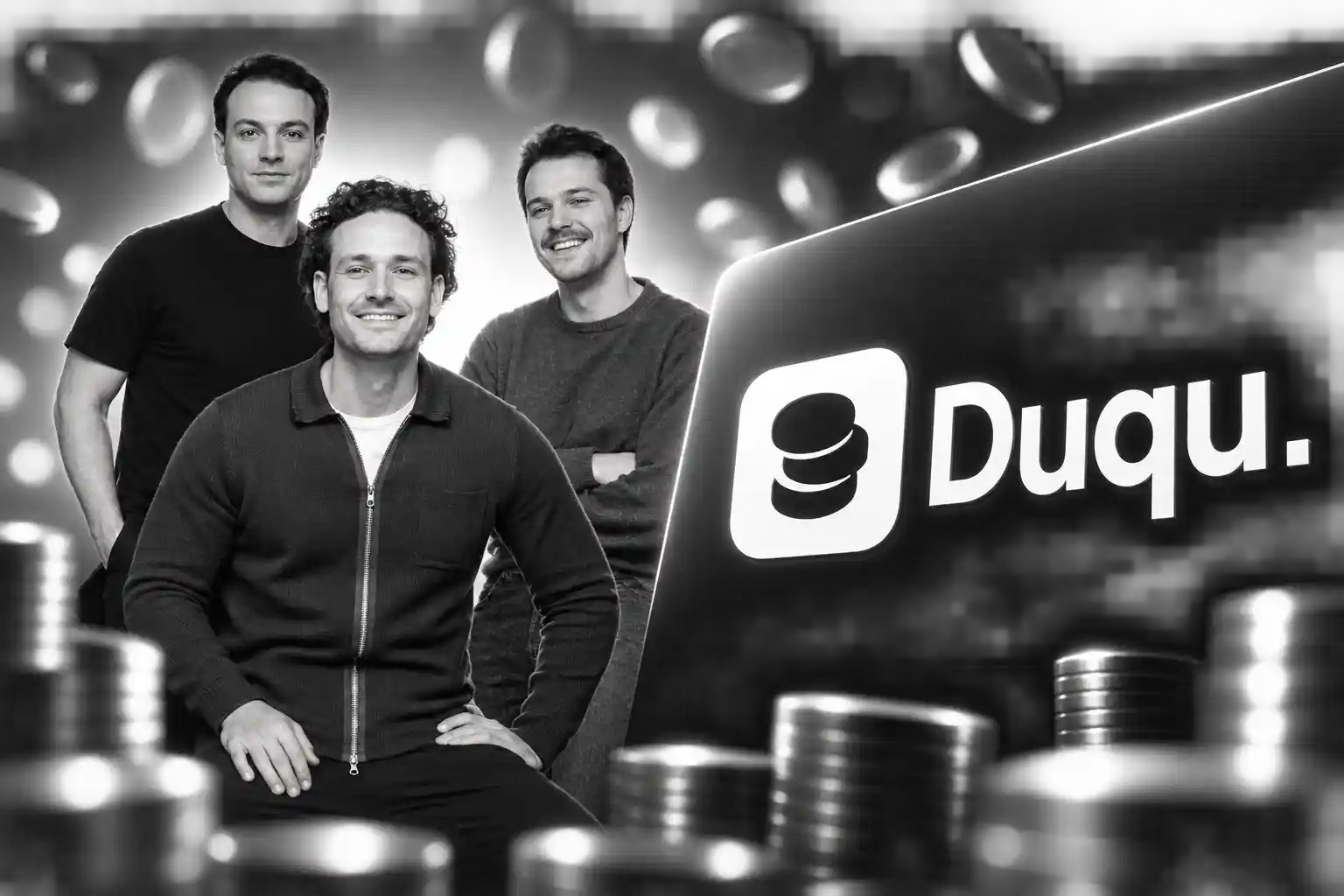
Amsterdam fintech Duqu raised €1.5 million in pre-seed funding on 24 September 2026 to advance cash against unpaid B2B invoices. Curiosity VC and No Such Ventures backed the round. The same cheque is meant to turn Duqu’s credit engine into a white-label tool for banks, leasing firms and other lenders that now find small tickets too costly to assess.
Co-founder Maas de Goede said businesses can arrange almost everything instantly, yet still wait weeks to be paid after the work is done. Funds move within 24 hours of approval, in 13 hours on average, and the buyer is not told.
Cash Against an Invoice, Not a Sale of One
Duqu B.V. is registered at Grasweg 3R1 in Amsterdam. De Goede founded the company in October 2025 with Victor Brouwer and Diederik Nassenstein. The product is a short business loan tied to a sent B2B invoice, not a sale of the receivable, so the merchant keeps the claim and the customer relationship.
The idea, de Goede has said, came after an entrepreneur he knew tried to borrow while a healthy firm waited on a long invoice. Payroll, stock and the next job still had to be paid. Duqu prices 2.9 percent for the first 30 days, with no subscription and no start-up fee. On a €2,500 invoice that is €72.50, leaving €2,427.50 in the account. There is no minimum or maximum ticket. A fee is due only when an advance is drawn.
The firm’s site scores 4.4 on Trustpilot and lists ING, Rabobank, ABN AMRO, bunq, Knab, Triodos, ASN and Revolut as bank links. The hook-up runs through PSD2. Duqu never sees login details. A bank link does not mean an approval.
FROM INVOICE TO CASH
- Check: About two minutes in the app, with a short note on the firm and the invoice.
- Link: Bank and invoice connect through PSD2 so Duqu can see business flows.
- Review: The engine scores the file, then a person still checks the application.
- Pay-out: After approval, money is due within 24 hours, and often within an hour.
That human check sits beside a claim that the proprietary engine now automates around 95 percent of credit assessment after 18 months of work. The advance finances a wait. It does not repair a missing purchase order or a line the buyer has already queried, and Duqu says it is likely to refuse invoices that are not final.
Dutch Payment Discipline Slipped in 2025
The pitch is a cash-flow squeeze caused by slow B2B settlement. Independent payment data for the Netherlands is less dire than a late-pay crisis, and more specific. Altares Dun & Bradstreet’s Payment Study North Europe 2026 found 25.3 percent of Dutch invoices unpaid on time in the fourth quarter of 2025. On-time settlement was 74.7 percent, down from 80.2 percent a year earlier. Invoices more than 90 days overdue stayed at 0.3 percent.
WHAT THE 2025 FIGURES SHOW
- Q4 on time: 74.7 percent of Dutch invoices were settled inside the agreed term, so 25.3 percent were late.
- Large firms: Only 37.9 percent of their invoices were paid on time in that quarter, so big buyers remain the slow ones.
- Hospitality: On-time pay fell to 76.0 percent from 85.7 percent, a drop of 9.7 points, the steepest sector move in the study.
- Revenue stuck: Intrum’s European Payment Report 2026 put late receipts at 11.43 percent of Dutch company turnover.
Barry de Goeij, who leads data science, trade and customer work at Altares, pointed to inflation, higher costs, the fall of the Dutch cabinet, and US tariffs as the backdrop. Smaller firms found deadlines harder. Atradius’s 2026 Payment Practices Barometer still found the Netherlands among Western Europe’s more punctual markets, with nearly three quarters of B2B sales on credit, more than 20 points above the regional average. Seven in ten Dutch suppliers reported delays from business customers. The legal term is 30 days unless the parties agree otherwise, so even a short overrun ties up cash a small firm already booked as earned.
Factoring Already Holds €8.8 Billion
Invoice finance is not a new Dutch product. Members of FAAN, the factoring and asset-based finance association, reported more than €8.8 billion of factoring funds in use in 2025, up 14.6 percent. Factoring volumes rose 5.3 percent. Available headroom grew 3.2 percent. Almost 7,000 firms used the product, though the client count fell. The World Factoring Yearbook 2026 put Dutch factoring at 14.5 percent of GDP.
Classic factoring buys the invoice, often tells the debtor, and usually wants turnover covenants and a longer contract. Duqu’s published comparison against that model is marketing, not a regulator’s table, but it is the offer merchants actually see.
DUQU’S OWN COMPARISON
| Term | Duqu | Factoring (as listed by Duqu) |
|---|---|---|
| Fee | 2.9% for the first 30 days | 4 to 12% |
| Fixed costs | €0 | From €1,000 a month |
| Invoice taken over | Never | Always |
| Customer notified | No | Yes |
| Customer pays you | Yes | Often not |
| Pick per invoice | Yes | Varies |
| Multi-year contract | No | Usually yes |
| Turnover rule | None | Usually yes |
| Money after approval | Within 24 hours | 1 to 5 working days |
| If the buyer never pays | Stays with the merchant | Depends on the contract |
That last row is the trade. Duqu does not take the credit risk off the seller. A freelancer who draws on a slow but honest client is buying time. A freelancer who draws on a fight over the work still owes Duqu if the buyer walks away.
What Banks Buy When They White-Label the Engine
The invoice book is the proof of life. The round is also paying to productise the scorer for other balance sheets. Duqu says the stack is modular, so a bank, a lender or a leasing firm can run applications against its own credit policy. No named institution has been announced as a customer. Herman Kienhuis of Curiosity VC described the gap the engine is supposed to close.
Small applications are relatively expensive for traditional lenders to assess and process. Duqu has built a fully AI-driven credit assessment and processing stack. As a result, businesses with smaller credit or working capital needs can be better served.
Herman Kienhuis, Curiosity VC
Thijn van Helvoirt of No Such Ventures, sometimes mislabelled as a Duqu founder in deal round-ups, went further. He said credit checks are still labour-heavy, so more volume usually means more staff, and that the same software could travel into leasing, mortgages and buy now, pay later.
Credit assessment is still a labour-intensive process for many providers. As a result, processing more applications often means hiring more people. Duqu automates a large part of that process while allowing lenders to retain their own credit policies. The same technology can also be applied to areas such as leasing, mortgages and buy now, pay later.
Thijn van Helvoirt, No Such Ventures
Duqu’s privacy statement already treats automated credit scoring as a high-risk AI system under EU rules, citing Regulation (EU) 2024/1689. Applicants can ask for a human review, an explanation, and a fresh look at the decision. KvK number 98394428 sits on that same filing. For a lender, the pitch is cheaper small-ticket throughput without giving up the rulebook. For Duqu, it is a second product that does not require the firm to fund every euro it scores.
Almost 1,500 Users After Three Months
The working-capital side is still a three-month book. Since launch the platform has almost 1,500 users and has processed €4.6 million in applications, of which more than €1.2 million has been advanced. Those are funding-day figures, not a year of seasoning, and they sit beside an industry factoring book measured in billions. The company says demand has been strong. It also still runs a person over each file.
De Goede’s line that growth cannot wait for an invoice is the merchant-facing story. The investor letters read more like a credit-ops story. If the scorer can make a €2,500 working-capital request cheap enough to underwrite, the same pipeline can be rented to firms that already hold deposits, lease books or card receivables. If it cannot, Duqu is a small invoice lender with a 2.9 percent, 30-day price and a thin capital base.
Use of proceeds is split in public remarks between growing the advance platform and pushing the engine further, including the offering for other financial firms. There is no disclosed split of the €1.5 million between those two jobs.
Large Buyers Still Stretch SME Cash
Dutch law already tried to shorten the wait that Duqu now finances. Large companies must pay SMEs and zzp’ers within 30 days. The Netherlands Enterprise Agency, RVO, states the other statutory caps on the same page.
DUTCH STATUTORY PAYMENT TERMS
- No term written: 30 days from receipt of the invoice.
- Company to company: Up to 60 days if the contract says so, and longer only if that is shown not to harm either side.
- Large firm to SME or zzp: 30 days, even when the buyer would rather write a longer term.
- Government: 30 days, extendable to 60 only in extraordinary cases.
An SME here means fewer than 250 staff, annual turnover of at most €50 million, and a balance sheet that does not exceed €43 million. If a customer misses the date, the creditor can charge a collection fee of at least €40 plus statutory commercial interest, which DNB publishes. Altares still found that only 37.9 percent of large-firm invoices cleared on time in the fourth quarter of 2025. The 30-day rule narrowed the legal window. It did not make big buyers punctual.
That is the seam Duqu is pricing. The merchant has already done the work. The law says the large customer should pay in 30 days. The invoice is still open. Duqu will wire against it by the next afternoon, keep the customer in the dark, and leave the default risk where it started. Banks are invited to rent the same decisioning when the ticket is too small for a credit committee. The €1.5 million does not change the payment term. It pays to sit in the gap the term leaves.
Frequently Asked Questions
How Does Duqu Get Repaid Once the Customer Pays?
The buyer keeps paying the merchant’s own account. After that money lands, Duqu collects the advance through a direct debit mandate or a business Tikkie. If the buyer never pays, the merchant still owes Duqu, because the advance is a loan to the seller rather than a purchase of the invoice.
What If the Invoice Stays Open After 30 Days?
Interest then runs pro rata at 2.9 percent per month on the amount that is still outstanding. The first-month fee is also 2.9 percent, so a file that remains unpaid is not a flat 30-day product. Duqu shows the net proceeds before the merchant accepts the draw.
Will Duqu Advance a Consumer Invoice?
No. The firm says it is business-only and will not fund a private bill or an invoice to a consumer. It also says it is likely to refuse work that is not yet a final invoice, or that is already in dispute, and that a match with its policy is not a promise of approval.
When Did the 30-Day Large-Company Rule Take Full Effect?
The Wet verkorten wettelijke betaaltermijn started in July 2022 for new contracts and applied to existing ones from 1 July 2023. A longer term written into a large-company contract with an SME or zzp’er is void, and 30 days applies in its place.
Disclaimer: This article is news reporting and analysis of a funding round and a working-capital product. It is for information only and is not credit advice, investment advice, or a recommendation to draw an invoice advance or to buy or sell any security. Anyone considering an advance, a white-label credit tool, or an investment in private fintech should speak with a qualified accountant, credit adviser, or regulated financial adviser who can review their own invoices, contracts, and risk. Fees, approval rates, legal terms, and company status are those given by the named firms and official pages on the dates cited and can change.

Edinburgh Opens a 2027 Tour Built for Time Trials

Korda Maps Auður From Meðalland to Irvine Bay

Apple Music Films Its New Logo in Mineral Oil

Oppo Prices the Pad Mini Above India’s iPad Mini

Austen Soaks Scotland Before Boelo Brings Weekend Gales

Volkswagen Sells the Osnabruck Plant to Clear a Board Fight

Apple’s Foldable iPhone Hinges on Samsung Display Supply

Saksham Gaur Finds He Is His Own Company’s Client

Tata Motors’ Iveco Tender Opens as Holders Still Decide

Onimusha Way of the Sword Preload Hits a Windows 11 Wall
-
 AUTO2 months ago
Volkswagen Sells the Osnabruck Plant to Clear a Board Fight
-
 NEWS2 months ago
Apple’s Foldable iPhone Hinges on Samsung Display Supply
-
 AUTO2 months ago
Tata Motors’ Iveco Tender Opens as Holders Still Decide
-
 BUSINESS2 months ago
Saksham Gaur Finds He Is His Own Company’s Client
-
 GAMING2 months ago
Onimusha Way of the Sword Preload Hits a Windows 11 Wall
-

 ENTERTAINMENT3 years ago
What is SD on Amazon Prime? – All You Need to Know
-

 BUSINESS2 months ago
Hyderabad 22-Carat Gold Jumps After a False Bargain
-

 NEWS2 months ago
iQOO 16 Locks 8,400 mAh While 100W Charging Holds