
NEWS
NUSX Plants a Munich Desk Inside Europe’s Top Hub
NUSX is opening a Munich outpost inside Urban Colab, pairing unused patents and a fifth VC seat with a three-city corridor.

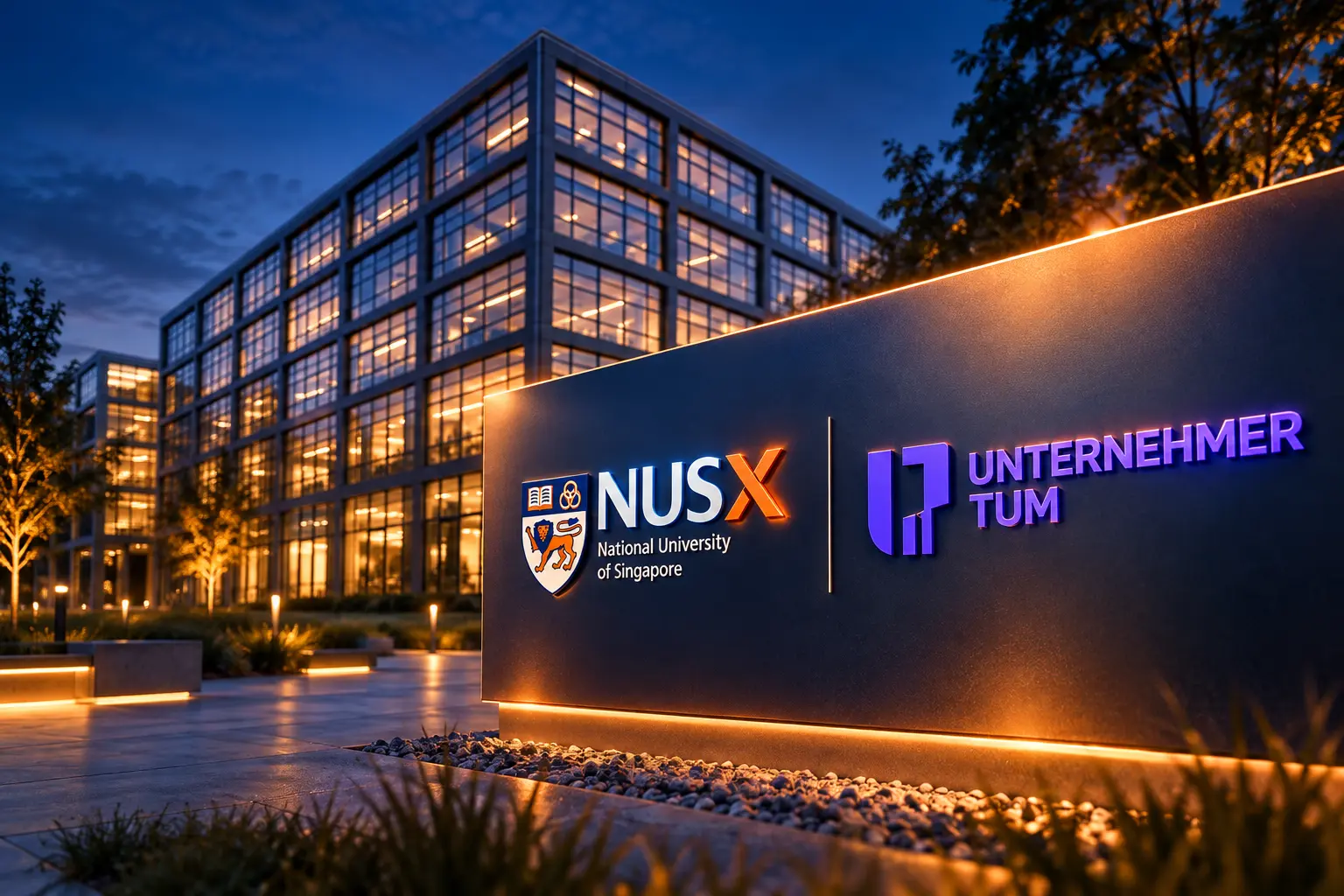
NUSX will open its first European outpost in Munich with UnternehmerTUM, after a 24 September 2026 rebrand from NUS Enterprise. The desk sits inside the 11,000-square-metre Munich Urban Colab. The same announcement put a Munich venture firm in talks for a fifth seat on a S$150 million programme and rolled out an AI engine built to match unused university patents with buyers.
That is a trade, not a raid. NUSX gets a door into European industry in biotech, AI and semiconductors. UnternehmerTUM gets a path into Singapore and Asia, including a possible desk of its own at the NUS i³ building.
NUSX Moves Into Munich Urban Colab
The Munich outpost will sit at Urban Colab, the joint City of Munich innovation centre that UnternehmerTUM already runs. The centre opened in 2021. Munich Urban Colab GmbH is held 83 per cent by UnternehmerTUM and 17 per cent by the city, with Claudia Frey as managing director.
NUSX is not arriving as a landlord. It is taking space inside a hall that already hosts UnternehmerTUM programmes, corporate labs and city projects. Selected NUS students will be able to join Startup Launchpad, Digital Product School and the UnternehmerTUM Incubator, and to intern at portfolio companies of the Munich venture firm still in talks.
TUM said UnternehmerTUM has ranked as Europe’s leading start-up hub for a third year, in a study of 180 hubs compiled with Statista. The NUSX announcement used that standing as the reason to plant the desk there, and cited TUM’s record in data science and AI in Germany. It also said TUM’s School of Life Sciences is home to 10 of the university’s 17 most-cited researchers.
WHAT MUNICH ALREADY RUNS
- High-growth firms: The announcement put more than 140 scalable start-ups in the TUM circle, including Celonis, Konux and Isar Aerospace.
- Industry work: It counted more than 500 innovation partnerships a year.
- People through the door: More than 17,000 participants a year go through UnternehmerTUM programmes.
Professor Dr Helmut Schönenberger, CEO of UnternehmerTUM and vice president for entrepreneurship at TUM, called the tie-up a direct gateway between the two hubs. Deep tech firms, he said, need research, capital and industry partners on more than one continent.
Nine Years of Student Swaps Came First
The new outpost sits on a student programme, not a cold introduction. NUS Overseas Colleges opened a Munich node in 2017. In the nine years since, it has sent nearly 120 NUS students to Munich and more than 90 TUM students to Singapore.
Alumni of that swap have already formed companies. The announcement named Factorem as one of the fast-growing ventures that came out of the exchange. The physical desk is what you build when the internships have already produced founders you can point to.
NUSX said that since 2001 it has nurtured 10 unicorns, more than 3,000 start-ups and 5,500 students. UnternehmerTUM, set up in 2002, has spent those same decades tying TUM research to Bavarian industry. The 24 September 2026 deal is the point where those two ledgers start sharing offices.
Who Already Sits in the S$150 Million Programme
The capital leg is quieter than the ribbon on the Munich desk, and it is not finished. NUS said it is in advanced discussions with a Munich-based venture firm closely tied to UnternehmerTUM, which would join the S$150 million NUS VC Programme as its fifth partner.
NUS launched that programme on 22 July 2025 to get research firms past seed. It commits S$50 million over three years to selected venture firms and S$100 million to an autonomous fund that can invest alongside them in NUS-linked companies. National GRIP, the university’s lab-to-venture track, still puts up to S$250,000 into a start-up at seed. The VC programme is the next cheque.
NUS President Professor Tan Eng Chye said research-based start-ups face longer research cycles than typical software firms, which leaves them exposed when investors pull back. Asia’s venture funding, the 2025 launch note said, had fallen to a decade low of S$85 billion, with early-stage deals at S$38 billion in 2024.
THE S$150 MILLION PROGRAMME’S PARTNERS
| Partner | Joined | Focus |
|---|---|---|
| Granite Asia | July 2025 | Multi-asset technology investing, one of the first two firms |
| 4BIO Capital | July 2025 | Life sciences, advanced therapeutics |
| Playground Global | June 2026 | Silicon Valley deep tech, host of the first outpost |
| Matter Venture Partners | June 2026 | US venture firm named with Playground |
| Munich-based firm (unnamed) | Advanced talks | Would become the fifth partner |
Until that fifth seat is signed, European follow-on capital for NUS firms still runs through the first four names. The Munich internships NUSX described for students are tied to the same unnamed firm’s portfolio, so those placements wait on the same discussion.
What Nova Does With 20,000 NUS Patents
The product NUSX put beside the Munich desk is not another accelerator brand. It is Nova, an AI engine built with Zima Labs to push university patents toward licensees. NUSX cited industry estimates that 70 to 80 per cent of university patents worldwide are never licensed, often because no one finds a buyer.
Nova draws on more than 20,000 NUS patents and invention disclosures, 9,000 research projects and 11,000 inventors. It then layers outside data on companies, investors and live market activity. The pitch is that a commercialisation manager can finish in minutes a search that used to take weeks.
WHAT NOVA IS BUILT TO DO
- Read a patent: It analyses a granted patent in minutes and scores licensing potential against live market evidence.
- Rank buyers: It orders possible licensees by complementary fit and drafts a tailored proposal for each.
- Flag the gaps: It also marks the patent’s limits, so the file is not sold as cleaner than it is.
- Open other paths: It can surface co-development, investment and even possible team members, each claim tied to underlying evidence.
European manufacturers in chips, health and industrial AI are the kind of counterpart that search is meant to find. Putting the engine next to Urban Colab gives those names a building, not only an inbox. The 70 to 80 per cent figure is the hole Nova has to close; the announcement did not claim it has closed it.
Through reciprocal outposts, deeper investment links, and new opportunities for our students and start-ups, we are bringing talent, research and capital closer together. This gives founders greater access to the partners, expertise and markets they need to validate, build and scale deep tech ventures from Singapore.
Dr Tan Sian Wee, NUS Senior Vice President (Innovation and Enterprise)
Dr Tan, who also spoke at the 2025 VC launch, has now put the same lab-to-market brief on a European floor. The patents still need a licensee after the ranking model runs.
Silicon Valley Opened in July, Shanghai Is Next
Munich is the second stop on a three-city line, not a one-off European tour. NUSX opened its first outpost in July 2026 at Playground Global’s The Studio in Silicon Valley, a 70,000-square-foot site with wet and dry labs, prototyping shops and precision tools. Playground Global and Matter Venture Partners had joined the VC programme in June 2026, so the US desk and the US capital seats arrived together.
A third outpost is planned for Shanghai in the fourth quarter of 2026. If that opening holds, NUSX will have staffed the United States, Europe and China inside six months of the first foreign desk. The university already runs older networks such as BLOCK71 and NUS Overseas Colleges; these outposts are meant to put deep-tech teams next to investors and customers earlier, rather than after a product is finished at home.
FROM STUDENT EXCHANGE TO THREE OUTPOSTS
- 2001: NUS Enterprise starts; NUSX later credits the unit with 10 unicorns, more than 3,000 start-ups and 5,500 students.
- 2002: UnternehmerTUM is founded beside TUM.
- 2017: NUS Overseas Colleges opens its Munich node.
- 22 July 2025: NUS launches the S$150 million VC programme with Granite Asia and 4BIO Capital.
- June 2026: Playground Global and Matter Venture Partners join the programme.
- July 2026: The first outpost opens at The Studio in Silicon Valley.
- 24 September 2026: NUS Enterprise becomes NUSX and announces the Munich partnership at A5X in Singapore.
- 25 September 2026: NUSX, the European Defense Tech Hub and TUM Venture Labs host a defence tech hackathon for 300 participants.
- Fourth quarter of 2026: A third outpost is planned in Shanghai.
Dr Tan said in June 2026 that Silicon Valley is one of the most demanding proving grounds for deep tech, and that research founders need investors who know how those companies are built, not only funded. Munich is the European version of that test. Shanghai, if it opens on time, is the China door.
Singapore’s S$37 Billion Plan Funds the Corridor
The outposts line up with the state’s research budget, not only with a university rebrand. Senior Minister Lee Hsien Loong, who chairs the Research, Innovation and Enterprise Council, said on 5 December 2025 that Singapore would be S$37 billion over the next five years into research and development, about 1 per cent of GDP. That S$37 billion (US$29 billion) RIE2030 plan is 32 per cent above the S$28 billion in RIE2025.
NUSX said the Munich focus on biotech, AI and semiconductors matches its own priorities and that national plan. RIE2030 puts semiconductors among its flagship bets. A university that can walk a chip or health patent into a Munich industrial office is doing the translation work the budget keeps asking for.
NUSX now groups that work under four tracks on its own site: Matter (materials and semiconductors), Logic (AI, software and data), Pulse (health, biotech and medtech) and Resilience (climate, energy and security). The Munich sectors sit inside the first three. The defence hackathon on 25 September 2026 sits inside the fourth.
The rebrand itself was unveiled at A5X, a three-day gathering NUSX billed as Asia’s deep-tech showcase, running 23 to 25 September 2026 in Singapore. NUS Enterprise became NUSX that week. Familiar programmes keep their names. The new wrapper is meant to join founder training, research translation, venture creation, industry deals and capital on one platform.
TUM Is Exploring a Desk in Singapore
The traffic is supposed to run west as well as east. UnternehmerTUM, through TUM Venture Labs, is exploring a presence at the NUS i³ building in Singapore, where NUSX is based. That would give Munich teams a door into Singapore’s research scene and, through it, into the rest of Asia, without waiting for a trade mission.
Deep tech ventures need more than one home market to grow; they need access to research, capital and industry partners across continents. By connecting Munich and Singapore through reciprocal outposts, we give founders on both sides exactly that: a direct path from an idea to a global venture.
Professor Dr Helmut Schönenberger, CEO of UnternehmerTUM and Vice President for Entrepreneurship, TUM
On 25 September 2026 the same pairing puts 300 people into the inaugural Singapore Defense Tech Hackathon, run by NUSX with the European Defense Tech Hub and TUM Venture Labs, on dual-use defence and security problems. That is a live test of the talent leg before the Munich office has a long lease under it.
NUSX has also published three targets through 2035: at least one NUS venture with more than US$100 million in yearly revenue or more than 1,000 jobs; US$1 billion in financial returns from investments in NUS ventures and licensing of NUS innovations; and ventures or innovations that reach at least one billion people. Nova’s licensing claims sit inside the second of those numbers. The Munich industrial names are one place those licenses would have to come from.
WHAT WE KNOW
- The Munich desk: NUSX said the outpost will be based at Urban Colab, with an initial focus on biotech, AI and semiconductors.
- The US desk: The Silicon Valley outpost opened in July 2026 at Playground Global’s The Studio.
- The rebrand: NUS Enterprise became NUSX on 24 September 2026 at A5X.
WHAT IS UNCONFIRMED
- The fifth fund seat: The Munich venture firm is in advanced talks, not named as a signed partner.
- The Shanghai outpost: It is planned for the fourth quarter of 2026 and has not opened.
- TUM in Singapore: TUM Venture Labs is exploring a presence at the i³ building, not announcing a lease.
The patents NUSX wants to license are still, on the figures it cited, mostly sitting on the shelf. The fifth investor is still a discussion. Shanghai is still a date on a slide. What 24 September 2026 did put on the ground is a Singapore desk inside Munich’s own hall, and a Munich invitation to take space in Singapore in return.

Edinburgh Opens a 2027 Tour Built for Time Trials

Korda Maps Auður From Meðalland to Irvine Bay

Apple Music Films Its New Logo in Mineral Oil

Oppo Prices the Pad Mini Above India’s iPad Mini

Austen Soaks Scotland Before Boelo Brings Weekend Gales

Volkswagen Sells the Osnabruck Plant to Clear a Board Fight

Apple’s Foldable iPhone Hinges on Samsung Display Supply

Saksham Gaur Finds He Is His Own Company’s Client

Tata Motors’ Iveco Tender Opens as Holders Still Decide

Onimusha Way of the Sword Preload Hits a Windows 11 Wall
-
 AUTO2 months ago
Volkswagen Sells the Osnabruck Plant to Clear a Board Fight
-
 NEWS2 months ago
Apple’s Foldable iPhone Hinges on Samsung Display Supply
-
 AUTO2 months ago
Tata Motors’ Iveco Tender Opens as Holders Still Decide
-
 BUSINESS2 months ago
Saksham Gaur Finds He Is His Own Company’s Client
-
 GAMING2 months ago
Onimusha Way of the Sword Preload Hits a Windows 11 Wall
-

 ENTERTAINMENT3 years ago
What is SD on Amazon Prime? – All You Need to Know
-

 BUSINESS2 months ago
Hyderabad 22-Carat Gold Jumps After a False Bargain
-

 NEWS2 months ago
iQOO 16 Locks 8,400 mAh While 100W Charging Holds