
GAMING
Minecraft Dungeons II Puts Mixed Co-Op on Dedicated Servers
Minecraft Dungeons II mixed co-op runs on dedicated servers, with heroes saved to a Microsoft account so couch and online players share one party.

Minecraft Dungeons II launched on September 29, 2026 with mixed couch co-op running on dedicated servers instead of the party leader’s machine. Up to four players can share one party, including people on the sofa and friends on other devices.
Stefan Annell, Technical Director on Minecraft Dungeons II, said the first game let the host carry everyone, so a weak connection or weaker hardware hit the whole session.
Dedicated Servers Take the Session Off Your Console
Annell’s team now parks online play on studio-run servers and picks the best one from each player’s ping. That change sits under the one-click crossplay motto he has used since work began, which he said should let someone boot the game and join friends even on another platform.
In the 2020 game, the party leader hosted. If that person’s internet dipped, the other three felt it. Dungeons II takes that job away from the living room PC or console and gives it to a server chosen for the group.
DUNGEONS 1 VS DUNGEONS II MULTIPLAYER
| Piece | Minecraft Dungeons (2020) | Minecraft Dungeons II (2026) |
|---|---|---|
| Who hosts online | The party leader’s machine | Studio servers, chosen by ping |
| Couch co-op | Offline only | Offline, or mixed with remote players |
| Finding a group | Friends list; Mojang said there was no matchmaking | Friends list, eight-character party code, matchmaking into live sessions |
| Hero data | Tied to the device you were on | Stored in Mojang’s backend |
| Online and offline | Split mainly by couch versus remote | Kept as separate modes so the studio can police online play |
Mojang Studios built the sequel with Double Eleven, the Middlesbrough studio that co-developed the first crawler. The new net code is the part of that sequel most players will feel before they notice a new weapon.
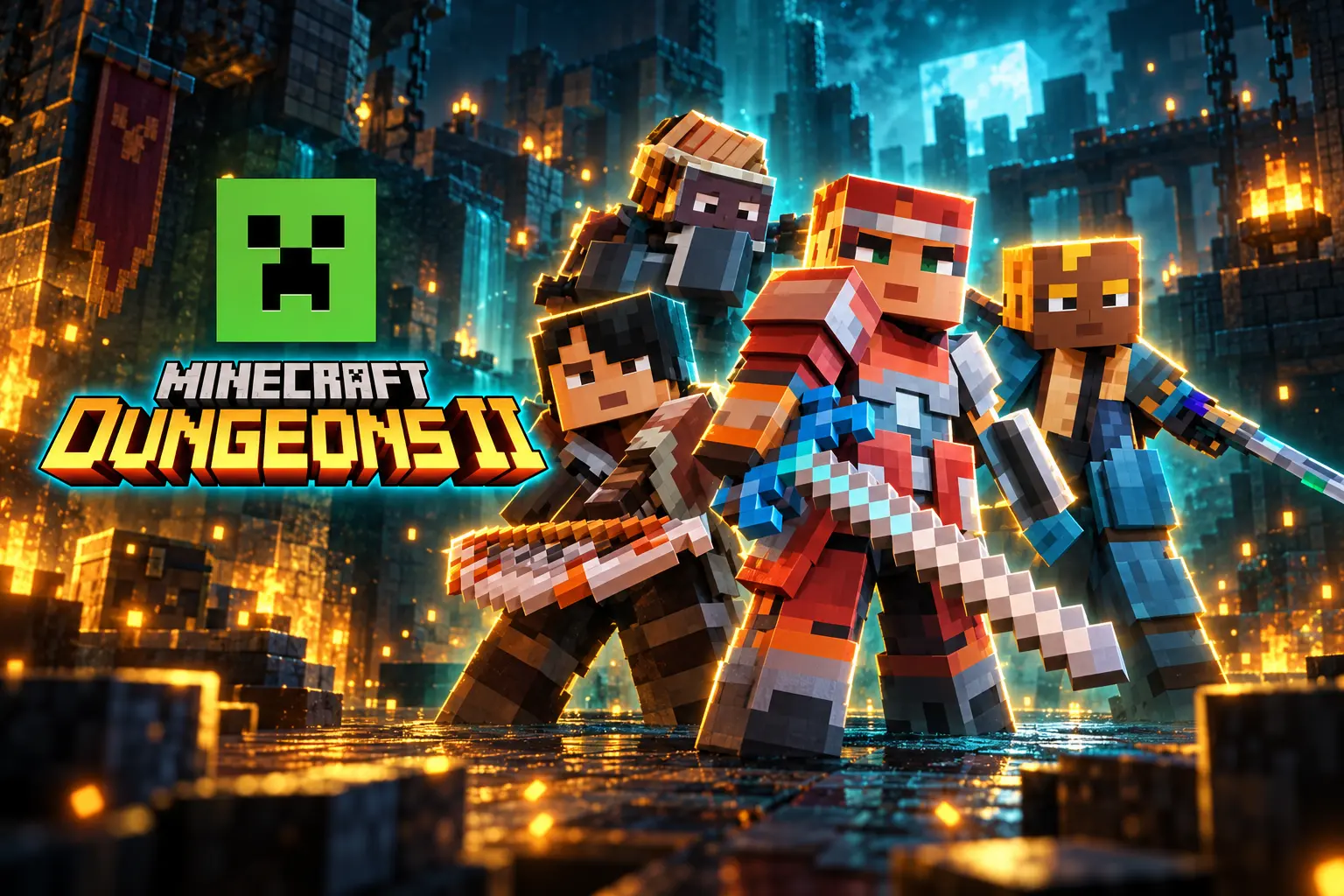
The Couch Can Call for Backup
Mixed co-op is the consumer face of that rebuild. Two or three people can sit on one device, then fill the remaining slots with players who join from somewhere else, still inside the same four-player cap.
The first Dungeons kept those paths apart. Local play lived in an offline session. Remote play lived online. You picked one. Dungeons II lets a sofa session go online and take guests, which is the feature families actually wanted when one friend could not come over.
Annell said a guest can also bring a hero, if the platform allows a second account on the host device. “If the platform supports it, you can sign in with your own platform account on a friend’s device and carry on with the hero you’ve been playing with. When you get home, you can pick up from where you left off, with the same hero. We store hero data online in our backend, so your progression isn’t tied to one specific device. You just need to sign in with your platform account!”
Launch-night play already used that split in a plain way. Households still piled onto one screen with extra pads. Remote friends dropped in once the session was online. The friction was sign-in, not the idea of sharing a dungeon.
Heroes Follow a Microsoft Account
Cloud saves only work if Mojang knows who you are. Linking platform logins to one Microsoft account is how the same hero continues on another box. Xbox Play Anywhere already covers a single Xbox and Windows purchase; the Microsoft identity is what tries to stretch that idea across PlayStation and Nintendo as well.
A PlayStation group still routes through that identity, which is the odd seam in a game sold on every major box. Some PC players could not attach an account on launch night, so the “boot it and it just works” line met a login wall before anyone typed a party code.
WHAT A MICROSOFT ACCOUNT UNLOCKS
- The same hero: Platform accounts tied to one Microsoft login keep the hero you were playing when you switch devices.
- Friend’s console: If the system allows it, you sign in on someone else’s machine, then pick up at home with that hero still intact.
- The Hero Cape: The same account is also how Mojang grants a cosmetic for people who played the first game, with a deadline of December 31, 2026.
- The snag: Cross-platform play completes that attach on the Microsoft account device link; local couch play on one device does not need every person to finish that step.
Offline heroes still exist as their own mode. Annell said keeping online and offline apart gives the team more control over the live side. The account is the ticket for everything that leaves the house.
How Do Party Codes Work in Dungeons II?
Friends from the first game will still see an in-game friends list. The new tool is an eight-character party code, letters and numbers, unique to the current party. Friends type it in a join dialog and land in the lobby or in a run that is already going, on any supported platform.
Annell put it this way: “A party code is an eight-character code made up of letters and numbers, unique to your current party. Your friends enter it in the ‘join by party code’ dialog and join you directly, through the lobby or an ongoing game, regardless of which platform anyone is using.”
Matchmaking sits beside that code. It can find a group when friends are busy, or fill empty slots in a party you already started. Annell said the system does not have to assemble a full four before a session begins. A scoring function looks at core quest progress, region, and power level, then can drop you into a run that is already underway, which he said should keep queues short.
That mid-session join is only safe because the server, not the host, owns the session. In the old model, a stranger landing on someone’s home connection was a support nightmare. On studio servers, it is just another client.
Five Boxes Share One Four-Player Party
Mojang’s own FAQ lists the sequel on Windows, Steam, Xbox Series X|S, PlayStation 5, Nintendo Switch, and Nintendo Switch 2. The Standard Edition is $29.99, $10 above the original’s $19.99 launch price. Xbox’s day-one Game Pass listing also covers the game, with Play Anywhere so one Xbox-side purchase plays on console and PC.
WHERE YOU CAN PLAY
| Hardware | How you get it | Online extra |
|---|---|---|
| Xbox Series X|S | Microsoft Store or Game Pass | Xbox online, sold as Game Pass |
| Windows | Microsoft Store, Steam, or Game Pass | Microsoft account |
| PlayStation 5 | PlayStation Store | That platform’s paid online extra |
| Nintendo Switch | Nintendo eShop | That platform’s paid online extra |
| Nintendo Switch 2 | Nintendo eShop | That platform’s paid online extra |
Mojang’s product page is blunt about the last column: online console multiplayer and co-op need a platform-specific online subscription, sold separately. Couch co-op and solo play do not. The High Council waiting in the Sift (the Grand Illusioner, Supreme Evoker, and Prime Enchanter) does not care which storefront paid the bill, but the servers do care that you signed in.
Why Mojang Split Online From Offline
Annell did not dress up the design reason. Separate modes make cheating easier to stop, and that in turn lets the team build systems they would not risk on a host’s box.
Keeping online and offline as separate modes also gives us more control over what happens online. It makes it easier for us to prevent cheating, which in turn gives us more options when designing and building the game.
Stefan Annell, Technical Director on Minecraft Dungeons II, Mojang deep dive
The first game never needed that much control. It shipped on May 26, 2020 as a four-player crawler with couch play and online play, and Mojang told players there was no matchmaking because it was meant for people you already knew. Support ended after update 1.17. On September 28, 2023, the studio wrote that the game had passed 25 million unique players and that the team had moved on to new Minecraft projects.
FROM HOST TO DEDICATED SERVERS
- May 26, 2020: Minecraft Dungeons launches with four-player couch and online play and no matchmaking.
- September 28, 2023: Mojang logs 25 million unique players, calls 1.17 the final update, and shifts the team.
- March 2026: Minecraft Dungeons II is announced, again with Mojang and Double Eleven.
- June 2026: Xbox names the September 29, 2026 date during its showcase.
- September 29, 2026: The sequel launches with mixed co-op, party codes, matchmaking into live sessions, and studio servers.
Matchmaking into a run that is already in motion, a hero that follows you home from a friend’s house, and a sofa that can still add a Switch player from another city all depend on that last line. The party is no longer a session someone hosts. It is a live service object with a code on it.
If you played the original on the same Microsoft account, log into Dungeons II before December 31, 2026 for the Hero Cape in this game and in Minecraft. The dungeon is still on the couch. The save, the anti-cheat, and the stranger who just matched into your run now live somewhere else.
Frequently Asked Questions
Does Minecraft Dungeons II Have Crossplay?
Yes. Windows, Xbox Series X|S, PlayStation 5, Nintendo Switch, and Nintendo Switch 2 can share one four-player party. Online play on a console still needs that system’s paid online extra, which Mojang says is sold separately from the game.
Do You Need a Microsoft Account for Co-Op?
You need one to carry a hero across platforms and to use the live services. Linking is a one-time attach of your platform login to that account. A local couch session on a single device does not require every person on the sofa to finish that attach.
Can You Play Dungeons II Couch Co-Op Offline?
Yes. Online and offline are separate modes, and both support couch co-op on the same device. You can finish the campaign in an offline local session and never open matchmaking; mixed co-op is what requires the session to go online.
Do You Need the First Game to Start Dungeons II?
No. Mojang’s FAQ says you do not have to play the original, though returning players may spot familiar references. The Hero Cape is a separate cosmetic for people who did play it, not a gate on the new campaign.
How Do You Unlock the Hero Cape?
Play Minecraft Dungeons, then log into Minecraft Dungeons II on the same Microsoft account before December 31, 2026. You do not need to own either game; joining a friend’s co-op session on that account can qualify, and the cape also unlocks in Minecraft Java and Bedrock.

Edinburgh Opens a 2027 Tour Built for Time Trials

Korda Maps Auður From Meðalland to Irvine Bay

Apple Music Films Its New Logo in Mineral Oil

Oppo Prices the Pad Mini Above India’s iPad Mini

Austen Soaks Scotland Before Boelo Brings Weekend Gales

Volkswagen Sells the Osnabruck Plant to Clear a Board Fight

Apple’s Foldable iPhone Hinges on Samsung Display Supply

Saksham Gaur Finds He Is His Own Company’s Client

Tata Motors’ Iveco Tender Opens as Holders Still Decide

Onimusha Way of the Sword Preload Hits a Windows 11 Wall
-
 AUTO2 months ago
Volkswagen Sells the Osnabruck Plant to Clear a Board Fight
-
 NEWS2 months ago
Apple’s Foldable iPhone Hinges on Samsung Display Supply
-
 AUTO2 months ago
Tata Motors’ Iveco Tender Opens as Holders Still Decide
-
 BUSINESS2 months ago
Saksham Gaur Finds He Is His Own Company’s Client
-
 GAMING2 months ago
Onimusha Way of the Sword Preload Hits a Windows 11 Wall
-

 ENTERTAINMENT3 years ago
What is SD on Amazon Prime? – All You Need to Know
-

 BUSINESS2 months ago
Hyderabad 22-Carat Gold Jumps After a False Bargain
-

 NEWS2 months ago
iQOO 16 Locks 8,400 mAh While 100W Charging Holds