
NEWS
MediaTek’s Googlebook Chip Is Built for Premium Laptops
MediaTek’s Dimensity CX C10 Max copies a Chromebook chip and targets a premium Googlebook, so Google’s 16GB RAM floor still sets the price.

MediaTek’s Dimensity CX C10 Max, announced September 21, 2026, is built for a premium Googlebook, not the $899 launch machines. None of the five laptops on pre-order use it.
Google still requires 16GB of RAM. That floor, during a memory shortage, does more to set the bill than a new Arm chip with last year’s core layout.
MediaTek Built This Chip for a Premium Googlebook
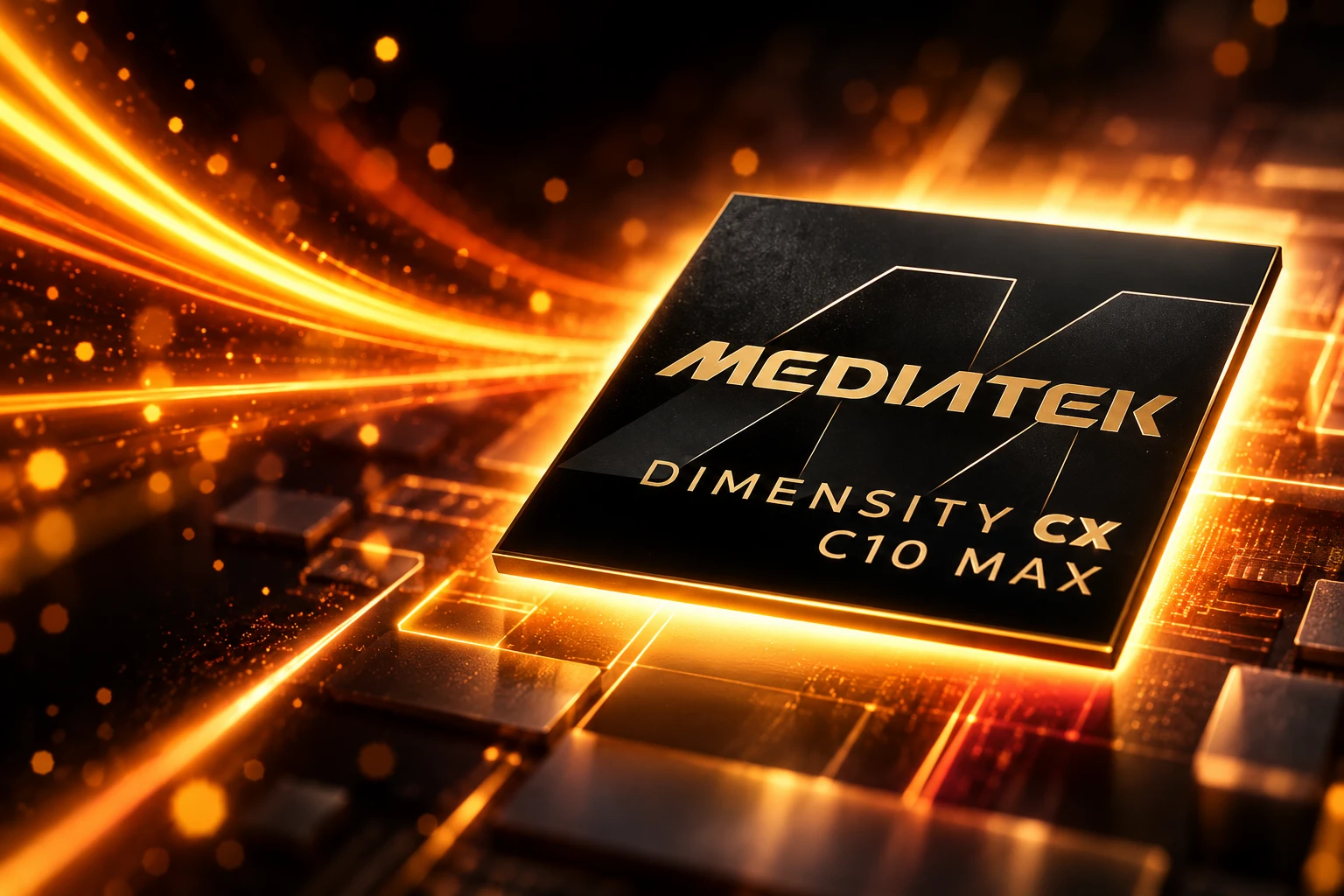
From Hsinchu, MediaTek introduced the first SoC in a laptop line it calls Dimensity Compute Experiences, or CX. The company said the C10 Max is meant to enable an upcoming premium, ultra-portable Googlebook device. That is the chipmaker’s wording, not a reviewer’s hope.
The part is made on TSMC’s 3nm process. MediaTek pitches an all-big-core eight-core CPU, an 11-core GPU, and its 8th-generation NPU 890, rated up to 55 TOPS, for Gemini Intelligence on the device. It also lists Wi-Fi 7 at up to 7.3Gbps, dual-engine Bluetooth 6.0, and an Imagiq 1090 camera block for sensors up to 32MP. The design brief is thinner, lighter, fanless laptops with all-day battery life.
Bringing these capabilities to Googlebook builds on our leadership in Android computing and continues our long history of collaboration with Google.
Vince Hu, Senior Vice President and General Manager of Data Center and Computing Business, MediaTek
Hu, who runs MediaTek’s data center and computing group, framed the silicon as flagship work, not a budget SKU. Other CX chips were not named. The C10 Max is the one on the slide.
MediaTek Dimensity CX C10 Max brings flagship performance to a new era of premium, ultra-portable Googlebook devices.
As the inaugural SoC in the new Dimensity CX family, it combines an All Big Core octa-core CPU, 11-core GPU and 8th-generation NPU on TSMC’s advanced 3nm… pic.twitter.com/J0YvQudOjI
— MediaTek (@MediaTek) September 21, 2026
MediaTek’s own post used the same premium line. The company later said the first laptop to carry the chip will be a Lenovo Googlebook that is not the Intel Lenovo Googlebook 15 already listed for pre-order. No ship window and no price came with that note.
Five Launch Models, None With MediaTek Inside
Google opened the category on the same day with Acer, ASUS, Dell, HP, and Lenovo. Googlebook pre-orders are now open on the Google Store, at Best Buy, and at other retailers. Machines reach U.S. shelves on October 4, 2026, and on October 5 in Canada, the U.K., Ireland, France, Germany, and Australia.
At launch, Google said buyers pick Intel Core Ultra Series 3 or Snapdragon X Elite, each with an NPU over 45 TOPS. MediaTek is on the partner list. It is not in this hardware wave.
THE $899 TO $1,299 LAUNCH SET
| Model | Processor | Starting price | Memory |
|---|---|---|---|
| Acer Googlebook 14 | Intel Core Ultra 5/7 Series 3 | $899 | 16GB |
| Lenovo Googlebook 15 | Intel Core Ultra 5 Series 3 | $1,099 | 16GB |
| Dell XPS Googlebook | Snapdragon X Elite | $1,199 | 16GB to 32GB |
| ASUS Googlebook 14 | Intel Core Ultra 5/7 Series 3 | $1,299 | 16GB to 32GB |
| HP Googlebook 14 | Snapdragon X Elite | $1,299 | 16GB to 32GB |
Three of the five use Intel. Two use Qualcomm. Acer’s convertible is the only machine at Google’s $899 start, and Acer’s Kelly Odle said that figure is an initial launch price for a limited time, with pricing to be rechecked against component supplies and other market pressures. ASUS quotes 2.2 pounds. Acer lists 1.13 kg and 13.9 mm. Dell’s XPS is 12.7 mm thick. Lenovo brought the 15-inch screen.
Every unit includes 12 months of Google AI Pro with 5TB of cloud storage, plus three-month trials of YouTube Premium, Adobe Photoshop, and CapCut. Googlebook OS is promised updates for up to 10 years. Battery claims on the platform are up to 14 hours of video playback and 16 hours of web browsing. Those extras sit on top of the silicon bill, they do not shrink it.
Last Year’s Chromebook Cores in a New Wrapper
The C10 Max uses one Arm Cortex-X925 at up to 3.73 GHz, three Cortex-X4 cores, and four Cortex-A720 cores, plus 12 MB of L3 cache and 10 MB of system-level cache. That is the same eight-core map as MediaTek’s Kompanio Ultra 910, the 2025 chip inside premium Chromebook Plus machines such as the Lenovo Chromebook Plus 14. The Kompanio Ultra 910 Chromebook chip specs also list an Immortalis-G925 MC11 GPU, UFS 4.0 storage, and the same NPU 890 family.
C10 MAX VERSUS KOMPANIO ULTRA 910
| Spec | Kompanio Ultra 910 | Dimensity CX C10 Max |
|---|---|---|
| CPU cores | 1x Cortex-X925, 3x Cortex-X4, 4x Cortex-A720 | Same layout |
| Peak X925 clock | 3.62 GHz | 3.73 GHz |
| L3 / system cache | 12 MB / 10 MB | 12 MB / 10 MB |
| LPDDR5X | 8,533 Mbps | 9,600 Mbps |
| GPU | Immortalis-G925 MC11 | Immortalis-G925 MC11 |
| NPU 890 | Up to 50 TOPS | Up to 55 TOPS dense |
The peak CPU clock is 0.11 GHz higher, about 3.0%. Memory support rises 12.5%. Advertised NPU throughput rises 10%. MediaTek skipped Arm’s newer Lumex C1 and C2 cores. The Cortex-X925 dates to 2024. The Cortex-X4 and Cortex-A720 date to 2023. The same 1+3+4 mix shipped in the Dimensity 9400 phone chip in 2024, and the later 9400+ already ran the X925 at 3.73 GHz.
Executives told reporters the C10 Max is aimed at Qualcomm’s last-gen Snapdragon X Elite X1E-84-100, not the newer X2 parts. Internal tests on ChromeOS R133 reference boards showed up to 15% faster multi-thread performance at 12W, and 50% lower power on single-thread work, versus a Windows 11 Galaxy Book 4 Edge. MediaTek also claims up to 19 hours on a 60Whr reference system. Those figures are the company’s lab numbers, not a retail Googlebook.
People who wanted a laptop NPU in the class of MediaTek’s latest phones will not find it here. The reuse is the point: this is a known Chromebook platform with a faster memory bus and a new brand on the slide.
Why 16GB of RAM Sets the Price Floor
Google’s hardware rules do more than pick a CPU vendor. John Maletis, vice president of laptops and tablets, published the bar on September 21: a baseline of 16GB of high-speed RAM across the portfolio, with some models at 32GB, plus those 45-plus TOPS NPUs, touchscreens up to 2.8K, haptic glass trackpads, and bodies in aluminum, magnesium alloy, and carbon fiber. Launch machines are meant to run Gemini work without spinning fans.
THE GOOGLEBOOK HARDWARE FLOOR
- Memory: 16GB is the minimum; some SKUs reach 32GB.
- AI block: A dedicated NPU over 45 TOPS at launch, before MediaTek’s 55 TOPS part arrives.
- Build: Touch displays, haptic trackpads, backlit keyboards, and premium metals on every model.
- Power: Fanless operation with up to 14 hours of video and 16 hours of web use.
That 16GB rule is the cost trap. DRAM contract prices continue to rise as suppliers keep quotes firm on tight supply. Jean Philippe Bouchard, IDC’s vice president of devices and consumers, said he does not see relief in the memory shortage before the end of 2027. A cheaper SoC cannot delete a soldered 16GB package Google will not let OEMs cut.
Chromebooks could still ship with 8GB under older Plus rules. Googlebook cannot. The platform is sold as the laptop that finally runs native Android apps and on-device Gemini with headroom, and the spec sheet is written that way on purpose.
Lenovo Already Sells the Twin Chip for $999
The cleanest price test is already on a store shelf. Lenovo’s Chromebook Plus 14 with the Kompanio Ultra 910, 16GB of memory, and 256GB of UFS is the machine this silicon already lived in. Its 16GB configuration listed at $749.99 after launch and later at $999. A 12GB, 128GB version listed at $649.99 and later at $829.99.
HOW THE TWIN CHIP GOT MORE EXPENSIVE
- June 2025: Lenovo ships the Chromebook Plus 14 on Kompanio Ultra 910, with the 12GB model listed near $649.99 and the 16GB model at $749.99.
- May 2026: Those two Lenovo configs, and an Acer Chromebook Plus Spin 514 on the same chip, carry higher tags, with the 16GB Lenovo at $999.
- September 21, 2026: MediaTek puts a 3.0% faster clock and a 10% TOPS bump on that layout and points it at a later Lenovo Googlebook.
- October 4, 2026: The five Intel and Qualcomm Googlebooks go on sale, still with 16GB as the floor.
If a near-identical 16GB MediaTek laptop already cleared $999 as a Chromebook, a Googlebook with the same memory floor, a haptic pad, and Google’s metal-and-Glowbar brief is not a natural sub-$899 product. The SoC was never the largest line on that bill of materials.
55 TOPS Meets Google’s 45 TOPS Bar
On paper the C10 Max’s NPU 890, at 55 TOPS of dense AI, sits above the launch rule of over 45 TOPS. Intel’s Core Ultra 5/7 parts in the Acer machine are quoted up to about 50 TOPS. First-gen Snapdragon X Elite in the Dell and HP units sits near 45 TOPS. MediaTek can claim a higher on-device number than the chips shipping in October.
Google needs that block for Gemini features that stay on the laptop: local transcription, summarization, and agents that keep running in the background. MediaTek says the NPU is built for those jobs with faster replies and a privacy pitch, because the work does not have to leave the device. That is a software story. It does not change the RAM count.
The CX line also sits, in MediaTek’s telling, between Kompanio Chromebook chips and higher-end laptop parts such as its RTX Spark products. A cheaper CX SKU could still appear. The chip that was announced is the Max, and it is aimed at the thin premium slot, not a school-board price band.
Lenovo’s MediaTek Googlebook Has No Ship Date
The first C10 Max laptop is a Lenovo Googlebook that is not on the October 4 list. MediaTek did not say which screen size, which memory option, or which month. Until that SKU is priced, the chip is a spec sheet and a partner slide.
Buyers who want Googlebook OS in 2026 will pay $899 to $1,299 for Intel or Qualcomm machines that already meet the 16GB rule. Acer has already said the $899 tag is temporary. Lenovo has already shown what this MediaTek layout costs once 16GB is mandatory. The later Arm Googlebook can still be a strong thin laptop. It is a poor bet as the machine that pulls the category under a thousand dollars and keeps it there.

Edinburgh Opens a 2027 Tour Built for Time Trials

Korda Maps Auður From Meðalland to Irvine Bay

Apple Music Films Its New Logo in Mineral Oil

Oppo Prices the Pad Mini Above India’s iPad Mini

Austen Soaks Scotland Before Boelo Brings Weekend Gales

Volkswagen Sells the Osnabruck Plant to Clear a Board Fight

Apple’s Foldable iPhone Hinges on Samsung Display Supply

Saksham Gaur Finds He Is His Own Company’s Client

Tata Motors’ Iveco Tender Opens as Holders Still Decide

Onimusha Way of the Sword Preload Hits a Windows 11 Wall
-
 AUTO2 months ago
Volkswagen Sells the Osnabruck Plant to Clear a Board Fight
-
 NEWS2 months ago
Apple’s Foldable iPhone Hinges on Samsung Display Supply
-
 AUTO2 months ago
Tata Motors’ Iveco Tender Opens as Holders Still Decide
-
 BUSINESS2 months ago
Saksham Gaur Finds He Is His Own Company’s Client
-
 GAMING2 months ago
Onimusha Way of the Sword Preload Hits a Windows 11 Wall
-

 ENTERTAINMENT3 years ago
What is SD on Amazon Prime? – All You Need to Know
-

 BUSINESS2 months ago
Hyderabad 22-Carat Gold Jumps After a False Bargain
-

 NEWS2 months ago
iQOO 16 Locks 8,400 mAh While 100W Charging Holds